Taxonomy & naming
The species was described by the Belgian ichthyologist Max Poll in 1978 as Lamprologus calvus, from a type series collected at Chipimbi on the southwestern coast of Lake Tanganyika in Zambia. In 1991 Maréchal and Poll moved it, together with its close relative the compressed cichlid, into the newly erected genus Altolamprologus, and that combination — Altolamprologus calvus (Poll, 1978) — is the valid name recognized today by the Catalog of Fishes and FishBase. The original genus name survives in the trade, where older stock is still occasionally labeled "Lamprologus."
The genus name pairs the Latin altus, "high," with Lamprologus, a nod to the deep, tall-bodied profile that sets these fish apart from their more torpedo-shaped relatives; the species epithet calvus means "bald," referring to the smooth, scaleless forehead of adult males. Altolamprologus belongs to the tribe Lamprologini, the large flock of substrate-spawning cichlids that dominates Tanganyika's rocky and shell habitats. The genus holds only two formally described species — A. calvus and A. compressiceps — plus at least one smaller, shell-dwelling form usually traded as A. sp. "compressiceps shell" that appears to be undescribed. The two named species are easily confused; A. calvus is the more elongate of the pair, with a noticeably longer, more pointed snout and steeper face. Locally the fish is known as kaubao.
Appearance
Reported maximum length is about 13.5 cm (5.3 in) total length, but that single figure hides a pronounced sexual size difference: males commonly reach roughly 6 in (15 cm) while females top out nearer 4 in (10 cm), so a mature pair is visibly mismatched. The body is deep, tall, and extraordinarily compressed from side to side — viewed head-on the fish is almost a blade — and is clad in unusually thick, heavily ossified scales. That armor is not decoration. It lets the fish bully its way into crevices full of other cichlids' eggs and shrug off the defensive nips of parents many times more aggressive than itself.
Color and pattern vary by collection locality, and the trade has split the species into a string of named forms. The two best known are the "black" or "black pearl" calvus from the Congo (DRC) shore — dark-bodied and dusted with rows of iridescent white to pale-blue spangles — and a yellow form from the Nkamba Bay area near Ndole Bay in Zambia; light grey populations exist as well. Fins are long and trailing in mature males, who also develop the bald, scaleless nape that gives the fish its name. Because the populations differ genetically and in pattern, serious keepers track them by locality and avoid crossing them.
Range & habitat
Altolamprologus calvus is a lacustrine endemic — found nowhere on Earth but Lake Tanganyika — and within the lake it occupies only the southern and southwestern shore, ranging from Tembwe Deux in the Democratic Republic of the Congo to Kasakalawe in Zambia, with the rocky Zambian coast at the lake's foot as its stronghold. Its entire global range has been estimated at an extent of occurrence of just under 5,000 km², a small footprint for a fish.
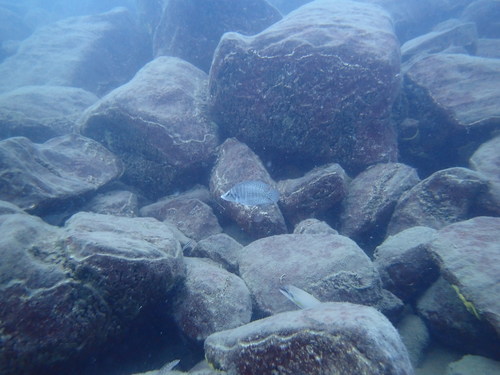
It is a creature of the rocky littoral, the boulder- and rubble-strewn shoreline zone where Tanganyika's cichlid diversity peaks. Reported depths run from about 10 to 135 ft (roughly 3 to 41 m), with the fish most at home among piled rocks riddled with cracks and shallow caves. Rather than hugging the bottom, it tends to cruise slowly through this terrain holding station about 1 to 3 ft (30 to 100 cm) off the substrate — a deliberate, hovering patrol. The water it lives in is hard and distinctly alkaline, typically pH 8 to 9 and warm, around 73 to 81 °F (23 to 27 °C); these are the stable, mineral-rich conditions of the open lake, and they matter for anyone trying to keep the fish well.
Ecology & diet
This is a predator built for tight spaces. The compressed body and large, protrusible mouth let it probe rock fissures that most fish cannot reach, and it feeds chiefly on small crustaceans — Tanganyika's abundant shrimp above all — picked off rock surfaces and out of crevices. Diet studies of the closely related A. compressiceps found shrimp making up more than 80 percent of stomach contents, and the natural history of A. calvus is understood to be much the same. It rounds out that menu with aquatic invertebrates and, opportunistically, the eggs and newly hatched fry of other cichlids, which it raids straight from their breeding cracks.
That last habit is where the armor-plated build pays off twice over: the same flattened body and thick scales that let it slip into a spawning cavity also protect it from the frantic counterattacks of the resident parents. FishBase places the species at a trophic level around 3.4 — a mid-level carnivore rather than an apex predator — and behaviorally it is a stalker, not a chaser, relying on patience and reach instead of speed.
Behavior & breeding
Out on the reef, A. calvus is solitary and unhurried, and its compressed anatomy underwrites one of the more memorable breeding strategies among Tanganyikan cichlids. It is a substrate spawner that nests in a crack or small cave deliberately chosen to be too narrow for the larger male to enter. The female squeezes inside and lays her eggs — reports range from about 200 up to roughly 300 — on the cavity ceiling or wall. The male, unable to follow, fertilizes the clutch by positioning himself at the entrance and releasing milt into the water current drawn in past the eggs. The female then stays sealed in the crevice tending the eggs, often blocking the opening with her own body, while the male patrols outside; care continues until the fry are free-swimming and able to leave the parents' territory. Incubation is short, on the order of a few days.
Keepers consistently describe the fish as deceptively peaceable for a predator — it is not strongly territorial day to day and spends much of its time hanging quietly in cover — but they are equally consistent that spawning females turn fierce, defending the nest cavity as hard as any male. Growth is slow: it can take a year or more to reach breeding size, and well-kept fish live on the order of eight to ten years.
In the aquarium
Calvus is a hobby classic, prized for its sculptural shape, its spangled patterning, and its calm, almost statuesque bearing. It is not, however, a beginner's impulse buy. A single fish or pair can be housed in a tank of around 30 gallons, but a 4-foot, 55-gallon or larger aquarium is more realistic for a small group or community, giving room to defuse the aggression that flares as the fish mature. The setup that works mirrors the wild reef: a sandy floor and stacked rock arranged to make narrow, vertical caves, ideally placed on the tank bottom before the sand so the structure can't be undermined by digging. For breeding, keepers report that whelk or barnacle shells set on end, or any crevice the female can just fit into and the male cannot, are what trigger spawning — the cavity must be sized to the female's body. Water should be hard and alkaline (pH ~8–9) with the high quality these lake fish expect, meaning generous, regular water changes.
The single most common mistake is misjudging that big mouth. Calvus looks slow and gentle, and it is — right up until a tankmate is small enough to swallow, at which point it becomes a quiet, efficient predator. Tiny dither fish, fry, and dwarf shell-dwellers like Neolamprologus multifasciatus are at real risk and make poor long-term company despite the frequent pairing of the two in the trade. Conversely, it makes a poor companion for herbivores such as Tropheus, whose low-protein diet it does not share. Keepers also caution against housing multiple females in cramped quarters, where females can be every bit as aggressive as males. The other recurring theme is patience: these fish grow slowly, color up slowly, and reward a keeper willing to wait.
Conservation
The IUCN Red List assesses Altolamprologus calvus as Near Threatened, in its most recent (2025) assessment, under criterion B1b(iii) — a verdict driven by its small range (an extent of occurrence of about 4,975 km²) combined with a continuing decline in habitat quality. The assessment is explicit that the species is probably more widely distributed than current records show, which is why it falls just short of a formally threatened category rather than into one. The identified pressures are specific and local: sedimentation reaching the lake from the river systems, unregulated collection for the aquarium trade, and, on the Zambian coast, destructive fishing methods. No part of its range currently lies within a protected area, and its population trend is unknown. In short: the fish itself is not endangered today, but it is flagged as one to watch, and the things degrading its home are getting worse rather than better.
That home is a strained one. Lake Tanganyika is under basin-wide pressure that bears directly on a shallow-water, rocky-shore specialist like calvus. The clearest threat at the shoreline is sedimentation: deforestation and farming in the lake's catchment send eroded soil into the nearshore, and in-lake studies have linked these sediment plumes to reduced species richness in the rocky littoral communities that calvus depends on — fine silt smothers the rock surfaces, fills the crevices the fish hunts and breeds in, and clouds the clear water of its biotope. Layered on top is climate warming. Long-term work on the lake (O'Reilly et al., 2003, Nature) found that a warming surface has stabilized the water column and weakened the wind-driven mixing that lifts deep nutrients into the sunlit zone, with sediment-core evidence pointing to roughly a 20 percent drop in primary productivity and an inferred ~30 percent decline in fish yields over the twentieth century; subsequent paleoecological work (Cohen et al., 2016, PNAS) tied that warming to measurable declines in both commercially important fishes and endemic shoreline life. These basin-scale forces fall most heavily on the pelagic fishery that feeds millions across the lake's four bordering countries, and they complicate the coordinated, four-nation management the lake's future needs — but the same warming and the same shoreline degradation also quietly erode the rocky habitat at the lake's southern foot where calvus lives. The honest summary is that the species is presently secure but narrowly ranged, in a lake whose littoral is being degraded faster than its open-water richness, and whose long-term trajectory under continued warming and shoreline development is the real source of concern.
Sources
- Eschmeyer's Catalog of Fishes — Altolamprologus calvus (Poll, 1978)
- FishBase — Altolamprologus calvus (Poll, 1978)
- GBIF — Altolamprologus calvus (Poll, 1978)
- USFWS Ecological Risk Screening Summary — Tanganyika Blackfin (Altolamprologus calvus)
- Seriously Fish — Altolamprologus compressiceps (genus natural history, diet, breeding, color forms)
- Cichlid Room Companion — Altolamprologus calvus (public profile: taxonomy, original description, conservation)
- Yuma, Narita, Hori & Kondo (1998) — Food resources of shrimp-eating cichlid fishes in Lake Tanganyika, Env. Biol. Fishes 52:371–378
- O'Reilly et al. (2003) — Climate change decreases aquatic ecosystem productivity of Lake Tanganyika, Nature 424:766–768
- Cohen et al. (2016) — Climate warming reduces fish production and benthic habitat in Lake Tanganyika, PNAS 113:9563–9568
- IUCN Red List — Altolamprologus calvus (Near Threatened, assessed 2025)
- ScienceDirect — Spatial variability in nearshore sediment pollution in Lake Tanganyika (littoral sedimentation impacts)
- tanganyika.si — Altolamprologus calvus 'Chisanze' (type locality, rocky biotope, localities)
- Cichlid-Forum — New Tanganyika Setup: Tips/Resources for Calvus (community: vertical caves, breeding shells, slow growth) — community/anecdotal
- Cichlid-Forum — Calvus Tank Size (community: stocking, harem, tank size) — community/anecdotal
- Australian Cichlid Enthusiasts Forums — Altolamprologus calvus (community: hardiness, aggression, protein diet) — community/anecdotal
- MonsterFishKeepers — Keeping Altolamprologus tank size (community: minimum tank size) — community/anecdotal
- Reddit r/Cichlid — Altolamprologus calvus help (community: temperament, bullying) — community/anecdotal