
Taxonomy & naming
George Albert Boulenger described this fish in 1898 as Lamprologus compressiceps, working from specimens that J. E. S. Moore had collected during his Lake Tanganyika expedition; the syntypes are held at London's Natural History Museum and the type locality is Kinyamkolo, the old name for Mpulungu at the lake's southern tip in present-day Zambia. The species name is plainly descriptive, joining the Latin compressus ("compressed") with -ceps ("head") for the narrow, knife-edged head and body.
In 1991 Maréchal and Poll moved the fish, along with the very similar A. calvus, into the new genus Altolamprologus, the prefix alto- ("high" or "tall") flagging the deep dorsal profile that offsets the lateral compression. Eschmeyer's Catalog of Fishes lists Altolamprologus compressiceps (Boulenger 1898) as the current valid name, with Lamprologus compressiceps as the original combination. Within the lake's species flock it belongs to the tribe Lamprologini, the substrate-brooding lineage that, with roughly a hundred species, is Tanganyika's most diverse. The genus holds only two described species; a small, shell-associated "dwarf" form sold as A. sp. "compressiceps shell" or "Sumbu dwarf" remains undescribed and may represent a distinct species.
Appearance
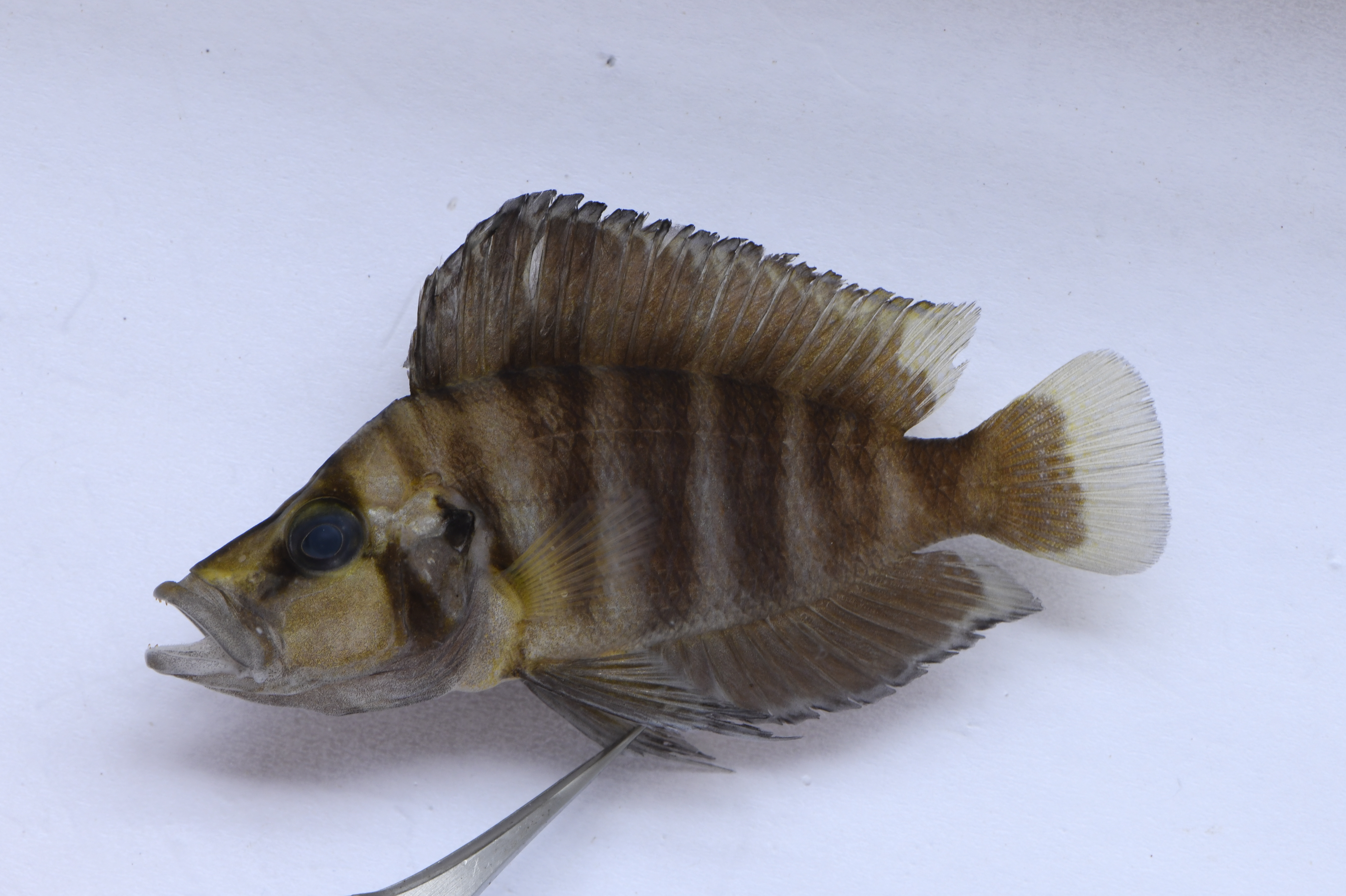
The defining trait is the body itself: extremely flattened side to side, deep from back to belly, and tapering to a small, pointed, almost beak-like head. The eyes sit high, the mouth is protrusible, and the whole animal looks built to be slid edgewise into a gap in the rocks.
Reports of maximum size vary and partly reflect the sexes being measured. FishBase records a maximum of about 4.8 in (12.3 cm) total length; Seriously Fish gives males a standard length of roughly 4-5 in (100-125 mm) against females of 3.5-4 in (90-100 mm); and habitat references describe males reaching 5-6 in (12-15 cm) total length with females staying near 3.5 in (9 cm). The practical takeaway is consistent across sources: males are noticeably larger than females, a strong sexual size dimorphism, while color and finnage differ little between the sexes apart from slightly extended fins on mature males.
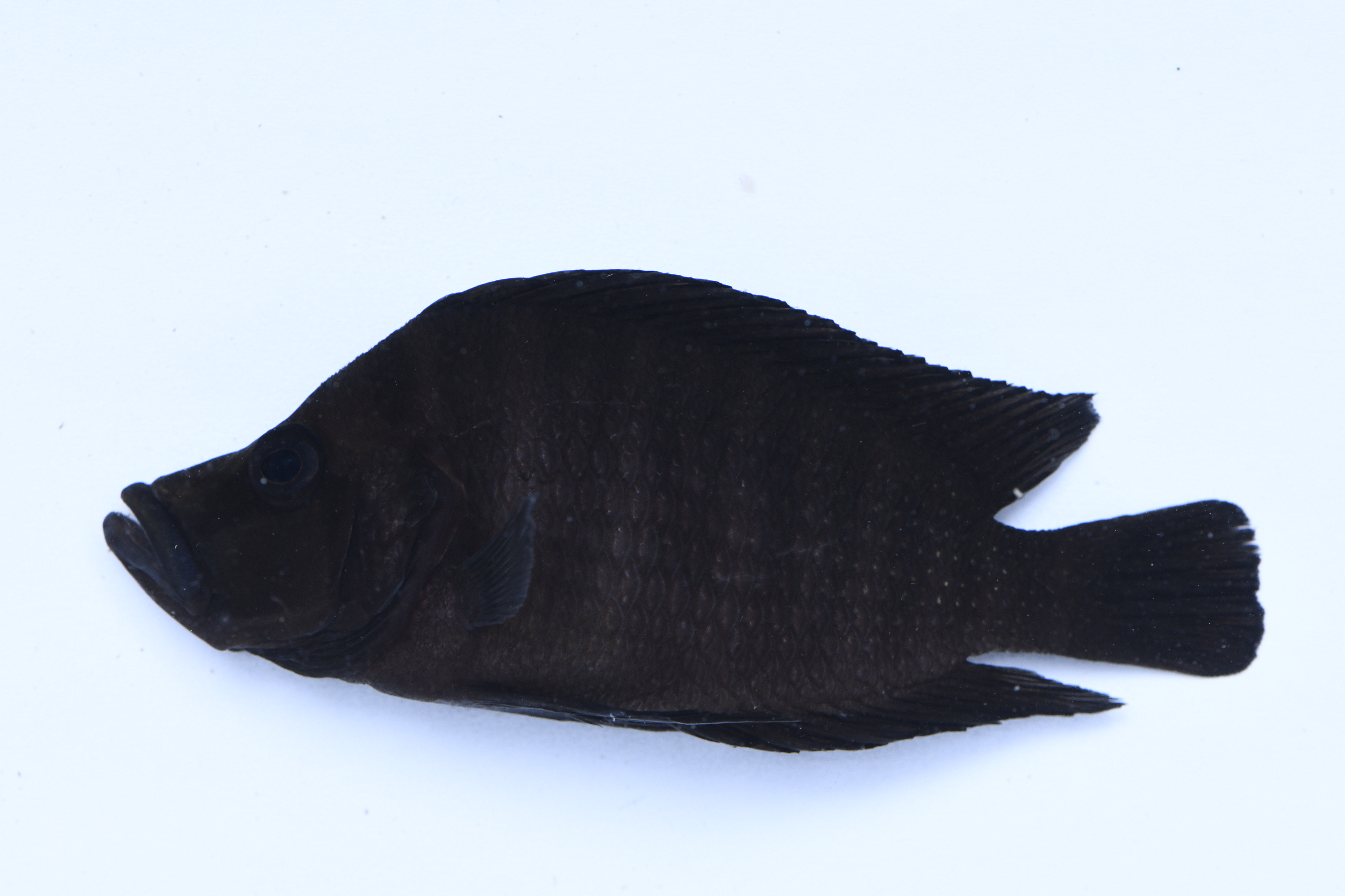
Color is highly variable by population. The hobby trade tracks dozens of geographic forms with names like "Kigoma red fin," "gold head," "black," "fire fin," and "anthracite," each tied to a stretch of shoreline. A. compressiceps is most often confused with its congener A. calvus; relative to calvus it has a shorter snout, a deeper body, scales running onto the head, and generally more distinct vertical barring.
Range & habitat
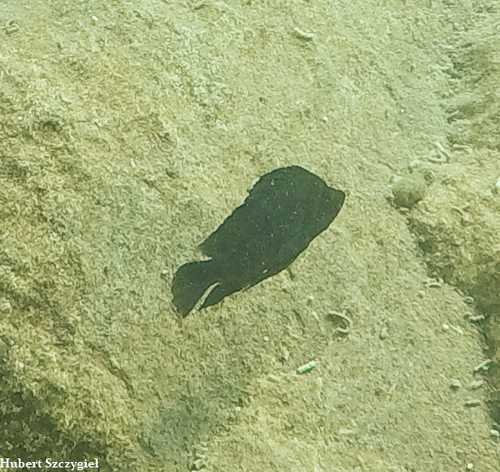
The species is endemic to Lake Tanganyika and distributed almost lake-wide, recorded at scores of localities from Burundi in the north down both coasts to the Zambian and Congolese shores in the south. It is a creature of rocky, rubble-strewn shorelines, living among piled boulders, narrow cracks, and small caves rather than open sand. Tellingly, it is largely absent from isolated rocky outcrops separated by stretches of bare substrate, suggesting it does not readily cross open bottom; that habitat-bound life is exactly what fragments it into so many local color races.
Depth records differ by source and by life stage. Habitat surveys place it most commonly in the upper rocky zone, roughly 3-50 ft (about 1-15 m), with juveniles drifting into shallower water and adults tending deeper; Seriously Fish notes adults mostly below about 33 ft (10 m). The undescribed dwarf form was found in sand near rocks at Cape Mpimbwe at around 80-100 ft (25-30 m), deeper than the typical rock-dwelling populations. The lake water itself is hard and distinctly alkaline, and in-situ this fish lives at a high pH near 8-9; FishBase's listed range of pH 6.5-7.5 sits below the lake's real chemistry and should be read as an outlier rather than a target.
Ecology & diet
A. compressiceps is a trophic specialist on the lake's crustaceans. A stomach-content study of Tanganyika's shrimp-eating cichlids by Yuma and colleagues (1998) found that shrimp dominated its diet, reported at over 80% of stomach contents, and FishBase places it at a trophic level near 3.6. In the wild it also takes other invertebrates and small fishes, hunting by inserting its compressed head and protrusible mouth into rock crevices that broader-bodied predators cannot reach, then suction-feeding prey from inside the gap.
That hunting style sets up one of the species' most striking adaptations. When aiming at shrimp it holds completely still, sometimes for up to ten seconds, which leaves it exposed to Perissodus microlepis, the famous Tanganyikan scale-eater that bites scales off live fish. A study by researchers including Hori's group found that A. compressiceps is rarely attacked by the scale-eater and that its scales require more force to tear off than those of other tested rock-dwelling predators, evidence that its tough, armor-like scales evolved as a morphological defense in lieu of the evasive maneuvers a free-swimming fish would use. In short, this cichlid trades agility for armor.
Behavior & breeding
Outside of breeding the fish is solitary and fairly retiring, holding a small home range in the rocks rather than patrolling territory. It is a substrate spawner with a weak, temporary pair bond. The female chooses a tight cave or crevice with an opening only she can pass through, lays a clutch on the order of 50-200 eggs, and the male fertilizes from outside the entrance by releasing milt that the female fans over the eggs, a workaround for a body shape and size difference that keeps him out of the nest. The female tends the eggs and larvae while the male loosely guards the surrounding area, often drifting off before the fry are free-swimming. Eggs hatch in roughly three days and the young become free-swimming within about five to seven days, at which point they are large enough to take newly hatched brine shrimp. Growth is slow, and a year or more may pass before young fish are sexually mature.
Genetic and morphometric work on southern populations found significant differentiation between sites despite their proximity, with the clearest shape differences in the head, consistent with a fish whose rock-bound, poor-dispersal lifestyle splinters it into locally adapted populations along the shoreline.
In the aquarium
This is a rewarding but unhurried fish, and most beginner missteps come from underestimating either its predatory side or its space needs. Experienced Tanganyikan keepers consistently flag tank length as the limiting factor: a 30-inch tank is widely considered too small for a pair to form and settle, 36 inches is the marginal minimum, and many keepers establish pairs in a larger 48-inch tank first. Because pairs do not form on demand, the usual approach is to grow out a group of about six and let a pair sort itself out, then rehome the surplus. Seriously Fish suggests base dimensions of roughly 48 x 18 in (120 x 45 cm) as a sensible floor.
Water should match the lake: hard, alkaline, around pH 8-9, in the high 70s Fahrenheit (about 24-28 C), with the pristine quality these fish expect and weekly water changes to maintain it. Aquascape with stacked rock built up from the tank floor to create caves and narrow cracks, set on the glass before adding sand so digging cannot topple it. It is not especially territorial toward unrelated species and suits a community of appropriately sized Tanganyikans such as Cyprichromis, Julidochromis, and many Neolamprologus, but two cautions recur: anything small enough to swallow will eventually be eaten, including fry and even the eggs of mouthbrooding tankmates, and it is a poor match for boisterous, herbivorous Tropheus or Petrochromis whose pace and high-protein-averse diet do not suit it. Keepers also strongly advise keeping geographic color forms, and the two Altolamprologus species, apart to avoid hybridization, and fitting a tight lid since the fish will jump. The undescribed "Sumbu/shell" dwarf form behaves like a shy shell-and-cave dweller and is reported to cohabit happily with shell-dwelling Neolamprologus multifasciatus.
Conservation
The IUCN Red List assesses Altolamprologus compressiceps as Least Concern, a status reaffirmed in a 2025 reassessment. Its lake-wide distribution and large overall population underpin that rating. As a Tanganyika endemic confined to rocky shoreline habitat, however, it is ultimately tied to the health of the lake; the broad threats facing Tanganyika's littoral fauna, including sedimentation from deforestation, shoreline development, and warming, bear watching even for a species not currently considered at risk. Collection for the aquarium trade is localized and has not been flagged as a population-level concern.
Sources
- Eschmeyer's Catalog of Fishes: Altolamprologus compressiceps (Boulenger 1898)
- FishBase: Altolamprologus compressiceps (Boulenger, 1898)
- GBIF: Altolamprologus compressiceps occurrence records
- Cichlid Room Companion: Altolamprologus compressiceps species profile (T. Andersen)
- Seriously Fish: Altolamprologus compressiceps (Compressed Cichlid)
- tanganyika.si: Altolamprologus compressiceps habitat & breeding profile (Konings photography)
- Yuma, Narita, Hori & Kondo (1998): Food resources of shrimp-eating cichlid fishes in Lake Tanganyika, Environmental Biology of Fishes 52:371-378
- Population genetics & geometric morphometrics of A. compressiceps (Hydrobiologia)
- Do Scales of Altolamprologus compressiceps Function as a Morphological Defense Against Scale-Eating?
- IUCN Red List: Altolamprologus compressiceps (Least Concern)
- Cichlid-Forum: tankmates and tank-size advice for calvus/compressiceps — community/anecdotal
- Cichlid-Forum: Altolamprologus compressiceps 'shell' keeping experience — community/anecdotal
- MonsterFishKeepers: Altolamprologus compressiceps care discussion — community/anecdotal
- African Diving Ltd: Altolamprologus compressiceps and ecological miniature (dwarf) forms — community/anecdotal
- tanganyika.si: Altolamprologus compressiceps 'Nkondwe Island' locality profile
- Encyclopedia of Life: Altolamprologus compressiceps (Compressed Cichlid)