Taxonomy & naming
Albert Günther described this fish in 1894 as Chromis callipterus; it now sits in the genus Astatotilapia within the haplochromine cichlids (subfamily Pseudocrenilabrinae). The genus name blends the Greek astatos, "unstable," with tilapia (from a Tswana word for fish), while the species epithet calliptera means "beautiful fin" — a fair description of the breeding male's finnage. English-speaking hobbyists and East African fisheries both call it the "eastern happy," "happy" being an old trade name for the genus.
Its placement carries unusual weight. Of the roughly 800 to 1,000 cichlid species in the Lake Malawi basin, nearly all are endemic to it; A. calliptera is one of a small handful of non-endemics, and the only Astatotilapia native to the lake itself (Turner, Ngatunga & Genner 2021). Whole-genome work — Malinsky and colleagues' 2018 survey of Malawi cichlids in Nature Ecology & Evolution, and later analyses of the radiation's hybrid origin — repeatedly recover A. calliptera as a generalist lineage sitting near the base of, or closely allied to, the explosive Malawi flock. In plain terms, it resembles the kind of unspecialized riverine cichlid the whole radiation seems to have come from, which is why it has become a reference organism for cichlid evolution and development.
Appearance
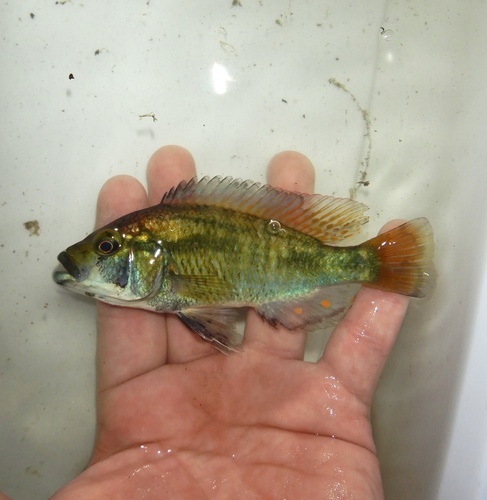
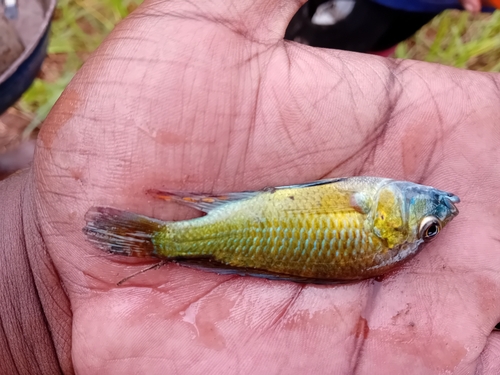
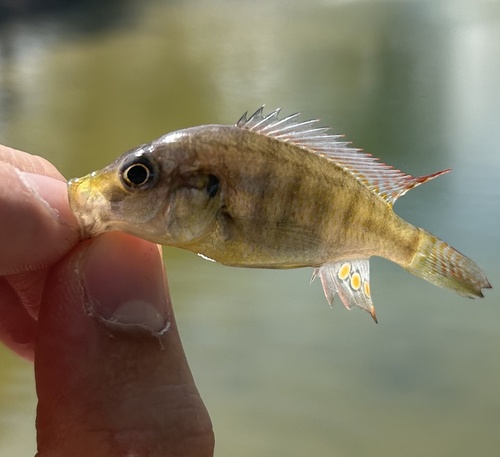
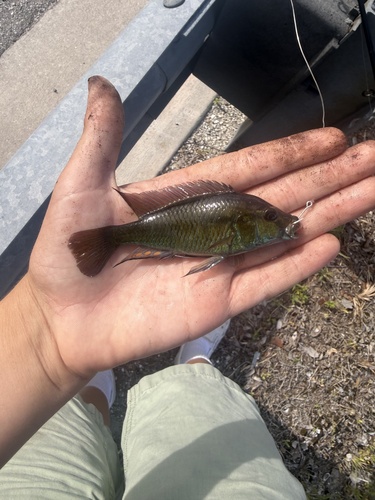
This is a modest fish by Malawi standards: FishBase gives a maximum of about 15 cm (6 in) standard length, and most aquarium specimens are smaller. The body is the classic deep-bellied haplochromine shape, and the quickest field marks are a dark bar running through the eye and across the operculum plus often-bluish lips — a pattern that genuinely fools people into thinking they are looking at a Lake Victoria haplochromine rather than a Malawi fish.
The species is sexually dichromatic. Dominant males flush green to yellow with red and blue highlights and carry yellow-orange "egg spots" (ocelli) on the anal fin; females and subordinate males stay a more subdued green-gray. Like a number of haplochromines, A. calliptera also throws orange-blotched (OB) and blotched-female colour morphs, and it features in the comparative literature on cichlid colour pattern (Maan & Sefc 2013). Coloration in haplochromines is mood- and status-dependent, so the vivid male is the breeding male; a stressed or low-ranking individual can look almost drab.
Range & habitat
A. calliptera has the broadest natural range of almost any fish associated with Lake Malawi. Beyond the lake itself it occupies Lakes Chilwa and Chiuta and the Lower Zambezi, Buzi, Pungwe and Save river systems, spanning Malawi, Mozambique, Tanzania, Zambia and Zimbabwe. That distribution is the heart of its story — this is a fish at home in both a great rift lake and the muddy streams around it.
Within Lake Malawi it is a shallow-water, nearshore animal, favouring vegetated and weedy margins rather than the open rocky reefs or sand flats where the famous mbuna and utaka live; it also moves freely into the inflowing rivers and marshes. FishBase records it as benthopelagic in warm, tropical water of roughly 24–28 °C. Crucially, populations across this range differ: Parsons and colleagues (2017) found that A. calliptera populations from the lake and from peripheral rivers and lagoons diverge in life-history traits, and that those differences don't fall neatly along a simple "lake versus river" line — a reminder that the species is really a mosaic of locally adapted populations.
Ecology & diet
Ecologically, A. calliptera is a generalist — the opposite of the narrow trophic specialists that define much of the Malawi radiation. FishBase and survey work list a catholic diet of aquatic invertebrates, algae, plant material, small fishes and plankton, and assign it a trophic level near 3.0, squarely omnivorous. Studies of the lake fauna describe it as a flexible feeder of shallow, productive, weed-fringed water rather than a fish tied to one food source.
That generalism is the ecological flip side of its evolutionary role. A lineage that can eat a bit of everything and live in both river and lake is well placed to colonize new habitats and, over time, to throw off specialized descendants. In the community it functions as a small, abundant nearshore omnivore — prey for larger predators, and itself a consumer of invertebrates and algae along the margins.
Behavior & breeding
Like the great majority of Malawi haplochromines, A. calliptera is a maternal (ovophilic) mouthbrooder with no pair bond. A male defends a small spawning site and courts passing females; the female lays a batch of eggs, takes them into her mouth almost immediately, and is drawn to nip at the egg-spots on the male's anal fin — the moment at which he releases sperm and fertilizes the clutch she is already carrying. She then broods alone.
FishBase describes incubation of roughly 12–14 days at 26 °C, after which the female releases the fry and continues to guard them for several more days, gathering them back into her mouth when a predator (or a diver) approaches; aquarium accounts often report somewhat longer holding periods. Reported clutch sizes are modest, on the order of a few dozen eggs. Outside breeding the species is gregarious but males become territorial and intolerant of rival males when in condition — typical haplochromine social structure.
In the aquarium
A. calliptera is a genuinely good aquarium fish: hardy, attractive, readily bred, and widely available at reasonable prices, which makes it a sensible African-cichlid choice for keepers with one important caveat. Hobby sources consistently rate it semi-aggressive, with the aggression aimed mainly at its own kind — a courting or territorial male can make life hard for rival males and for similar-looking fish in too small a space. The recurring community advice is that its "enough room" threshold is larger than people expect for a 6-inch fish; a single male with females is straightforward, but multiple males want real footprint.
Practical setup follows from its biology rather than from mbuna folklore. Aim for a tank of around 75 gallons or more for a group, with sand substrate, rockwork for sightline breaks and refuges, and some open swimming room; it tolerates and may nibble plants. Water should be hard and alkaline in the Malawi range — roughly pH 7.5–8.5 — and warm. As an omnivore it does well on quality flake and pellet rounded out with frozen or live invertebrate foods. Because it spawns easily, expect holding females; the common keeper mistakes are crowding males together and assuming a small adult size means a small territory.
Conservation
The IUCN Red List assesses Astatotilapia calliptera as Least Concern (assessment dated 22 May 2018). That status is well earned: the species has a very wide distribution across lakes and river systems in five countries, tolerates a broad range of conditions, and is a generalist rather than a narrow-range endemic. It supports a modest commercial and subsistence fishery and a steady aquarium trade, but neither appears to threaten it at the species level, and it is hardy enough to have established (at least temporarily) as an introduced fish in Florida. In short, this is a fish in good standing even where many of its lake-mates are not.
That said, it lives in a basin under real strain. The Chavula et al. (2023) review of the Lake Malawi/Niassa/Nyasa basin (Journal of Great Lakes Research 49(6):102241) documents over-fishing and the well-known collapse of the chambo tilapia fishery, heavy sediment and nutrient loading washing off deforested catchments, roughly 0.7 °C of shallow-water warming that strengthens stratification and cuts the lake's productivity, and a growing risk from invasive species. Those pressures fall most heavily on exactly the habitat A. calliptera occupies: the shallow, vegetated, nearshore margins and the rivers feeding the lake, where sedimentation, shoreline development and nutrient enrichment hit hardest. So the honest reading is a split one — the species itself is secure and adaptable, but the inshore Malawi habitat it depends on is being degraded, and a fish this tied to nearshore productivity is not immune to a lake that is warming and silting at its edges.
Sources
- FishBase — Astatotilapia calliptera (Eastern happy)
- Eschmeyer's Catalog of Fishes — Astatotilapia calliptera (species record)
- USGS Nonindigenous Aquatic Species — Astatotilapia calliptera factsheet
- IUCN Red List — Astatotilapia calliptera (Least Concern)
- USFWS Ecological Risk Screening Summary — Eastern Happy
- Malinsky et al. 2018 — Whole-genome sequences of Malawi cichlids reveal multiple radiations (Nature Ecology & Evolution)
- Parsons, Bridle, Rüber & Genner 2017 — Evolutionary divergence in life history traits among populations of Astatotilapia calliptera (Ecology and Evolution)
- Turner, Ngatunga & Genner 2021 — Astatotilapia species from Malawi, Mozambique and Tanzania (EcoEvoRxiv)
- Maan & Sefc 2013 — Colour variation in cichlid fish: developmental mechanisms (review)
- Konings, A. 2008 — Species profile: Astatotilapia calliptera (Cichlid Room Companion)
- AquariumDomain — Astatotilapia calliptera species profile
- Chavula et al. 2023 — Lake Malawi/Niassa/Nyasa basin: Status, challenges, and research needs (J. Great Lakes Research 49(6):102241)
- malawicichlids.com — Bibliography of Lake Malawi Biology
- New England Cichlids import list / hobby trade (Facebook group thread) — community/anecdotal