Taxonomy & naming
Aulonocara stuartgranti was described by Manfred K. Meyer and Rüdiger Riehl in 1985, in volume 2 of Baensch & Riehl's aquarium atlas, from specimens taken at Mpanga Rocks near Chilumba on Lake Malawi's northwestern shore (holotype SMF 20057, Senckenberg Museum). The genus name blends the Greek aulos, a flute or pipe, with kara, head — a nod to the conspicuous open canals and sensory pores that channel the head of these fishes. The species honors Stuart M. Grant (1937–2007), the English-born exporter whose Kambiri Point station near Salima supplied much of the Malawi cichlid trade for decades.
The genus has a messy nomenclatural history, and stuartgranti sits near its center. Eschmeyer's Catalog of Fishes lists it as valid, while the IUCN assessment treats two later names, Aulonocara hansbaenschi and Aulonocara steveni (both Meyer, Riehl & Zetzsche, 1987), as synonyms — a reminder that the sand-dwelling Aulonocara are a tight, recently radiated cluster that taxonomists and aquarists have repeatedly split and lumped. In the trade the fish carries a thicket of names, including "flavescent peacock," "Grant's peacock," "blue neon," "red flush" and the old umbrella label "Aulonocara nyassae," most of them tied to a specific collecting locality rather than a distinct biological species.
Appearance
This is a moderately sized peacock. FishBase records a maximum of about 4.6 in (11.8 cm) total length, and field workers note that shallow-water populations top out near 3.5–4 in (9–10 cm) while deeper-water forms run larger; aquarium-grown males are frequently reported at 5–6 in (13–15 cm), with hobby sources occasionally claiming more. Take the upper figures as captive, well-fed extremes rather than wild norms.
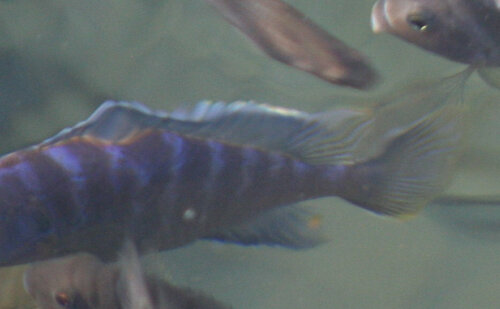
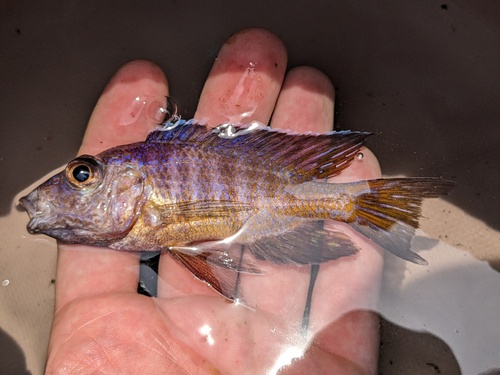
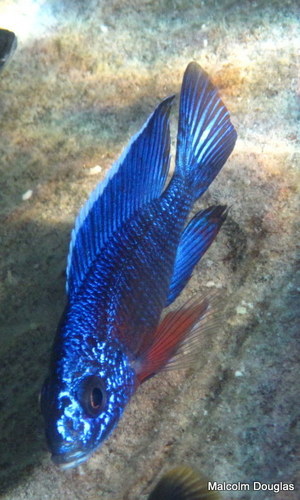
Like most Aulonocara, A. stuartgranti is strikingly sexually dichromatic. Dominant males blaze with metallic blue over the face and gill covers, often shading into orange, red or yellow along the body and fins depending on the population — the Ngara "flametail" earns its name from a fiery orange tail and flank, while Usisya and Cobue fish lean blue. Females and subordinate or stressed males are a cryptic gray-brown with faint vertical barring, almost dull enough to be mistaken for a different fish. Males also carry the usual haplochromine egg-spots (ocelli) on the anal fin. Across its range the species fragments into dozens of named geographic morphs, and color is also tied to social rank: a male only colors up fully once he holds a territory, which is a frequent source of confusion for keepers waiting on a drab juvenile to "turn."
Range & habitat
A. stuartgranti is endemic to Lake Malawi and widespread within it. The IUCN range description traces it along the western shore from Ngara south to Kande Island in Malawi, along the eastern (Tanzanian) shore south of the Ruhuhu River, and down the entire Mozambican coast to Chimwalani Reef. That broad distribution is the main reason it is considered secure.
Ecologically it is a fish of the lake's "intermediate" zone — the transitional habitat where rocky reef gives way to open sand, rather than the pure rock of the mbuna or the open sandflats of the deeper sand-dwellers. Males hold territories beneath and between rocks, especially large overhanging boulders that suspend over sand, while females and non-breeding males forage out on the adjacent sediment and bolt for cover among the rocks when disturbed. Populations occur from the shallow sublittoral (around 16 ft / 5 m in some bays) to deeper offshore reefs, and the genus is known to host paired shallow and deep forms within a single bay. In-situ the water is warm and stable — FishBase cites roughly 72–79 °F (22–26 °C) — alkaline, hard, and oxygen-rich, the typical chemistry of Malawi's upper water column.
Ecology & diet
A. stuartgranti is a sand-sifting micro-predator with a genuinely remarkable feeding apparatus. In the lake it hangs almost motionless a few millimeters above the sandy bottom, then darts down to strike at small invertebrates — crustaceans, insect larvae and snails — buried in or moving through the sediment. FishBase places it at a trophic level of about 3.5, squarely a carnivore on small benthic prey rather than an algae-grazer.
The striking part is how it finds prey it cannot see. Peacocks have unusually widened cranial lateral-line canals along the lower jaw, long suspected to detect the faint water movements of hidden invertebrates. Schwalbe, Bassett and Webb tested this directly on A. stuartgranti in a 2012 study in the Journal of Experimental Biology: the fish located and ate tethered live brine shrimp in total darkness, and when the lateral line was temporarily disabled with cobalt chloride that ability collapsed — confirming that the canal system, not vision, drives prey capture in the dark. The work also showed the fish switches between sensory channels, leaning on the lateral line at night and combining it with sight by day. It is one of the cleaner demonstrations of lateral-line-mediated feeding in any cichlid, and it explains both the fish's hovering hunting posture and the sensory pits that gave the genus its name.
Behavior & breeding
Socially, A. stuartgranti follows the standard Malawi peacock template: polygynous, with dominant males defending a cave or sheltered patch among the rocks and courting any receptive female that wanders in from the surrounding sand. Several territorial males may occupy a single large cave system, while females gather in loose, drab groups over the open bottom between male territories. Aggression is real but moderate by Malawi-cichlid standards — keepers across forums consistently rate stuartgranti as calmer than mbuna or the hybridized "OB" and "dragonblood" peacocks, though males will harass each other and pester females.
Reproduction is maternal mouthbrooding. A courting male leads a female to his spawning site, typically inside or beneath a cave, where she lays eggs and immediately takes them into her mouth, fertilizing them by mouthing the male's anal-fin egg-spots in the classic haplochromine fashion. She then broods the developing young in her buccal cavity for roughly three weeks, eating little, before releasing free-swimming fry. Clutches are modest and scale with female size — hobbyist breeders report anywhere from about 5 to 50 eggs — and well-conditioned females can spawn on a roughly monthly cycle. A cooler, generous water change is a commonly cited spawning trigger among breeders, plausibly mimicking seasonal cues, though that remains anecdotal rather than established.
In the aquarium
Stuartgranti is one of the better peacocks for an intermediate keeper, but it is not a community fish in the loose sense. Give it a tank with a real footprint — a 4-foot, 55-gallon (about 210 L) tank is a sensible floor for a colony, and bigger is better — with a sandy bottom and rockwork arranged into caves and overhangs that echo its natural rock-sand interface. Malawi chemistry suits it: hard, alkaline water around pH 7.8–8.6 and roughly 76–82 °F (24–28 °C).
The two mistakes keepers make are stocking ratio and hybridization. A single male with a group of four to six females spreads his attention and keeps any one female from being harried to death; a lone pair rarely ends well. More importantly, A. stuartgranti interbreeds freely with other Aulonocara and with the man-made peacock strains, and the offspring are muddy mongrels with no conservation or display value — so a serious keeper runs a single Aulonocara species per tank, or goes the all-male route with visually distinct, unrelated species to suppress breeding entirely. It accepts prepared foods readily, but a quality color-enhancing diet with some frozen or live invertebrate component flatters its colors and respects its sand-sifting biology. Avoid feeding mammalian-fat-heavy foods, and avoid mixing it with hyper-aggressive mbuna that will outcompete and bully it.
Conservation
The IUCN Red List assesses Aulonocara stuartgranti as Least Concern (Konings 2018, assessed 22 June 2018), with a population judged stable. The reasoning is straightforward: it is endemic to Lake Malawi but very widely distributed, common at most sites, and its preference for rocky areas means subsistence seine fishermen catch it only incidentally. It is, however, a flagship of the Malawi ornamental export trade — sold under a parade of locality and trade names — and while the assessors concluded that aquarium collection has had no measurable impact on wild populations, vulnerability analyses of Lake Malawi's ornamental fishery (Msukwa and colleagues) flag narrow-range, locality-restricted forms as the ones most exposed to targeted collection. As a translocation footnote, fish from Cobwé in Mozambique were moved to Thumbi West Island inside Lake Malawi National Park.
Least Concern for the species does not mean the lake is healthy, and the honest framing is to say exactly that. The basin review by Chavula et al. (2023, Journal of Great Lakes Research 49(6):102241) documents a lake under mounting strain: over-fishing and the collapse of the commercially vital chambo (Oreochromis) fishery, heavy sediment and nutrient loading washing off deforested catchments, and roughly +0.7 °C of warming in the shallow water column that strengthens stratification, suppresses the upwelling of deep nutrients and trims primary productivity — alongside the looming risk of invasive species such as Nile tilapia entering the catchment. For an intermediate-zone, sand-and-rock fish like stuartgranti, the most direct of these is sedimentation: silt smothering the rock-sand interface degrades exactly the foraging and spawning habitat this species depends on, and clouding the water blunts the visual half of its day-night feeding. The species is not in trouble today, but its security rests on a lake whose nearshore habitats are quietly being eroded.
Sources
- Eschmeyer's Catalog of Fishes — Aulonocara stuartgranti (species record)
- FishBase — Aulonocara stuartgranti (Flavescent peacock) summary
- GBIF — Aulonocara stuartgranti occurrence records
- Schwalbe, Bassett & Webb (2012), 'Feeding in the dark: lateral-line-mediated prey detection in the peacock cichlid Aulonocara stuartgranti', Journal of Experimental Biology 215:2060-2071
- Schwalbe, Bassett & Webb (2012) — open PDF (University of Rhode Island DigitalCommons)
- Webb Lab — Development and Evolution of the Lateral Line System in Cichlid Fishes (project page)
- Chavula et al. (2023), 'Lake Malawi/Niassa/Nyasa basin: Status, challenges, and research needs', Journal of Great Lakes Research 49(6):102241 (DOI 10.1016/j.jglr.2023.102241)
- IUCN Red List — Aulonocara stuartgranti (Konings 2018, Least Concern)
- Greater Chicago Cichlid Association — Aulonocara stuartgranti 'Ngara' species profile
- Sam Borstein's Cichlids — Aulonocara stuartgranti profile (color morphs & natural habitat)
- Fishipedia — Aulonocara stuartgranti (Flavescent peacock) fish sheet
- Practical Fishkeeping — 'Cichlids with a sixth sense' (Aulonocara lateral-line feeding)
- Cichlid-Forum — combining peacocks; stuartgranti aggression and coloration (community thread) — community/anecdotal
- Cichlid-Forum — coloring up Aulonocara 'Ngara Flametail': rank and gender (community thread) — community/anecdotal
- Reddit r/Cichlid — tank size and harem ratios for stuartgranti 'Usisya' peacocks — community/anecdotal
- MonsterFishKeepers — promoting peacock cichlid breeding (cool water-change trigger, anecdotal) — community/anecdotal
- Fish Lore — peacock cichlid hybrid aggression vs. pure strains (community thread) — community/anecdotal