Taxonomy & naming
The species was described in 1899 by the prolific Belgian-British ichthyologist George Albert Boulenger, who placed it in the catch-all genus Paratilapia as Paratilapia dewindti. The material came from the Congo Free State Expedition led by Lieutenant Charles Lemaire, and the fish was named for Jean Charles Louis De Windt, a young Belgian geologist on that expedition who died in 1898. In 1920 Charles Tate Regan erected the genus Aulonocranus to hold it, and that combination — Aulonocranus dewindti (Boulenger, 1899) — is the valid name recognized today by Eschmeyer's Catalog of Fishes and FishBase. The genus name is built from the Greek aulos, a flute or pipe, and kranion, skull, a reference to the conspicuous tube-like sensory canals on the head.
The genus is monotypic: A. dewindti is the only species in it. A second name, Paratilapia lukugae, was coined by Boulenger in 1919 for fish from the Lukuga River outflow, but it is now treated as a junior synonym of dewindti. Northern and southern lake populations differ slightly in color — southern fish tend to be more strongly yellow — and that variation has kept a low simmer of discussion about whether the lukugae form deserves any taxonomic recognition, but no split is currently accepted. Aulonocranus belongs to the tribe Ectodini, the flock of sand-and-open-water cichlids that also includes the showier featherfins (Cyathopharynx, Ophthalmotilapia, Cunningtonia) and the sand-sifting Callochromis and Xenotilapia; in the hobby it is sold simply as a featherfin, and it carries the local name Likuko.
Appearance
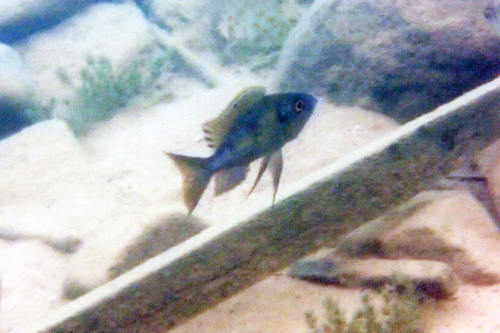
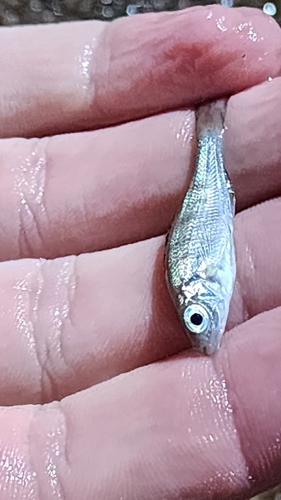
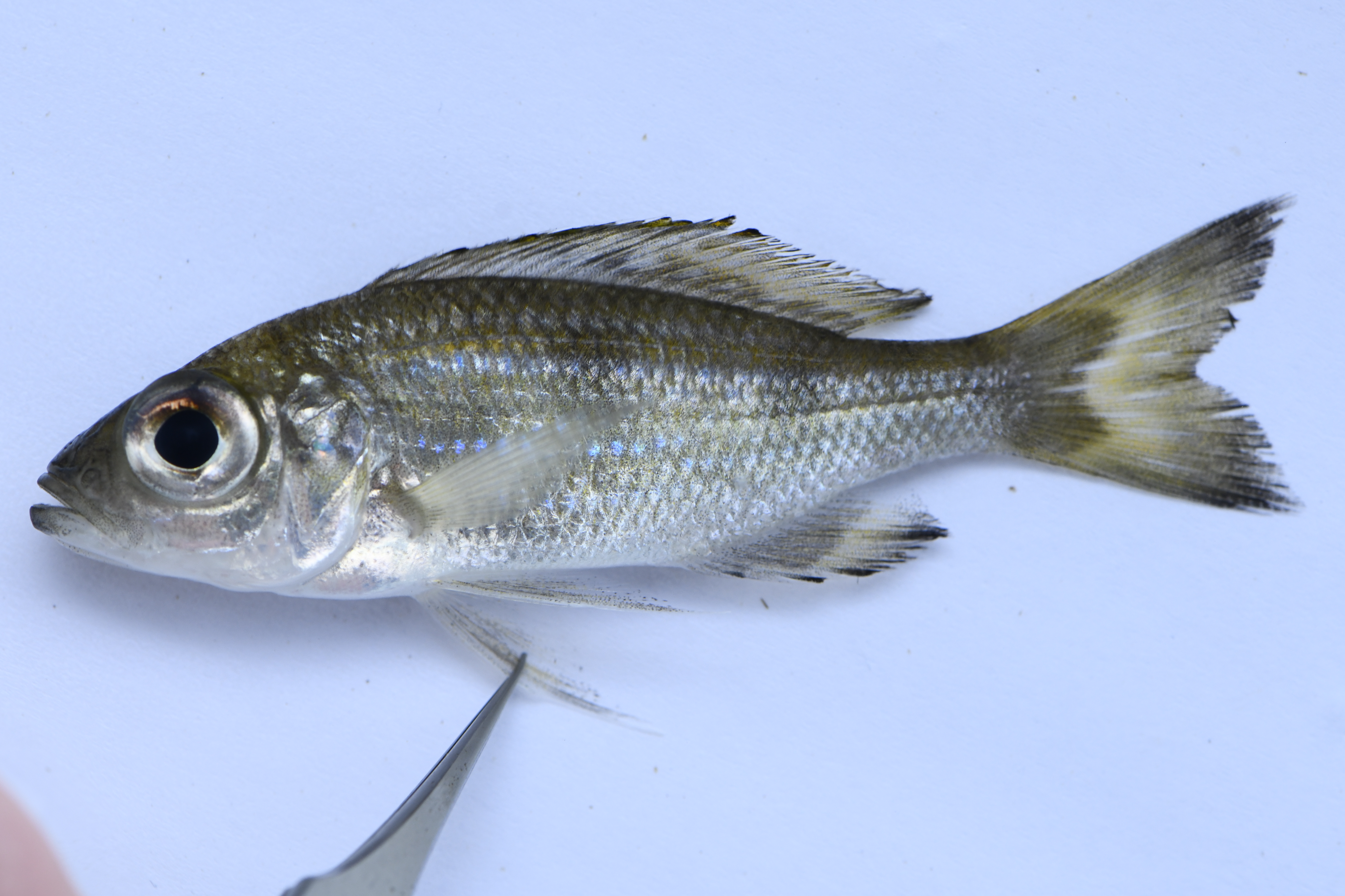
This is a moderately sized, elongate cichlid with the high-set, oversized eyes and slightly underslung mouth typical of a fish that works the sand. FishBase lists a maximum of about 5.5 in (14 cm) total length; in practice keepers and field guides report males reaching roughly 5 to 6 in (13–15 cm) while females stay smaller, nearer 4 in (10 cm). The sexes are easy to tell apart once mature. Dominant males are the prize: depending on the population they flush into a metallic mix of blue and yellow, the body spangled with iridescent scales and the unpaired fins drawn out into the trailing filaments that give the featherfins their name. The pelvic fins in particular grow long and trailing in males. Females and subordinate males are far plainer — basically a shining silver, often with a faint dusting of purplish-blue iridescence along the flanks — and their fins are noticeably shorter.
The feature that matters most to a biologist is on the head: the snout and cheeks carry conspicuously enlarged lateral-line sensory pores. Those pores let the fish detect the tiny movements of prey hidden in the sand, and they are a striking case of convergent evolution — the unrelated peacock cichlids (Aulonocara) of Lake Malawi evolved nearly the same hardware for nearly the same job, which is why hobbyists sometimes call A. dewindti a kind of Tanganyikan peacock.
Range & habitat
Aulonocranus dewindti is a Lake Tanganyika endemic and one of the lake's genuinely lake-wide fishes, recorded around essentially the entire shoreline of the four countries that share the basin, with the type locality at Moliro on the Congolese coast. It also turns up in the lake's connected waters, the Rusizi inflow in the north and the Lukuga outflow to the west. Across that range there is modest geographic color variation rather than any sharp breaks.
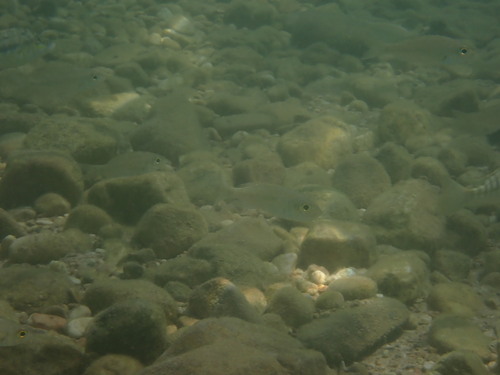
It lives in what Tanganyika specialists call the intermediate habitat — the transitional zone where the rocky shore gives way to open sand, a bottom of fine sand mixed with pebbles and scattered rocks. This is shallow water: the fish is typically found from roughly 3 to 30 ft (about 1–10 m) and often shallower than 15 ft (5 m), with one behavioral study working on resident males at just 3 to 7 ft (1–2 m) along the Zambian shore. It is not a rare fish in this zone. In quantitative surveys near Kalambo it was among the most abundant cichlids present — by one field account second only to Variabilichromis moorii, at densities on the order of 40 individuals per 100 m². The water it lives in is the warm, hard, alkaline water of the open lake, around 75–79 °F (24–26 °C) — stable conditions that anyone keeping the fish should aim to reproduce.
Ecology & diet
Aulonocranus dewindti is a benthic invertivore that doubles as a roaming plankton-picker. Out on the sand flats it forages by hovering low and scanning the substrate, using those enlarged head pores to sense the movement of buried prey before darting down to take it; the diet is dominated by small invertebrates sifted from the sand — insect larvae (including the lake's abundant midge and sandfly larvae) and small crustaceans — making it an animal-matter specialist despite being sometimes labeled an omnivore. FishBase places it at a trophic level of about 3.4, a mid-level carnivore. The old field characterization of the species as a 'semi-pelagic roamer' that gathers over sandy bottoms in loose schools of several hundred fish captures the other side of its ecology: outside of breeding it is a mobile, sociable fish of open water rather than a crevice-bound territory holder.
In the community of the intermediate zone it occupies the role that the sand-sifting Xenotilapia and the peacocks fill elsewhere — converting the invertebrate productivity of bare sand into fish biomass, in a habitat that holds fewer species than the crowded rocky reef but supports some of them in great numbers.
Behavior & breeding
Breeding is where this otherwise unassuming fish becomes interesting. Aulonocranus dewindti is a maternal mouthbrooder and a lek breeder: when males come into condition they leave the roaming shoals and stake out spawning territories on open sand, each one excavating a shallow circular crater — a bower — usually sited next to a rock that serves as a landmark. Several males set up close together, forming a loose lek that females visit to choose a mate. The female spawns in the chosen male's bower, takes the fertilized eggs into her mouth, and then leaves; she alone broods the clutch, incubating for roughly three weeks (about 21 days) before releasing free-swimming fry. FishBase notes brooding females in the 2.8–3.5 in (7–9 cm) standard-length range carrying young up to about 0.6 in (1.6 cm).
The bower is not just built, it is maintained — and that maintenance has made the fish a small celebrity in animal-cognition research. A 2023 field study on the Zambian shore (Pirat and colleagues, Animal Cognition) showed that resident males reflexively clear debris dropped into the crater, and that when offered a snail shell and a stone simultaneously they reliably remove the shell first, revealing a built-in decision rule. The researchers could even tell individuals apart day to day because nesting males are strongly philopatric, returning to exactly the same bower. The take-home for an aquarist is simple: these males are compulsive sand-movers, and a spawning male will rearrange a tank's entire substrate to build his crater. Aggression is real but modest by featherfin standards — territorial males spar and chase, especially while breeding, but the species is generally less belligerent toward tankmates than its larger relatives.
In the aquarium
By featherfin standards this is one of the more manageable species — smaller, hardier, and less prone to the wasting problems that plague Cyathopharynx and Ophthalmotilapia — but it is still a fish with specific needs and not a casual community pick. The non-negotiable is floor space: this is a sand cichlid that builds bowers, so it wants a long tank with an open, fine-sand bottom. A 4-foot tank of around 75 gallons (300 L) is a sensible minimum for a single male with several females; keepers consistently advise giving featherfins essentially the whole bottom and keeping rockwork to a few smooth, low pieces used as territorial reference points. That last point is practical, not aesthetic — like other featherfins, A. dewindti has large, somewhat protruding eyes that are easily scratched or damaged on sharp rock, so jagged decor is a genuine hazard.
Stock it as a harem, one male to several (four to six) females; a second male can be kept only in a larger tank where the two can hold separate bowers, and crowding too many males into a small tank forces the keeper to intervene. Water should match the lake: hard, alkaline (around pH 8–9) and warm (mid-70s to low-80s °F / ~24–27 °C), with the strong filtration and steady water changes Tanganyikans demand. It mixes well with open-water schoolers such as Cyprichromis and with rock-dwellers that keep to the structure, since the niches barely overlap. Feed a varied, animal-leaning diet — quality cichlid pellets or flakes supplemented with frozen mysis, krill, daphnia, and brine shrimp. Two cautions from experienced keepers: don't overdo plant- or spirulina-heavy foods for what is really a carnivore, and be ready for the substrate to end up wherever the dominant male decides his crater should be.
Conservation
Aulonocranus dewindti is assessed by the IUCN Red List as Least Concern (most recently 4 February 2025). That rating is well earned at the species level: the fish is endemic to Lake Tanganyika but distributed lake-wide, locally abundant in its sandy habitat, fast-growing and quick to mature, and under no meaningful targeted pressure — it is a minor component of artisanal catches and a relatively uncommon aquarium export rather than a heavily collected one. In short, the species itself is not in trouble.
Its home, however, is. Lake Tanganyika faces basin-wide pressures that a shallow-water sand-dweller is directly exposed to. The first is warming. Long-term work led by Catherine O'Reilly (2003, Nature) found that rising surface temperatures have strengthened the lake's stratification and weakened the wind-driven mixing that lifts deep nutrients into the sunlit zone, with sediment-core evidence pointing to a roughly 20% drop in primary productivity over the twentieth century and an inferred decline in fish yields on the order of 30%. Andrew Cohen and colleagues (2016, PNAS) extended that picture with a ~1,500-year paleoecological record, tying sustained warming over the last ~150 years to shrinking algal production and an estimated 38% contraction of the oxygenated benthic habitat in their study areas — and to measurable declines in both fishery fishes and endemic bottom-dwelling life. Because A. dewindti feeds on sand-bottom invertebrates whose food base is that same lake productivity, a less productive lake means a thinner table for it.
The second pressure is the one that bears most directly on this guild: sedimentation. Deforestation and farming across the lake's catchment send eroded soil into the nearshore, and in-lake studies (Cohen and co-workers in the 1990s, and later nearshore-pollution surveys) have linked these sediment loads to reduced species richness in littoral communities. For a fish that hunts by sensing prey in clean sand and breeds in carefully tended sand craters, heavy silt is a habitat-quality problem in a way it is not for an open-water plankton-feeder — it smothers the invertebrate fauna the fish eats and degrades the substrate the males sculpt. These strains play out across a lake shared by four nations (Burundi, the Democratic Republic of the Congo, Tanzania, and Zambia), where coordinated management of fisheries and watersheds remains difficult. The honest summary: A. dewindti is secure today and rightly listed as Least Concern, but it lives in a lake whose littoral and productivity are being eroded by warming and sediment — pressures that fall on exactly the shallow sand habitat this species depends on.
Sources
- FishBase — Aulonocranus dewindti (Boulenger, 1899)
- Eschmeyer's Catalog of Fishes — Aulonocranus dewindti (species record)
- GBIF — Aulonocranus dewindti (Boulenger, 1899)
- Cichlid Room Companion — Aulonocranus dewindti (Boulenger, 1899)
- Cichlid Room Companion — Aulonocranus (genus grouping, Ectodini)
- Pirat et al. 2023 — Cognitive flexibility in a Tanganyikan bower-building cichlid, Aulonocranus dewindti (Animal Cognition; PMC)
- tanganyika.si — Aulonocranus dewindti (biotope, breeding, husbandry profile)
- AquaInfo — Spawning Aulonocranus dewindti (keeper account, featherfin sensory pores & bower-building)
- Aquarium Glaser — Aulonocranus dewindti (monotypic genus, intermediate-habitat notes)
- Cichlid-Forum — Aulonocranus dewindti experience? (keeper thread: tank size, eye fragility, tankmates) — community/anecdotal
- IUCN Red List — Aulonocranus dewindti (Least Concern)
- O'Reilly et al. 2003 — Climate change decreases aquatic ecosystem productivity of Lake Tanganyika (Nature; AfricaMuseum PDF)
- Cohen et al. 2016 — Climate warming reduces fish production and benthic habitat in Lake Tanganyika (PNAS)
- Lake Tanganyika: Status, challenges, and opportunities for research (Journal of Great Lakes Research)
- Sediment pollution and littoral biodiversity in Lake Tanganyika (Conservation Biology, Cohen et al.)