

Taxonomy & naming
George Albert Boulenger described Bathybates fasciatus in 1901 from a single specimen taken on the west coast of Lake Tanganyika; that holotype still resides in the Natural History Museum, London. The valid name and authority are confirmed by Eschmeyer's Catalog of Fishes and FishBase, and the species has carried it without synonymy ever since — so the occasional hobby listing of "Boulenger, 1898" is simply an error to disregard.
The genus name is a small piece of poetry: from the Greek bathys, "deep," and bates, "one who walks," a "deep-walker" for a fish of the open abyss. The epithet fasciatus, "banded," points to the dark vertical bars along its flanks. Around Tanganyika the fish is known by a rich set of vernacular names — bangabanga, mbanga and mubangabanga in Swahili, ilembela (plural malembela) in other Bantu languages, and umbangabanga in Rundi.
B. fasciatus belongs to the tribe Bathybatini, an ancient lineage within Tanganyika's cichlid radiation that diverged early from the rest of the flock. Genetic work places it among the "true" pelagic Bathybates alongside its close relative B. leo, and morphological accounts separate it cleanly from look-alikes: it carries only six or seven vertical bars where B. horni shows roughly twelve to fourteen, and it lacks the horizontal striping of B. leo.
Appearance
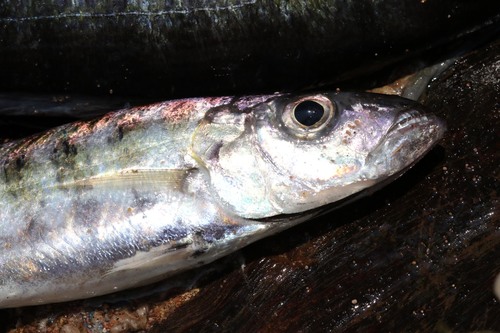
This is a long, laterally compressed, distinctly un-cichlid-looking fish: streamlined and silvery, built for the open water rather than the reef. The body is pale and reflective, crossed by a modest set of six or seven dark vertical bars, with large eyes set in a relatively small head and a comparatively small mouth for such an active predator. The overall impression is less "jewel cichlid" and more "oversized sardine" — which, as it turns out, is the whole point.
Reliable maximum size is about 39.7 cm (15.6 in) total length, the figure carried by FishBase from the CLOFFA checklist and cited in the 2025 IUCN assessment. Specialist Tanganyika references put well-grown adults at around 41 cm (16 in). Some hobby care sheets inflate this to 45–50 cm (18–20 in); those numbers are not supported by the taxonomic literature and are best treated with caution. Sexual dimorphism is weak — there is no dramatic male coloration to rely on — though mouthbrooding females are reported to look duller than males, a subtle and inconsistent cue at best.
Range & habitat
Bathybates fasciatus is endemic to Lake Tanganyika and ranges widely through it, recorded from all four riparian nations — Burundi, the Democratic Republic of the Congo, Tanzania and Zambia. As a lacustrine endemic it exists nowhere else on the planet.
It is a pelagic species — a roamer of the open water column rather than a fish tied to a patch of rock or sand. The depth picture is unusual and worth getting right. Adults are creatures of the deep, commonly working waters down to roughly 160–200 m (525–660 ft), foraging over open sandy and muddy bottoms in clean water; the IUCN assessment gives an overall depth band of about 5–160 m (16–525 ft). Juveniles, by contrast, live shallow, often in sandy areas less than 5 m (16 ft) deep, where the silvery young mingle with juvenile sardines and other small shining fishes. In its native water the lake runs warm and hard — broadly 23–25 °C (73–77 °F), alkaline with a pH near 8–9 — the stable, mineral-rich chemistry that defines Tanganyika.
Ecology & diet
B. fasciatus is a piscivore near the top of the pelagic food chain, with a calculated trophic level around 4.2. Its prey is overwhelmingly the lake's clupeids — the endemic sardines Stolothrissa tanganicae and Limnothrissa miodon — supplemented occasionally by small cichlids and shrimp. In doing so it plugs directly into the same silver-fish economy that feeds millions of people around the lake.
The elegant twist is how it hunts. Its own sardine-like silhouette and coloration let it approach prey schools unnoticed, a resemblance that functions as aggressive mimicry: the predator dressed as the prey, drifting in among the sardines until it is close enough to strike. This pelagic, follow-the-bait lifestyle also shapes its genetics. A 2019 phylogeographic study by Koblmüller and colleagues found that the truly open-water Bathybates — B. fasciatus and B. leo — show essentially no population structure across the entire lake, a signature of constant mixing as they trail mobile sardine schools, whereas their bottom-associated relatives are genetically more partitioned.
Behavior & breeding
Socially, B. fasciatus forms schools and is described as generally peaceful toward fishes of similar size — its aggression is the impersonal hunger of a predator, not the territorial belligerence of a rock-dwelling cichlid. Anything small enough to swallow, however, is food.
Reproduction follows the maternal mouthbrooding pattern typical of many Tanganyikan cichlids, but with a distinctive migration built in. Adults move up from deep water to shallow sandy areas to spawn; after the male fertilizes the clutch, the female takes the eggs into her mouth. Specialist accounts report relatively small broods of around 30 eggs carried for roughly 38 days, with fry released at about 17 mm (0.7 in). Those young then stay in the shallows, schooling alongside juvenile sardines — the same disguise the adults exploit, deployed for safety rather than ambush. One detail merits an honest flag: some field reports relayed in the IUCN assessment describe eggs being laid among grasses in shallow water and left unattended, which sits awkwardly with the mouthbrooding accounts. The likeliest reading is the standard pick-up-and-brood sequence, with the apparent contradiction owing to brief, easily misread spawning behavior in the field.
In the aquarium
Let's be honest up front: this is not a community fish, not a beginner fish, and not a fish most aquarists should pursue. It appears in the trade only rarely, almost always as wild-caught adults that arrive as incidental catch from the sardine fishery, and keepers who have found one routinely report being unable to source a second — a real obstacle for anyone hoping to breed a colony. Prices reflect that scarcity; long-time hobbyists recount paying well over a hundred dollars per wild fish.
If you do keep one, plan around its biology. This is a large, fast, open-water swimmer that needs a long tank with extensive clear swimming room — specialist references suggest on the order of 800 liters (about 210 US gal) and up, and some go considerably larger. Decor should be minimal: a fine sand bottom and few or no rocks, because these big-eyed, deep-water fish are nervous and prone to injuring themselves bolting into obstacles, glass or equipment, as keepers of congeneric Bathybates consistently warn. They demand the hard, alkaline Tanganyikan water they evolved in, dislike dry flake foods, and take live and frozen fare. Realistically they are best kept as a species tank or only with other large open-water Tanganyikans such as other Bathybates or Haplotaxodon — never with anything small enough to be eaten. Treat any single dramatic claim from a forum as a lead, not gospel; the consistent signal across keepers is "sensitive, jumpy, hard-water specialist, advanced only."
Conservation
Bathybates fasciatus was assessed as Least Concern on the IUCN Red List in 2025 (assessor C. Sibomana), unchanged from its 2006 listing. The justification is straightforward: it is genuinely widespread across Lake Tanganyika, so localized threats are unlikely to imperil the whole population. That headline, though, hides real unevenness. The assessment notes the species is considered stable in Tanzania but possibly in slow decline in Zambia, abundant in the southern DRC yet sharply reduced in the north, and — most strikingly — has become very rare in Burundi after steep declines between 2010 and 2015. It is taken mainly as bycatch alongside sardines, with illegal and non-selective gear and localized pollution flagged as pressures, and an annual three-month fishing closure (roughly May–August) coordinated by the Lake Tanganyika Authority is identified as a measure this fish would benefit from. It is used locally for food and to a small degree exported for the aquarium trade.
The species' own status sits inside a lake under strain, and a deep-water pelagic predator is exposed to exactly the basin-scale pressures that bite hardest offshore. Lake Tanganyika has warmed measurably: O'Reilly and colleagues (2003, Nature, doi:10.1038/nature01833) found that warming surface waters strengthen stratification and weaken the seasonal mixing that lifts nutrients into the sunlit zone, estimating roughly a 20% drop in primary productivity and, with it, on the order of a 30% decline in fish yields. Cohen and colleagues (2016, PNAS, doi:10.1073/pnas.1603237113) added that reduced mixing has shrunk the oxygenated benthic habitat in their study areas by about 38% since the early twentieth century, alongside falling fish catches. Because B. fasciatus depends on the clupeid food web that the same warming undermines — and because that Stolothrissa/Limnothrissa-and-Lates pelagic fishery feeds four nations and is governed jointly through the Lake Tanganyika Authority — its long-term prospects are tied less to targeted collection than to whether the lake's open-water productivity holds up. In short: the species itself is Least Concern today, but the water body it lives in is not, and the honest framing is that a stable global rating coexists with worrying local declines and a warming, less productive lake.
Sources
- Eschmeyer's Catalog of Fishes: Bathybates fasciatus
- FishBase: Bathybates fasciatus
- IUCN Red List: Bathybates fasciatus (Bangabanga), 2025 assessment
- Koblmüller et al. 2019, 'Only true pelagics mix: comparative phylogeography of deepwater bathybatine cichlids from Lake Tanganyika', Hydrobiologia 832:93–103
- Koblmüller et al. 2012, 'Evolutionary History of Lake Tanganyika's Predatory Deepwater Cichlids' (Bathybatini), Int. J. Evol. Biol.
- O'Reilly et al. 2003, 'Climate change decreases aquatic ecosystem productivity of Lake Tanganyika', Nature 424:766–768
- Cohen et al. 2016, 'Climate warming reduces fish production and benthic habitat in Lake Tanganyika', PNAS
- tanganyika.si — Bathybates fasciatus species page
- Fishipedia — Bathybates fasciatus fish sheet
- FishBase Field Guide: Bathybates fasciatus (diet, schooling)
- Cichlid Fish Forum — 'Bathybates Fasciatus' (wild-caught sourcing, keeping) — community/anecdotal
- MonsterFishKeepers — 'bathybates Fasciatus' (price, sensitivity, glass-bolting) — community/anecdotal