
Taxonomy & naming
Bathybates leo was described by the Belgian ichthyologist Max Poll in 1956, in the species-rich volume of the "Exploration hydrobiologique du lac Tanganika (1946–1947)" that documented much of the lake's offshore fish fauna. The holotype (MRAC 112490) came from the Bay of Nyanza at a depth of 60 m, with paratypes spread along the lake from Usumbura (now Bujumbura) in the north to Kasanga in the south. Eschmeyer's Catalog of Fishes lists the name as valid with no junior synonyms, and FishBase, GBIF and the Cichlid Room Companion all follow that placement.
The fish sits in the subfamily Pseudocrenilabrinae and the endemic Tanganyikan tribe Bathybatini, alongside its six congeners and the related genus Hemibates. The genus name is built from Greek bathys, "deep," plus bates, "one that walks or goes" — a nod to the deepwater habits of the group. The species epithet leo, "lion," is Poll's; he did not leave a detailed explanation, so any reading of it is inference rather than fact. Around the southern fisheries it is known locally as bangabanga, a name shared loosely with other large open-water predators.
Appearance
Bathybates leo is a mid-sized cichlid by the standards of its genus, reaching about 26 cm (10 in) in total length according to the CLOFFA checklist data carried by FishBase — smaller than heavyweights like B. fasciatus or B. ferox, which push toward 30–40 cm (12–16 in), and well above the diminutive B. minor at around 20 cm (8 in).
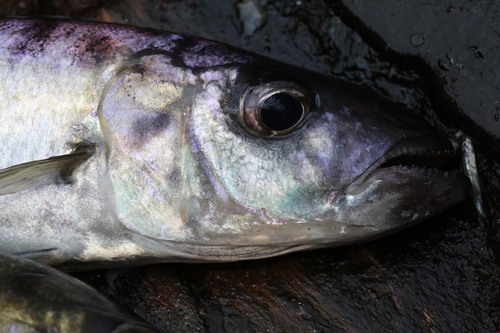
In body plan it is one of the genus's fast-swimming, fusiform predators: a torpedo-shaped, silvery fish built for sustained cruising in open water rather than the deep-bodied, high-finned look of rock-dwelling Tanganyikans. Coulter grouped it with B. fasciatus and the elusive B. horni as the streamlined pelagic morphotype, set apart from the more generalized, blunter shape of the benthic feeders (B. graueri, B. vittatus, B. ferox) and from the small, clupeid-mimicking B. minor. Like other Bathybates it carries dark markings on a pale ground, but published in-life color description is thin; this is a fish known far better from trawl nets and fish markets than from photographs, and most images that exist show freshly caught specimens rather than living, displaying animals.
Range & habitat
Bathybates leo is endemic to Lake Tanganyika and has been recorded basin-wide, from the northern waters off Burundi to the southern Zambian and Tanzanian shores — the type series alone spans nearly the full length of the lake. FishBase places it across the tropical 3°S–9°S band of the lake.
What makes it unusual is where in the lake it lives. Rather than the littoral rock and sand most aquarium cichlids favor, B. leo is a true pelagic (eupelagic) fish of the open water column. With B. fasciatus it ranges through the lake's offshore zone down to the limit of the oxygen-bearing layer — roughly 50 m deep in the north and as much as 200 m in the south, where the oxycline sits lower. Below that boundary the water is permanently anoxic and essentially lifeless, so the oxygenated upper layer is the entire habitable world for an open-water hunter. A 2019 phylogeographic study by Koblmüller and colleagues found that B. leo, like other genuinely pelagic Bathybates, shows little genetic structure across the lake: with no reefs or depth bands to divide it, the population mixes freely, exactly what you'd expect of a strong-swimming fish that crosses open water at will.
Ecology & diet
Bathybates leo is a piscivore, and a fairly specialized one. FishBase, drawing on the lake's fisheries literature, records that it forms schools and feeds mainly on clupeids — the two endemic "Tanganyika sardines," Stolothrissa tanganicae and Limnothrissa miodon, that form the silver backbone of the lake's open-water food web. Estimated at a trophic level around 4.2, it is a high-order predator near the top of the pelagic chain.
That diet places B. leo in a small but ecologically important guild. Together with Lates perches, large clariid catfishes and the giant emperor cichlid Boulengerochromis microlepis, the pelagic Bathybatini are the dominant predators of Tanganyika's open water. Chasing fast, schooling prey through featureless blue water demands mobility, and the streamlined build of B. leo is the morphological signature of that lifestyle — a cichlid converging on the body shape of a tuna or a jack. It is worth being honest about the limits of what's documented: detailed gut-content studies specific to B. leo are scarce, and much of what we say about it is generalized from the genus and from the broader pelagic fishery, where bathybatine cichlids are known to prey on the same clupeids that the commercial fleets target.
Behavior & breeding
Socially, B. leo is a schooling, roaming fish rather than a territory-holder; it has no rocky home to defend and instead moves with — and through — concentrations of its clupeid prey across open water. That is about as far as confident statements go for behavior in the wild.
Breeding is the least-documented part of its biology. Bathybates are mouthbrooders, as are the great majority of Tanganyikan cichlids outside the substrate-spawning lamprologines, but the specifics for B. leo — spawning site, clutch size, which sex broods, seasonal timing in open water — are not well established in the accessible literature, and it would be irresponsible to invent them. No captive spawning has been reported. The most relevant scientific signal is indirect: the 2019 phylogeographic work found genetic evidence of recent population growth in the eupelagic Bathybates, consistent with a wide-ranging fish whose offspring disperse freely through the water column rather than recruiting back to a natal reef.
In the aquarium
For practical purposes, Bathybates leo is not an aquarium fish. FishBase notes a nominal aquarium trade, and Bathybates do occasionally surface with specialist Tanganyikan importers, but long-time hobbyists on cichlid-forum.com report seeing the genus offered at most a couple of times a year — and then almost always the larger B. fasciatus or B. ferox, not B. leo — with no captive-bred fry ever changing hands. Aquaticrepublic and the Cichlid Room Companion both list its aquarium breeding as simply unreported.
If one did end up in a tank, the honest assessment from experienced keepers is sobering: these are open-water chase predators, and the consensus on the forums is that they need something on the order of an 8-foot, 300-gallon (roughly 2.4 m, 1,100 L) tank just to swim normally, kept in the hard, alkaline, well-oxygenated water (pH around 8.5–9.0) the lake demands. The recurring care-sheet claim that Bathybates are "easy and peaceful," repeated from older hobby books, should be treated skeptically: a wild-caught, schooling piscivore taken from the cold, stable, oxygen-rich open lake is a delicate import, not a beginner fish. The realistic verdict is that this is a species to appreciate in the wild and in the fishery, not a candidate for the living room.
Conservation
Bathybates leo was assessed for the IUCN Red List as Least Concern, most recently on 11 March 2025 (and likewise in the earlier 2006 assessment). It is widespread across the lake, faces no targeted collection pressure, and as a relatively small bathybatine carries a low intrinsic fishing-vulnerability score. There is no evidence the species itself is in trouble — and the responsible thing is to say exactly that, rather than overstate a threat.
The more important context is the lake it depends on. Lake Tanganyika is under real, measurable strain. O'Reilly and colleagues (2003, Nature, DOI 10.1038/nature01833) showed that sustained warming has strengthened the lake's stratification and weakened the seasonal mixing that lifts nutrients into the sunlit layer, with an estimated ~20% decline in primary productivity that may translate into roughly 30% lower potential fish yields. Cohen and colleagues (2016, PNAS, DOI 10.1073/pnas.1603237113) documented a related squeeze from below: as the lake warms, the oxygenated layer thins, and they estimated a loss on the order of 38% of the oxygenated benthic habitat available to lake life. Along the coasts, deforestation-driven sedimentation continues to smother the rocky littoral (Cohen et al. 1993).
For a fish like B. leo these are not abstractions. Its entire world is the oxygenated open-water layer above the anoxic deep, and its food is the clupeid stock that feeds a commercial fishery spanning four nations — Burundi, Tanzania, the Democratic Republic of the Congo and Zambia — coordinated, at least on paper, through the Lake Tanganyika Authority. Warming that shrinks productivity and the habitable oxygen layer presses simultaneously on the predator and on its prey base; heavy clupeid fishing presses on that prey base from the other side. So the accurate framing is the one the Red List implies: the species is currently secure, but it is secure inside a lake whose pelagic engine is being squeezed by climate and fishing pressure at once — and a deep-water specialist with nowhere shallower to go is exactly the kind of fish that has the least room to adapt if that engine falters.
Sources
- Eschmeyer's Catalog of Fishes — Bathybates leo Poll, 1956
- FishBase — Bathybates leo summary
- GBIF — Bathybates leo occurrence search
- IRMNG — genus Bathybates Boulenger, 1898
- Kirchberger et al. 2012 — Evolutionary History of Lake Tanganyika's Predatory Deepwater Cichlids (PLoS / PMC)
- Koblmüller et al. 2019 — Only true pelagics mix: comparative phylogeography of deepwater bathybatine cichlids (Hydrobiologia)
- O'Reilly et al. 2003 — Climate change decreases aquatic ecosystem productivity of Lake Tanganyika (Nature)
- Cohen et al. 2016 — Climate warming reduces fish production and benthic habitat in Lake Tanganyika (PNAS)
- Bathybates leo — The IUCN Red List of Threatened Species 2025 (Least Concern)
- Cichlid Room Companion — Bathybates leo (Thomas Andersen, public profile)
- AquaticRepublic — Bathybates leo data sheet
- FAO — The Fishery of Stolothrissa tanganicae in Lake Tanganyika
- Kmentová et al. 2016 — Reduced host-specificity in a parasite infecting non-littoral Lake Tanganyika cichlids (Scientific Reports)
- Cichlid Fish Forum (cichlid-forum.com) — "anyone ever keep Bathybates?" (community/anecdotal) — community/anecdotal
- tropicalfreshwaterfish.com — Lake Tanganyika species list (pelagic, size, endemism)