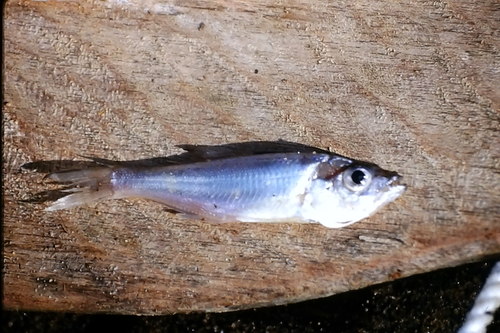

Taxonomy & naming
Bathybates minor was described by the prolific Belgian-British ichthyologist George Albert Boulenger in 1906, in his "Fourth Contribution to the Ichthyology of Lake Tanganyika," reporting on fishes collected during W. A. Cunnington's third Tanganyika Expedition of 1904–1905. The type material came from Kituta and Lofu in the southern reaches of the lake. The name carries its biology in it: Bathybates is built from the Greek bathys, "deep," and bates, "one who walks," a nod to the genus's deepwater habits, while the species epithet minor simply marks it as the small one of the group.
The species sits in the tribe Bathybatini within the cichlid subfamily Pseudocrenilabrinae, alongside the seven-or-so other Bathybates and the related Hemibates. Its identity has been stable: Eschmeyer's Catalog of Fishes, FishBase, and the IUCN all list it as valid under Boulenger's original combination, with no burdensome synonymy to untangle. Around the lake it is known in Swahili as bangabanga (also mbanga). What gives B. minor outsized scientific interest is its position in the genus: mitochondrial and AFLP phylogenies agree that this small, morphologically distinct fish is the sister lineage to all the larger Bathybates species, the most ancient branch of a flock that otherwise diversified rapidly into a cluster of look-alike big predators.
Appearance
Bathybates minor is the smallest member of its genus by a wide margin. FishBase gives a maximum of about 8 in (20.5 cm) total length, against the 12–15 in (30–40 cm) reached by relatives such as B. ferox and B. fasciatus. The body is fusiform and laterally compressed — a streamlined, silvery, almost sardine-like shape that is no accident, given how the fish makes its living. The mouth is large and the dentition predatory, in keeping with a diet of whole fish.
The species is best known for a quirk of sexual dimorphism that sets it apart from essentially every other cichlid in the lake: the females grow markedly larger than the males. Field and hobby observations summarized by Tanganyika-focused references put adult females at roughly 8 in (20–20.5 cm) while males typically top out near 5 in (12–12.5 cm). Males carry faint horizontal lines along the flank; females reach the full body size and a plainer silver. This female-larger pattern is genuinely unusual — in most Tanganyikan cichlids the male is the bigger, showier sex — and it is one of the features that flags B. minor as the odd one out in Bathybates.
Range & habitat
Bathybates minor is endemic to Lake Tanganyika, the long, deep Rift Valley lake shared by Burundi, the Democratic Republic of the Congo, Tanzania, and Zambia, and it is found throughout the lake rather than confined to one shore. Unlike many of the lake's celebrated rock-dwelling cichlids, it is a fish of open water: FishBase classes it as pelagic, and Coulter's survey data, summarized in the modern phylogenetic literature, treat B. minor as the genuinely pelagic Bathybates while its larger cousins live deeper as bathypelagic or benthic hunters.
The depth picture is distinctive. The IUCN records the species across 0–200 m, but the ecological literature is more precise about where the adults actually concentrate: B. minor was reportedly never taken below about 70 m, whereas the larger Bathybates descend to 150–200 m. The species also penetrates the deltas of slow, major affluent rivers such as the Malagarasi. Juveniles tell their own habitat story — they gather in extremely shallow sandy zones, sometimes in less than 5 m of water, schooling with clupeids and young Ectodini before moving offshore. Tanganyika's open water is warm, alkaline, and highly oxygenated near the surface; like all of the lake's endemics, B. minor is adapted to those stable, hard, high-pH conditions rather than the soft acidic water of many tropical fish.
Ecology & diet
Bathybates minor is a specialized clupeid hunter, and the way it hunts is the most memorable thing about it. Its main prey are the lake's endemic pelagic sardines — chiefly Stolothrissa tanganicae, with Limnothrissa miodon as well — the same "dagaa" that anchor Tanganyika's commercial fishery. Rather than chase these schools down in open water the way the fusiform big Bathybates do, B. minor exploits its own resemblance to its prey: small and silvery, it mingles directly inside the sardine shoals, shadows their daily vertical migrations, and launches surprise attacks from within. This is a textbook case of aggressive mimicry, where a predator's prey-like appearance is itself the hunting tool.
That lifestyle places B. minor high in the pelagic food web — FishBase estimates a trophic level of about 4.2, squarely that of a piscivore. Within the genus it represents one of the three feeding morphotypes that the late Tanganyika biologist Geoffrey Coulter recognized: the small clupeid-mimic (B. minor), the fast fusiform pelagic predators (B. fasciatus, B. leo), and the deeper-bodied benthic fish-eaters (B. ferox, B. graueri, B. vittatus). Read against the phylogeny, that diversity tells an evolutionary story: from a benthic-feeding ancestor, the lineage first produced the pelagic clupeid specialist B. minor, after which the larger forms radiated to exploit benthic and bathypelagic prey.
Behavior & breeding
Out in the lake, Bathybates minor is a schooling, shoal-following fish rather than a territorial rock-holder, and its social life is organized around the hunt and the open water rather than a defended patch of substrate. Toward fishes of its own size it reads as relatively peaceful; the aggression is reserved for prey small enough to swallow.
Like the great majority of Tanganyikan cichlids, B. minor is a maternal mouthbrooder — the female carries the fertilized eggs and developing fry in her mouth. The detailed reproductive biology of this offshore species has not been studied as closely as that of the shallow rock-dwellers, but the available natural-history accounts suggest a shoreward spawning movement: adults appear to move from deeper water into shallow sandy zones to breed, and females release their fry in those shallows. The young then remain in shallow, sandy water until they reach about 2 in (5 cm), frequently joining mixed schools of other shallow-water juveniles. Those juveniles also show a striking defensive trick of their own — a dark patch on the front of the dorsal fin that has been interpreted as mimicry of small Trematocara, a different and presumably less worthwhile target, before the fish grows into its adult sardine-stalking role.
In the aquarium
Bathybates minor is a connoisseur's fish, not a hobby staple, and honesty requires saying that very few aquarists will ever keep it. Bathybates as a genus appears in the trade only occasionally — long-time Tanganyika keepers report seeing wild imports perhaps a couple of times a year, mostly the larger B. fasciatus and B. ferox, at a premium price, and essentially never captive-bred fry. B. minor specifically is harder to come by still.
If you do encounter one, treat it as the open-water predator it is. Tanganyika-focused references recommend a large tank with extensive open swimming space — on the order of a 200 cm (roughly 6.5 ft) footprint and 720 L (about 190 US gal) as a sensible minimum — dimly lit, floored with fine sand, with little or no rockwork and any rocks kept smooth. The water should be hard and alkaline to match the lake. Temperamentally these are not the wall-to-wall aggressors many people expect from rift-lake cichlids; keepers and references describe Bathybates as comparatively peaceful toward similarly sized tankmates. The catch is the obvious one for a fish whose whole biology is eating other fish: anything small enough to fit in its mouth, including dither fish and small cichlids, is food. Diet in captivity runs to frozen and live foods — small fish, small crustaceans, and other high-quality fare. The common mistakes are predictable: too small a tank for a roaming pelagic species, and optimistic tankmate choices that quietly disappear.
Conservation
Bathybates minor was most recently assessed for the IUCN Red List in 2025 (assessment published version 2025-2, assessed 12 March 2025) and listed as Least Concern, the same category it held in 2006. The reasoning is straightforward: it is widespread across the whole of Lake Tanganyika, so the localized threats it faces are not, on present evidence, enough to push the species toward a threatened category. That said, the 2025 assessment is explicit that the population trend is decreasing, with a suspected slow decline concentrated in the northern end of the lake, where fishing is largely uncontrolled and where the species' clupeid prey is itself being overfished. B. minor is caught incidentally alongside the sardines, so overfishing is flagged as a localized threat. The assessment notes there are no targeted conservation measures for the species, but that it would benefit from the May–August fishing ban trialled under the four-nation Lake Tanganyika Authority, which gives the pelagic stocks a breeding window.
That species-level "Least Concern but declining" verdict has to be read against the strain on the lake as a whole. Lake Tanganyika is warming, and a warmer surface layer mixes less with the deep water; O'Reilly and colleagues (2003, Nature) inferred from sediment records that primary productivity may have fallen by roughly 20%, implying on the order of a 30% drop in fish yields. Cohen and colleagues (2016, PNAS) added that reduced mixing has shrunk the oxygenated benthic habitat by about 38% in their study areas, accompanying documented declines in commercially important fishes. Basin reviews (e.g. Phiri et al. 2023) tie these climate signals together with heavy fishing pressure on the Stolothrissa–Limnothrissa–Lates pelagic fishery that feeds four countries. For a pelagic, sardine-dependent predator like B. minor, the exposure is indirect but real: it does not depend on the rocky littoral that sedimentation degrades, but it sits directly on top of the clupeid stock, so warming-driven productivity loss and over-harvest of the sardines bear down on it through its food supply. The fish itself is not, today, a conservation priority — but the system it hunts in is under measurable pressure, and the IUCN's own "decreasing" trend is the early edge of that.
Sources
- Bathybates minor — FishBase species summary
- Eschmeyer's Catalog of Fishes (Bathybates, species record)
- Bathybates minor Boulenger, 1906 — World Register of Marine Species (WoRMS)
- Genus Bathybates — iNaturalist
- Koblmüller et al., Evolutionary History of Lake Tanganyika's Predatory Deepwater Cichlids (Bathybatini)
- Reduced host-specificity in a parasite infecting non-littoral Lake Tanganyika cichlids
- Food resources of Lake Tanganyika sardines (clupeid predators incl. Bathybates)
- Boulenger, 1906 — Fourth Contribution to the Ichthyology of Lake Tanganyika (original description)
- Bathybates minor — Cichlid Room Companion (public profile)
- Bathybates minor — tanganyika.si (habitat, dimorphism, breeding, mimicry)
- Bathybates ferox — FishBase (congener size comparison)
- Sibomana, C. 2025. Bathybates minor. IUCN Red List of Threatened Species 2025
- O'Reilly et al. 2003 — Climate change decreases aquatic ecosystem productivity of Lake Tanganyika (Nature)
- Cohen et al. 2016 — Climate warming reduces fish production and benthic habitat in Lake Tanganyika (PNAS)
- Phiri et al. 2023 — Lake Tanganyika: status, challenges, and opportunities for research
- The Fishery of Stolothrissa tanganicae — FAO
- "anyone ever keep Bathybates?" — Cichlid-Forum (community, anecdotal) — community/anecdotal
- Bathybates fasciatus — MonsterFishKeepers (community, anecdotal on trade availability) — community/anecdotal