

Taxonomy & naming
Ethelwynn Trewavas described this fish in 1935 as Haplochromis heterotaenia in her landmark synopsis of the cichlid fishes of Lake Nyasa (the name Malawi then carried). Eccles and Trewavas reassigned it to the genus Buccochromis in their 1989 revision of Malawian haplochromine genera, and the Catalog of Fishes, FishBase, and the IUCN all now treat Buccochromis heterotaenia (Trewavas, 1935) as the valid name. The lectotype, BMNH 1935.6.14.1419, is held at London's Natural History Museum.
The genus name blends the Latin bucca, a mouthful or cheek, with the Greek-derived chromis used for perch-like fishes, an apt nod to the cavernous mouths these predators carry. The species epithet heterotaenia, roughly "differently banded," points to the diagonal stripe that runs from the nape toward the tail and distinguishes the genus. Buccochromis is a small flock of large piscivores; the Cichlid Room Companion recognizes seven valid species, with B. nototaenia the type species. Older literature and synonymy carry the names Cyrtocara heterotaenia and Haplochromis heterotaenia.
One naming tangle is worth flagging honestly. A separate nominal species, Buccochromis atritaeniatus (Regan, 1922), is known only from preserved museum material, and some hobbyists have applied that label to living heterotaenia stock. Specialist sources treat the live fish in the trade as B. heterotaenia; the atritaeniatus name is best left to the type specimen until the question is properly resolved.
Appearance
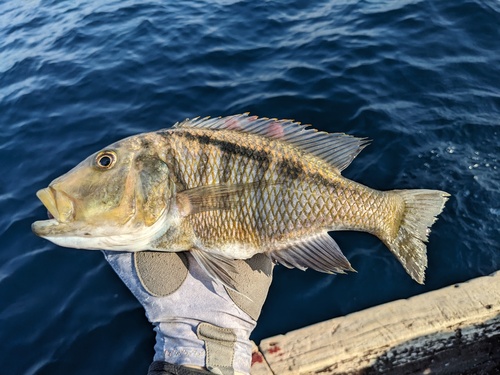
This is a big, tall, broad fish. FishBase and the CLOFFA checklist give a maximum of about 16 in (40 cm) total length, and field references describe individuals to roughly 42 cm standard length; females run somewhat smaller, to around 14 in (35 cm). What sets heterotaenia apart from its more torpedo-shaped relatives, such as B. nototaenia, is bulk: it grows noticeably deeper and wider, so a large adult looks genuinely massive rather than merely long.
Adult males develop a metallic blue head and body crossed by faint vertical bars, with yellow-to-orange flushing in the fins. The dark oblique stripe that gives the species its name runs from near the front of the dorsal fin back to the caudal peduncle; in a fully colored, displaying male it can fade out of view, but it remains visible on females and subadults. Females and non-displaying fish are a more subdued brown-gray, with both the diagonal stripe and the vertical barring retained. Subadults show the striped pattern clearly, which is part of why this species is so often confused with congeners and with similarly patterned large haps.
Range & habitat
Buccochromis heterotaenia is endemic to Lake Malawi and is distributed throughout it, with records spanning the Malawian, Mozambican, and Tanzanian sectors of the lake and a long list of island and reef localities from Boadzulu and the Maleri group to Likoma, Taiwanee Reef, and Tsano Rock. The IUCN puts its estimated extent of occurrence near 49,500 km2, reflecting that lake-wide spread.
It is a fish of rocky and intermediate zones rather than open mud or pure sand, and it is most often seen cruising over sand close to rocky structure where prey shelter. The IUCN assessment specifies deeper rocky areas, and hobby field accounts citing Konings place it largely in the deeper habitat band, roughly 100 to 260 ft (30 to 80 m), which keeps it out of the snorkel-depth zone where most photographed mbuna live. FishBase records the lake's typical surface conditions for the species: a pH of about 7.3 to 8.3 and warm tropical temperatures around 24 to 27 C (75 to 81 F), the hard, alkaline water characteristic of the rift lake.
Ecology & diet
Heterotaenia is a piscivore, and a fairly committed one: FishBase places it at trophic level 4.2, near the top of the lake's fish-eating guild. Its prey is smaller fish, chiefly the abundant smaller cichlids that share its rocky and intermediate habitat. Reports describe it hunting in packs, a behavior shared with several large Malawi predators, where loose groups move together over the substrate and pick off fish flushed from cover. Field accounts note that it is more of an opportunistic stalker than a high-speed open-water chaser, working close to structure rather than running prey down across open water.
As a large, wide-ranging predator that draws on many smaller species rather than specializing on one, heterotaenia sits among the lake's apex cichlids and helps regulate the abundance of the smaller fishes it eats. Its medium resilience and moderate fishing vulnerability, as estimated by FishBase, are typical of a fish of this size and trophic position.
Behavior & breeding
Like the great majority of Lake Malawi cichlids, B. heterotaenia is a maternal mouthbrooder. The IUCN assessment, drawing on Konings and colleagues, describes males constructing a semicircular spawning dish alongside a large boulder, which a male defends and uses to court passing females. After the eggs are fertilized the female takes them into her mouth, and these are notably productive spawns: clutches can easily exceed 500 eggs, large by Malawi-cichlid standards and consistent with the fish's size.
The brooding female carries the developing young for roughly three weeks, not feeding while she does so, and then ascends to shallower water to release the fry, where she continues to guard them and lets them shelter back in her mouth well after they first swim free. Adult males are territorial and dominant, and in confined space only one male can typically be maintained, since rival males will fight until one remains. Keepers consistently report that a harem of one male to several females spreads the male's attention and spares any single female from relentless pursuit.
In the aquarium
This is emphatically not a community fish, and it is not a beginner's project. It reaches well over a foot, is a predator that treats small tankmates as food, and males turn aggressive as they mature, so the honest tank recommendation is a very large aquarium, on the order of 8 ft (about 300 cm) long with substantial depth and volume; hobby sources commonly cite minimums around 200 US gallons (800 L). A footprint with open swimming room over fine sand, with rockwork present but not dominating the layout, suits its natural cruising habit. Water should follow the lake: hard, alkaline, pH roughly 7.5 to 8.5, in the high-70s to low-80s F.
Tankmates must be other large, robust Malawi species that can hold their own; anything small enough to fit the mouth will eventually disappear into it. As with many large haps, keep a single male with multiple females rather than competing males. Encouragingly, keepers find it undemanding at the dinner table, taking prepared foods, frozen mysis and shrimp, and quality pellets readily rather than insisting on live fish. Experienced rift-lake hobbyists also note a broader pattern that applies here: large predatory haps often grow on slowly and only show their full size, color, and temperament after two to four years, and they need patience and the space to mature rather than an early, overcrowded community tank. It is irregularly available in the ornamental trade, usually sold under its scientific name.
Conservation
The IUCN Red List assesses Buccochromis heterotaenia as Least Concern (assessment dated 22 June 2018, published in the amended 2019 version by Konings, Kazembe, Makocho and Mailosi). The reasoning is straightforward: the species is endemic to Lake Malawi but distributed throughout it, so although localized declines have been reported, they are not thought to extend to the lake-wide population. Its population trend is listed as unknown. Direct pressure on the species is modest and mostly from fishing: it is caught as food (juveniles in beach seines, adults by hook and line, gill net, or trawl), is locally known as Mbowe and sometimes targeted by line fishermen, and is only irregularly collected for the aquarium trade. It occurs within the Lake Malawi National Park, and the assessors recommend monitoring its population trend.
That reassuring species-level verdict sits inside a lake under real strain. The basin review by Chavula et al. (2023, Journal of Great Lakes Research 49(6):102241) catalogs the pressures on Lake Malawi/Niassa/Nyasa, which holds an estimated 800 to 1,000 mostly endemic fish species: over-fishing and declining fishery health, heavy sediment and nutrient loading from deforested and cultivated catchments, the effects of climate change and variability, and the risk posed by invasive species. Warming of the shallow water column, on the order of +0.7 C, strengthens stratification and tends to cut the mixing that drives productivity. For a deeper-water, rocky-zone predator like heterotaenia, the most relevant of these are the slow squeeze on lake productivity that supports its prey base, sedimentation that degrades the rocky and intermediate habitat it depends on, and the general intensification of the fishery. So the honest framing is this: the fish itself is currently secure across the lake, but the lake it cannot leave is not, and its long-term status is tied to how those basin-scale pressures are managed.
Sources
- Catalog of Fishes (Eschmeyer) — Haplochromis heterotaenia / valid as Buccochromis heterotaenia
- FishBase — Buccochromis heterotaenia summary
- iNaturalist — Buccochromis heterotaenia taxon page
- Trewavas, E. (1935). A Synopsis of the Cichlid Fishes of Lake Nyasa. Ann. Mag. Nat. Hist. 16(91):65-118
- Chavula et al. (2023). Lake Malawi/Niassa/Nyasa basin: Status, challenges, and research needs. J. Great Lakes Res. 49(6):102241
- IUCN Red List — Buccochromis heterotaenia (Least Concern, amended 2019 of 2018 assessment)
- Cichlid Room Companion — Buccochromis heterotaenia (public profile)
- Cichlid Room Companion — genus Buccochromis (public profile)
- malawi.si — Buccochromis heterotaenia 'Ndomo Point'
- AquaInfo — Buccochromis heterotaenia (cites Konings, Malawi Cichlids in their Natural Habitat)
- MonsterFishKeepers.com — Large Predatory Haps? (community thread on large Malawi predators) — community/anecdotal