
Taxonomy & naming
George Albert Boulenger described this fish in 1908 as Paratilapia rhoadesii, working from specimens taken in Lake Malawi (then Lake Nyasa). It was later transferred to the genus Buccochromis, erected by Eccles and Trewavas in their 1989 revision of the Malawian haplochromine cichlids; the current combination, Buccochromis rhoadesii (Boulenger, 1908), is accepted by Eschmeyer's Catalog of Fishes, FishBase and the IUCN. The genus name blends the Latin bucca, "mouth" or a mouthful of food, with the Greek chromis, an old name for a perch-like fish — a nod to the large, prey-engulfing jaws shared across the genus. The species epithet honors Captain Edmund L. Rhoades, commander of the British anti-slavery gunboat Gwendolen on the lake.
The nomenclatural history is tangled in a way worth flagging: Boulenger's original syntype series was later split, with one specimen referred to Buccochromis lepturus and the other treated as the name-bearing type of rhoadesii, eventually fixed as a lectotype by Eschmeyer in 1998. As a result, B. rhoadesii has historically been confused with B. lepturus (Regan, 1922), and the two are still occasionally conflated in the hobby. Buccochromis sits within the subfamily Pseudocrenilabrinae and belongs to the vast Lake Malawi haplochromine flock — the "haps" of aquarium shorthand — a group of several hundred closely related, recently evolved species.
Appearance
This is an elongate, fusiform predator built for cruising rather than ambush. Maximum reported size varies by source: FishBase lists 34.1 cm (about 13.4 in) total length, and a popular hobby care profile gives a similar 33–35 cm (13–14 in), while field-based accounts from specialists report mature males approaching 14 in (around 35 cm), with females somewhat smaller. The honest summary is that a large male is roughly a foot to fourteen inches long — a substantial fish.
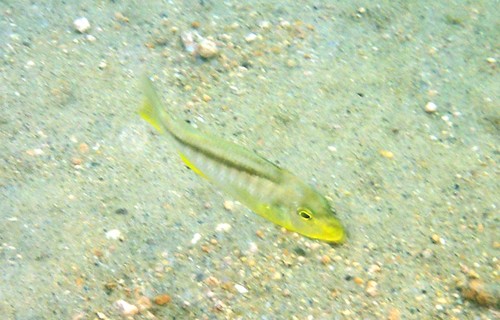
Coloration is the source of the trade name. Subadults are typically yellow and comparatively deep-bodied, and a dark stripe runs along the lateral line; these traits, together with a snout that is longer than that of the similar B. lepturus, are the practical features used to separate the two species. Like most haplochromines, the fish is sexually dimorphic: dominant, sexually active males develop the brighter, more saturated colors, while females and non-territorial males stay plainer. Because color intensifies with maturity and social rank, the most reliable identification comes from fully grown individuals rather than juveniles, which can be hard to tell apart from related sand-dwelling predators.
Range & habitat
Buccochromis rhoadesii is a lacustrine endemic of the Lake Malawi system. It is widely distributed throughout Lake Malawi itself and extends into Lake Malombe and the upper Shire River, the lake's outflow; because Malawi's shoreline is shared, its range spans the waters of Malawi, Mozambique and Tanzania. Estimates from the IUCN assessment put its area of occupancy near 3,150 km² within an extent of occurrence of about 30,050 km².
Unlike the rock-dwelling mbuna, this is a fish of soft bottoms and open water. It is regularly found over muddy substrates in shallow, sheltered bays and over sandy areas off beaches, and small groups of adults are reported from depths of roughly 15 to 30 m (about 50 to 100 ft). Juveniles occupy very shallow sandy shores in large numbers, where they are routinely swept up in beach seines. In-situ conditions across this habitat band are the typical Malawi profile — hard, alkaline water around pH 7.4–8.4 with a temperature of roughly 23–27 °C (73–81 °F) — reflecting the lake's mineral-rich, well-buffered chemistry.
Ecology & diet
B. rhoadesii is a piscivore — a fish-eating specialist — and sits high in the lake's food web, with FishBase estimating a trophic level of about 4.2. It hunts smaller fishes across the sand and mud flats and the open water above them, using its size, speed and large mouth to overtake and engulf prey rather than to crop algae or sift sediment as many of its neighbors do. Juveniles, concentrated in the shallow sandy nursery zones, presumably take smaller invertebrate and fish prey before graduating to the adult diet.
In a lake whose cichlid radiation is famous for fine-grained trophic partitioning — scale-eaters, snail-crushers, plankton-pickers, sand-sifters — the open-water predators like Buccochromis occupy the role of mobile, cruising hunters that crop the abundance of smaller haplochromines and other prey fish. That position makes them part of the lake's predatory pressure on the very species flock they belong to, a feedback that researchers have long invoked when explaining why so many Malawi cichlids are cryptically colored or tied to sheltering rock.
Behavior & breeding
Outside of breeding, B. rhoadesii is largely a solitary cruiser, though it is also reported in loose aggregations; where small groups form, there is typically only a single sexually active male among them. Like the great majority of Lake Malawi haplochromines, it is a maternal mouthbrooder. The female takes the fertilized eggs into her mouth and incubates the clutch there, sheltering the developing young through the vulnerable early stages — a strategy that trades high fecundity for the survival of comparatively few, well-protected offspring.
The spawning ritual is the most distinctive part of its natural history. A breeding male constructs a large bower — a heap of sand about 60–70 cm (24–28 in) high with a slanted spawning surface and, notably, no raised rim around the spawning area, which helps distinguish its constructions from those of some other bower-building cichlids. The male defends and displays at this sand castle to attract passing females; courtship, egg-laying and immediate fertilization happen on the slanted face before the female collects the eggs. The IUCN-listed generation length of about three years is consistent with a medium-resilience fish that matures and turns over fairly quickly for its size.
In the aquarium
This is not a community fish for a small tank. It is offered in the hobby — irregularly, as it is rarely imported in quantity — usually under the name "Yellow Lepturus" (and sometimes the old label "Haplochromis lepturus"). Given its adult length and constant, cruising nature, the consistent advice from experienced keepers is a long tank: a six-foot footprint is treated as a sensible minimum for a male with several females, and the often-quoted ~125–130 gallon (around 500 L) figure should be read as a floor, not a target. Standard Malawi parameters apply — hard, alkaline water around pH 7.5–8.5 and roughly 24–27 °C (75–81 °F), with strong filtration and open sand for swimming.
Temperament reports converge on "peaceful for a predator." Toward other species of similar size it is generally easygoing; the main friction is male-on-male, usually limited to chasing rather than serious damage. The genuine pitfall is its mouth: this is an obligate fish-eater, and anything small enough to be swallowed will eventually be treated as food, so it must not be combined with small tankmates or dither fish. Feed protein-rich foods, but avoid the common error of overfeeding a big, greedy predator in a closed system. In short, it is a rewarding fish for an aquarist with the space and the discipline to match it with appropriately large companions — not a beginner's cichlid.
Conservation
On the IUCN Red List, Buccochromis rhoadesii is assessed as Least Concern (assessment dated 22 June 2018, published 2019, later amended to add distribution data), on the grounds that it is endemic to Lakes Malawi and Malombe but widespread, with only local declines that are not believed to extend to the lake-wide population; the population trend is recorded as unknown. The threats the assessment names are direct fishing pressure — subsistence beach seines and demersal (bottom) trawling, particularly in the heavily worked southern part of the lake — plus irregular collection for the ornamental trade. It does at least occur within Lake Malawi National Park, and the assessors recommend monitoring its population trend.
That "Least Concern" label should be read against the strain on the lake itself rather than as an all-clear. The 2023 basin review by Chavula and colleagues in the Journal of Great Lakes Research documents a system under compounding pressure: over-fishing that has driven the collapse of the prized chambo (Oreochromis) fishery; heavy sediment and nutrient loading washing off deforested catchments; roughly 0.7 °C of warming in the shallow waters, which strengthens stratification and tends to suppress the nutrient upwelling that feeds the lake's productivity; and a growing risk from invasive species. For an open-water predator that depends on a healthy base of smaller prey fish and that spawns and rears its young over the very sandy, shallow bays where seines operate and sediment settles, those basin-scale problems matter. The trawl-and-seine fishery that targets the southern lake removes both this species and the prey it eats, and shoreline sedimentation degrades its breeding and nursery grounds. The species itself is not currently threatened; the water body it depends on is under real and increasing stress, and that is the honest framing.
Sources
- Eschmeyer's Catalog of Fishes — Buccochromis rhoadesii (CAS)
- FishBase — Buccochromis rhoadesii summary
- IUCN Red List — Buccochromis rhoadesii (Konings et al. 2019, amended 2018 assessment)
- Chavula et al. 2023 — Lake Malawi/Niassa/Nyasa basin: Status, challenges, and research needs, J. Great Lakes Research 49(6):102241
- Chavula et al. 2023 — bibliographic record & reference list (OUCI)
- Cichlid Fish Forum — Buccochromis rhoadesii from Lake Malawi (species profile, photo by Ad Konings) — community/anecdotal
- Aqua-Fish.net — Yellow lepturus cichlid (Buccochromis rhoadesii) care profile
- Fishipedia — Buccochromis rhoadesii fish sheet
- Monster Fish Keepers — Buccochromis species discussion thread — community/anecdotal
- Imperial Tropicals — Buccochromis rhoadesii (Yellow Lepturus) predator hap
- GBIF — Buccochromis rhoadesii (Boulenger, 1908) occurrence & taxonomy
- Original description: Boulenger, G.A. 1908 (as Paratilapia rhoadesii), Ann. Mag. Nat. Hist. (8) 2(9):239 — CoF reference 575
- Eschmeyer's Catalog of Fishes — genus Buccochromis (Eccles & Trewavas, 1989)
- Cichlid Fish Forum — Lake Malawi species library (Buccochromis genus profiles, incl. rhoadesii) — community/anecdotal
- IUCN — Sayer, Palmer-Newton & Darwall 2019, Conservation priorities for freshwater biodiversity in the Lake Malawi/Nyasa/Niassa catchment