
Taxonomy & naming
The species was described in 1898 by the Belgian-British ichthyologist George Albert Boulenger, originally as Paratilapia macrops, from syntypes collected at Kinyamkolo (now Mpulungu) and Mbity Rocks at the Zambian foot of Lake Tanganyika. Maréchal and Poll moved it to the genus Callochromis in their 1991 CLOFFA treatment, and that combination — Callochromis macrops (Boulenger, 1898) — is the valid name recognized today by Eschmeyer's Catalog of Fishes and FishBase. A scatter of names from the early twentieth century, including Pelmatochromis xenotilapiaformis Borodin, 1931 and Tylochromis macrophthalmus David, 1936, are now treated as synonyms.
The genus name blends the Greek kalos or kallos, "beautiful," with chromis, an old word for a perch-like fish; the epithet macrops means "large-eyed," the feature that gives the trade name big-eyed mouthbrooder. Callochromis sits in the tribe Ectodini, the radiation of sand- and intermediate-zone cichlids that also includes Xenotilapia, Enantiopus, Ectodus, Aulonocranus and Cyathopharynx. Within the lake the species is highly variable, and aquarists track a string of geographic color forms — "Ndole Bay" (the well-known red macrops), "Moliro" and "Kasanga" among them. A closely related northern form, C. melanostigma, was once treated as a subspecies of macrops but is now considered a distinct species, which is part of why the two are reported from different ends of the lake.
Appearance
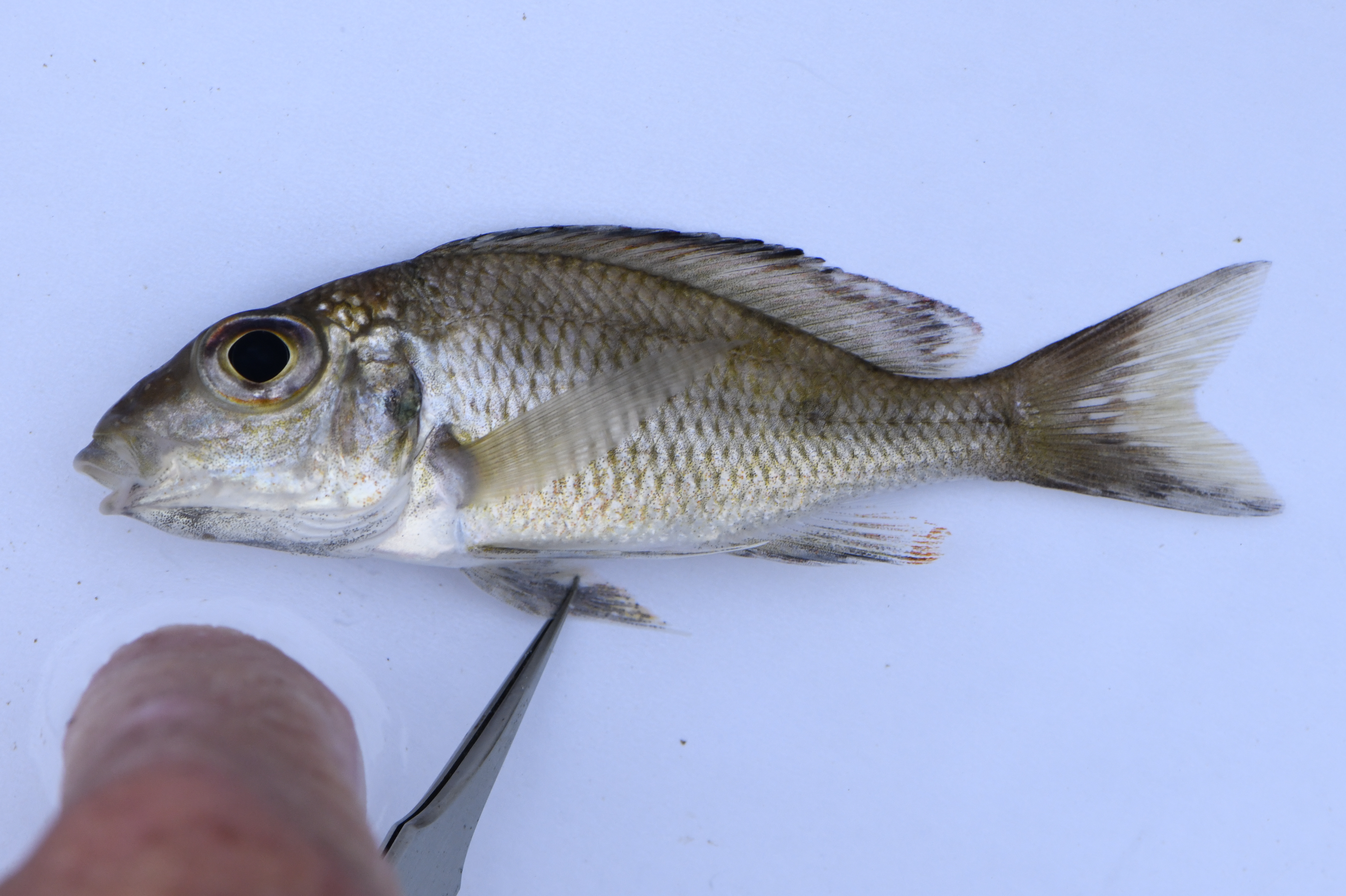
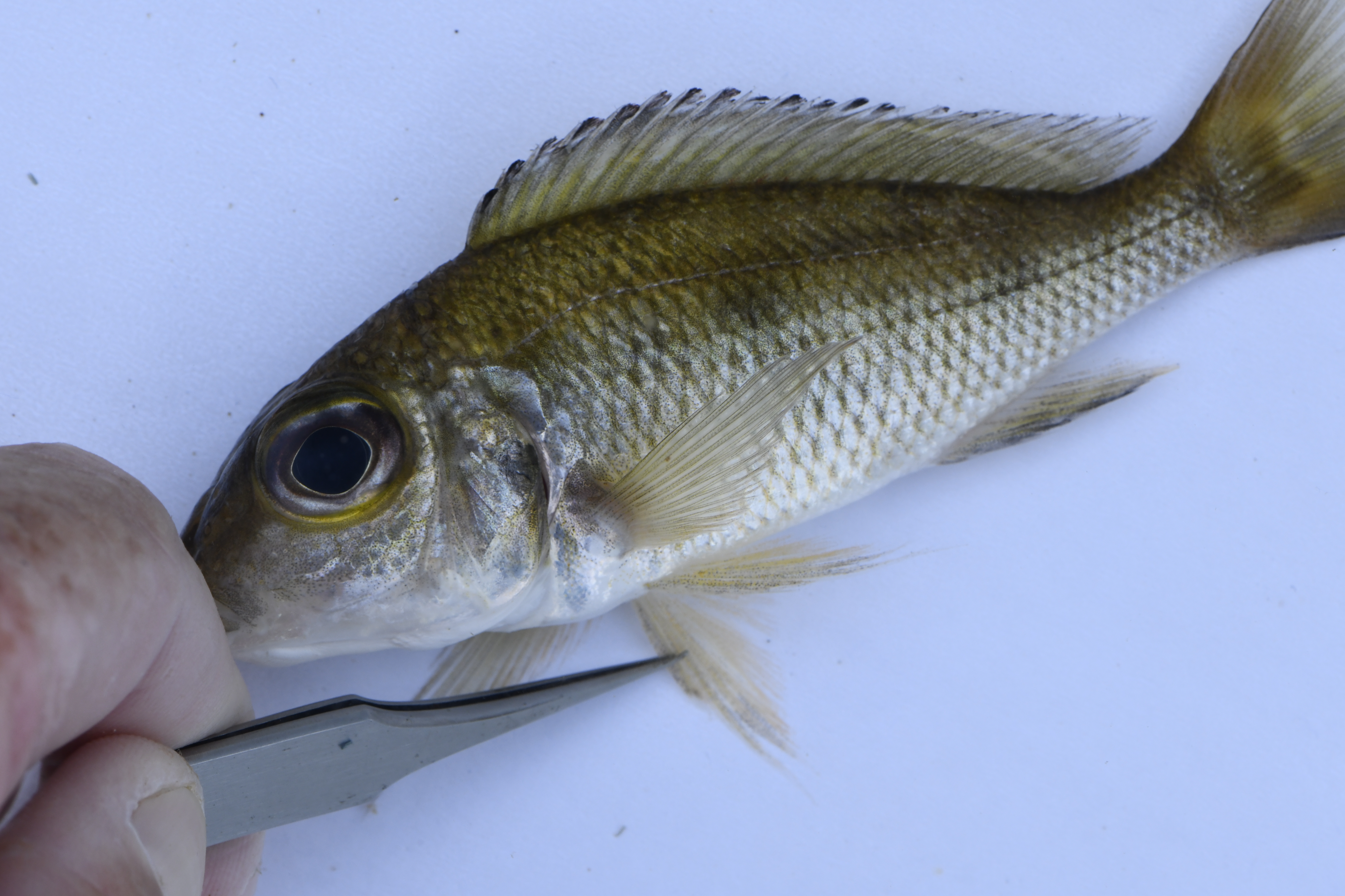
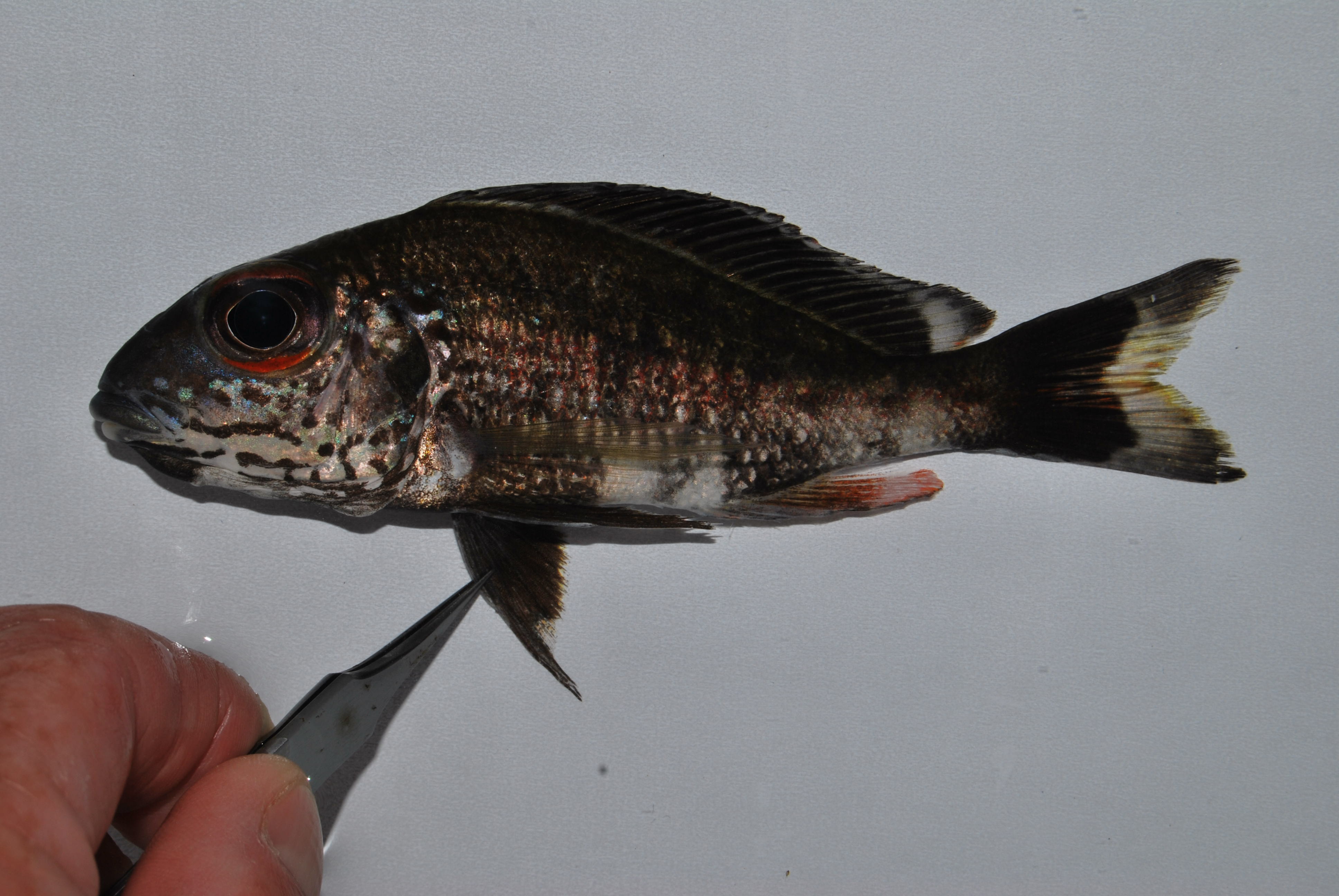
This is a streamlined, sandy-toned cichlid with a large eye and a downturned, sand-probing mouth. Maximum size is one of the few points where reliable sources genuinely disagree: FishBase lists 5.3 in (13.5 cm) total length, citing the CLOFFA checklist, while the most recent IUCN assessment and Konings's field work give a maximum closer to 6.3 in (16 cm) TL. The likeliest explanation is sexual size difference layered on top of geographic variation — specialist sources describe males reaching roughly 6 in (16 cm) with females markedly smaller, often topping out near 3.5 in (9 cm).
Sexual dimorphism is strong and makes the fish easy to sex. Females and non-breeding males are an unassuming silvery-fawn, well camouflaged against pale sand. A dominant, displaying male is a different animal entirely: depending on the population he flushes into metallic blues, greens and — in the famous Ndole/Nkamba forms — deep reds and oranges across the flanks and fins, with the capacity to switch that color on and off in seconds as his mood and status shift. Males also carry orange-to-red markings on the anal fin that figure in courtship. The geographic forms differ enough in color that experienced keepers treat them as separate lines and do not mix them.
Range & habitat
Callochromis macrops is a lacustrine endemic — it lives nowhere on Earth but Lake Tanganyika — and within the lake it is widespread, recorded from the shores of southern DR Congo, Zambia, Tanzania and Burundi, essentially all the way around except the extreme north (north of Nyanza-Lac in Burundi and Cape Karamba in the DRC). It also pushes into the delta of the Malagarasi River. This broad distribution, and the many color forms along it, are typical of a fish tied to a habitat that recurs in patches around the whole shoreline.
That habitat is the shallow sand. The species favors open, sandy bottoms close to rocks it can use for cover, often in sheltered bays and near river outlets — depths of roughly 3 to 20 ft (about 1 to 6 m). Tellingly, it tends to occupy water that is murkier than most of the lake, rich in suspended sediment, where beds of aquatic plants such as Vallisneria spiralis, Ceratophyllum demersum and Hydrilla can take hold. Tanganyika's open water is famously clear, hard and alkaline; in the macrops's preferred bays the chemistry is the same — warm (about 75–81 °F / 24–27 °C), pH on the high side of 8 — but the visibility is not, which is part of what sets this fish's niche apart from the lake's clear-water sand dwellers.
Ecology & diet
Functionally, Callochromis is one of Tanganyika's "sand sifters." It feeds much as the South American eartheaters (Geophagus) do: it takes a mouthful of sand, sorts it inside the mouth and over the gill rakers, ejects the clean grains through the gill covers, and swallows whatever edible material is left behind. The catch is small bottom-dwelling invertebrates — insect larvae, ostracods and other micro-crustaceans, and small molluscs hidden in the substrate — making the fish a benthic invertebrate predator rather than an algae grazer. FishBase places it around trophic level 3.5, squarely in the carnivore range, and the IUCN assessment describes the same varied bottom diet of molluscs, ostracods and insect larvae.
In the community of the sandy littoral, macrops shares the bottom with other Ectodini such as Xenotilapia and Enantiopus and with eartheating relatives like Aulonocranus dewindti, which occupy overlapping intermediate habitats. That overlap matters: these species partition the same sand resource, and the macrops is among the more assertive of them in claiming feeding and breeding space. It is, in turn, a small fish in a lake full of larger piscivores, and it is taken in inshore fisheries as well, so it sits in the middle of the food web rather than at the top.
Behavior & breeding
The headline behavior is the breeding system. Callochromis macrops is a maternal mouthbrooder with a lekking, bower-building courtship. A mature male clears and builds a large sand structure — a volcano- or turret-shaped mound that can stand 8–12 in (20–30 cm) high and a foot or more across, often piled against a rock — and in the wild these bowers are spaced a couple of meters apart across the sand, each defended by its owner. Spawning happens on the mound: the female lays, then immediately takes the eggs into her mouth, and fertilization is completed orally. The male's folded anal fin, with its orange-red blotch, presents a three-dimensional egg-dummy; the female, moving to gather what she reads as stray eggs, brings her mouth to the male's vent, where his milt fertilizes the clutch she is already carrying. (Egg-dummies of this kind are the textbook feature of Lake Malawi haplochromines and are uncommon among the Ectodini, which makes their prominent role in this species notable rather than typical.) The female then broods a clutch usually given as about 25 to 60 eggs for roughly three weeks, not feeding while she carries, before releasing free-swimming fry.
Socially, the species is gregarious in nature — it occurs in loose schools and aggregations over the sand — but the males are fiercely territorial, and intraspecific aggression, especially male-to-male, is intense. FishBase records the schooling habit and the maternal mouthbrooding; specialist sources are blunt that this is one of the most aggressive sand-dwelling cichlids in the lake. Aggression toward other species is comparatively more moderate, but two males with too little space between their bowers is a recipe for trouble.
In the aquarium
This is a striking but demanding aquarium fish, and the honest framing is that its beauty comes with a temper. The non-negotiable is a deep bed of fine sand and a large open floor: macrops is an obligate sand-sifter and a bower-builder, and a male will shovel a surprising volume of substrate, so 2–3 in (5–8 cm) of sand and an uncluttered footprint matter more than elaborate rockwork. Provide a few rock piles in the corners or at one end as refuges for harried females, plus optional clumps of Vallisneria or Ceratophyllum true to the wild biotope, but keep the center open. Water should track the lake: hard, alkaline (pH roughly 8–9), warm (mid-to-high 70s °F), and kept clean with generous water changes.
Stocking is where keepers most often go wrong. Specialist guidance and forum consensus agree on a harem — one male with at least three or four females — to spread the male's relentless courtship and aggression so no single female is bullied to death. In a tank under about 6 ft (180 cm) of length, keep only one male; multiple males demand a much larger floor with rock-broken sightlines to establish separate territories. Aquarium-size recommendations run from a 4-ft, ~55–65 gal (about 240 L) tank for a single harem upward, with more space needed for any multi-male setup. Do not house it with shell-dwellers or other sand-sifters, which compete directly for the same bottom; better tankmates occupy different strata — open-water Cyprichromis above, or robust rock-dwellers like Altolamprologus in a big tank. One useful reality check from keepers: individual temperament varies, and a lone, sub-dominant macrops in a busy community can actually behave as one of the shyest fish in the tank — the ferocity is overwhelmingly a story about breeding males with bowers to defend. The other common error is mixing geographic color forms, which hybridize readily and should be kept apart.
Conservation
Callochromis macrops is assessed by the IUCN Red List as Least Concern, in its most recent assessment (assessed 12 March 2025, published 2025), and that rating is well founded for the species itself: it is endemic to Lake Tanganyika but ranges around almost the whole lake, is common and abundant in inshore fisheries catches, and faces no major lake-wide threat. The assessment does flag two localized pressures — over-fishing in shallow water, chiefly by beach seining, and inshore siltation — and notes that the fish is in the ornamental (aquarium) trade nationally and internationally, though that trade is not identified as a population-level threat. Population trend is listed as unknown, and no part of its range lies in a protected area. The assessors note that the species would benefit from the seasonal fishing ban (trialled May–August and coordinated by the Lake Tanganyika Authority) being maintained as an ongoing measure.
That "Least Concern" verdict sits inside a lake under real strain, and the honest summary is that the species is secure today in a habitat whose trajectory is not. Lake Tanganyika is warming: O'Reilly et al. (2003, Nature, doi:10.1038/nature01833) showed that a warming surface has strengthened stratification and weakened the wind-driven mixing that lifts deep nutrients into the sunlit zone, with sediment-core evidence pointing to roughly a 20% drop in primary productivity and an inferred ~30% decline in fish yields over the twentieth century. Cohen et al. (2016, PNAS, doi:10.1073/pnas.1603237113) tied the same warming to a measurable loss of oxygenated benthic habitat — about 38% in their study areas — alongside declines in fish and mollusc populations. These basin-scale forces fall hardest on the open-water clupeid (Stolothrissa, Limnothrissa) and Lates fishery that feeds four nations, and on the deep benthos, rather than directly on a shallow-sand fish. But the pressures that do bear on macrops are precisely the ones the IUCN names: sedimentation from catchment deforestation and farming smothers and clouds exactly the shallow, already sediment-rich bays it favors, and intensive beach seining works the same nearshore sand it lives over. Set against the four-country governance challenge embodied by the Lake Tanganyika Authority, the realistic read is a locally abundant, unthreatened fish whose shallow littoral home is being degraded faster than its numbers yet show — worth watching, not yet at risk.
Sources
- Eschmeyer's Catalog of Fishes — Callochromis macrops (Boulenger, 1898)
- FishBase — Callochromis macrops summary
- IUCN Red List — Callochromis macrops (e.T60478A47192110, Sibomana 2025)
- GBIF — Fishes of Lake Tanganyika (Callochromis occurrences)
- Seriously Fish — Callochromis macrops (Big-eyed Mouthbrooder)
- tanganyika.si — Callochromis macrops 'Ndole Bay' (Red Macrops)
- Fishipedia — Callochromis macrops 'Mtosi'
- Aquarium Glaser GmbH — Callochromis macrops
- Cichlid Room Companion — Ad Konings author page (Tanganyika cichlids in their natural habitat)
- Morita et al. 2014 — Bower-building behaviour in Tanganyikan cichlids (J. Evolutionary Biology)
- Sefc 2011 — Mating and Parental Care in Lake Tanganyika's Cichlids (Int. J. Evolutionary Biology)
- O'Reilly et al. 2003 — Climate change decreases productivity of Lake Tanganyika (Nature)
- Cohen et al. 2016 — Climate warming reduces fish production and benthic habitat in Lake Tanganyika (PNAS)
- TA-Aquaculture — Rift Lake diets: Lake Tanganyika feeding guilds
- The Cichlid Stage — Observations of a community Tanganyikan tank (keeper account) — community/anecdotal
- Cichlid-Forum — Lake Tanganyika cichlids community discussion — community/anecdotal
- Reddit r/Cichlid — sand substrate for Tanganyikan cichlid tanks — community/anecdotal