

Taxonomy & naming
The species was described in 1906 by George Albert Boulenger, the prolific Belgian-British ichthyologist who named much of Lake Tanganyika's cichlid fauna, originally as Pelmatochromis melanostigma. Maréchal and Poll placed it in the genus Callochromis in their 1991 CLOFFA treatment, and the combination Callochromis melanostigma (Boulenger, 1906) is the name recognized today by Eschmeyer's Catalog of Fishes and FishBase. For much of the twentieth century the fish was not treated as a full species at all but as a subspecies, Callochromis macrops melanostigma — a relationship the modern literature still acknowledges, since the two are very close and most likely the northern fish evolved from a macrops-like ancestor. Eschmeyer's catalog also flags Ectodus descampsii ornatipinnis Borodin, 1936 as a name questionably synonymized here, a reminder that the genus is not fully settled; Konings (2019) noted that Callochromis may need revision.
The genus name pairs the Greek kalos or kallos, "beautiful," with chromis, an old word for a perch-like fish; the epithet melanostigma means "black spot/mark," from the Greek melas (black) and stigma (mark). Within the lake, Callochromis sits in the tribe Ectodini, the radiation of sand- and intermediate-zone cichlids that also includes Xenotilapia, Enantiopus, Ectodus, Aulonocranus and Cyathopharynx. Aquarists track it by collection point — "Burundi," "Nyanza-Lac" and "Lueba" forms appear in the hobby — though the geographic color variation is noticeably less dramatic than in its sister C. macrops. There is no settled English common name; importers sometimes borrow the nickname "parrot" for the male's coloration.
Appearance
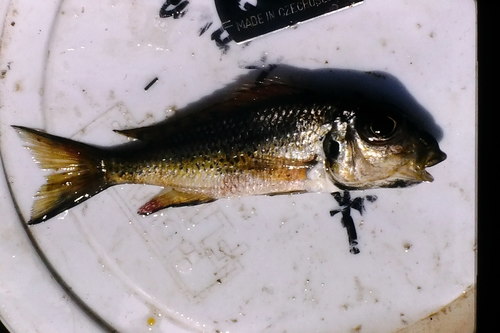
This is a streamlined, large-eyed cichlid with a slightly underslung, sand-probing mouth — the body plan of a fish built to work a soft bottom. Reliable sources converge on a maximum length of about 5.9 in (15 cm) total length, with females staying several centimeters shorter than males; the hobby occasionally cites 16 cm, within the same range. There is little dispute here, which is unusual and welcome.
Sexual dimorphism is pronounced and makes the fish trivial to sex. Females and non-breeding males are an unassuming silvery-grey, well camouflaged against pale sand, and females hold that plain coloration for life. A dominant, displaying male is a different animal: the slender red-and-yellow body carries a blue-black throat, gold "eyebrow" markings above the large eye, and washes of green across the flanks, with red and white edging on the dorsal and red figuring in the anal fin. Keepers who have kept the species describe the male's ability to switch this color on and off in seconds as his mood and status shift. Those anal-fin markings matter biologically as well as aesthetically: they function as egg-dummies during spawning, a feature shared with only a handful of Ectodini.
Range & habitat
Callochromis melanostigma is a lacustrine endemic — it lives nowhere on Earth but Lake Tanganyika — and unlike the lake-wide C. macrops it is confined to the lake's northern basin. Its range runs from Cape Karamba (also rendered Caramba) on the Ubwari Peninsula in the Democratic Republic of the Congo round to Nyanza-Lac in Burundi, taking in localities such as Luhanga, Pemba and Moboko. The 2025 IUCN assessment puts the extent of occurrence at just 4,498 km², a small footprint that is central to the species' conservation status.
The habitat is shallow, sediment-rich sand. The fish favors open sandy or muddy bottoms close to rocks it can use for cover, often in sheltered bays and near river mouths, at depths of roughly 3 to 33 ft (about 1 to 10 m); specialist hobby sources narrow the everyday range to about 1 to 6 m. Tellingly, this is murkier water than most of Tanganyika, rich in suspended sediment, where rooted plants such as Vallisneria spiralis, Ceratophyllum demersum and Hydrilla verticillata can take hold. The lake's open water is famously clear, hard and alkaline; in melanostigma's preferred bays the chemistry is similar — warm, around 75–79 °F (24–26 °C) at the surface, with a high pH — but the visibility is not, and that turbid, vegetated sand is the niche that sets the fish apart.
Ecology & diet
Functionally, Callochromis melanostigma is one of Tanganyika's sand-sifters. It feeds much as the South American eartheaters do: it takes a mouthful of sand and mud, sorts the edible fraction inside the mouth and over the gill rakers, ejects the clean grains, and swallows what remains. The catch is small bottom-dwelling invertebrates — insect larvae, micro-crustaceans such as ostracods, and other meiofauna buried in the substrate — which makes it a benthic invertebrate predator rather than an algae grazer. FishBase places it around trophic level 3.5, squarely carnivorous, and the IUCN account describes the same habit of filtering sediment and mud to feed. Keepers note the same behavior in captivity: the fish is almost constantly working the sand, digging and chewing in search of food.
In the community of the northern sandy littoral, melanostigma shares the bottom with other Ectodini and eartheating relatives that partition the same intermediate habitat. It is a mid-sized fish in a lake full of larger piscivores, and it is taken in inshore artisanal fisheries, so it sits in the middle of the food web rather than at the top — a prey item as well as a predator. FishBase rates its intrinsic fishing vulnerability as low, but, as the conservation picture shows, low vulnerability on paper has not protected a fish with such a small range from local decline.
Behavior & breeding
Socially the species is gregarious, forming loose shoals or "banks" over the open sand, but breeding males are strongly territorial and intraspecific aggression — male against male above all — is intense. The breeding system is the classic Ectodine pattern: Callochromis melanostigma is a maternal mouthbrooder with bower-building courtship. A mature male clears and constructs a volcano- or crater-shaped sand mound, roughly 20–30 cm high and 20–35 cm across, with a spawning platform on top; in the wild these nests are spaced a couple of meters apart across the sand. Spawning happens on the mound: the female lays, immediately takes the eggs into her mouth, and fertilization is completed orally. The male's anal fin carries reddish egg-dummies, and as the female moves to gather what she reads as stray eggs she brings her mouth to the male's vent, where his milt fertilizes the clutch she is already carrying. This egg-dummy mechanism is the textbook feature of Lake Malawi haplochromines and is uncommon among the Ectodini — most bower-building Ectodines lack conspicuous anal-fin spots — which makes its presence here notable. The female then broods a clutch usually given as about 25 to 60 eggs for roughly three weeks at 77–81 °F (25–27 °C), not feeding while she carries, before releasing free-swimming fry.
There is an unsettling wrinkle to all of this. In aggregation, Ectodine bower-builders typically court on leks — clustered arenas of neighboring nests. Konings (2019) reported that lekking has not actually been observed in C. melanostigma in recent years, and suggested the population density may now have fallen too low for males to set up the breeding leks that are the genus's usual strategy. If correct, that is a behavioral symptom of scarcity, not merely a quirk of the species.
In the aquarium
This is a striking but demanding aquarium fish, and the honest framing is that the beauty comes with a serious temper. The non-negotiable is a deep bed of fine sand over a large open floor: melanostigma is an obligate sand-sifter and a bower-builder, and a courting male shovels a surprising volume of substrate, so an uncluttered footprint matters more than elaborate rockwork. Provide rock piles at the ends as refuges for harried females, and clumps of Vallisneria or Ceratophyllum true to the wild biotope, but keep the center open. Water should track the lake: hard, alkaline (pH on the high side of 8), warm (mid-to-high 70s °F), and kept clean with generous water changes. Specialist sources put the realistic minimum at about an 80-gallon (300 L) tank, and that is for a single harem, not a crowd.
Stocking is where keepers most often go wrong, and the forum record is blunt about it. The consensus is a harem — one male with at least three to five or six females — to spread the male's relentless courtship so no single female is bullied to death. Multiple keepers independently describe a dominant male killing tankmates and bunching the survivors into a corner even in six-foot tanks; one reported a male wiping out everyone but a single female in a 72-inch, 135-gallon setup. The lesson is consistent: keep one male unless the tank is genuinely large with broken sightlines, and do not underestimate this fish on the strength of care-sheet language that calls it merely "semi-aggressive." Most of the aggression is species-specific, so suitable tankmates occupy different strata — open-water Cyprichromis above, or robust rock-dwellers like Altolamprologus — rather than other sand-sifters that compete for the same bottom. Encouragingly, the same keepers who battle the aggression also report easy spawning once a settled pair or harem is established.
Conservation
Callochromis melanostigma was assessed by the IUCN Red List as Near Threatened in its most recent evaluation (assessed 12 March 2025, published 2025; criterion B1b(iii,v)), an uplisting from the Least Concern rating it carried in 2006. That change is the heart of its conservation story. The species is endemic to Lake Tanganyika and restricted to the northern basin, with an extent of occurrence of only 4,498 km², and its population trend is listed as decreasing. The assessors — drawing on traditional knowledge from a 2025 fishers' workshop in Morogoro, Tanzania — record that a fish once described as very common is now reported to be becoming increasingly rare, driven by non-selective fishing gear (notably beach seines) working the same shallow sand it breeds over, with sedimentation from agricultural runoff and soil erosion, and capture for the aquarium trade, as additional pressures. The behavioral red flag noted above belongs here too: Konings's suggestion that densities may have dropped below the threshold for males to form breeding leks would, if borne out, compound a fishing-driven decline with a reproductive one. There are no conservation measures in place for the species, and no part of its range lies in a protected area.
Those species-level threats sit inside a lake under broader strain. Lake Tanganyika is warming: O'Reilly et al. (2003, Nature, doi:10.1038/nature01833) showed that a warming surface has strengthened stratification and weakened the wind-driven mixing that lifts deep nutrients into the sunlit zone, with sediment-core evidence pointing to roughly a 20% decline in primary productivity and an inferred ~30% drop in fish yields over the twentieth century. Cohen et al. (2016, PNAS, doi:10.1073/pnas.1603237113) tied the same warming to a measurable loss of oxygenated benthic habitat — about 38% in their study areas — alongside declines in fish and mollusc populations, while shoreline sedimentation continues to degrade the rocky and sandy littoral (Cohen et al. 1993). These basin-scale forces fall hardest on the open-water clupeid (Stolothrissa, Limnothrissa) and Lates fishery that feeds four nations, and on the deep benthos, rather than directly on a shallow-sand fish. But the pressures that bear most directly on melanostigma are local and immediate — intensive beach seining and catchment-driven siltation in exactly the turbid, vegetated northern bays it depends on — and they are unfolding against a four-country governance challenge embodied by the Lake Tanganyika Authority. Unlike its abundant, Least-Concern sister C. macrops, this is a narrow-range fish whose numbers are already slipping, and the honest read is that it warrants real attention now rather than after the fact.
Sources
- Eschmeyer's Catalog of Fishes — Callochromis melanostigma (Boulenger, 1906)
- FishBase — Callochromis melanostigma summary
- IUCN Red List — Callochromis melanostigma (e.T60477A47192044, Mushagalusa 2025; Near Threatened)
- GBIF — Fishes of Lake Tanganyika occurrence dataset (Callochromis records)
- Cichlid Room Companion — Callochromis melanostigma, 'Parrot from Lake Tanganyika' (Anikstein, 2003)
- tanganyika.si — Callochromis melanostigma 'Burundi' (biotope, breeding, care)
- Seriously Fish — Callochromis macrops (sister species; care and Ectodine biology)
- Fishipedia — Callochromis melanostigma species sheet
- Morita et al. 2014 — Bower-building behaviour and sperm competition in Tanganyikan cichlids (J. Evolutionary Biology) — Ectodine egg-spots note
- Oral fertilization and anal-fin egg dummies in mouthbrooding cichlids (review/abstract, ResearchGate)
- Bower size and male reproductive success in a cichlid lek (Tanganyikan Ectodini; open PDF)
- O'Reilly et al. 2003 — Climate change decreases productivity of Lake Tanganyika (Nature)
- Cohen et al. 2016 — Climate warming reduces fish production and benthic habitat in Lake Tanganyika (PNAS)
- Cichlid-Forum — 'Questions about Callochromis species' (keeper reports of male aggression and breeding) — community/anecdotal
- Imperial Tropicals — Callochromis melanostigma (trade availability and notes) — community/anecdotal
- Cichlid-Forum — Lake Tanganyika Species community discussion board — community/anecdotal