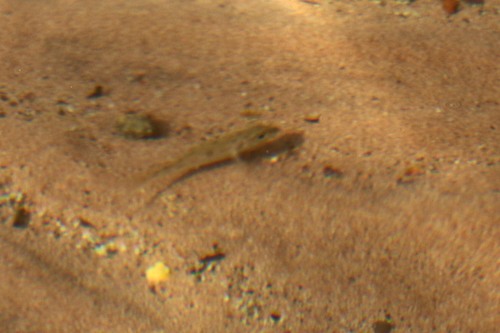


Taxonomy & naming
George Albert Boulenger described this fish in 1906 as Pelmatochromis pleurospilus, working from syntypes collected at Mpala and Tembwi on the Congolese (DRC) coast of Lake Tanganyika; those specimens are held in the Natural History Museum, London (BMNH). It was later moved into the genus Callochromis, where the Catalog of Fishes and FishBase both recognize it today as Callochromis pleurospilus (Boulenger, 1906). The genus name is Greek — kalos, beautiful, joined to chromis, an old name for a perch-like fish — so the binomial reads, loosely, as 'the beautiful cichlid with a flank spot,' pleurospilus meaning side-blotch.
There is one taxonomic wrinkle worth flagging, because it bears directly on the aquarium trade. Callochromis stappersii (Boulenger, 1914) is treated as a junior synonym of C. pleurospilus. The name stappersii was historically misapplied to a Tanzanian population that ichthyologists now regard as a distinct, still-undescribed fish — referred to in Ad Konings's work as Callochromis sp. 'pleurospilus tanzania.' The practical upshot is that much of what reaches hobbyists under the label 'pleurospilus' may not be true C. pleurospilus at all (see Conservation). On the lake, Bantu-speaking fishers know the fish as ililima.
Callochromis belongs to the tribe Ectodini, Tanganyika's radiation of sand- and open-water cichlids — the same lineage that produced the featherfins (Ophthalmotilapia, Cyathopharynx) and the small sand-sifters (Xenotilapia, Enantiopus). Within that flock, Callochromis are the sand-bottom specialists par excellence: built low and streamlined, with a downturned mouth and the burrowing reflex that defines the genus. C. pleurospilus is the smaller, more lightly built member of the group, contrasting with the larger, more pugnacious C. macrops complex it is often compared to.
Appearance
This is a fusiform, gently elongated cichlid — deepest at the start of the dorsal fin, with a nearly straight belly line and a distinctly low-set mouth that betrays its bottom-feeding habits. The jaws carry conical, slightly recurved teeth in inner and outer rows; the dorsal fin runs 12–14 spines and 11–14 soft rays, the anal fin three spines, and there are 30–32 vertebrae. The body scales are ctenoid (comb-edged), and the pelvic fins draw out into fine filaments. None of this makes for a flashy fish at rest: most of the time C. pleurospilus is a plain, pale, silvery animal that disappears against the sand it lives on.
Maximum size is one of the few points where sources genuinely disagree, and it is worth being plain about. FishBase lists a maximum of 10 cm (about 4 inches) total length, citing the CLOFFA check-list. Field-oriented and hobby references run a little higher — Konings-derived material and the locality site tanganyika.si put adults at up to roughly 11 cm (4.3 inches), with dominant males occasionally reaching about 12 cm (4.7 inches). The honest summary is that this is a small cichlid in the 4-to-5-inch range, with males the larger sex.
Sexual dimorphism follows the standard Ectodine pattern. Females stay silvery and understated their whole lives. Males, especially when holding a courting territory, flush with color — a metallic sheen and iridescent flecking across the flanks and fins that you have to see up close, and at the right moment, to appreciate. Compared with the C. macrops complex, C. pleurospilus is the smaller fish and shows a paler, more silvery breeding dress rather than the bolder nuptial colors of its larger relatives. The anal fin of mature males carries egg-shaped markings (egg-spots), a feature that turns out to matter in spawning.
Range & habitat
Callochromis pleurospilus is endemic to Lake Tanganyika — it occurs nowhere else on Earth — and it is distributed around most of the lake's shoreline. The IUCN assessment, following Konings and colleagues (2019), describes it as present all around the lake except along the Tanzanian coast between Kipili and the Mahale Mountains, and notes that it pushes into the delta of the Malagarasi River. FishBase phrases the gap slightly differently, as an absence from the south end of the lake; either way, the fish is best understood as near-lake-wide with a defined break on the eastern shore, and several geographic color forms are recognized across that range.
What the fish is faithful to is the substrate. This is a shallow-water sand specialist, found over sandy and sediment-rich bottoms in inshore waters — typically in sheltered bays and near river mouths, often where suspended sediment keeps the water turbid. Most observations come from shallow depths, frequently within the top few meters (on the order of 3 m / about 10 ft), with deeper records uncommon. That shallow, soft-bottom, coastal niche is central to everything else about the species, including its conservation outlook: it lives in exactly the band of the lake where human activity is most concentrated.
Like all Tanganyikan cichlids, it inhabits hard, alkaline, mineralized water that stays remarkably stable year-round. FishBase gives a pH range of 7.0–8.5, hardness around 10–15 dH, and temperatures of roughly 23–28 degrees Celsius (about 73–82 degrees Fahrenheit) for the species — squarely within the lake's famously constant chemistry. The fish evolved in water that barely shifts from one week to the next, a fact that shapes how it must be kept in captivity.
Ecology & diet
C. pleurospilus makes its living off the lakebed. It forages over sand near rocks, taking a varied menu of small invertebrates collected from and just below the surface of the sediment: small molluscs, ostracods (seed shrimp), insect larvae, fish larvae, and similar small prey. FishBase places its trophic level at about 3.5, marking it as a genuine carnivore rather than a detritus-grazer — a small predator working the interface between sand and water.
Its feeding behavior is tied to its single most distinctive trait. Callochromis are accomplished burrowers, and C. pleurospilus will bury itself in the sand to evade predators, sometimes staying submerged for several minutes before re-emerging. The same low-slung body and downturned mouth that let it dig also let it probe the substrate for food. In the wild the species is reported to form schools, the loose aggregations typical of open-sand cichlids that find safety in numbers over terrain with little cover.
Ecologically, then, this is a mid-level consumer of the soft-bottom community — one of the many small cichlids that convert the lake's benthic invertebrate productivity into fish biomass, and in turn feed the larger predators that patrol the coastal zone. It is common enough to show up in inshore fishery catches, which underscores its role as a real component of the shallow-water food web rather than a rarity.
Behavior & breeding
Outside of breeding, C. pleurospilus is a gregarious open-sand fish, but the males turn territorial and combative when conditions are right. Like the rest of the Ectodini, it is a maternal mouthbrooder, and its courtship is built around the sand itself. A ready male excavates a shallow, volcano-shaped crater in the substrate — roughly 15 cm (6 inches) across — and defends it as a spawning arena; in nature these male territories are spaced a couple of meters apart, the species spreading out into a loose lek of courting males over the sand flats.
Spawning follows the classic egg-spot script. The female lays a clutch on the crater and takes the eggs into her mouth almost immediately; the male's anal-fin egg-spots act as decoys that draw the female to nip at his vent, where she takes up his milt and fertilizes the brood already in her mouth. She then carries and broods the developing young alone — incubation lasting roughly 17 to 20 days (some aquarium accounts say about three weeks) — before releasing free-swimming fry. Reported brood sizes are modest, on the order of 15 to 40 young, consistent with a small-bodied cichlid.
Keepers' lived experience fills in what the literature leaves out, and the recurring theme is male aggression. Independent hobbyists report that males can be brutal toward one another and will harass females hard enough to stress them — 'sunken bellies on the females' is cited as a warning sign that the dominant male is running them ragged. Several keepers also note that the fish breeds readily for a stretch and then tapers off: sand-sifters of this kind are often described as breeding actively for only a couple of years and going through quiet periods, so a single founding group may stop producing after a year or two unless younger fish are coming up behind them. A number of keepers find that a large water change reliably triggers spawning, a common cue for rift-lake cichlids that mimics seasonal change.
In the aquarium
This is a specialist's fish more than a beginner's, and the reasons are behavioral rather than chemical. A fine sand substrate is not optional — it is the whole point. The fish needs sand both to forage naturally and to perform its burrowing escape and its crater-building courtship; on bare glass or gravel it is denied the behaviors that make it worth keeping. Build the tank around an open, deep bed of fine sand with rockwork pushed to the back or sides to create sightline breaks and refuges, leaving the central footprint open.
Footprint, not just volume, is what matters. Specialist references suggest a tank length of at least 100 cm (about 40 inches) and a volume of at least 200 liters (around 50 US gallons) for a group, and experienced keepers lean toward a four-foot tank as a practical minimum, with a six-foot tank if a second male or other open-sand species is in the mix. The standard recommendation is one male with a group of several females (four to six is commonly cited), which spreads his attention and reduces the risk of any single female being harassed to death. Watch the females for thinning bellies; that is the early warning that the male's aggression has tipped from courtship into bullying. Be wary of care-sheet claims that this is an 'easy' community fish — the conspecific aggression is the catch.
Tankmate choice should respect the fact that this is a bottom-and-open-water fish that wants the sand to itself. Keepers report it doing fine alongside fish that use other parts of the tank, and even spawning in mixed Tanganyikan setups, but warn that it will terrorize other open-sand competitors — pairing it with bottom-territorial featherfins such as Cyathopharynx, which defend the same substrate, is a recipe for conflict. Calmer, water-column or rock-dwelling species coexist far better. Keep the water hard, alkaline (pH comfortably above 7.5) and warm and stable to mirror the lake. Feeding is straightforward for a small carnivore: it readily takes frozen and prepared foods such as mysis, cyclops, daphnia, and quality flake or pellet, fed in small amounts across the day. One last honest note for buyers — much of the trade 'pleurospilus' is actually the undescribed Tanzanian fish, so a keeper after the true species should buy on locality and from a knowledgeable source.
Conservation
Callochromis pleurospilus is assessed by the IUCN Red List as Least Concern (Sibomana 2025; assessed 12 March 2025; e.T60476A47191966), the same category it held in the previous 2006 assessment. The reasoning is straightforward: the fish is endemic to Lake Tanganyika but widespread across most of it, common, and 'fairly abundant in inshore fisheries catches,' with no lake-wide decline reported. The population trend is listed as unknown. The one threat the assessors flag specifically is over-fishing in shallow water — particularly beach seining — which can be a localized pressure on a fish that lives precisely where those nets are dragged. There is a useful trade footnote here too: the true species is not thought to be in the ornamental trade, whereas the undescribed Callochromis sp. 'pleurospilus tanzania' that has long been confused with it is regularly exported. So collection pressure for the aquarium hobby largely falls on a different fish than the one named here.
A clean bill of health for the species, though, sits inside a lake under real and accumulating strain, and that wider context is the part a status line alone misses. Two decades of limnology tell a consistent story. O'Reilly and colleagues (2003, Nature) used sediment-core and instrumental records to show that a warming lake has become more strongly stratified, weakening the seasonal mixing that lifts deep nutrients into the sunlit zone; they estimated primary productivity may have fallen by roughly 20 percent, with knock-on declines in fish yield, and argued that climate, not just fishing, was driving the change. Cohen and colleagues (2016, PNAS) extended the picture with paleoecological data, linking sustained warming to reduced fish production and to the loss of benthic (bottom) habitat — on the order of a 38 percent reduction in the suitable habitat available to the lake's bottom-dwelling animals as the oxygenated coastal band narrows. Layered on top of these are sedimentation from deforested, cultivated catchments, which smothers exactly the sand and mud bottoms this species forages and breeds over, and the large commercial pelagic fishery for clupeids (Stolothrissa and Limnothrissa sardines) and their Lates predators, which removes biomass from the open-water system.
For a shallow-water, sand-bottom fish like C. pleurospilus, the most consequential of these pressures hit close to home. Sedimentation and shoreline development degrade the inshore soft-bottom habitat it depends on, beach-seine fishing operates in the same shallow band, and the warming-driven squeeze on the productive coastal zone narrows the very band of the lake where it lives. Because Tanganyika is shared by four nations — Burundi, the DRC, Tanzania, and Zambia — its long-term health hinges on coordinated, basin-scale management of fishing, catchment land use, and climate-driven change, the remit of the four-country Lake Tanganyika Authority rather than any single government. The accurate, unembellished summary is the useful one: C. pleurospilus is not currently threatened, but it is fully exposed to the slow, lake-wide deterioration the science has been documenting for twenty years, and its fortunes will track the coastal zone's.
Sources
- Eschmeyer's Catalog of Fishes — Pelmatochromis pleurospilus / valid as Callochromis pleurospilus (Boulenger, 1906)
- FishBase — Callochromis pleurospilus (Boulenger, 1906)
- GBIF — Callochromis pleurospilus (Boulenger, 1906) (taxon 2369716)
- ITIS — Callochromis pleurospilus report (TSN 649057)
- IUCN Red List — Callochromis pleurospilus (Sibomana, C. 2025; e.T60476A47191966)
- O'Reilly et al. 2003 — Climate change decreases aquatic ecosystem productivity of Lake Tanganyika (Nature; PubMed abstract)
- Cohen et al. 2016 — Climate warming reduces fish production and benthic habitat in Lake Tanganyika (PNAS)
- Phiri et al. 2023 — Lake Tanganyika: Status, challenges, and opportunities for research (J. Great Lakes Research)
- Cichlid Room Companion — Tawil, P. 2012, Species profile: Callochromis pleurospilus (crc10082)
- tanganyika.si — Callochromis pleurospilus 'Resha' (locality account, after Ad Konings)
- AquariumDomain — Callochromis pleurospilus species profile (care & breeding)
- Fishipedia — Callochromis pleurospilus fish sheet
- Cichlid-Forum — 'Callochromis pleurospilus' (breeding/aggression thread, community/anecdotal) — community/anecdotal
- Cichlid-Forum — 'Callochromis pleurospilus tankmates?' (compatibility thread, community/anecdotal) — community/anecdotal
- Cichlid-Forum — 'Callochromis pleurospilus' (mixed-tank breeding report, community/anecdotal) — community/anecdotal