
Taxonomy & naming
Ethelwynn Trewavas described this fish in 1935 as Haplochromis euchilus, from specimens taken at Deep Bay (Chilumba) in the northern reaches of Lake Malawi. The genus name she and David Eccles later coined, Cheilochromis, is built from the Greek cheilos, "lip," and chromis, a generic old name for a perch-like fish — a fitting label for a cichlid whose lips are its signature. Eccles & Trewavas erected the monotypic genus in their 1989 revision of the Malawian haplochromines, and Eschmeyer's Catalog of Fishes today lists the species as valid as Cheilochromis euchilus (Trewavas, 1935).
Nomenclature here is not entirely settled. The IUCN, following Ad Konings' 2016 treatment, places the fish back in the genus Chilotilapia (as Chilotilapia euchilus), and older and trade literature scatters synonyms including Cyrtocara euchila and Pseudohaplochromis euchilus. The hobby almost universally still calls it Cheilochromis, and that is the name carried by the taxonomic authorities, so it is the one used here — with the Chilotilapia placement noted as a live alternative. To importers it travels as "Haplochromis Euchilus," the Malawi thicklip, or simply the big-lipped cichlid. Within the lake's enormous haplochromine flock it belongs to the loose ecological group of roving, invertebrate-hunting "haps" of the open and intermediate zones.
Appearance
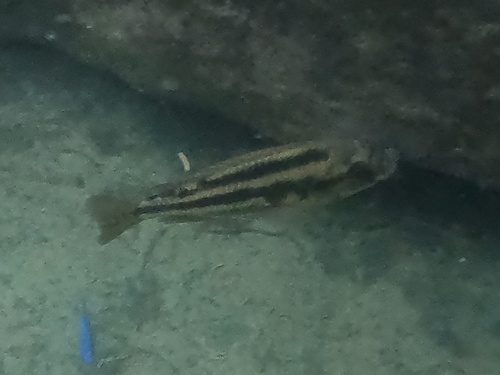
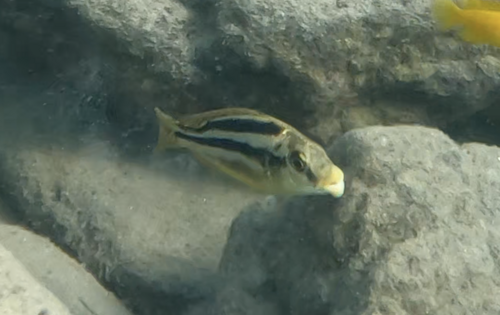
This is a substantial cichlid. FishBase records a maximum of about 14 in (35 cm) total length, with a common length closer to 9 in (22 cm); field references such as malawi.si give males to roughly 10 in (25 cm) and females to about 7.5 in (19 cm). The body is the elongate, gently tapered form of a typical predatory hap, but the head is what catches the eye — the lips are thick, rubbery, and drawn out into soft finger-like projections on both the upper and lower jaw.
Those lips are not fixed. Their development tracks how hard the fish works rock surfaces, so individuals that feed more over sand can show noticeably less lip swelling than rock-feeders. Coloration is strongly mood- and sex-dependent. Most of the time the fish is a plain, pale silver crossed by faint horizontal stripes; a dominant, breeding male transforms into a striking metallic blue with darker bars. That bright dress is genuinely uncommon both in the wild and in tanks — a point on which aquarists repeatedly agree — so a silver, unremarkable adult is the default rather than a sign of a poor specimen.
Range & habitat
Cheilochromis euchilus is endemic to Lake Malawi (also called Lake Niassa or Nyasa), the great rift lake bordered by Malawi, Mozambique, and Tanzania, and it is distributed lake-wide rather than restricted to one shore. It is a fish of the "intermediate" habitat — the transition zone where sand meets scattered rock — and tends to forage over open sand close to rocky structure. It is overwhelmingly a shallow-water animal, usually found no deeper than about 26 ft (8 m).
The water it lives in is hard and alkaline, as it is throughout the lake: FishBase gives a pH of roughly 8.0–8.5, hardness around 10–15 dH, and temperatures of about 75–79 °F (24–26 °C). Because it works rock surfaces in the well-lit nearshore zone, this is a species tied to clear water and clean rock — a detail that matters when the lake's wider condition is considered.
Ecology & diet
The thicklip is an invertebrate hunter, sitting around trophic level 3.2 in FishBase's estimate. Its method is the genus's whole reason for existing: it presses those fleshy lips over a crack or pit in the rock to form a tight seal, then draws out the small crustaceans, insect larvae, and other invertebrates hiding inside. The cushioned lips both improve the seal and, plausibly, buffer the constant abrasion of pushing against rough stone — which is also why the lips grow more pronounced in fish that feed this way most heavily.
FishBase summarizes the diet tersely as "insects," and field-based hobby references describe it more broadly as invertebrates extracted from rock crevices and sand; the two are consistent, differing mainly in resolution. Either way this is a benthic micro-predator rather than a fish-eater, occupying a feeding niche — suction extraction from hard substrate — shared by only a handful of unrelated "thick-lipped" cichlid lineages across the African lakes, a classic case of convergent evolution.
Behavior & breeding
Like the great majority of Lake Malawi cichlids, C. euchilus is a maternal mouthbrooder. After spawning, the female takes the fertilized eggs into her mouth and broods them there; she then hides among the rocks and stays solitary while carrying, giving up feeding for the duration. Unlike many sand-dwelling Malawi haps, breeding males are not reported to build sand bowers — instead, males in color are seen in the rocky parts of the intermediate habitat, where spawning takes place.
In temperament it is best described as moderate. Field and aquarium observers characterize it as a relatively peaceful, even somewhat timid hap that can nonetheless turn sharply aggressive toward very similar-looking species — the usual cichlid pattern of conspecific and look-alike rivalry. Keepers' accounts back this up but with variation: in one well-documented forum exchange, several owners reported males that stayed drab and subordinate for the better part of a year, while another described a male that sat near the top of the pecking order. Individual personality, and whether the fish is housed with overbearing tankmates, clearly shapes how it behaves — treat any single account as one data point, not the rule. Generation length is short, on the order of 2–3 years.
In the aquarium
This is not a fish for a small or casual setup, and the honest framing matters more than the care-sheet optimism that surrounds large "haps." An adult can approach a foot in length and is an active swimmer, so a realistic home is a long tank — field-reference guides suggest a minimum length around 6.5 ft (200 cm) and volume upward of 800 L (about 210 gallons). Aim for fine sand with a few larger rocks and generous open swimming space rather than a wall-to-wall rock pile; that mirrors the intermediate biotope and gives it room to forage.
Water should be hard and alkaline to match the lake — roughly pH 7.8–8.6, with reported keeping temperatures in the high 70s °F. On temperament, plan around two realities keepers consistently report: it is generally peaceful for its size but intolerant of similar-shaped species, and males are slow and reluctant to color up, often staying plain for many months and showing best in a settled group with females rather than a crowded all-male tank. A harem of one male to several females in a species-appropriate, spacious setup is the configuration most associated with seeing both good color and breeding. The most common mistakes are simply housing it too small and expecting instant blue — patience and tank length are the price of admission.
Conservation
The IUCN Red List assesses Cheilochromis euchilus (under the name Chilotilapia euchilus) as Least Concern, last assessed on 22 June 2018 and published in 2019, with a population trend listed as stable. The justification is straightforward: it is widespread lake-wide with no recorded major decline, and it occurs within Lake Malawi National Park. The species-specific pressures the assessors flag are modest — incidental subsistence fishing by hook and line (it is not specifically targeted) and collection for the ornamental trade, where it moves internationally as "Haplochromis Euchilus." So the species itself is not, at present, a conservation concern.
That said, the lake it depends on is under real strain, and a shallow rock-feeding endemic is exposed to several of those pressures. The basin review by Chavula and colleagues (2023, Journal of Great Lakes Research 49(6):102241) documents heavy over-fishing — most visibly the collapse of the commercial chambo (Oreochromis) stocks — alongside rising sediment and nutrient loading washing off deforested catchments, and a warming of roughly 0.7 °C in the shallow water column that strengthens stratification and tends to cut productivity. The review also flags invasive-species risk. For C. euchilus the most relevant of these is sedimentation: a fish that earns its living sucking invertebrates out of clean rock in the well-lit nearshore zone is precisely the kind of specialist that loses out when silt smothers rock surfaces and reduces water clarity. None of that has yet shown up as a measured decline in this species, and overstating the case would be wrong — the accurate statement is that the fish is Least Concern while the lake around it is not in good health, and continued monitoring is what the assessors themselves recommend.
Sources
- Eschmeyer's Catalog of Fishes — Cheilochromis euchilus (species record)
- FishBase — Cheilochromis euchilus (Malawi thick lip)
- GBIF — Cheilochromis euchilus occurrence and taxonomy
- iNaturalist — Malawi Thicklip (Cheilochromis euchilus)
- IRMNG — Cheilochromis Eccles & Trewavas, 1989
- IUCN Red List — Chilotilapia (Cheilochromis) euchilus, Least Concern
- Chavula et al. 2023, Lake Malawi/Niassa/Nyasa basin: Status, challenges, and research needs (J. Great Lakes Res. 49(6):102241)
- Chavula et al. 2023 (ResearchGate copy)
- malawi.si — Cheilochromis euchilus species page (biotope, size, diet, breeding)
- Tropical Freshwater Fish — Big-lipped Cichlid (Cheilochromis euchilus)
- Tropical Fish Hobbyist — Cichlid World (Mar/Apr 2020)
- Ron's Cichlids — Euchilus "Thick Lips" (trade care notes)
- Encyclopedia of Life — Malawi thick lip articles
- U.S. Fish & Wildlife Service — Big-lipped Cichlid (Cheilochromis euchilus)
- Cichlid-Forum — 'Cheilochromis euchilus coloring up in all-male tank?' (keeper accounts) — community/anecdotal
- MonsterFishKeepers — algae/invertebrate-eating fish thread referencing C. euchilus — community/anecdotal
- Reddit r/Cichlid — ID thread identifying Cheilochromis euchilus ('thick lips') — community/anecdotal