Taxonomy & naming
Chindongo bellicosus was formally described in 2016 by Shan Li, Ad Konings and Jay R. Stauffer Jr. in a revision of the Pseudotropheus elongatus species group published in Zootaxa (4168(2):353–381). That paper did more than name one fish: it carved a new genus, Chindongo, out of the sprawling "elongatus" assemblage, and named C. bellicosus as its type species — the anchor that defines the genus. The genus name comes from a Chichewa word for the small rock-dwelling cichlids of the lake, while the species epithet bellicosus is Latin for "warlike" or "fond of war," a direct reference to the fish's pugnacious temperament.
Before it had a Linnaean name, the fish circulated in the hobby and in the survey literature under several provisional labels. Ribbink and colleagues flagged it in their 1983 mbuna survey as Pseudotropheus elongatus 'aggressive' and 'slab', and Konings later used Pseudotropheus sp. 'elongatus aggressive' and 'elongatus slab'. The 2016 revision folded both of those informal forms into the single species C. bellicosus. Chindongo is defined by a tight set of skeletal and dental characters — bicuspid teeth in the front of the outer tooth row on both jaws, a moderately to steeply sloped vomer meeting the parasphenoid at 53–68°, a small mouth with the lower jaw slightly shorter than the upper, and a flank pattern of vertical bars with no horizontal striping at any age. Familiar aquarium fish such as Chindongo demasoni, C. saulosi and C. elongatus were moved into the genus alongside it.
Appearance
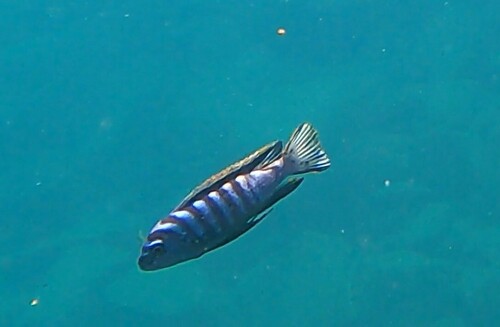
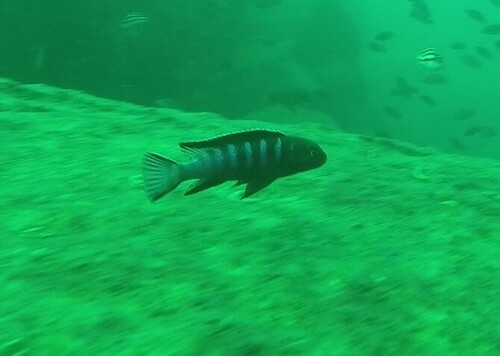
This is an elongate, fairly shallow-bodied mbuna — the old trade name 'elongatus' captured the silhouette well. Body depth runs about 22.8–30.9% of standard length, noticeably slimmer than relatives such as C. saulosi. Dominant males are deep blue along the flank, the color washing back into the caudal fin, with a black cheek and breast; the front half of the body carries several dark vertical bars while the rear half and the caudal peduncle stay clear, an incomplete barring pattern that is one of the species' most useful field marks. Females and subordinate males are far plainer — a beige to bluish ground color, greyer barring, never the male's saturated blue, with shorter fins.
Reports of maximum size differ depending on how the fish is measured. FishBase lists a maximum of 3.7 in (9.3 cm) standard length from the original description, while hobby and field sources commonly cite roughly 4.7 in (12 cm) total length for males in the wild, with females a little smaller near 3.9 in (10 cm); well-fed aquarium specimens can reach 6 in (15 cm) or so. The difference is largely standard length versus total length plus captive growth, not a real disagreement about the animal. Telling C. bellicosus apart from its many congeners rests on color and counts rather than shape: it has 6–8 bars below the dorsal versus four in C. demasoni and five in C. saulosi, and its barring fades on the rear body where C. elongatus stays barred along its whole flank and tail.
Range & habitat
Chindongo bellicosus is a Lake Malawi endemic with a relatively compact range in the southern, southwestern part of the lake. Records run from the eastern tip of Maleri Island across Nakantenga Island and the rocky islands and reefs around the Nankumba Peninsula as far as Monkey Bay, taking in well-known dive and collection sites such as Zimbawe Rock (the type locality), Thumbi West and East, Mumbo, Domwe and Namalenje. Like most mbuna it shows local variation between reefs, which is why aquarium stock is usually tagged with a collection point.
It is an inhabitant of the intermediate and rocky zones in comparatively shallow water, living among boulders and broken rock where aufwuchs — the carpet of algae and the tiny invertebrates living in it — grows thickest. Lake Malawi's rocky shallows are warm, hard and alkaline, generally around 75–82 °F (24–28 °C) with a pH near 7.7–8.6, and that stable, mineral-rich water is the backdrop to everything about how this fish feeds and breeds. Tellingly, several reef populations occur on habitat described as rich in sediment, a detail that matters when considering what threatens the species.
Ecology & diet
Chindongo bellicosus is an aufwuchs grazer. It works the algal turf on rock surfaces, combing and scraping the filamentous strands with its bicuspid teeth — jaws of this design are built to pull loose food from among long algae rather than to rasp rock bare. Its diet is dominated by the diatoms and blue-green algae (cyanobacteria) embedded in that turf; when plankton is available in the water column it will take that too, an opportunism the IUCN assessment notes explicitly. FishBase places its estimated trophic level around 2.5, consistent with a largely herbivorous, low-on-the-food-chain grazer.
That feeding ecology is the engine behind the fish's temperament. An algal garden is a defendable, renewable food patch, and C. bellicosus defends it hard — which is exactly why keepers are warned off feeding it protein-rich foods that its gut is not built to process. In the wider mbuna community it occupies the same grazer guild as dozens of other rock cichlids, partitioned by microhabitat, depth and the fine details of tooth shape and feeding angle that let so many similar species coexist on one reef.
Behavior & breeding
If one trait defines this fish, it is territoriality. Unusually, both males and females hold and defend feeding territories on the rocks, and the aggression is directed not only at conspecifics but at other algae-grazing mbuna competing for the same turf. Observers consistently rank it among the most belligerent of the rock cichlids — the specific name is not an exaggeration.
Reproduction follows the classic Lake Malawi pattern: C. bellicosus is a maternal (ovophile) mouthbrooder with a polygynous, harem-style structure. A territorial male intensifies his blue coloration, spreads his fins and performs quivering lateral displays to lead a ripe female to a spawning site — typically a cave or sheltered spot within his rock territory. The female lays eggs and takes them into her mouth, picking up the male's sperm to fertilize the clutch, then carries the developing eggs and fry for roughly three weeks before releasing free-swimming young. Brooding females retreat into the rockwork, and there is no biparental care: once the fry are released they fend for themselves. In the wild that means most are quickly eaten, which is normal for the strategy and keeps populations in balance.
In the aquarium
C. bellicosus reaches the hobby but is firmly a fish for experienced mbuna keepers, and the reason is its aggression rather than any fragility. Specialist and community sources are unanimous that this is one of the harder-tempered mbuna: a single male will relentlessly harass conspecifics, and because females are territorial too, even same-sex squabbles can turn lethal. The standard advice is a long tank — at least 5 ft (150 cm) and on the order of 130 gallons (about 500 L) — aquascaped with sand and dense rockwork that breaks sightlines and provides many caves and bolt-holes. Keep one male with a group of several females, and only alongside other robust mbuna; mixing it with another blue-barred grazer invites confusion and constant warfare.
Water should mirror the lake: hard, alkaline (pH roughly 7.5–8.5) and warm, around 75–79 °F (24–26 °C). Feed it as the herbivore it is — Spirulina-based flakes and pellets and vegetable matter — and avoid protein-heavy frozen or live foods, which are linked to the bloat that plagues rift-lake grazers. The most common keeper mistakes are predictable: too small a footprint, too few hiding places, the wrong tankmates, and a meat-heavy diet. Get those right and it is a hardy, vividly colored, easily bred fish; get them wrong and it becomes the tank's tyrant.
Conservation
The IUCN Red List assesses Chindongo bellicosus as Least Concern (assessment by Ad Konings, dated 22 June 2018), with a population trend judged stable. The reasoning is straightforward: it is a common resident of rocky shores across a reasonably wide stretch of the southern lake, and essentially its entire range falls within Lake Malawi National Park, a designated protected area. It is not targeted by the ornamental fish trade, so collection pressure on wild stocks is minimal — most aquarium fish are captive-bred. The one threat the assessment singles out is sedimentation from soil erosion, which is notable given that several of this fish's reefs are already described as sediment-rich habitat.
That species-level reassurance sits inside a lake under real strain. The basin review by Chavula and colleagues (Journal of Great Lakes Research 49(6):102241, 2023) documents mounting anthropogenic and climatic stress on Lake Malawi/Niassa/Nyasa: heavy over-fishing and the long decline of the commercially vital chambo (Oreochromis) tilapias; rising sediment and nutrient loads washing off deforested, intensively farmed catchments; and warming of roughly 0.7 °C in the shallow surface waters, which strengthens the lake's stratification, slows the mixing that lifts nutrients into the sunlit zone, and trims overall productivity. For a shallow-water, rock-dwelling aufwuchs grazer like C. bellicosus, sedimentation is the most direct concern — silt smothers the algal turf it grazes and the rock crevices it spawns in, and the species' confinement to a string of southern reefs gives it little room to relocate. The honest summary is this: the fish itself is not currently threatened and enjoys unusually good legal protection, but the rocky-shore habitat it depends on is exposed to pressures that are intensifying lake-wide, so its security is better read as conditional than guaranteed.
Sources
- Chindongo bellicosus — FishBase summary (ID 68971)
- Chindongo bellicosus — FishBase (Stockholm mirror)
- Catalog of Fishes — Chindongo bellicosus (species record)
- Li, S., Konings, A.F. & Stauffer, J.R. 2016. A revision of the Pseudotropheus elongatus species group, with description of a new genus and seven new species. Zootaxa 4168(2):353–381
- Chindongo bellicosus — IUCN Red List (Konings 2018, Least Concern)
- Chavula et al. 2023. Lake Malawi/Niassa/Nyasa basin: Status, challenges, and research needs. J. Great Lakes Research 49(6):102241
- Chindongo bellicosus — malawi.si species & locations pages
- Chindongo bellicosus 'Thumbi East Island' — malawi.si profile (biotope, aggression, breeding)
- Chindongo bellicosus — AquaInfo species profile
- De Angelo, A.R. 2024. "Success with Chindongo bellicosus." Buntbarsche Bulletin 323:6–11 (abstract, Cichlid Room Companion)
- My Mbunas — Chindongo reclassification discussion (Cichlid Fish Forum) — community/anecdotal
- Starting a Chindongo (Pseudotropheus) colony — stocking advice (r/Cichlid) — community/anecdotal