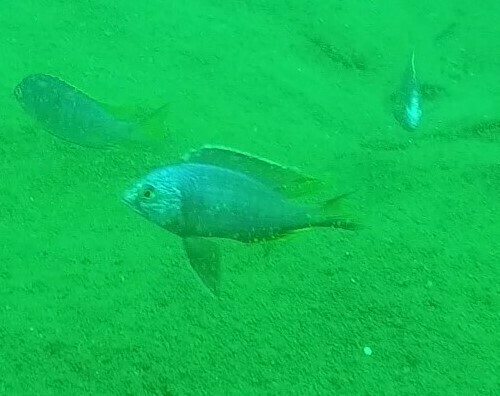
Taxonomy & naming
Copadichromis atripinnis was formally described in 2002 by Jay R. Stauffer Jr. and Tetsu Sato, from specimens collected at the northern tip of Thumbi West Island in the Cape Maclear region of southern Lake Malawi. The holotype — an adult male of 101.9 mm standard length — was taken at 17 to 22 m depth in April 1999. The species epithet is Latin for "black fin," chosen for the solid black pigmentation of the pelvic and anal fins and the broad black bands on the caudal fin of breeding males.
The genus Copadichromis was erected by Eccles and Trewavas in 1989 to gather the sand-dwelling, protrusible-mouthed zooplankton feeders that Malawian fishermen had long lumped under the local name "utaka." By its own describers' admission the genus is almost certainly polyphyletic — an artificial bundle of look-alikes rather than a tidy natural group — and authors including Konings and Stauffer have repeatedly flagged this. C. atripinnis was placed by its describers near a cluster of congeners (C. trewavasae, C. geertsi, C. azureus, C. mbenjii and C. ilesi) whose males, like its own, incorporate a stone into the spawning bower — a behavioral character, not a confirmed phylogeny. The fish reappeared four years later in Stauffer and Konings' 2006 review of the genus. In the hobby it circulates as the "three spot eastern" or "eastern three spot," and was previously sold as Copadichromis sp. 'three spot eastern' before it had a formal name.
Appearance
This is a modestly sized, fusiform cichlid built like the open-water plankton feeder it is. The original description records a maximum of about 103 mm (4 in) standard length; counting the tail, wild males reach roughly 14 cm (5.5 in) total length and females stay smaller, near 12 cm (4.7 in), while well-fed aquarium males are reported to push toward 16 cm (6.3 in). FishBase lists a maximum of 10.3 cm SL, which reflects the type series rather than the largest fish seen.
Non-breeding fish and females are a plain, silvery animal whose most reliable field mark is the trio of dark blotches that gives the trade name its "three spot": one above the pectoral fin (the supra-pectoral spot, which overlaps the upper lateral line), one above the anal fin, and one near the tail base. A breeding male is a different creature — pale powder-blue overall with six or seven faint vertical bars, a blue head, yellow flecking on the flank scales, and the diagnostic black livery: jet-black pelvic fins edged in white, a black anal fin studded with small yellow eggspots and rimmed in bright yellow, and broad black bands along the top and bottom of an otherwise pale-blue, yellow-striped tail. The dorsal fin carries a dark submarginal band and a white margin. These black fins separate it at a glance from most utaka; finer characters — the dorsal-fin base length (56–62% of standard length), the position of that supra-pectoral spot, and gill-raker counts — distinguish it from the handful of congeners it most resembles, such as C. chrysonotus and C. verduyni.
Range & habitat
Copadichromis atripinnis is endemic to Lake Malawi and confined to the southern part of the lake. The 2002 description treated it as a Cape Maclear specialty, but subsequent survey work widened the known range considerably: it is now recorded around the Maleri Islands, at Chidunga Rocks, around essentially all the islands of the Nankumba (Nankhumba) Peninsula — Thumbi West, Domwe, Mumbo, Nankoma — and along the eastern shore from Meponda in Mozambique south to Makanjila Point, including the Luwala and Chimwalani reefs. Locality variants such as a "Chiofu Bay" form and a "Chidunga" type circulate among hobbyists collecting along that eastern coast.
The fish keeps to the intermediate zone — the sand/rock interface — rather than the rock faces favored by mbuna or the truly open water of the pelagic utaka. It is a fish of moderate depth, typically 12 to 25 m, and is rarely found shallower than about 10 m. Like the rest of Lake Malawi's cichlid fauna it lives in hard, alkaline, well-buffered water: the lake sits around pH 7.7–8.6 with relatively high carbonate hardness and warm, thermally stable surface layers year-round. Because it stays below the wave-stirred shallows, this is not a fish of the brightly lit shoreline but of the dimmer, sandier slopes just beyond the reefs.
Ecology & diet
C. atripinnis is a zooplanktivore in the classic utaka mold, with the protrusible, tube-like mouth the whole guild uses to pick individual crustaceans from open water. Foraging fish — chiefly females and subadults — gather in schools that can number more than a hundred individuals and hang two to three meters off the bottom, straining plankton from the water column. FishBase places its trophic level near 3.3, the carnivore-leaning end of the planktivore range.
The diet is not strictly water-column plankton, though. Territorial males, anchored to their bowers near the substrate, also feed off the sand and rocks and take larger prey — sizeable invertebrates and even fish fry. That split — a schooling, midwater female phase and a bottom-tied, more opportunistic male phase — is a recurring theme in the species' biology. As one of many utaka sharing these intermediate slopes, it is a small but genuine link between the lake's plankton production and its larger predators, and historically utaka as a group have been an important food fish for lakeside communities.
Behavior & breeding
Like all Lake Malawi haplochromines, C. atripinnis is a maternal mouthbrooder — the female alone broods and guards the young. It is also a bower-builder, and the bower is the most distinctive thing about its breeding. On sandy slopes near rocky areas, territorial males construct circular-to-oval sand nests with a central depression and a raised rim, spaced roughly 2 to 7 m apart and often packed densely across a slope. Each bower incorporates a stone — usually set at the deeper edge of the sand mound, sometimes a small loose rock entirely inside the bowl, sometimes the exposed edge of a larger boulder. The depression is deepest beside that stone, and spawning happens at the deepest point, with the bowl slanted toward the rock. Measured bowers averaged about 30 by 20 cm across with a mound roughly 10 cm high. This stone-in-the-bower habit is what led the describers to group the species with a particular set of congeners.
Courtship follows the familiar mouthbrooding script: the male displays in intensified breeding color to draw a female down to his bowl, the pair circle, the female lays and immediately takes up her eggs, and the male fertilizes them — his egg-spotted anal fin part of the lure. She then broods the clutch in her mouth for roughly three weeks, eating little, before releasing free-swimming fry; brooding and post-release females gather in small nursery schools near the bottom. Males are territorial at the bower but, by African-cichlid standards, not extreme — the literature and keepers alike describe them as defending a nest against rival males while tolerating multiple females, rather than as relentless aggressors.
In the aquarium
This is a keepable but not beginner-grade utaka, and the honest constraints are space and social structure. A male holds and works a territory, and females naturally live in groups, so a harem of one male to several females (1:2 or 1:3 is the usual Malawi recommendation) wants real floor space — a tank on the order of 150 cm (about 5 ft / ~125 gal) at minimum for a single group, and larger again if you run more than one male. The setup should read as its native intermediate zone: an open sandy bottom for bower-building with scattered rock structure, rather than the rock wall of an mbuna tank. Hard, alkaline water suits it — roughly pH 7.5–8.5, moderate-to-high hardness, and a temperature around 22–26 °C (72–79 °F).
It accepts prepared and frozen foods readily — spirulina-based pellets, mysis, brine shrimp, cyclops and similar — and a varied, plankton-leaning diet keeps both health and male color. As with other utaka, color is the real catch in mixed setups: keepers on cichlid forums consistently report that open-water Copadichromis tend to show full male color only when dominant and given females, and wash out among assertive haps and peacocks in an all-male tank. Tankmates should be comparably sized, peaceful Malawi species — gentler Pseudotropheus, Cynotilapia or Labidochromis, or other mild haps and utaka — and overtly aggressive or hyper-territorial fish are a poor match. The species is uncommon in the trade and usually sold under a collection-locality label (for example "Chiofu Bay"), so most keepers will be buying wild-type or line-bred stock rather than a mass-produced strain.
Conservation
The IUCN Red List assesses Copadichromis atripinnis as Least Concern (assessed 22 June 2018, by Ad Konings), with a population trend judged stable and the species described as common in its intermediate-zone habitat. Notably, this is a downgrade: the 2006 assessment had listed it as Vulnerable, and the broader distribution documented since then — well beyond the original Cape Maclear type locality — is part of why the more recent assessment is sanguine. It occurs within Lake Malawi National Park, which affords its core range some protection. The pressures specific to it are modest: as an utaka it is taken in subsistence fisheries using chirimila (open-water seine) nets, and it is collected irregularly for the ornamental trade, sometimes sold under the misleading label "Haplochromis Azureus." Neither is currently considered a major threat.
That species-level reassurance, however, sits inside a lake under real and growing strain. The basin review by Chavula et al. (2023, Journal of Great Lakes Research 49(6):102241) documents over-fishing — most visibly the collapse of the prized "chambo" (Oreochromis) stocks — alongside heavy sediment and nutrient loading washing off deforested catchments, and warming of roughly 0.7 °C in the shallow water. That warming strengthens the lake's thermal stratification, which suppresses the vertical mixing that lifts nutrients into the sunlit zone and ultimately curbs the plankton production at the base of the food web; invasive-species risk compounds the picture. For a plankton-dependent fish of the moderate-depth slopes, the most relevant of these is the productivity squeeze: a zooplanktivore's fortunes track the plankton supply, and sedimentation off the adjacent shoreline can degrade the sand/rock habitat it spawns on. So the accurate framing is the modest one — C. atripinnis is itself Least Concern and not at present declining, but it lives in a lake whose baseline conditions are shifting in ways that bear directly on the planktivore guild it belongs to.
Sources
- Catalog of Fishes (Eschmeyer, CAS) — Copadichromis atripinnis (species record)
- FishBase — Copadichromis atripinnis summary
- GBIF — Copadichromis atripinnis Stauffer & Sato, 2002 (taxon 2373867)
- Stauffer, J.R. Jr. & Sato, T. 2002. A new species of Copadichromis (Cichlidae) from Thumbi West Island, Lake Malawi. Ichthyological Exploration of Freshwaters 13(1):91–95 (full PDF)
- Abstract of Stauffer & Sato (2002) — original species description
- Stauffer, J.R. Jr. & Konings, A.F. 2006. Review of Copadichromis (Teleostei: Cichlidae) with the description of a new genus and six new species. Ichthyol. Explor. Freshwaters 17(1):9–42 (ResearchGate)
- Chavula, G.M.S. et al. 2023. Lake Malawi/Niassa/Nyasa basin: Status, challenges, and research needs. Journal of Great Lakes Research 49(6):102241 (DOI 10.1016/j.jglr.2023.102241)
- IUCN Red List — Copadichromis atripinnis (Konings 2018), Least Concern; e.T60864A47219176
- AquaInfo — Copadichromis atripinnis (hobby profile, John de Lange)
- malawi.si — Copadichromis atripinnis / sp. 'eastern three spot' (locations & maps)
- Cichlid Room Companion — Copadichromis (genus overview, public page)
- Cichlid Room Companion — reference record for Stauffer & Sato (2002) original description
- Cichlid Fish Forum (cichlid-forum.com) — 'Copadichromis Species' thread (keeper experience, utaka color & temperament) — community/anecdotal