Taxonomy & naming
Thomas D. Iles described this fish in 1960 as Haplochromis borleyi, in a study of the zooplankton-feeding Haplochromis of what was then Lake Nyasa (Annals and Magazine of Natural History). It was later transferred to Copadichromis, the genus erected by Eccles and Trewavas in their 1989 revision of the Malawian haplochromine genera, and that combination is the valid name today (Catalog of Fishes; FishBase). The genus name comes from the Greek kopas, "carved," joined to Chromis; the species epithet honors Sir Henry J. H. Borley, who directed the Game Fish and Tsetse Control Department of colonial Nyasaland.
Copadichromis belongs to the group of Malawi cichlids hobbyists and ichthyologists alike call "utaka" — a Chichewa fisheries term for the shoaling, plankton-eating haplochromines that are netted in open water. The genus is taxonomically thorny: several utaka are subtle variations on a theme, and recent work continues to disentangle them (for example, the 2022 taxonomic study of C. mloto and C. virginalis). In the trade C. borleyi is almost always sold under a collecting locality — "Kadango," "Mbenji," "Nkhata Bay" — and sometimes still under the obsolete names Haplochromis borleyi or "Haplochromis red Kadango."
Appearance
Reported maximum size depends on how you measure and whom you ask. FishBase, following the CLOFFA checklist, gives 14 cm (5.5 in) total length; Seriously Fish puts adult males at up to 8 in (20 cm); and experienced keepers consistently describe males averaging around 7 in (18 cm) with the occasional 9 in (23 cm) individual. The honest summary is that a good male is a substantial fish — roughly 6 to 8 in (15 to 20 cm) — and females run noticeably smaller.
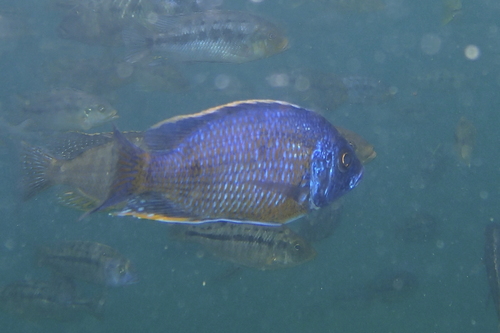
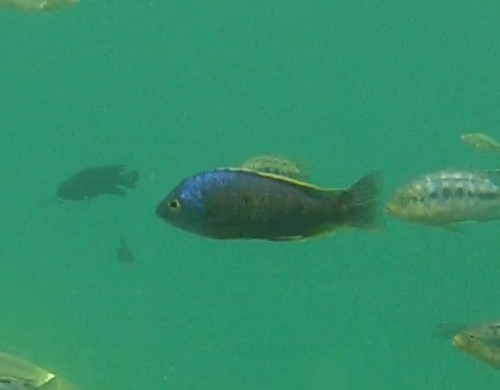
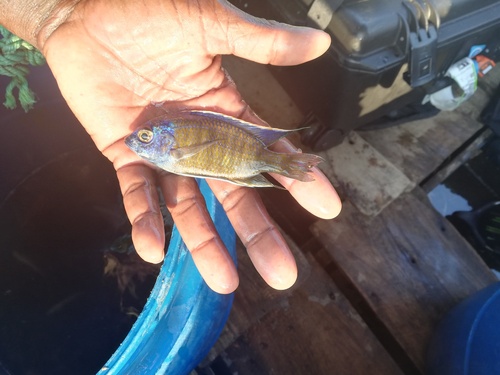
The species is strongly sexually dichromatic. Dominant males develop a metallic blue face and head over flanks that range from deep red through orange to yellow depending on population, with elongated pelvic and dorsal fins; females and juveniles are a plainer silvery-grey with fins tinted red, orange, or nearly clear. Like most Malawi mouthbrooders, males carry egg-shaped ocelli ("egg spots") on the anal fin. The catch for identification is geography: Ad Konings documents at least a dozen distinct male color variants around the lake, which is why the fish is sold by locality. That variability also makes it easy to confuse with congeners such as C. azureus, and color alone is an unreliable guide to identity.
Range & habitat
C. borleyi is endemic to Lake Malawi (also called Lake Nyasa and Lake Niassa), the great rift lake shared by Malawi, Mozambique, and Tanzania. The IUCN describes it as one of the most widespread cichlids in the lake, recorded at nearly every rocky shore except Likoma Island, and Seriously Fish lists collecting sites scattered from Kadango and Nkhata Bay to Mbenji Island and Crocodile Rocks.
It is a fish of the rocky littoral. Individuals associate with large boulders and rocky reefs, typically in fairly shallow water — roughly 5 to 20 m (16 to 65 ft), with the IUCN citing an average around 10 m (33 ft) — while shoals gather in the open water above and around the rocks, often mingling with other utaka. That dual habit, anchored to the reef but feeding into the water column, is the heart of the species' ecology. The water it lives in is hard and alkaline: FishBase gives an in-situ pH of roughly 8.0 to 8.5 and temperatures of about 24 to 26 °C (75 to 79 °F), values typical of Malawi's stable, well-buffered surface layer.
Ecology & diet
This is a specialist zooplanktivore — a plankton picker — and it feeds the way the rest of the utaka do. Facing into the current, it uses large eyes to spot individual copepods and other drifting prey, then fires out a highly protrusible upper jaw while clamping the gill covers shut; the resulting pulse of suction draws the prey item into the extended tube of the mouth (Iles 1960; Seriously Fish). FishBase places it at a trophic level of about 3.4, consistent with a diet built on animal plankton rather than algae or detritus.
Ecologically, the utaka are an important link in Lake Malawi's offshore food web, converting the lake's zooplankton production into fish biomass that supports both predators and people. Because C. borleyi shoals in open water in large numbers, it is one of the species that local fishermen target with chirimila (open-water seine) nets, which makes its ecology and its economics inseparable.
Behavior & breeding
Socially, C. borleyi is a shoaling fish with a lek-like breeding system. Outside of spawning, females and juveniles travel in loose schools through the water column while mature males hold territories down on the rockwork. The IUCN notes that breeding males can be found year-round rather than in a single tight season.
Reproduction is maternal mouthbrooding, the standard Malawi strategy. A territorial male defends a spawning site against a large boulder and displays in intense color to draw females in; spawning usually takes place on the vertical rock face, and sometimes upside-down beneath an overhang, though some males instead clear a shallow bower of sand on top of a boulder (FishBase). The female lays eggs in batches and immediately takes each batch into her mouth; drawn to the egg spots on the male's anal fin, she approaches to collect them and the male releases milt, fertilizing the brood in her mouth. She then broods a clutch of roughly 60 eggs for about three to four weeks, not feeding, before releasing free-swimming fry. The fry are large enough at release to take brine shrimp nauplii straight away.
In the aquarium
C. borleyi is one of the more popular Malawi haps and deservedly so: it is hardy, active, and uses the whole water column. But it is not a small-tank fish. Keepers consistently warn that a standard 75-gallon (48-in / 120-cm) tank is marginal for adults; the practical floor for a group is closer to a 6-ft (180-cm), 125-gallon-plus tank, and Seriously Fish recommends nothing under 60 in (150 cm). It wants open swimming space with a sand substrate and some rock structure for spawning sites.
Its reputation as "peaceful" needs an asterisk. It is peaceful for a Malawi cichlid — it should never be mixed with rowdy mbuna — but breeding males are genuinely hard on females and can harass rival males relentlessly. The standard fix is a harem: one male to three or more females, so no single female is singled out. Several independent keepers describe needing a long tank to absorb a spawning male's behavior, and the same keepers note that a lone male can actually be a calming presence in a community. Avoid keeping it with similarly colored fish, and avoid other Copadichromis or close utaka, which it can hybridize with — a real concern given how many look-alike variants exist. Better company is peaceful haps and Aulonocara (peacocks). Water should be hard and alkaline (pH ~7.5–8.5, roughly 77–84 °F / 25–29 °C per Seriously Fish), and a varied diet that includes some Spirulina or vegetable matter alongside small meaty foods keeps colors strong; despite its wild specialization, it is unfussy at the dinner table in captivity.
Conservation
On the IUCN Red List, C. borleyi is assessed as Least Concern (assessment by Konings, Kazembe, Makocho and Mailosi, published 2018, replacing an earlier 2006 Least Concern listing). It is endemic to Lake Malawi but widespread along the rocky shores, with an estimated area of occupancy of about 1,220 km² and extent of occurrence near 29,600 km², and it occurs inside Lake Malawi National Park. The assessment identifies no major widespread threat; the pressures it does flag are subsistence fishing with chirimila nets — the species is a netted utaka — and steady collection for the ornamental trade, where it is shipped under its scientific name. Population trend is recorded as unknown. In short: the fish itself is not currently in trouble.
The lake around it is another matter, and the species cannot be considered in isolation from it. The basin review by Chavula and colleagues (2023, Journal of Great Lakes Research) frames Lake Malawi/Niassa/Nyasa as a system under severe and increasing stress from human and climatic pressures, with sediment and nutrient loading off deforested catchments, intensifying fishing, climate change, and invasive-species risk identified as the priority concerns. The lake's most famous fisheries collapse — the decline of the chambo (Oreochromis) tilapias to overfishing — shows how quickly a heavily netted Malawi stock can fall, and as a commercially harvested open-water shoaler, C. borleyi sits in exactly the guild that pressure targets. Warming of the shallow water (on the order of +0.7 °C) tends to strengthen the lake's stratification, slowing the mixing that lifts nutrients into the sunlit surface layer and thereby trimming the plankton production that a zooplanktivore like this one ultimately depends on. None of this has yet moved the species off Least Concern, and it would overstate the case to call C. borleyi threatened. The accurate statement is the careful one: a common, resilient fish whose long-term security is tied to the health of a great lake that is, on current evidence, under growing strain.
Sources
- Catalog of Fishes (Eschmeyer) — Copadichromis borleyi
- FishBase — Copadichromis borleyi summary
- FishBase — Copadichromis borleyi reproduction summary
- GBIF — Copadichromis borleyi occurrences
- Iles, T.D. 1960. A group of zooplankton feeders of the genus Haplochromis (Cichlidae) in Lake Nyasa. Annals and Magazine of Natural History (13)2:257–280
- Taxonomic investigation of the zooplanktivorous Lake Malawi cichlids Copadichromis mloto and C. virginalis (2022)
- Chavula, G.M.S. et al. 2023. Lake Malawi/Niassa/Nyasa basin: Status, challenges, and research needs. Journal of Great Lakes Research 49(6):102241
- Seriously Fish — Copadichromis borleyi
- Cichlid Room Companion — Ad Konings author page (Copadichromis borleyi profile reference)
- Cichlid Room Companion — Copadichromis groupings
- Borstein cichlid profiles — Copadichromis borleyi
- IUCN Red List — Copadichromis borleyi (e.T60860A47218899)
- Cichlid-Forum — Copadichromis borleyi Kadango (tank size & aggression thread) — community/anecdotal
- Australian Cichlid Enthusiasts Forums — Copadichromis Borleyi Red Kadango — community/anecdotal
- MonsterFishKeepers — Tank mates for red fin borleyi — community/anecdotal
- Cichlid-Forum — Copadichromis borleyi breeding and identification — community/anecdotal
- Reddit r/Cichlid — Copadichromis borleyi identification discussion — community/anecdotal