
Taxonomy & naming
George Albert Boulenger described this fish in 1908 as Paratilapia chrysonota, and for most of the twentieth century the aquarium and scientific worlds knew it as Haplochromis chrysonotus. It moved to its current genus when David Eccles and Ethelwynn Trewavas erected Copadichromis in their 1989 revision of the Malawi haplochromines (the type species is Haplochromis quadrimaculatus Regan, 1922). The genus name blends the Greek kopas, "carved," with Chromis; the species epithet chrysonotus means "gold-backed," a nod to the bright dorsum that breeding males flush.
Copadichromis is the heart of the utaka, a group of roughly two dozen described plankton-feeding cichlids endemic to Lake Malawi, characterized by shoaling habits, highly protrusible jaws, and maternal mouthbrooding. One naming snarl is worth flagging because it trips up hobbyists constantly: the old combination "Haplochromis chrysonotus" was for years applied in the trade to the brilliant blue fish now called Copadichromis azureus (Konings, 1990). The two are genuinely different species, and much of the "C. chrysonotus" sold or photographed in the hobby is actually C. azureus or a look-alike. When you read about this fish, check which animal the source really means.
Appearance
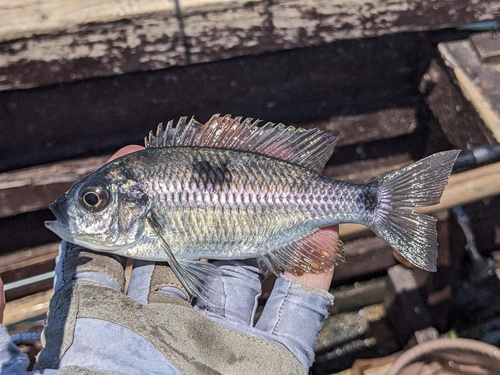
This is a modest-sized, deep-bodied utaka. FishBase lists a maximum of about 6.4 in (16.3 cm) total length, while the IUCN assessment cites 12.5 cm standard length; the discrepancy is mostly the difference between measuring to the tail tip versus the base of the tail, so figure on a fish that tops out in the 5-6 in (13-16 cm) range.
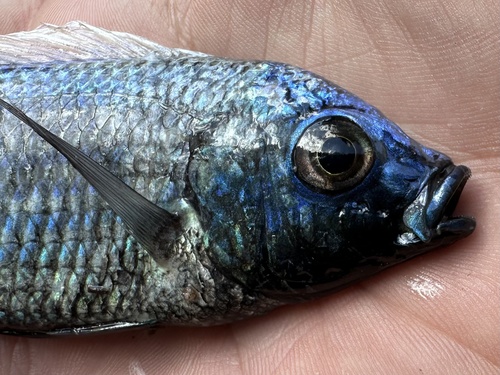
Color is strongly tied to sex and breeding state. Females, juveniles, and non-breeding males are a plain, pale brassy fish marked with three dark blotches along the lateral line, the classic understated utaka look. A male in spawning dress is transformed: iridescent blue washes over the head and flanks while the back and dorsal fin light up in brilliant yellow or white, the "gold back" the species was named for. Because the drab phase is so generic, females and quiescent males are notoriously hard to separate from other Copadichromis on appearance alone, which is exactly why the trade-name confusion with C. azureus persists.
Range & habitat
Copadichromis chrysonotus is a lacustrine endemic, found only in Lake Malawi and the small, shallow Lake Malombe just downstream of it, with records spanning the lake from Karonga in the north to Monkey Bay in the south and across the Malawian, Mozambican, and Tanzanian shores. The IUCN assessment puts its area of occupancy near 3,150 km² and its extent of occurrence around 30,050 km² — widespread, but tethered to near-shore waters.
It is a benthopelagic, inshore fish rather than a true open-lake pelagic. It is most associated with rocky areas but spends much of its time over and above them in the water column, and large schools of breeding males gather near rocks or beneath floating objects such as logs and moored boats; juveniles settle inshore over sand. The water it lives in is hard and alkaline, the signature of the Rift lakes: FishBase gives a pH of about 8.0-8.5, hardness of 10-15 dH, and temperatures of roughly 73-79 °F (23-26 °C) in the inshore band it occupies.
Ecology & diet
Like the rest of the utaka, C. chrysonotus is a zooplanktivore. It feeds in mid-water on the lake's drifting crustacean plankton, using the protrusible, tube-like mouth shared by the genus to pick individual prey out of the water column. FishBase places it at a trophic level of about 3.4, consistent with a small-prey planktivore rather than a piscivore.
That feeding mode makes it part of a hugely important link in Lake Malawi's food web. Utaka convert the lake's plankton production into fish flesh in enormous numbers and are themselves a staple of the inshore fishery and prey for larger predators. Ecologically the species is a shoaling animal of the productive near-shore zone, abundant where plankton is abundant, which is also why it concentrates seasonally and is so easily netted.
Behavior & breeding
The breeding biology is what sets this fish apart, and it is unusually well documented thanks to fieldwork by Lance Smith at Lake Malawi National Park (published in African Zoology, 2000) and an earlier note by Eccles and Lewis (1981) on "midwater spawning." Like virtually all Malawi cichlids, C. chrysonotus is a maternal mouthbrooder — but it is the only littoral Malawi species known to spawn in open water without a substrate-based territory. Males in full breeding color aggregate in sheltered areas at least several meters deep, and each one defends a mobile breeding territory roughly a cubic meter in size near the surface, shifting it as he courts passing females. Spawning, courtship, and egg-taking all happen up in the water column rather than over a bower or rock.
Smith found breeding to be nearly year-round, from August to May, with peaks in August-September and January-March and a clear lull in May-June. Fecundity and fertility rose with female size, and brooding females carried their young to about 15-16 mm before releasing them. Researchers have suggested the open-water strategy may reduce egg predation during spawning and sidestep the competition for substrate territories that crowds the lake bottom. There is also a long-standing observation, going back to Ribbink in 1977, of C. chrysonotus juveniles turning up in the broods of other cichlids — possibly a "cuckoo" behavior, possibly accidental incorporation after the mother abandons them; the question remains unresolved.
In the aquarium
Honestly, this is not a common aquarium fish, and most tank stories filed under "Copadichromis chrysonotus" are about something else (usually the showier C. azureus). The IUCN notes it is only rarely collected for the ornamental trade. If you do keep true C. chrysonotus, treat it as a shoaling, open-water utaka: it wants swimming room, not a maze of caves. A long, wide footprint matters more than height, and a six-foot tank is a sensible floor for a group; keep it in numbers, with several females per male to spread out courtship attention.
Water should mirror the lake — hard, alkaline (pH around 8), and warm. Utaka are generally less belligerent than the rock-dwelling mbuna, but breeding-dressed males defend space and a single male can harass tankmates, so the species suits a spacious haplochromine/utaka community rather than a crammed mbuna tank. The most common mistake is simpler than any care parameter: buying the fish on its label. Confirm the identification before you build a breeding project around it, and assume drab individuals could be a different Copadichromis until a male colors up.
Conservation
Copadichromis chrysonotus is assessed by the IUCN Red List as Least Concern (assessment dated 22 June 2018, published 2019; assessors Konings, Kazembe, Makocho and Mailosi). The rationale is straightforward: it is widespread across Lakes Malawi and Malombe, occurs inside Lake Malawi National Park, and faces no lake-wide threat severe enough to flag. The population trend is listed as unknown, and the assessment recommends monitoring. The one threat called out specifically is overfishing — utaka like this are taken in quantity with chirimila (open-water seine) nets — and the species sees only minor, mostly national-level pressure from the ornamental trade.
That "Least Concern" label sits inside a lake that is under real strain. The basin review by Chavula and colleagues (Journal of Great Lakes Research, 2023) catalogs the pressures on Lake Malawi/Niassa/Nyasa: heavy over-fishing — most visibly the near-collapse of the chambo (Oreochromis) fishery in the lake's southern arms — alongside sediment and nutrient loading washing off deforested catchments, an invasive-species risk, and warming of roughly +0.7 °C in shallow water that strengthens stratification and tends to cut the plankton productivity the whole system runs on. For a near-shore, plankton-eating utaka that is itself a fishery target, those pressures are not abstract: it sits squarely in the inshore zone exposed to sedimentation and is directly harvested by the same fishery that hammered chambo, and any sustained decline in plankton would bite a planktivore first. The species is not currently threatened, but its security depends on a lake whose inshore waters are being asked to absorb a great deal.
Sources
- Copadichromis chrysonotus — Eschmeyer's Catalog of Fishes (CAS)
- Copadichromis chrysonotus — FishBase summary
- Copadichromis chrysonotus — GBIF
- Smith, L.W. 2000. The reproductive biology of an open-water spawning Lake Malawi cichlid, Copadichromis chrysonotus. African Zoology 35(2)
- Smith 2000 — full text (ResearchGate)
- Eccles, D.H. & Lewis, D.S.C. 1981. Midwater spawning in Haplochromis chrysonotus in Lake Malawi. Environmental Biology of Fishes 6(2)
- Taxonomic investigation of the zooplanktivorous Lake Malawi Copadichromis (mloto/virginalis) — PMC
- Copadichromis (genus) — Cichlid Room Companion
- Copadichromis chrysonotus — Fishipedia
- Copadichromis chrysonotus — IUCN Red List (LC, assessed 2018)
- Chavula, G. et al. 2023. Lake Malawi/Niassa/Nyasa basin: Status, challenges, and research needs. J. Great Lakes Research 49(6):102241
- More fish in Lake Malawi at risk of extinction (chambo decline) — WWF
- Effort development and the collapse of the fisheries of Lake Malawi — FAO
- "C. chrysonotus" ID and the C. azureus naming confusion — Aquarium World forum (community/anecdotal) — community/anecdotal
- Keeping deep-water haps and utaka — Cichlid Fish Forum (community/anecdotal) — community/anecdotal