
Taxonomy & naming
Ethelwynn Trewavas described this fish in 1935 as Haplochromis cyaneus, in her landmark "Synopsis of the Cichlid Fishes of Lake Nyasa" (Annals and Magazine of Natural History). It was transferred to Copadichromis in the 1989 revision of the Malawian haplochromine genera by David Eccles and Trewavas, and that combination — Copadichromis cyaneus (Trewavas, 1935) — is the valid name today, with Haplochromis cyaneus retained as a synonym (Catalog of Fishes; FishBase; IUCN). The genus name joins kopadi, Greek for a shoal of fish (a nod to the shoaling habit of most Copadichromis), to Chromis, the old Aristotelian fish-name reused across African cichlid genera; the epithet cyaneus is simply Latin for "blue." The etymological reference work etyfish notes that Trewavas left the allusion unexplained, but it almost certainly points to the brilliant blue of a territorial male.
The species sits in the genus's Quadrimaculatus group and belongs to what fishers and ichthyologists alike call the "utaka" — a Chichewa term for the shoaling, plankton-eating haplochromines netted in open water. Copadichromis is a taxonomically thorny radiation of look-alike planktivores, and C. cyaneus is one of the harder ones to pin by eye. In the aquarium trade it is sold almost exclusively under a locality label, "Zimbabwe Rock" (a reef off Likoma Island), and still occasionally under the obsolete Haplochromis cyaneus.
Appearance
This is a medium-sized utaka. FishBase, following the CLOFFA checklist (Maréchal 1991), gives a maximum of about 7.5 in (19 cm) total length; the natural-history database Fishipedia lists an average near 7 in (18 cm) and a maximum around 8 in (20 cm), with a lifespan on the order of six years. Females and non-breeding fish run smaller and plainer.
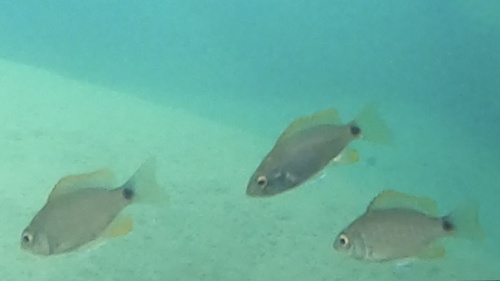
The species is strongly sexually dichromatic. A dominant, breeding male turns an intense metallic blue across the head and body — the trait the name records — often with darker fins, while females, juveniles, and subordinate males are a muted silvery-grey, sometimes with faint dark markings. Like most Malawi mouthbrooders, males carry egg-shaped ocelli ("egg spots") on the anal fin. One practical field cue keepers report is mood-driven: a stressed fish can throw up a set of dark vertical bars across an otherwise pale body, then drop them again as it settles. Because so many utaka converge on the same blue-male, grey-female pattern, color alone is an unreliable guide to identity — C. cyaneus is easily confused with congeners, and provenance matters more than appearance for a confident ID.
Range & habitat
C. cyaneus is endemic to Lake Malawi (also called Lake Nyasa and Lake Niassa), the great rift lake shared by Malawi, Mozambique, and Tanzania. The IUCN describes it as widespread, found all around the lakeshore including Likoma and Chizumulu Islands, with the curious exception that it has not been recorded at Taiwanee Reef. Its mapped area of occupancy is about 1,220 km² within a much larger extent of occurrence near 49,500 km².
It is a fish of the clean rocky shore. FishBase and the IUCN both stress that it is found only over sediment-free rocks in clear water — it avoids the silty, turbid habitats some of its relatives tolerate — while the fish themselves hang in the open water just off the boulders. It is benthopelagic: tied to the reef but feeding into the water column above it. The water it lives in is hard and alkaline, with FishBase giving an in-situ pH of roughly 7.4 to 8.4 and temperatures around 23 to 27 °C (73 to 81 °F), values typical of Malawi's stable, well-buffered surface layer.
Ecology & diet
C. cyaneus is a planktivore — specifically a zooplankton picker, in the mold of the utaka group that Thomas Iles first characterized in his 1960 study of the lake's plankton-feeding Haplochromis. FishBase places it at a trophic level of about 3.4, consistent with a diet built on drifting animal plankton rather than algae or detritus. Like the rest of the genus it feeds with a highly protrusible mouth, picking individual copepods and other small invertebrates out of the water with large eyes and a quick suction strike.
Ecologically these open-water plankton feeders are a key link in Lake Malawi's offshore food web, converting the lake's zooplankton production into fish biomass that supports both predators and people. Because C. cyaneus gathers in foraging schools over the rocks, it is one of the species swept up by local utaka fishers — its ecology and its place in the subsistence fishery are inseparable.
Behavior & breeding
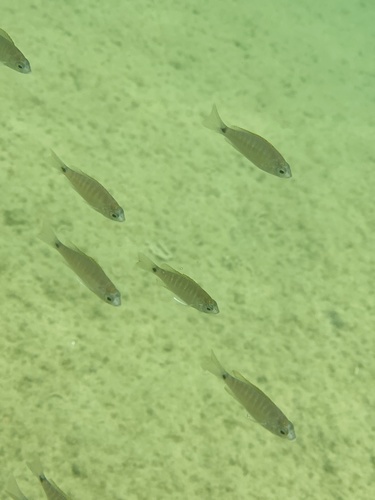
Socially, C. cyaneus runs a lek-like system layered onto a shoal. The IUCN's habitat account is unusually specific: females and non-breeding males congregate in open water in small foraging schools, while mature males defend sites on large boulders — but, tellingly, they "neither mark them nor defend them aggressively." That is a gentler territoriality than the bower-building, sand-flinging displays of many Malawi cichlids, and it fits the fish's reputation as a comparatively mild-mannered utaka.
Reproduction is maternal mouthbrooding, the standard Malawi strategy. A male in full blue draws a female down to his rock; she takes the eggs into her mouth almost as she lays them, and — cued by the egg spots on the male's anal fin — collects his milt to fertilize the brood inside her mouth. She then carries the developing clutch for several weeks without feeding before releasing free-swimming fry. The IUCN notes that juveniles are released into shallow parts of the rocky habitat, and records a generation length of about two years — a fast turnover that underpins the species' high modeled resilience.
In the aquarium
C. cyaneus is an uncommon fish in the hobby, kept mostly by Malawi specialists who prize the deep blue of a dominant male in the "Zimbabwe Rock" form. It is not a difficult fish so much as a demanding one in space: it is a shoaling utaka, and the consensus among keepers and reference sites (e.g. Fishipedia) is to keep a group of at least five in a large tank — on the order of 200 gallons (about 800 L) or a six-foot footprint — with open swimming room above a sand substrate and some rockwork for males to claim.
Honest framing matters here. Sources split on temperament: the wild fish is a relatively non-aggressive, schooling planktivore, and some keepers describe it as mild, while trade and care listings warn that males can be pushy toward conspecifics and similar-looking tankmates at breeding time. Both can be true — a non-territorial fish in open water can still bully a rival in the closed world of a tank. The reliable approach is the usual one for utaka: keep a harem (one male to several females) so no single fish is singled out, give plenty of length to diffuse a displaying male, and avoid mixing it with other blue Copadichromis or close utaka, which invites both fighting and hybridization. Water should be hard and alkaline (pH around 7.5–8.5, roughly 75–81 °F / 24–27 °C). Despite its wild plankton specialization it is unfussy at the dinner table, taking quality flake, small pellets, and frozen foods; a varied diet keeps the blue strong. Wild-type stock can be genuinely hard to source, so most aquarium fish trace to a few breeder lines.
Conservation
On the IUCN Red List, C. cyaneus is assessed as Least Concern (assessment by Konings, Kazembe, Mailosi and Makocho, published 2018, upholding an earlier 2006 Least Concern listing). The justification is straightforward: it is endemic to Lake Malawi but widespread along the rocky shores, with no major widespread threat identified, and it occurs inside Lake Malawi National Park. Population trend is recorded as unknown. The one pressure the assessors flag is subsistence fishing with chirimila (open-water seine) nets — this is a netted utaka and a food fish, not a fish targeted by the ornamental trade. In plain terms, the species itself is not currently in trouble.
The lake around it is a different story, and a rocky-shore planktivore cannot be considered apart from it. The basin review by Chavula and colleagues (2023, Journal of Great Lakes Research) frames Lake Malawi/Niassa/Nyasa as a system under severe and increasing stress: sediment and nutrient loading washing off deforested catchments, intensifying and partly unregulated fishing, climate change, and the looming risk of invasive species. Two of those pressures bear directly on this fish. First, it depends on clean, sediment-free rock and clear water — exactly the habitat that shoreline deforestation and the resulting siltation degrade. Second, roughly +0.7 °C of warming in the shallow water tends to strengthen the lake's stratification, slowing the mixing that lifts nutrients into the sunlit surface layer and thereby trimming the plankton production a zooplanktivore ultimately lives on; the collapse of the chambo (Oreochromis) tilapias under overfishing is a standing reminder of how fast a heavily netted Malawi stock can fall. None of this has moved C. cyaneus off Least Concern, and it would overstate the case to call it threatened. The accurate statement is the careful one: a common, resilient fish whose long-term security is bound to the health of a great lake that is, on current evidence, under growing strain.
Sources
- Catalog of Fishes (Eschmeyer) — Copadichromis cyaneus
- FishBase — Copadichromis cyaneus summary
- FishBase — Copadichromis cyaneus field guide
- GBIF — Copadichromis cyaneus occurrences
- The ETYFish Project — Cichlidae (Pseudocrenilabrinae) etymology, Copadichromis cyaneus
- Trewavas, E. 1935. A Synopsis of the Cichlid Fishes of Lake Nyasa. Annals and Magazine of Natural History, ser. 10, 16:65–118
- Iles, T.D. 1960. A group of zooplankton feeders of the genus Haplochromis (Cichlidae) in Lake Nyasa. Annals and Magazine of Natural History (13)2:257–280
- Eccles, D.H. & Trewavas, E. 1989. Malawian cichlid fishes: the classification of some haplochromine genera (genus reference)
- Chavula, G.M.S. et al. 2023. Lake Malawi/Niassa/Nyasa basin: Status, challenges, and research needs. Journal of Great Lakes Research 49(6):102241
- Cichlid Room Companion — Copadichromis cyaneus profile
- Cichlid Room Companion — genus Copadichromis
- Fishipedia — Copadichromis cyaneus
- IUCN Red List — Copadichromis cyaneus (e.T61028A47229505), assessed 2018
- Ron's Cichlids — Cyaneus Zimbabwe Rocks (trade common name & temperament) — community/anecdotal
- Imperial Tropicals (Facebook) — Copadichromis cyaneus at Ndomo Reef, Likoma Island — community/anecdotal
- American Cichlid Association (Facebook) — Copadichromis cyaneus Zimbawe Rock keeper post — community/anecdotal
- Cichlid Forum — Copadichromis utaka stocking & compatibility discussion — community/anecdotal