
Taxonomy & naming
Copadichromis mloto was described by the British fisheries biologist T. D. Iles in 1960, originally as Haplochromis mloto, in his Annals and Magazine of Natural History review of the zooplankton-feeding haplochromines of "Lake Nyasa" (the lake's older name). The type series came from Nkhata Bay, on the middle of the lake's western shore. Iles separated it from the very similar C. virginalis on little more than its slimmer build; every meristic count and almost every other measurement overlapped between the two. The fish has since also appeared in the literature under Cyrtocara mloto before the genus Copadichromis was erected by Eccles and Trewavas in 1989 (type species Haplochromis quadrimaculatus, Regan 1922) to hold the utaka.
The name has had a difficult life. As Turner and colleagues lay out in their 2023 Hydrobiologia study, C. mloto "has not been positively identified since its original description." Iles' own type series of C. virginalis contained two forms he heard local fishermen call "Kaduna" and "Kajose," and later workers — Konings, Turner, Snoeks — suspected these were different things. Whole-genome sequencing of 51 fresh specimens resolved it: the slender Kajose form long filed under C. virginalis is in fact conspecific with C. mloto, representing its deeper-bodied, sexually mature individuals, while true C. virginalis is a more rock-associated fish. The two species split only an estimated ~50,000 years ago, in line with the lake's last major refilling. Copadichromis belongs to one of the most spectacular vertebrate radiations on Earth — on the order of 800 cichlid species evolved within Lake Malawi — and the utaka are its open-water specialists. In the hobby the fish circulates under trade tags like "Ivory Head Mloto" and various locality names ('Luwala Reef', 'Mloto Undu', 'Mloto Liuli'), several of which may turn out to be undescribed relatives rather than C. mloto proper.
Appearance
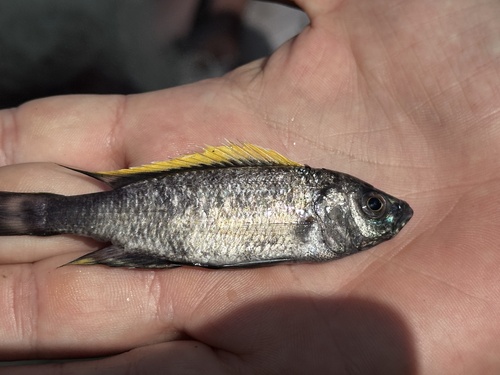
This is a modest, streamlined cichlid. FishBase gives a maximum of about 5.3 in (13.5 cm) total length, and hobby and biotope sources put typical adults at roughly 4.7–5.5 in (12–14 cm); maturity is reached around 4 in (10 cm). Outside of breeding it is an unremarkable fish to the untrained eye — silvery and countershaded, the classic look of a "pure utaka," one of the few utaka that largely lack the dark flank spots most of the genus carries. Iles thought it had smaller teeth than its relatives, but the 2023 re-examination did not bear that out; small simple teeth, bicuspid in the outer row and tricuspid within, are the rule across these fish.
The drama is reserved for ripe males. They turn a dark blue-black over the body and fins and develop a brilliant metallic-blue head and nape — a "blaze" not unlike that of Copadichromis azureus — that flares during courtship. Some northern populations and close relatives (the "white-top" forms from Likoma and Chizumulu) instead show a pale, shiny blue-white dorsal surface over a dark belly. Females and juveniles stay a drab grey-beige and are very hard to tell from other small utaka. That muted, sexually plastic appearance is exactly why the species evaded confident identification for so long: Iles never had a breeding male in his type series, so there was no diagnostic colour pattern to anchor the name.
Range & habitat
Copadichromis mloto is endemic to Lake Malawi (with records also from connected Lake Malombe to the south). It has a broadly lake-wide historical range — Nkhata Bay, Senga Point, the Luwala and Chimwalani reefs, Otter Point, Chilumba, the waters off Likoma — though confirmed recent records cluster in the south, especially the south-east and south-west arms and Lake Malombe.
More than most cichlids on this site, it is a fish of open water rather than a particular rock or reef. It is one of the genuinely pelagic utaka, recorded well offshore, but it also ranges over sand and mud bottoms; the 2023 study found it in trawls from the shallowest hauls at about 59 ft (18 m) down to 374 ft (114 m). That depth band is telling — this is an animal of the productive, well-mixed upper and middle water, not the rocky littoral. The lake itself is the relevant habitat: warm (surface waters around 75–82 F / 24–28 C), hard and alkaline (pH roughly 7.7–8.6), and strongly and permanently stratified, with a deoxygenated abyss below a few hundred feet. Like the rest of the utaka, C. mloto lives in the thin, oxygenated, plankton-rich lid of the lake.
Ecology & diet
Ecologically, C. mloto is a zooplanktivore — a specialist on the small crustaceans (copepods and cladocerans) drifting in open water. The utaka are built for exactly this: a small, highly protrusible mouth that shoots forward to engulf individual prey, and numerous long, fine gill rakers that strain plankton. FishBase places the species at a trophic level of about 3.4, the signature of a planktivore rather than a top predator.
This feeding guild matters far beyond the aquarium. The utaka are not just ecologically pivotal — converting open-water plankton production into fish biomass — they are commercially central, one of the lake's important food fishes. C. mloto sits at the heart of that. The 2024 genomic survey by Sawasawa and colleagues concluded that C. mloto (the fish long mislabeled "virginalis kajose") is "the true utaka most targeted by fisheries." Schooling in the open lake puts it directly in the path of seines and trawls, which is the central thread linking its ecology to its conservation.
Behavior & breeding
Copadichromis mloto is a shoaling, generally peaceable fish that forms schools in open water and is often netted in mixed-species shoals alongside other utaka. Like all Copadichromis it is a maternal mouthbrooder: the female collects the fertilized eggs into her mouth and incubates the developing fry there, giving no parental role to the male beyond spawning.
Reproduction follows the utaka pattern of seasonal, lek-like aggregations. Konings reports males of this species building bowers — shallow craters scraped in the substrate that serve as courtship arenas — at depths of around 75 ft (23 m) off Otter Point in the south of the lake, mostly over sand. Males develop their blue-black breeding dress and metallic head only when sexually active, displaying to passing females over these spawning sites. There is a neat natural-history detail in the old literature: Fryer and Iles (1972) recorded C. mloto breeding from August to November, offset from the May–June season of its look-alike C. virginalis, a seasonal separation that may help keep the two from interbreeding where they overlap. The genomic work hints there may be more here than one species — at least three geographically widespread, partly sympatric clades persist within "C. mloto" despite gene flow, pointing to cryptic, still-undescribed diversity.
In the aquarium
C. mloto is an uncommon but rewarding aquarium fish, almost always sold as wild imports aimed at serious Malawi keepers rather than as a staple. In captivity it takes prepared foods readily — quality flake, plus frozen mysis, brine shrimp and bloodworm — and asks for the same water as the rest of the lake's fish: hard, alkaline (around pH 8.0–8.5) and warm (about 77–79 F / 25–26 C).
The honest care notes are about space and society, not difficulty. This is an active, open-water shoaler, so it wants swimming room: plan on a tank at least 4 feet (120 cm) long, and 5 feet is better, with a large open span of fine sand and some rock structure rather than wall-to-wall rockwork. Keep it in a group — one or two males with several females — to spread male attention and let natural shoaling behavior emerge. For an utaka it is relatively placid; males get territorial and pushy when in breeding colour but are not the lake's bullies. Sensible tankmates are other calm haps and peacocks — Aulonocara, Lethrinops, milder Protomelas, Copadichromis borleyi — and it does poorly housed with rowdy mbuna, which will outcompete and harass it. The most common mistake is treating it like a rock cichlid in a cramped, rock-stuffed tank; give it water column and a peaceful crowd and it settles. One caveat worth stating plainly: because the "mloto/virginalis" complex is genuinely tangled and several trade names may be undescribed relatives, wild stock sold under this name is not always the same fish, so locality data from the importer is worth more than the label.
Conservation
On the IUCN Red List, Copadichromis mloto is currently Data Deficient (assessed 2018 by Ad Konings; errata version 2019), with a decreasing population trend. That is a downgrade in confidence, not in concern: it had been listed as Least Concern in 2006. The DD rating is itself a symptom of the taxonomic muddle — assessors note that C. mloto, C. virginalis and "C. kajose" are lumped together in fisheries statistics, so the species is essentially not being identified in catches even when present, which makes its true status unknowable from the data on hand. The signal that does exist is not reassuring: the population was estimated to have declined by more than 50% by 2003 relative to the early 1990s, the fish went unrecorded in lake-wide surveys in 1998–1999 and again in a 2016 survey of the southern lake, and the assessment flags it as a once-widespread species now rare. The threat is unambiguous — intensive beach-seine and commercial trawl fishing of an open-water schooling fish. Unlike many showy Malawi cichlids, it is barely touched by the aquarium trade; the pressure is the food fishery. It does at least occur within Lake Malawi National Park.
That species-level picture sits inside a lake under broad strain. The basin review by Chavula and colleagues (2023, Journal of Great Lakes Research 49(6):102241) documents the pressures on Lake Malawi/Niassa/Nyasa: over-fishing and the collapse of the once-abundant chambo (Oreochromis) fishery; rising sediment and nutrient loading washing off deforested catchments; and warming of roughly +0.7 C in the shallow waters, which strengthens the lake's already strong stratification and tends to reduce nutrient mixing and primary productivity. For a plankton-eater, those last two points bite directly: C. mloto depends on the productivity of the open upper water, and anything that weakens mixing or shifts plankton dynamics narrows the resource base under it, while the fishery removes adults from the same water faster than depleted utaka stocks can refill. Recent genomic work suggesting cryptic diversity within C. mloto adds a quiet worry — if the name covers several lineages, lake-wide catch totals could mask the loss of distinct populations. The fair summary is the careful one: the species is not formally listed as threatened, but "Data Deficient with a decreasing trend" in a heavily fished, warming lake is not the same as "fine," and better identification of utaka in catches is the first thing it needs.
Sources
- Copadichromis mloto — FishBase species summary
- Eschmeyer's Catalog of Fishes — Copadichromis mloto (species record)
- Copadichromis mloto — IUCN Red List (Konings 2018, errata 2019; e.T60870A148656528)
- Turner et al. 2023 — Taxonomic investigation of the zooplanktivorous Lake Malawi cichlids Copadichromis mloto (Iles) and C. virginalis (Iles), Hydrobiologia
- Sawasawa et al. 2024 — Population genomic analysis reveals cryptic diversity in the heavily fished utaka Copadichromis mloto (bioRxiv preprint)
- Chavula et al. 2023 — Lake Malawi/Niassa/Nyasa basin: Status, challenges, and research needs, Journal of Great Lakes Research 49(6):102241
- Copadichromis — genus overview, Cichlid Room Companion
- Copadichromis mloto — species profile, Cichlid Room Companion
- Copadichromis mloto 'Luwala Reef' — biotope & care notes, malawi.si (photos by Ad Konings)
- Copadichromis mloto — species profile (Matt Clarke), Practical Fishkeeping
- Copadichromis mloto Ivory — care sheet, Fishipedia
- Copadichromis mloto — GBIF species page
- Introduction thread (keeper discussion of Ivory Head Mloto / Copadichromis), Cichlid Fish Forum — community/anecdotal
- Copadichromis Ivory Head Mloto Undu — species-only keeper video — community/anecdotal
- Cichlid species in the IUCN Red List (Copadichromis listing), Cichlid Room Companion catalog