Taxonomy & naming
Copadichromis trewavasae was described by Ad Konings in 1999, in a Tropical Fish Hobbyist paper that introduced three new Copadichromis at once (the others being C. ilesi and C. geertsi). The holotype came from Membe Point off Likoma Island, and the name honors Dr. Ethelwynn Trewavas (1900–1993), the British ichthyologist whose decades of work underpin much of how we classify the haplochromine cichlids of the African Great Lakes. The genus name Copadichromis blends the Greek kopas ("carved") with Chromis, the old catch-all for cichlid-like fishes.
The genus itself was erected by Eccles and Trewavas in 1989 to hold a group of plankton-feeders that had previously been shuffled through Haplochromis and Cyrtocara. Today it contains roughly two dozen described species plus a long tail of undescribed forms, all endemic to Lake Malawi and known collectively as "utaka" — a Chichewa fisheries term for the silvery midwater cichlids that swarm over the lake's reefs and open water. C. trewavasae sits in the informal mbenji species group. A practical taxonomic headache, flagged in the species accounts themselves: female C. trewavasae cannot be reliably told apart from female C. verduyni, so identification of non-breeding fish leans heavily on locality and on breeding-male coloration.
Appearance
This is a modestly sized cichlid. The largest measured males reach about 4.1 in (10.5 cm) standard length, with females smaller at around 3.3 in (8.3 cm); total length runs a little above that. The body is the fusiform, faintly elongate shape typical of the utaka. Fin counts run to 15–17 dorsal spines and 9–12 soft rays, with three anal spines.
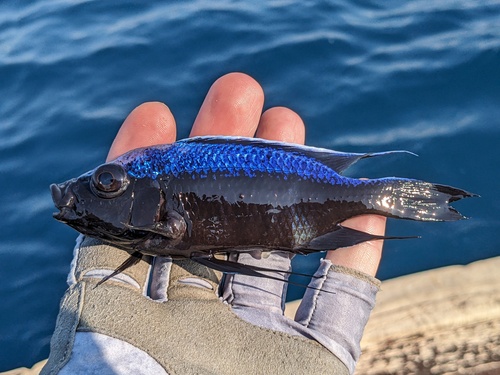
The field mark Konings used to diagnose it is a trio of dark blotches along the flank: a supra-pectoral spot roughly one-and-a-half times the size of the supra-anal spot and touching the upper lateral line, with the supra-anal spot sitting separate from that line. Non-breeding fish are otherwise an unremarkable silvery-grey, which is exactly why females are so hard to separate from look-alike congeners. The drama is reserved for breeding males, which turn the ventral body black and carry a blue-to-white blaze running along the dorsum above the lateral line, continuing back to the rear of the dorsal fin and onto the upper edge of the tail. That pale crest over the head and back is what earns the fish its "ivory head" trade name.
Range & habitat
C. trewavasae is endemic to Lake Malawi and has a patchy, oddly disjunct distribution. It is found around Likoma and Chizumulu islands (in the Mozambican waters at the lake's center), along the Tanzanian shore between Msisi/Makonde and Manda, and as a small subpopulation at Cobwé in Mozambique. Strikingly, the more than 200 km of shoreline between Cobwe and Manda appears to hold none of it — a reminder of how finely Malawi cichlids partition the lake.
Its preferred zone is the intermediate habitat: the transition where sandy bottom and scattered rock occur in roughly equal measure, at depths of about 33–98 ft (10–30 m), most commonly 49–82 ft (15–25 m). The IUCN assessment notes it often turns up in sediment-rich patches where muddy deposits coat the substrate. Like all of Lake Malawi, the water it lives in is hard and alkaline, warm and remarkably stable year-round — the natural template for the tank conditions this fish needs. Keeping it to that sand-rock seam rather than the true open water matters for more than habitat description: it shapes both how the fish breeds and how exposed it is to the lake's fisheries.
Ecology & diet
C. trewavasae is a zooplanktivore in the broad sense — one of the utaka whose ecological and commercial importance on Lake Malawi is hard to overstate. Both sexes feed on plankton in the water column close to the bottom, supplemented by benthic invertebrates and particulate matter drifting near the substrate. FishBase places it at a trophic level of about 3.4, consistent with a small predator picking off zooplankton and tiny invertebrates rather than grazing algae.
The utaka as a guild are built for this work, with protrusible, tube-like jaws that shoot forward to engulf individual plankters from midwater. Where many Copadichromis form vast feeding shoals out over open water, C. trewavasae forages lower and more locally, hanging near the bottom along its rock-and-sand interface. That foraging style keeps it physically and ecologically apart from the most heavily exploited open-water utaka, even though it draws on the same planktonic food base.
Behavior & breeding
Like all Lake Malawi haplochromines, C. trewavasae is a maternal mouthbrooder with no biparental care: the female alone carries and protects the eggs and fry in her buccal cavity. The breeding system is lek-like. Territorial males set up next to a rock and excavate a crater- or cave-shaped bower in the sand beneath or against it, and spawning takes place there. After spawning the female takes over entirely; mouthbrooding females stay closer to the bottom than foraging fish and sometimes gather in small groups.
Outside of breeding the species is fairly gregarious but not densely so. Females typically occur in small groups rarely numbering more than about ten individuals and remain near the bottom. This bower-on-the-substrate spawning, rather than the open-water reef spawning some other utaka use, is part of what defines the mbenji group and is one of the more reliable ways to tell these fish apart from their congeners in the field — males do their courting at a fixed nest site rather than in midwater.
In the aquarium
C. trewavasae reaches hobbyists as wild and F1 stock under names like "Ivory Head Mloto," "Mloto Likoma," and "Likoma Island." Be warned that these names are misleading: true "mloto" in the strict sense is Copadichromis mloto, a different fish, and the genus carries a thicket of trade labels that don't map cleanly onto valid species. Buy on the scientific name and collection locality when you can.
It is one of the easier-going utaka to keep, but it is not a small-tank fish. A group wants a long aquarium — vendors and keepers converge on roughly 75 gallons (about 285 L) as a sensible minimum, with more length better for a colony. Replicate the home water: hard, alkaline conditions around pH 7.8–8.6 and temperatures in the high 70s Fahrenheit (mid-to-high 20s C), with a sand base, rockwork to anchor male territories, and open midwater for swimming. Keep them as a group, ideally with a surplus of females per male to spread male aggression, which sharpens markedly at spawning time. Two honest corrections to the care-sheet folklore: this is a planktivore, not a true omnivore, so a quality plankton-leaning prepared diet (and frozen items like cyclops, brine shrimp, and mysis) suits it better than a heavy meat or vegetable regimen; and "peaceful" is relative — males are territorial breeders and should not be mixed with timid tankmates or, generally, with mbuna, whose pugnacity and dietary needs clash with these midwater feeders.
Conservation
The IUCN Red List assesses Copadichromis trewavasae as Least Concern (assessed 22 June 2018, by the species' own describer, Ad Konings), with a population trend listed as stable. That is an upgrade from its previous 2006 listing of Vulnerable, and the reasoning is instructive. The species is endemic to Lake Malawi and known from only four localities, which technically meets the area-of-occupancy threshold for an Endangered listing — but no decline has actually been detected after four decades of collection by the ornamental trade, and crucially, because it lives among and near rocks rather than in true open water, it largely escapes the chirimila/utaka nets that target the open-water plankton-feeders. It is regularly collected for the aquarium hobby (where it is traded as "Mloto Likoma") and remains very popular; over-collection and subsistence netting are named as potential, not realized, threats.
That species-level reassurance sits inside a lake under real strain. The Chavula et al. (2023) basin review (Journal of Great Lakes Research 49(6):102241) catalogues the pressures on Lake Malawi/Niassa/Nyasa: over-fishing and the collapse of the commercially vital chambo (Oreochromis) fishery, heavy sediment and nutrient loading washing off deforested catchments, roughly +0.7 °C of warming in the shallow water column that strengthens stratification and cuts the mixing that fuels plankton productivity, and the looming risk of invasive species. For a planktivore like C. trewavasae, the warming-and-stratification story is the one to watch: the utaka depend on a productive plankton base, and a less productive, more stratified lake squeezes the food web they sit on. The sediment-rich patches this species already tolerates also hint at exposure to shoreline runoff. So the honest summary is the nuanced one — C. trewavasae itself is currently secure and not declining, but it is secure within a lake whose basin-scale trends are running the wrong way, and its fortunes are tied to whether Malawi's plankton productivity holds up.
Sources
- Eschmeyer's Catalog of Fishes — Copadichromis trewavasae (CAS)
- FishBase — Copadichromis trewavasae summary
- IUCN Red List — Copadichromis trewavasae (Konings 2018, Least Concern)
- Cichlid Room Companion — Copadichromis trewavasae species profile
- Cichlid Room Companion — Copadichromis genus overview
- Konings, A. 1999. Descriptions of three new Copadichromis species (Cichlidae) from Lake Malawi. Trop. Fish Hobbyist 47(9):62–84 (via ResearchGate)
- Taxonomic investigation of the zooplanktivorous Lake Malawi utaka (PMC)
- Chavula et al. 2023, Lake Malawi/Niassa/Nyasa basin: status, challenges, and research needs. J. Great Lakes Res. 49(6):102241
- WWF — More fish in Lake Malawi at risk of extinction
- Fishipedia — Copadichromis trewavasae fish sheet
- Quinn's Fins — Ivory Head Mloto (Copadichromis trewavasae 'Likoma Island') care notes & trade name
- Malawi Cichlids — Copadichromis genus / utaka feeding ecology reference
- Cichlid Fish Forum (cichlid-forum.com) — community keeping experience, Malawi haps/utaka — community/anecdotal
- r/Cichlid (Reddit) — community discussion on Lake Malawi tank setup and stocking — community/anecdotal
- African Cichlid Breeders community — F1 Copadichromis trewavasae 'Mloto' Lupingu keeping reports — community/anecdotal