Taxonomy & naming
George Albert Boulenger described this fish in 1897 as Chromis rendalli, from specimens Dr. Percy Rendall collected in the upper Shire River of what was then British Central Africa — the species name honors that collector, a physician and itinerant naturalist who worked across Africa and the Caribbean in the late nineteenth century. For most of the twentieth century the fish carried the name Tilapia rendalli, and older literature also calls it Tilapia melanopleura. The current placement in the genus Coptodon follows Dunz and Schliewen's 2013 molecular revision of the haplotilapiine cichlids, which broke the old catch-all genus Tilapia into several lineages; Coptodon is a substrate-spawning group distinct from the mouthbrooding Oreochromis and Sarotherodon.
The synonymy is long — Boulenger and later workers described the same broadly distributed fish repeatedly under names such as Tilapia christyi, T. druryi, T. kirkhami, T. sexfasciata, and T. swierstrae, all now folded into C. rendalli. In the trade and in fisheries it goes by redbreast tilapia, red-breasted bream, and many local names (Chichewa mphende, Swahili sato or ngege). Within Lake Malawi it sits apart from the great haplochromine species flock: it is not one of the lake's endemic radiation, but a member of a wider African tilapiine lineage that happens to occur there naturally.
Appearance
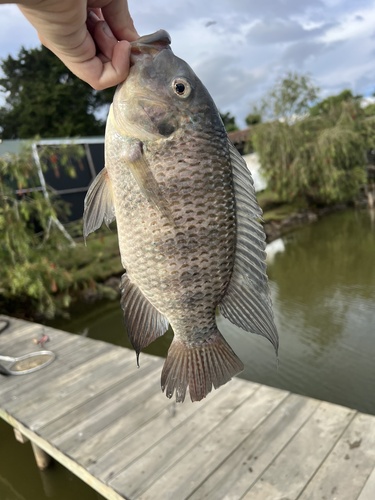
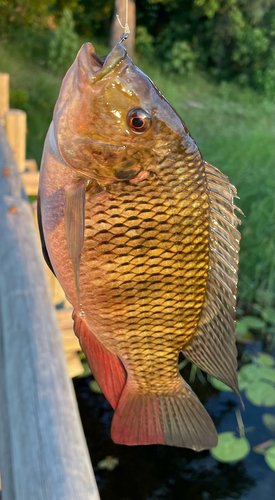
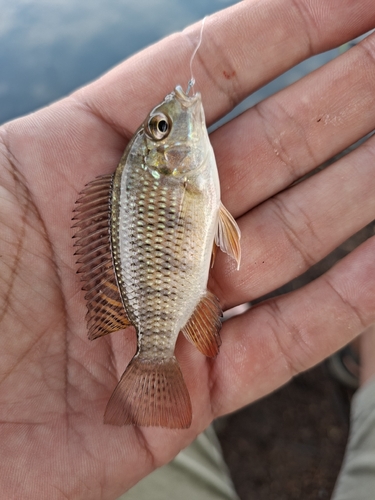
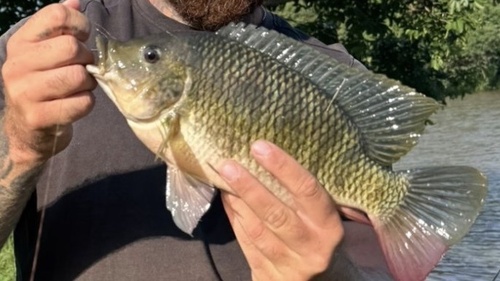
Redbreast tilapia is a large, laterally compressed cichlid with a deep body, a steep forehead, a relatively narrow head, and a small mouth — the build of a fish that grazes vegetation rather than chases prey. Reported maximum size varies with the source: FishBase lists 45 cm (about 18 in) total length and a weight near 2.5 kg (5.5 lb), while Skelton's southern African guide gives roughly 40 cm (16 in); most fish encountered are smaller, with sexual maturity around 18 cm (7 in). The dorsal fin carries 15–17 spines, and there are 29 vertebrae.
Coloration is variable: the body is often olive to brownish over a pale belly, but breeding and well-conditioned fish develop the bright red-to-orange throat and belly that give the species its common name. The sexes look broadly alike, with males simply growing larger. The hard identification problem is its near-twin, Coptodon zillii (redbelly tilapia), with which it readily hybridizes where the two meet; the two are notoriously difficult to separate, and many museum and aquarium records of one are likely the other or a hybrid. Useful tells, per FishBase, are C. rendalli's steeper head profile, fainter vertical barring, and — in East African populations — a tail fin split into a brownish upper and yellowish lower half, versus the more uniform, spotted tail of C. zillii.
Range & habitat
Few African freshwater fishes have a larger natural range. Coptodon rendalli is native across the upper and central Congo basin (the Katanga region, Lualaba, and Kasai drainages), the Zambezi system, the Cunene and Okavango, and the east-coast rivers and coastal lakes south to KwaZulu-Natal — and, importantly for this site, it is genuinely native to the Lake Malawi basin as well as Lakes Tanganyika, Chilwa, and Chiuta and the Shire River. The 2025 IUCN assessment lists Malawi among its native countries and notes that it occurs within Lake Malawi National Park. It has also been spread far beyond that range by people, introduced across Africa and to islands such as Hawaii and Puerto Rico for aquaculture, angling, and aquatic-weed control, sometimes with adverse ecological effects.
This is a shallow-water, littoral fish, not a creature of the open lake. It favors quiet, well-vegetated margins, backwaters, floodplains, swamps, and lagoons; FishBase gives a depth range of about 3–8 m (10–26 ft), and it spawns in the marginal fringe of plants. Its physiological tolerances are wide — reported temperatures from roughly 8 to 41 °C (46–106 °F), salinity up to about 19 parts per thousand, and notable resistance to suspended silt. In Lake Malawi that means it belongs to the weedy, sheltered shoreline and embayment habitats rather than the rocky reefs or the deep, oxygen-poor water below the thermocline.
Ecology & diet
Functionally, redbreast tilapia is a macrophyte specialist — one of relatively few African cichlids that makes a living chewing higher plants. Adults graze the leaves and stems of submerged and marginal vegetation, supplemented with filamentous algae, detritus, and some aquatic invertebrates; FishBase places its trophic level at about 2.3, near the herbivore end of the scale. The diet shifts with age, a pattern documented repeatedly: juveniles feed largely on plankton and switch toward herbivory as they grow (a planktivorous habit is pronounced enough in some populations that it has been studied in its own right). That plant-processing ability is exactly why the fish has been stocked around the world for weed control, including historically in Malawian fish ponds.
In the lake community it occupies the vegetated-littoral grazer niche, converting macrophyte and algal production into fish biomass and, in turn, feeding larger predators. It grows quickly, reaches a respectable size, tolerates poor water, and is prized eating — a combination that makes it both an important subsistence and small-scale commercial fish and a frequent target for aquaculture.
Behavior & breeding
Unlike the maternal mouthbrooders that dominate Lake Malawi, C. rendalli is a substrate spawner with biparental care. A monogamous pair clears vegetation and excavates a nest — typically a saucer-shaped pit, but reportedly 0.5–1.2 m (1.6–4 ft) across — in shallow water near the plant fringe, lays adhesive eggs on the cleaned surface, and both parents guard the eggs and fry. Several broods may be raised over a breeding season, and the fish forms loose schools and is mainly active by day.
The Lake Malawi populations do something more elaborate, and it is the species' most interesting natural-history story. Ribbink, Marsh and Marsh, working in the lake and publishing in 1981, described breeding pairs digging large tunnels into the nest substrate and practicing communal care of young — fry from multiple broods sheltering together and being guarded jointly. Both the tunneling and the communal crèching are read as anti-predator adaptations, responses to the unusually heavy predation pressure of a lake packed with hundreds of cichlid species. It is a striking case of a wide-ranging, behaviorally flexible fish modifying its breeding strategy to fit a particular, predator-dense environment.
In the aquarium
Redbreast tilapia is kept far more often by aquaculturists and pond owners than by display aquarists, and for good reason: it gets big, it is a determined digger, and it will shred most aquatic plants. A single adult realistically needs something in the range of a 75-gallon tank, and a group or breeding pair wants a genuinely large, long aquarium with a sand substrate, robust mechanical filtration to handle the bioload, and only the hardiest plants — or none, since they regard greenery as food and landscaping material in equal measure. The good news is that its wide tolerance of temperature, hardness, and even silty water makes water chemistry forgiving; the challenge is space, mess, and temperament.
It is not aggressive in the relentless way some Central American cichlids are, but it is a large, territorial substrate spawner, and a breeding pair will bulldoze the tank and drive off tankmates near the nest. Suitable companions are other large, robust fish that can hold their own and stay out of the excavation zone; small or delicate species are a poor match. One genuine pitfall is identity: fish sold as "redbreast" or "Rendall's" tilapia are frequently misidentified, and the species hybridizes freely with C. zillii, so trade specimens may not be pure. A more serious caution sits outside the tank — tilapias are among the most invasive freshwater fishes worldwide, several jurisdictions restrict or ban them, and they should never be released into the wild.
Conservation
Coptodon rendalli is assessed as Least Concern on the IUCN Red List, most recently reassessed on 24 February 2025 (Mabo 2025), and it has been rated Least Concern in every assessment back to 2006. The justification is straightforward: an enormous native range, broad habitat tolerance, and no major range-wide threat. The species is also unusually resilient to fishing — assessors note it can withstand heavier pressure than other tilapias, partly because it readily jumps over seine nets and partly because its eggs and fry are protected inside excavated holes and tunnels. The recognized threats are local rather than global: intensifying fishing in places (a declining trend is noted in parts of Zambia), dam construction, and the loss of vegetated margins and floodplains to agriculture, which removes the shallow, weedy habitat it needs to breed. One note of caution on the literature: a 2024 genetics paper described the species as "vulnerable," citing the 2019 IUCN assessment, but that assessment in fact rated it Least Concern — the species has not been listed as Vulnerable, and the "vulnerable" label appears to be an error.
That the fish itself is secure does not mean its home lake is. Lake Malawi is under real strain, and the basin-scale review by Chavula and colleagues (2023, Journal of Great Lakes Research 49(6):102241) catalogs the pressures: heavy sediment and nutrient loading from deforested, frequently burned, and cultivated catchments; over-fishing and the long decline of the prized chambo tilapias; and warming, with shallow waters having warmed by roughly 0.7 °C over six decades against about 0.18 °C at depth — a contrast that strengthens the lake's permanent stratification and tends to lock nutrients below the thermocline, lowering productivity. Invasive species, including the looming risk of Nile tilapia establishment, add further hazard. These pressures bear directly on a fish like C. rendalli: as a shallow, vegetated-shoreline breeder, it is squarely in the path of the very degradation the review flags, which specifically notes that siltation and shoreline change reduce the breeding sites of native tilapias that spawn in very shallow water. So the honest summary is the careful one — the redbreast tilapia is a Least Concern species, but it lives in a lake whose littoral zone is being degraded, and its local fortunes will track the health of those weedy margins more than its global status line suggests.
Sources
- Coptodon rendalli (Redbreast tilapia) — FishBase species summary
- Eschmeyer's Catalog of Fishes — Coptodon rendalli (Boulenger, 1897)
- Coptodon rendalli — IUCN Red List (Mabo 2025, version 2025-2, Least Concern)
- Tilapia rendalli (redbreast tilapia) — USGS Nonindigenous Aquatic Species profile
- Coptodon rendalli — Cichlid Room Companion species profile (public page)
- Ribbink, Marsh & Marsh (1981), Nest-building and communal care of young by Tilapia rendalli in Lake Malawi, Env. Biol. Fishes 6(2):219–222
- Dunz & Schliewen (2013), Molecular phylogeny and revised classification of the haplotilapiine cichlids formerly referred to as 'Tilapia', Mol. Phylogenet. Evol. 68:64–80
- Chavula et al. (2023), Lake Malawi/Niassa/Nyasa basin: Status, challenges, and research needs, J. Great Lakes Res. 49(6):102241
- The aquaculture potential of Tilapia rendalli in relation to its feeding habits (size-related dietary shift: juvenile zooplankton → adult macrophyte grazing)
- FAO — Interactions between fish and aquatic macrophytes: Tilapia rendalli used for plant control in Malawi
- Genetic and haplotype diversity of redbreast tilapia (Coptodon rendalli) — COI and D-loop study
- Coptodon rendalli — SANBI national assessment (South Africa), Least Concern
- Coptodon rendalli — FishBase field-guide summary (distribution, Lake Malawi tunnel-nesting note)
- Stauffer et al. — Nile Tilapia, a threat to the endemic fishes of Lake Malawi (invasive-species risk)
- Redbreast tilapia species guide (substrate-spawner natural history, hobby/angling perspective)
- MonsterFishKeepers.com — fish ID thread on mislabeled 'Rendall's Tilapia' (community ID caution) — community/anecdotal
- MonsterFishKeepers.com — South African fish blacklist thread (Tilapia rendalli regulation) — community/anecdotal
- Pond Boss Forum — keeper discussion of tilapia for weed/algae control — community/anecdotal