Taxonomy & naming
Albert Günther described the fish in 1894 as Chromis horei, working from specimens that the missionary-navigator Captain Edward Coode Hore had collected on Lake Tanganyika; the species epithet honors Hore, and the syntypes still reside in the Natural History Museum, London. Over the following century the name drifted across genera as ichthyologists wrestled with the sprawling, ill-defined assemblage of African haplochromines: it was carried in 'Haplochromis', then settled for decades as Ctenochromis horei, the combination under which nearly all aquarium literature still lists it.
That stability ended in 2022. Genner and colleagues, sequencing genome-wide markers, showed that Ctenochromis as historically conceived was paraphyletic — not a true branch of the tree but a grab-bag of unrelated lineages. They restricted Ctenochromis to two Pangani-drainage species in northern Tanzania and erected a new genus, Shuja, for the Tanganyikan fish, giving the valid name Shuja horei (Günther, 1894). The genus name comes from the Swahili shujaa, 'warrior' or 'brave one', a nod to the combative males — a rare instance of a scientific name capturing exactly what keepers complain about. Eschmeyer's Catalog of Fishes and FishBase both now treat Shuja horei as the accepted name. (It was also briefly combined as Pseudosimochromis horei by Schedel et al. (2019), before the 2022 revision placed it in its own genus, Shuja.) Whichever label is on the tank, the fish itself is a member of the tribe Tropheini, the Tanganyikan haplochromine radiation that is the sister group to the great species flocks of Lakes Malawi and Victoria — which makes this unassuming fish a useful window onto how those famous radiations began.
Appearance
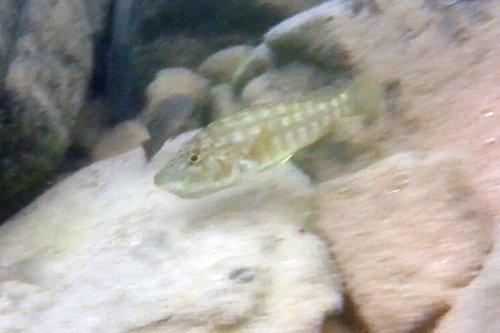
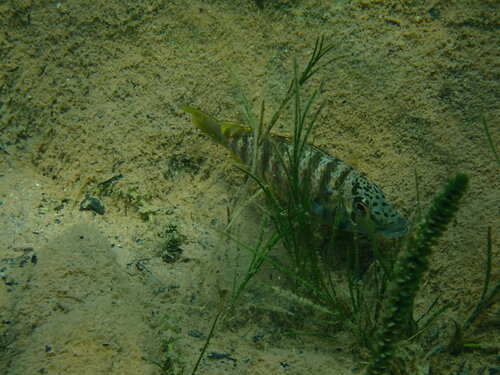
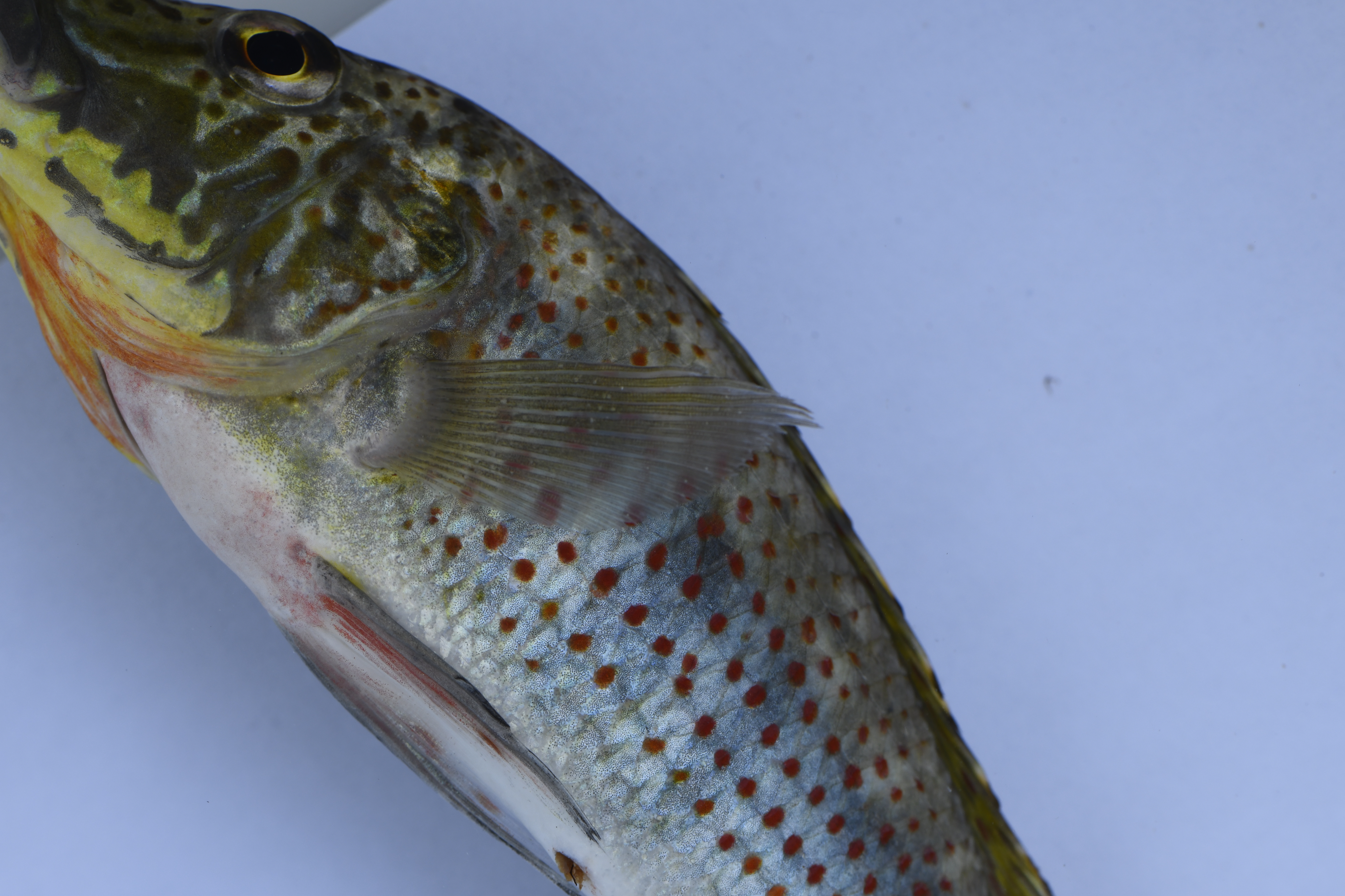
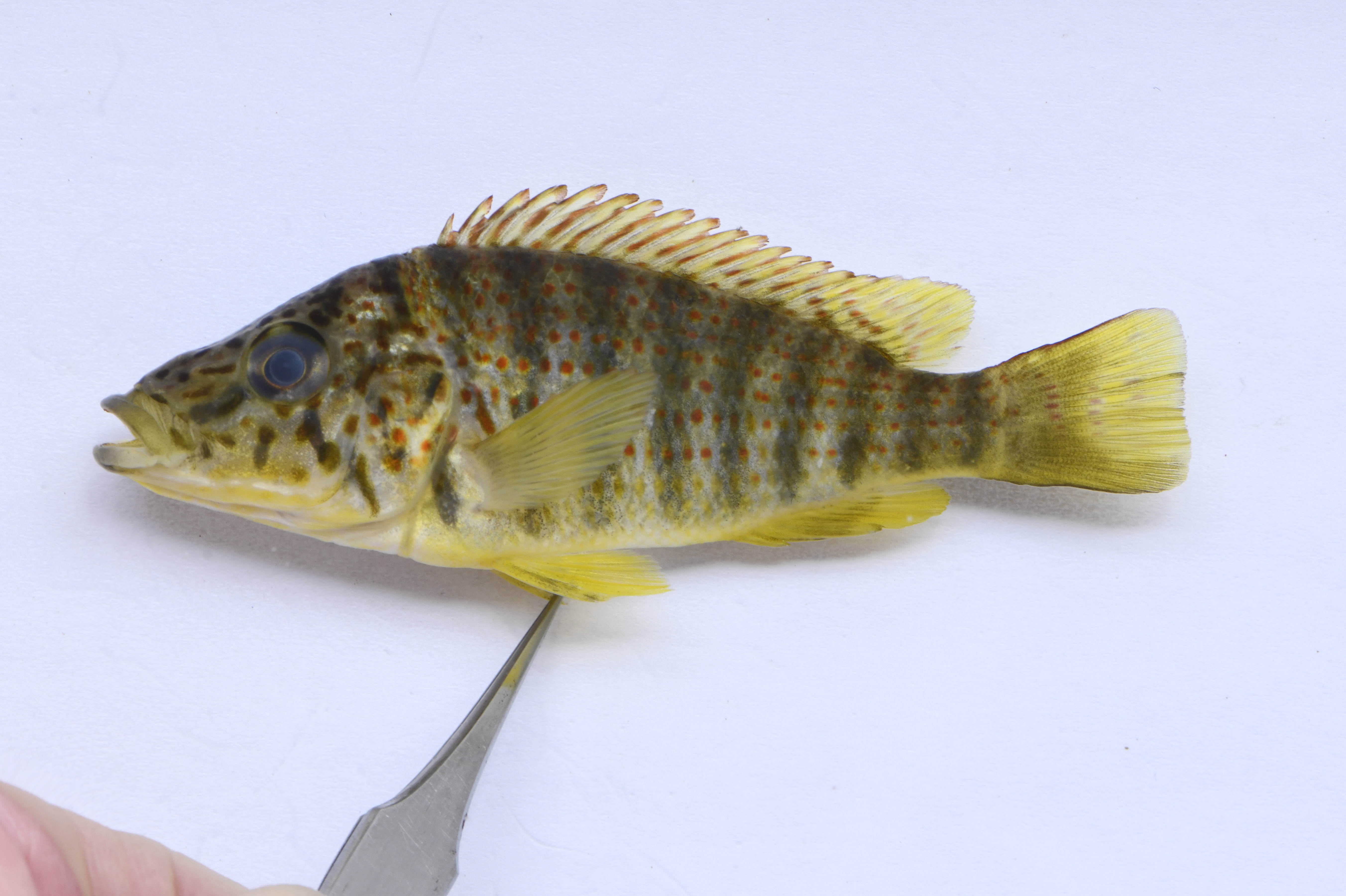
This is a fairly large, deep-bodied haplochromine with a fusiform, oval cross-section and a blunt, faintly marked face. FishBase gives a maximum of about 8 in (20 cm) standard length; in practice dominant males run to roughly 6 in (15 cm) and females are visibly smaller, the usual haplochromine pattern of male-biased size. The dorsal fin carries around 14 spines and 8 soft rays. A useful field mark, noted in the descriptive literature, is the scattering of irregular dark blotches across the head.
Color is mood-dependent and sexually dimorphic. A courting, dominant male lights up with iridescent blues and greens over the flanks and the egg-spot-bearing anal fin typical of haplochromines, while subordinate fish, females, and stressed individuals fade to a drab tan crossed by dark vertical bars. Hobbyists treat those heavy black bars as a stress and aggression signal — they flare up when a fish is frightened or when a male is throwing his weight around — so the same individual can look like two different fish within an hour. Because the species ranges around the whole lake, populations vary somewhat in the intensity of male color, but it has never been split into the elaborate geographic-variant trade like Tropheus; a horei is a horei.
Range & habitat
Ctenochromis horei is endemic to the Lake Tanganyika basin but, unlike the rock-bound specialists that dominate the lake's reputation, it is a wide-ranging generalist of the soft margins. It occurs essentially lake-wide across all four riparian nations — Burundi, the Democratic Republic of the Congo, Tanzania, and Zambia — and, unusually for a Tanganyikan cichlid, it pushes well into flowing water: it is common in tributary and outflow rivers including the Lukuga, Ruzizi, Nua, and Malagarasi, and has been recorded up the Lukuga as far as the Kisimba-Kilia rapids. This tolerance of riverine conditions sets it apart from the lake's many stenotopic endemics and helps explain its broad distribution.
Within the lake it is a benthopelagic fish of the shallow, sheltered inshore zone, favoring areas with sand and scattered rock and, importantly, vegetation — the weedy, sediment-floored shallows rather than the steep rocky reefs. Keepers who have studied wild behavior note that because it lives in these warm, oxygen-rich surface shallows, it expects highly oxygenated water, a detail that matters in the aquarium. In-situ conditions are those of the open lake's upper layer: warm, around 73–81 °F (23–27 °C), hard, and alkaline, with reported pH spanning roughly 7 to nearly 9. Tying it to the water body itself, this is a fish of Tanganyika's productive littoral fringe — the interface between the lake and its catchment — rather than of the clear, deep rock walls.
Ecology & diet
Trophically, horei is a carnivore that behaves like an opportunistic predator. Comparative work on the Tropheini (Wanek & Sturmbauer 2015) places it firmly in the carnivorous group alongside Gnathochromis pfefferi and the snail-eater Lobochilotes labiatus, distinct from the algae-grazing Tropheus-type tropheines — a useful corrective to care sheets that imply it is primarily a grazer. The broader Tanganyikan evidence that diet predicts gut length (Wagner et al. 2009) underlines the point: predators in this fauna carry the shorter intestines that go with animal prey. In the wild it is a stalking hunter of the shallows, taking small invertebrates, insects and other 'bugs', and readily ambushing any smaller fish or fry it can overpower; specialists who keep it describe a fish that does not so much chase as lie in wait and lunge.
That said, the picture is best read as carnivore-leaning omnivore. Experienced keepers report that wild fish also browse plant and algal material in their vegetated habitat, and the species' presence in nutrient-rich inshore and riverine zones fits a flexible, generalist diet — exactly the ecological plasticity you would expect of a fish that thrives both in the lake and up its rivers. In the lake community it occupies a mid-level predatory role, neither apex piscivore nor specialist grazer.
Behavior & breeding
Socially, horei is a polygamous harem breeder and a maternal mouthbrooder — the reproductive mode that defines the haplochromine line and, through it, the Malawi and Victoria radiations. A dominant male establishes and defends a territory, typically in vegetated shallows, and courts multiple females; spawning follows the classic haplochromine script, with the female taking the eggs into her mouth and the male's egg-spots drawing her to fertilize the clutch she is already brooding. The female then incubates the eggs and larvae orally — measured broods carry larvae up to about 0.6 in (1.42 cm) total length in females of roughly 3.3–3.8 in (8.4–9.6 cm) standard length — retreating into rock or cover while she holds, and releasing free-swimming fry that she may shelter for a short time afterward.
The headline trait is aggression. Across independent keepers the testimony is strikingly consistent: males are relentless toward females and murderous toward rival males, to the point that the established advice is to buy a group of eight to a dozen, let a hierarchy form, and remove surplus males. One specialist, asked to rank Tanganyikan mouthbrooders, called it the meanest he had kept size-for-size, harder to manage than Tropheus or Petrochromis; another watched a single dominant male systematically eliminate every other male and most of his females. Females need genuine refuges — caves or crevices a pursuing male physically cannot enter — or they get harried to death. This is corroborated, anecdotal hobby experience rather than published ethology, but the agreement across many keepers makes it reliable: horei is not a fish that mellows in company.
In the aquarium
Horei is an occasionally available, undeniably handsome fish that is best matched to keepers who actively want to manage aggression rather than avoid it. The consensus minimum is a 75-gallon (about 285 L), 4-to-5-foot tank, and bigger is genuinely better — keepers who succeed long-term tend to use 125 gallons (about 470 L) or more, with European references putting the practical floor near 500 L (about 130 gal) and a 55-inch (140 cm) footprint. Recreate the wild margin: a sand bed (the fish digs), piles of rock arranged into caves and sightline breaks, and even bundles of artificial plants — multiple keepers specifically credit dense cover and tubes too small for the big male as the difference between a breeding colony and a body count. Because it comes from warm, well-oxygenated shallows, keep the water hard and alkaline (pH ~8–9), warm, clean, and well-aerated, with the generous water changes Tanganyikans expect.
The honest tankmate advice is unforgiving. This fish will bully or kill smaller, gentler tankmates and eat anything it can swallow, so the timid open-water cichlids people love — Cyprichromis, Paracyprichromis, Xenotilapia — are a known disaster with it; several keepers describe added cyps vanishing overnight. What does work is robust, fast, similarly assertive company in a large tank: Tropheus, Petrochromis, Limnotilapia, large Lamprologus and gobies have all been housed with it successfully by experienced keepers, the logic being that nothing slow or shy survives the male's attention. Avoid keeping multiple males unless the tank is big enough to dilute the violence. The common mistakes are predictable: buying a pair (you want a harem), under-housing them, and mixing them with peaceful dithers because a price list made them look like just another colorful Tang. It is not a beginner fish, and the literature's occasional 'easy to breed' rating is true only in the narrow sense that they spawn readily — keeping the spawners alive is the hard part.
Conservation
The species itself is not of conservation concern at present. The IUCN Red List assesses Ctenochromis horei (as Shuja horei) as Least Concern, most recently dated 20 February 2025, reflecting its wide, lake-wide distribution, its tolerance of riverine habitat, and a healthy resilience profile; it supports only minor subsistence fisheries and carries low fishing vulnerability. As a widespread, adaptable inshore generalist, it is among the Tanganyikan cichlids least likely to be tipped toward extinction by any single local threat — a contrast to the lake's many narrow-range rocky endemics.
That individual security, however, sits inside a lake under real and worsening strain, and a shallow-margin fish like horei is exposed to exactly the pressures that bear hardest on the nearshore. Two are paramount. The first is warming. Long-term work led by O'Reilly and colleagues (Nature, 2003) showed that a warming surface has strengthened Tanganyika's stratification and weakened the wind-driven mixing that lifts deep nutrients into the sunlit zone, inferring on the order of a 20 percent decline in primary productivity over the twentieth century — a loss that propagates up the food web that this predatory species sits within. Paleoecological records analyzed by Cohen and colleagues (PNAS, 2016) tied that same warming to measurable declines in both commercially important fishes and endemic benthic life, and to a shrinking of viable benthic habitat as the oxygenated layer thins. The second is sedimentation: deforestation and farming across the four-nation catchment send eroded soil into the very inshore, vegetated shallows that horei depends on, smothering substrate, clouding water, and degrading the littoral nursery zones. Layered onto these is the heavy, growing pressure of the basin-wide clupeid-and-Lates pelagic fishery that feeds millions around the lake, and the inherent difficulty of coordinating protection across Burundi, the DRC, Tanzania, and Zambia — the four states whose shared stewardship is formalized through the Lake Tanganyika Authority. The honest summary, then, is the one the skill demands: this particular fish is currently fine, but its home is not, and the warming and shoreline degradation that are quietly remaking Tanganyika's littoral fall squarely on the shallow, weedy habitat where horei lives.
Sources
- Eschmeyer's Catalog of Fishes — horei (Chromis), valid as Shuja horei (Günther 1894)
- FishBase — Shuja horei (Günther, 1894) [formerly Ctenochromis horei]
- Genner et al. 2022 — Revision of the African cichlid genus Ctenochromis, with the new genus Shuja from Lake Tanganyika (European Journal of Taxonomy 819)
- Wanek & Sturmbauer 2015 — Form, function and phylogeny: comparative morphometrics of Lake Tanganyika's cichlid tribe Tropheini (Zoologica Scripta 44)
- Wagner et al. 2009 — Diet predicts intestine length in Lake Tanganyika's cichlid fishes (Functional Ecology 23)
- GBIF — Fisheries of Lake Tanganyika occurrence dataset
- Fishipedia — Ctenochromis horei species sheet (size, habitat, behavior, range)
- Cichlid Room Companion (Ask Pam) — Ctenochromis horei husbandry and behavior
- Cichlid-Forum — 'Ctenochromis Horei' thread (community keeping experience; anecdotal) — community/anecdotal
- IUCN Red List — Shuja horei (Least Concern, assessed 2025)
- O'Reilly et al. 2003 — Climate change decreases aquatic ecosystem productivity of Lake Tanganyika (Nature)
- Cohen et al. 2016 — Climate warming reduces fish production and benthic habitat in Lake Tanganyika (PNAS)
- Lake Tanganyika: Status, challenges, and opportunities for research (J. Great Lakes Research, 2023)
- FAO — Lake Tanganyika Authority (four-nation governance: Burundi, DRC, Tanzania, Zambia)
- International Waters Governance — Lake Tanganyika Convention member states