Taxonomy & naming
Cynotilapia chilundu was formally described in 2016 by Shan Li, Ad Konings, and Jay Stauffer in their revision of the Pseudotropheus elongatus species group (Zootaxa 4168: 353–381). That paper was a substantial cleanup of a tangled assemblage of elongate mbuna: it erected the new genus Chindongo, redistributed several species among Metriaclima, Tropheops, and Cynotilapia, and described six additional new species, of which C. chilundu was one. The holotype, an 82.9 mm adult male catalogued as PSU 12774, came from Taiwanee Reef in the open lake.
The species epithet is refreshingly literal: chilundu is Chichewa for "reef," chosen because the fish is found on nothing but a reef. The genus name Cynotilapia blends Greek kyon (dog) with the African tilapia, a nod to the prominent canine-like teeth shared by the group. C. chilundu is placed in Cynotilapia on the strength of its widely spaced, unicuspid oral teeth and a moderately inclined vomer — the dental and skull characters that separate this genus from its mbuna relatives.
Hobbyists had been keeping and trading this fish well before it had a name, under the informal label Cynotilapia sp. "elongatus taiwan," or simply "Elongatus Taiwan," after its type locality. That older trade name still circulates and is worth knowing when reading older forum threads or stock lists.
Appearance
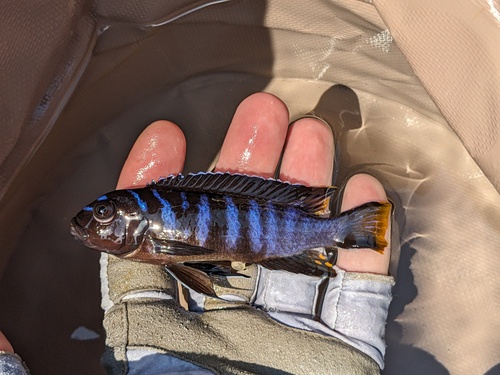
This is a small, distinctly slim cichlid. The largest measured specimen reached about 3.3 in (8.3 cm) standard length, and most are smaller; it is a genuine dwarf even by mbuna standards. The diagnostic feature is leanness: body depth runs 24.9–31.1% of standard length, against 31.8–37.2% in the look-alike congeners C. afra, C. zebroides, and C. aurifrons. Put two side by side and C. chilundu reads as the pencil of the group. Fin counts are typical for the genus — roughly 17–19 dorsal spines with 7–10 soft rays, and three anal spines with 7–8 soft rays.
Like most mbuna, the species is sexually dichromatic. Males carry the bright blue-and-black barred livery the trade prizes, and crucially show a dark submarginal band in the dorsal fin — a feature that helps separate males from the otherwise similar C. axelrodi, which lacks it. Females are more subdued but not plain: they retain distinct vertical bars on the flank and bars across the interorbital region of the head, characters that are absent or indistinct in female C. axelrodi. Those head and flank markings are a useful field and tank check when telling the two apart.
Range & habitat
C. chilundu is one of the most narrowly distributed cichlids known from Lake Malawi: it has been recorded only from Taiwanee Reef, a submerged offshore reef at roughly 11°57.4′S, 34°35.3′E. The reef lies in Mozambican waters, though in practice it is fished mainly by people from Chizumulu Island on the Malawian side. The IUCN estimates the area of occupancy at just 4 km² — effectively a single rocky outcrop in the middle of the lake.
The fish keeps to the upper reaches of that reef. Taiwanee never rises nearer the surface than about 16 ft (5 m), so this is not a shallow shoreline animal; it occupies the crown of a deep reef where boulders pile into a maze of caves and crevices. Those caves are central to its life — they are both refuge and nursery. As a Malawi rock-dweller it lives in the lake's characteristically hard, alkaline water (high pH, well-buffered), the same chemistry that defines mbuna habitat lake-wide. The reef-bound, deep-rock setting is exactly the sort of isolated patch that drives the lake's explosive, location-by-location cichlid speciation.
Ecology & diet
C. chilundu is best described as an opportunistic planktivore that also grazes. In the wild it feeds largely on plankton — algae and diatoms mostly, with zooplankton taken when it is abundant. That flexible, mid-water-plus-grazing strategy is typical of Cynotilapia, which tend to sit between the dedicated aufwuchs-scraping mbuna and the open-water zooplankton pickers. FishBase places the species at a trophic level of about 3.4, consistent with a diet that mixes plant and small animal material.
Territorial males complicate the picture. Because a breeding male cannot stray far from the cave he is defending, he ends up feeding on whatever he can extract from the aufwuchs — the film of algae, diatoms, and small invertebrates coating the rocks — within his small patch. So the same fish behaves as a roaming planktivore when free and a site-bound grazer when guarding a spawning cave. As a numerically modest, short-lived species (generation length around a year) confined to one reef, its ecological footprint in the lake is small, but it is a textbook member of the rock-reef community that makes Malawi's mbuna flock so diverse.
Behavior & breeding
Reproduction is built around the caves of the reef. C. chilundu is a maternal mouthbrooder, and males defend cavities among the large boulders as spawning sites. A territorial male holds station near a rocky edge or cave mouth; although he stays close to home, he will chase rival males several metres off when pressed. Ripe females move to a male's cave to spawn inside it, after which the female takes the eggs into her mouth and broods them.
Field observers rarely encounter mouthbrooding females, and the likely reason is telling: brooding females hide deep among the rocks and apparently release their fry there, out of sight. That cryptic, cave-bound brooding keeps the most vulnerable members of the population tucked into the reef structure. The overall pattern — cave-spawning, harem-style male territoriality, maternal mouthbrooding — is standard mbuna biology, but the species executes it in an unusually confined vertical band on a single reef.
In the aquarium
Sold as "Elongatus Taiwan," C. chilundu is a colorful dwarf mbuna that experienced Malawi keepers regard as rewarding but not beginner-proof. Despite its small size, the male is genuinely pugnacious. Keepers on cichlid forums report males in a 55-gallon tank killing females over time, even while the group bred readily enough to replace the losses — a candid reminder that "dwarf" does not mean "peaceful." The standard mitigation applies: keep one male with several females (a 1-male-to-4-or-more-female ratio is the usual advice for aggressive dwarf Cynotilapia), provide a lot of broken-up rockwork to fracture sight lines, and don't undersize the footprint. Many keepers run them successfully in four-foot tanks, but the honest read is that more females, more rock, and more swimming length all buy peace.
For tankmates, hobbyists commonly pair them with other moderate mbuna such as Iodotropheus sprengerae ("rusties") and Labidochromis caeruleus (yellow labs), and they show up regularly in busy all-male mbuna displays. Avoid housing them alongside the closely similar blue-barred Cynotilapia and Pseudotropheus, both to prevent hybridization and to reduce the relentless same-pattern aggression. Water should be hard and alkaline to mirror the lake. Treat the forum reports as anecdotal but consistent: the recurring theme across independent keepers is an outsized male temperament in a small body, best managed with numbers and aquascaping rather than wishful thinking.
Conservation
The IUCN Red List assesses Cynotilapia chilundu as Vulnerable under criterion D1 (assessed by Ad Konings in 2018; errata version 2019). The listing is driven almost entirely by how few and how concentrated the fish are: the population is restricted to one location — Taiwanee Reef — with an estimated 500 to 1,000 mature individuals and an area of occupancy of about 4 km². The population trend is judged stable and the species is reported as common on the reef itself, so this is a case of a small, single-site range rather than an observed decline. Direct pressures are modest: it is only rarely collected for the ornamental trade (where it is the "Elongatus Taiwan"), and it is not targeted by fishermen, though it can be caught as bycatch in the small-meshed chirimila nets that utaka fishermen work over the reef.
The larger risk is the state of the lake around it. Basin-scale reviews of Lake Malawi (Chavula et al. 2023, Journal of Great Lakes Research 49(6):102241) document over-fishing and the collapse of the chambo (Oreochromis) fishery, heavy sediment and nutrient loading off deforested catchments, roughly +0.7 °C of warming in shallow waters that strengthens stratification and curbs primary productivity, and a standing risk from invasive species. For a deep-reef planktivore like C. chilundu, the most relevant of these is productivity: a species that depends on plankton and aufwuchs is exposed to any lake-wide decline in the food base that warming-driven stratification can cause. It is important not to overstate the case — the fish is not itself heavily fished or collected, and its assessed trend is stable. But a species whose entire world is one reef has essentially no margin: a single localized event — a destructive fishing practice, a pollution pulse, an introduced competitor or pathogen — could affect the whole population at once. The Vulnerable rating reflects that fragility, set against a lake that is itself under mounting strain.
Sources
- Cynotilapia chilundu — Catalog of Fishes (Eschmeyer), California Academy of Sciences
- Cynotilapia chilundu — FishBase species summary
- Cynotilapia chilundu — GRSciColl / GBIF type specimens
- Li, Konings & Stauffer (2016): A Revision of the Pseudotropheus elongatus species group, Zootaxa 4168(2):353–381 (abstract & references)
- Li, Konings & Stauffer (2016) revision — PubMed record
- Li, Konings & Stauffer (2016) revision — ResearchGate (holotype figure)
- Konings, A. (2018, errata 2019): Cynotilapia chilundu — IUCN Red List of Threatened Species e.T117808095A148848619
- Chavula et al. (2023): Lake Malawi/Niassa/Nyasa basin — status, challenges, and research needs, J. Great Lakes Research 49(6):102241
- Cynotilapia chilundu species profile — Cichlid Room Companion (public page)
- Cynotilapia chilundu 'Taiwanee Reef' / sp. 'elongatus taiwan' — malawi.si species & locations
- Nouveautés systématiques (name-change tracker: 'elongatus taiwan' → Cynotilapia chilundu) — Philippe Burnel
- "A question on 55 gallon stocking" — Cichlid Fish Forum (keeper reports on 'Elongatus Taiwan' aggression & breeding) — community/anecdotal
- "Suggested tank additions?" — Cichlid Fish Forum (Cyno sp. 'elongatus Taiwan' in mixed mbuna stocking) — community/anecdotal
- "150 Gallon Malawi Reef" — MonsterFishKeepers.com (juvenile 'elongatus taiwan' claiming territory early) — community/anecdotal
- "Malawi Bloat??" — MonsterFishKeepers.com (keeper notes on juvenile C. 'elongatus taiwan' health/behavior) — community/anecdotal