Taxonomy & naming
Cyprichromis coloratus was formally described by Tetsumi Takahashi and Michio Hori in 2006, in the Journal of Fish Biology (68, Suppl. B: 174–192), from 41 type specimens collected along the Zambian coast; the holotype came from Wonzye Point at about 12 m depth. The species epithet is simply the Latin coloratus, "colored" — a nod to the bright fins of breeding males. The genus name blends Latin cyprinus (carp) with the Greek chromis, an old catch-all for a perch-like fish.
The genus Cyprichromis belongs to the small tribe Cyprichromini, the open-water "sardine cichlids" endemic to Lake Tanganyika. Takahashi and Hori distinguished C. coloratus from its congeners on counts and proportions: it carries more dorsal-fin spines than C. leptosoma (14–15 vs. 11–13) but fewer scales than the fine-scaled C. microlepidotus (41–44 in the longitudinal line vs. 59–70), and it differs from C. zonatus in its shallower body, smaller eye, and the absence of the vertical flank bars that mark zonatus males. Its validity is accepted by Eschmeyer's Catalog of Fishes and FishBase. For years aquarists had circulated this fish under provisional trade names — 'Leptosoma Goldfin' and 'Grandiosus' — and it was once thought identical to the form sold as Cyprichromis sp. 'Leptosoma Jumbo'; the two are now understood to occur side by side at sites such as Isanga, so the names are not interchangeable.
Appearance
This is a torpedo-shaped, fusiform fish built for life in open water rather than crevices. Reported maximum size varies with how it is measured: the original description gives 10.3 cm (4.1 in) standard length for males and 9.2 cm (3.6 in) for females, while field references describe it as a comparatively large Cyprichromis reaching roughly 14 cm (5.5 in) in total length. In practice, expect adult males around 4–5 in (10–13 cm) and somewhat smaller females.
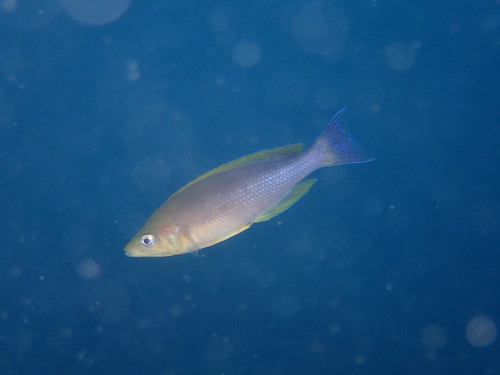
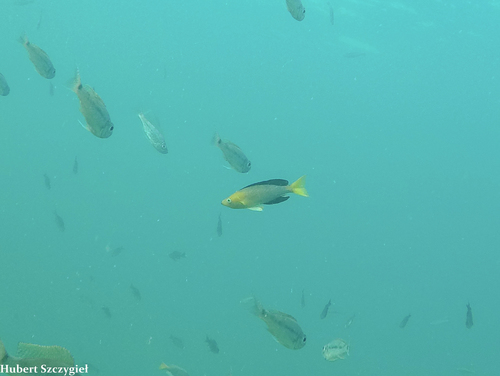
The striking feature is male polymorphism. Within one population, some males wear a blue caudal fin paired with a yellow dorsal, while others show the reverse — a yellow tail over a pale blue dorsal. This within-population dichromatism (most obvious in the caudal fin) is itself a diagnostic trait separating coloratus from the non-dichromatic C. zonatus. Males lack the distinct pearly or yellow body spots seen in C. microlepidotus and C. pavo, and they show no vertical bands on the flanks. Females and juveniles are the plain silvery-grey of a schooling planktivore, and males run larger and far more colorful than females — the everyday sexual dimorphism of the tribe.
Range & habitat
Cyprichromis coloratus is a Lake Tanganyika endemic confined to the lake's southern end, along the Zambian shore. Records run from the Kalambo River area near the Tanzania border south past Wonzye Point, Kasenga, Isanga Bay and Nkumbula Island toward Mbete Bay; it may also follow the southern Ulungu escarpment and could cross into Tanzanian waters. The IUCN puts its extent of occurrence at only about 571 km², a genuinely small range for a lake fish, though as a recently described species its true distribution may be wider than the surveyed sites suggest.
It lives exclusively over rocky substrate, hovering and cruising 1–5 m (3–16 ft) above the bottom rather than resting on it. The depth band runs from about 5 m down to at least 35 m (16–115 ft), with the fish most abundant around 15 m (50 ft). This is the open water immediately above and beyond deep rocky shores — the same blue-water zone shared by C. leptosoma, C. pavo and the 'leptosoma jumbo' form. Like the rest of the lake, the water here is hard and alkaline, with a stable pH in the high 8s and temperatures in the mid-70s Fahrenheit (roughly 24–27 °C).
Ecology & diet
Cyprichromis coloratus is a specialist zooplanktivore: the original description reports it feeds almost exclusively on cyclopoid copepodids — the juvenile stages of small copepod crustaceans — picked one at a time from open water with its highly protrusible, upturned mouth. FishBase places it at a trophic level of about 3.5, the expected value for a small carnivore working the plankton.
Ecologically, the cyprichromines are the cichlid lineage that left the rocks to exploit the pelagic plankton crop, and coloratus is part of that guild. Its dense, roaming schools convert drifting zooplankton into fish biomass close to the rocky shore, where that biomass in turn feeds the lake's mid-water and ambush predators — Tanganyika's open-water hunters such as Bathybates and the larger lamprologines patrol exactly this habitat. The fish's own modest size and fast turnover (FishBase rates its productivity high and its fishing vulnerability low) fit a short-lived forage species near the base of the predatory food web.
Behavior & breeding
Socially, coloratus lives a double life. Females and sub-adult males travel in conspecific schools of tens to hundreds, and these frequently merge with schools of related Cyprichromis into huge mixed-species aggregations that drift back and forth across a stretch of reef roughly 150–250 m long. Mature males, by contrast, drop out of the school to hold station: each defends a three-dimensional territory in open water above a particular large rock or boulder, and neighboring males pack these territories together into a lek-like array at depths of about 8–30 m (26–100 ft).
Reproduction follows the cyprichromine template — it is a maternal mouthbrooder, and its spawning behavior matches that documented for C. leptosoma by Ad Konings. A territorial male courts passing females from his patch of open water, bending his body and quivering his ventral fins; eggs are released a few at a time and taken straight into the female's mouth, with little or no contact with any surface. The female then broods the clutch alone for roughly three weeks before releasing free-swimming fry. Males are polygamous, spawning with multiple females over a season, which is what makes the lek of clustered male territories worthwhile.
In the aquarium
Cyprichromis are among the most rewarding open-water Tanganyikans to keep, and coloratus — sometimes still sold as a 'jumbo' or 'goldfin' type — is no exception, but it is a fish for the middle and upper water column, not a centerpiece for a small tank. Keep it as a shoal: a group of at least ten, with a male-to-female ratio around 1:2 or 1:3 so no single female is hounded. That argues for a long tank of at least roughly 90–110 gallons (about 350–400 L), prioritizing horizontal swimming length over height, with a few larger rocks to give subordinate fish refuge. Substrate is irrelevant to spawning, since these fish breed in open water, so aquascape for the rockwork and the swimming lane.
Water should mirror the lake: hard and alkaline, pH around 8–8.8, GH on the order of 15–25, and temperatures in the mid-70s °F (about 24–27 °C). Diet is easy — a varied mix of small frozen and dry foods stands in for the wild copepod diet. Two cautions recur across keepers and field references. First, this is a notorious jumper that uses open water to flee, so a tight, gap-free lid is essential. Second, despite the genus's gentle reputation, coloratus runs more assertive than the average Cyprichromis: it is best not mixed with delicate sand-sifters like Xenotilapia, though it coexists well with sturdier open-substrate cichlids such as Callochromis. The most common mistakes are keeping too few fish, housing them too shallow and short, and treating the genus as uniformly peaceful.
Conservation
Cyprichromis coloratus was assessed by the IUCN as Least Concern in 2025 (assessed 12 March 2025; assessor Y. Fermon). The reasoning is candid: its mapped range is small — an extent of occurrence of only about 571 km², which on area alone would fall within the Endangered thresholds — but no major, widespread threat has been identified, the species is likely under-surveyed, and Cyprichromis are typically abundant where they occur, forming schools of thousands. The assessment does flag two species-specific pressures: collection for the aquarium trade, which matters more for a range-restricted fish than a wide-ranging one, and pollution from agricultural and forestry runoff reaching its corner of the lake. The population trend is listed as unknown.
That "Least Concern" verdict sits inside a lake under real strain, and the honest framing is that the species itself looks secure while its home does not. Lake Tanganyika has been warming and mixing less; O'Reilly and colleagues (2003, Nature) estimated that warming-driven stratification cut primary productivity by roughly 20%, implying about a 30% drop in fish yields, and Cohen and colleagues (2016, PNAS) found that reduced mixing had shrunk the oxygenated benthic habitat in their study areas by some 38%. Shoreline development and sedimentation degrade the rocky littoral that coloratus depends on, and the lake's pelagic clupeid (Stolothrissa and Limnothrissa) and Lates fishery — which feeds four bordering nations — has been heavily pressed, prompting governance through the four-country Lake Tanganyika Authority and trial closed seasons (a May–August fishing ban). A rock-associated, shallow-to-mid-depth planktivore like coloratus is most exposed to two of these threads: warming that thins the plankton crop it eats, and sedimentation that smothers the rocky shores it lives over. The seasonal ban, intended for the food fishery, would also give this species protected time to reproduce. None of this currently elevates its Red List status, but it is the context in which a narrow-range endemic should be read.
Sources
- Eschmeyer's Catalog of Fishes: Cyprichromis coloratus (species record)
- FishBase — Cyprichromis coloratus summary
- GBIF — Cyprichromis coloratus
- Takahashi & Hori 2006, Description of a new Lake Tanganyikan cichlid fish of the genus Cyprichromis, J. Fish Biol. 68(Suppl. B):174-192
- Takahashi, Hori & Nakaya 2002, New species of Cyprichromis from Lake Tanganyika, Copeia 2002(4):1029-1036 (via ResearchGate)
- Cichlid Room Companion — Cyprichromis coloratus (public profile)
- tanganyika.si — Cyprichromis coloratus (habitat, breeding, aquarium notes)
- Fishipedia — Cyprichromis coloratus
- AquaticRepublic — Cyprichromis coloratus data sheet
- Practical Fishkeeping — New Cyprichromis cichlid described
- African Diving Ltd — blog on Cyprichromis coloratus and the 'jumbo' forms — community/anecdotal
- Cichlid Forum — Cyprichromis schooling and aggression discussion — community/anecdotal
- Reddit r/TanganyikanCichlid — breeding Cyprichromis — community/anecdotal
- IUCN Red List — Cyprichromis coloratus (Fermon 2025, Least Concern)
- O'Reilly et al. 2003, Climate change decreases aquatic ecosystem productivity of Lake Tanganyika, Nature (PubMed)
- Cohen et al. 2016, Climate warming reduces fish production and benthic habitat in Lake Tanganyika, PNAS
- Lake Tanganyika: Status, challenges, and opportunities for research (J. Great Lakes Research)
- ISS — Overfishing forces Zambia's third Lake Tanganyika fishing ban