

Taxonomy & naming
George Albert Boulenger described this fish in 1898 from specimens collected by J. E. S. Moore in Lake Tanganyika, placing it in the catch-all genus Paratilapia as Paratilapia leptosoma. The name is descriptive rather than poetic: leptos (slender) and soma (body), for a cichlid built more like a minnow than a typical thick-bodied Tanganyikan. The species was shuffled to Limnochromis by Regan in 1920, then moved to the newly erected genus Cyprichromis by Scheuermann in 1977; Poll later (1986) split the torpedo-shaped Cyprichromini into Cyprichromis proper and Paracyprichromis and formalized the tribe. Eschmeyer's Catalog of Fishes and FishBase both carry Cyprichromis leptosoma (Boulenger, 1898) as the valid name, with Paratilapia leptosoma and Limnochromis leptosoma as historical synonyms.
C. leptosoma is the smallest and most slender member of its genus and, as the genus's type species, anchors a small flock of open-water specialists that also includes C. microlepidotus, C. pavo, C. coloratus and C. zonatus. The hobby's situation is messier than the literature. Several fish sold as "Cyprichromis leptosoma" — notably the larger "leptosoma jumbo," plus trade forms labelled Kigoma, Kitumba and others — are widely regarded by Konings and others as distinct, mostly undescribed species rather than true C. leptosoma. When weighing a care sheet or a size claim, it is worth asking which fish is actually being discussed.
Appearance
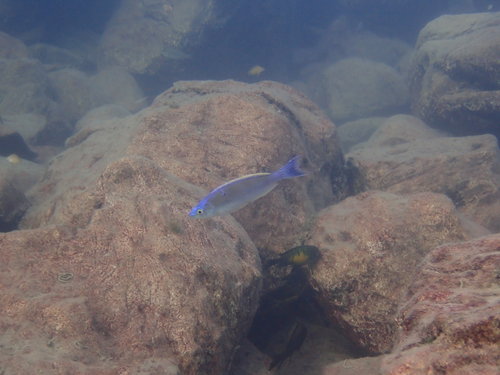
This is a long, pencil-thin cichlid. Reported maximum size varies with who is measuring and which population is meant: FishBase lists 11 cm (4.3 in) total length, Konings and the IUCN give a maximum of about 10 cm (3.9 in), and experienced keepers often cite a body length closer to 8 cm (3 in) for true leptosoma — with the separate "jumbo" form reaching perhaps 12 cm (4.7 in). Meristics are consistent: roughly 12-13 dorsal spines, 15-16 dorsal soft rays, three anal spines, and 35-37 vertebrae in a fusiform body.
Sexual dimorphism is stark. Males color up over months into vivid blues and yellows, frequently with brightly tipped pelvic fins and tail patterns that vary by locale; females stay a plain silvery-brown that serves as camouflage in the shoal. A striking quirk is male polychromatism — within a single population, blue-tailed and yellow-tailed males can swim side by side, a pattern documented across several Cyprichromis and thought to be tied to female mate choice and sexual selection. The combination of slender build, bright male finnage and that within-population color variation separates leptosoma from its stockier or differently marked congeners.
Range & habitat
Cyprichromis leptosoma is a lacustrine endemic — found only in Lake Tanganyika and nowhere else. Sources draw the range slightly differently: the Cichlid Room Companion places it along the eastern shore between Mpulungu (Zambia) and Kigoma (Tanzania), while the IUCN's 2025 assessment maps it through the southeastern lake from Mahale in Tanzania to Kasakalawe in Zambia, and notes it may also occur on the less-surveyed Congolese western shore. Either way it is a fish of the eastern and southern rocky coasts, present as several distinct geographic color variants.
Despite the "open-water" billing, it is not truly pelagic in the oceanic sense. As Konings stresses, these fish live only where rocky shores exist: they hover in the water column just off the reef, retreat into the rocks when threatened, and raise their young there, which is exactly why so many isolated, locally distinct populations have evolved. Depth reports run from about 5 to 30 m (16-100 ft), with the IUCN citing a need for rocky habitat at least 10 m (33 ft) deep. In situ the water is warm (roughly 24-27 °C / 75-81 °F), hard, and strongly alkaline, with pH commonly given between about 7.8 and 9.0 — the demanding rift-lake chemistry shared by all Tanganyikans.
Ecology & diet
Cyprichromis leptosoma is a drifting zooplanktivore. It hangs in midwater in a characteristic head-down "headstander" posture and picks small crustaceans and other plankton from the column with a highly protrusible mouth; FishBase places it at a trophic level of about 3.5 and notes it will also take small shelled prey. Because it tracks the daily vertical movements of plankton, it is among the Cyprichromis species often seen near the surface.
Its ecological signature is the school. Aggregations number from hundreds to many thousands of individuals, and leptosoma frequently mixes with congeners such as C. microlepidotus and the undescribed "jumbo," as well as Paracyprichromis species. Molecular work on the Cyprichromini reads this lineage as a stepwise evolutionary march toward open water — from the more substrate-bound Paracyprichromis through to the genuinely column-dwelling leptosoma and microlepidotus. The fish sits in the middle of the food web: a dense, accessible prey base for larger Tanganyikan predators, most famously the deep-water Cyphotilapia (frontosa), which makes leptosoma a natural forage species in the lake.
Behavior & breeding
Breeding is where this fish earns its reputation. C. leptosoma is a maternal mouthbrooder that spawns entirely in open water, with no nest or substrate involved. Males defend three-dimensional territories in the column — a lek-like array of invisible "airspace" boxes above the rocks — and court passing females with a head-down, fin-flaring display. When a female responds, she snaps at the male's brightly tipped pelvic fins; he releases milt, she lays an egg or two, and she immediately takes the eggs into her mouth, fertilizing them there. The sequence repeats until her small clutch is complete. In the wild the cycle tends to follow the lunar month.
The eggs are remarkable. Keepers and researchers consistently note they are among the largest cichlid eggs measured, which forces a trade-off: clutches are tiny, often just nine to twenty eggs. After roughly three weeks of incubation the female releases unusually large, fully capable fry — about 15-20 mm (0.6-0.8 in) — that can take zooplankton at once and, in the lake, sometimes shelter near the nests of predatory Lepidolamprologus, which ignore the harmless cyps while driving off other intruders. Genetics adds a twist to the tidy picture of one male per brood: a 2016 study of a mixed Cyprichromis breeding school found multiple paternity in 18 of 22 leptosoma broods (averaging well over two fathers per clutch), far more than in the closely related C. coloratus from the same school — most plausibly the work of sneaker males slipping fertilizations into the open-water spawns.
In the aquarium
Cyprichromis leptosoma is genuinely rewarding but not a casual community fish, and several common care-sheet claims need qualifying. It is peaceful toward bottom-dwelling Tanganyikans and makes an excellent dither fish, but it is not aggression-free: dominant males will harass rivals, and keepers report a single alpha bullying other males into hiding, an effect made worse in tanks too short to break up sight lines. The cure is a real group (eight or more, with extra males or a female-skewed ratio) and length rather than mere gallons — most experienced keepers want a tank of at least 4 ft / ~130 cm (around 55 US gal) so the fish have horizontal swimming room and the school can spread out. Tank height matters too; very shallow tanks (a foot deep) are widely considered marginal.
Water must be hard and alkaline (pH roughly 8.0-9.0) and clean, as these fish are sensitive to deteriorating quality. Two practical mistakes recur. First, they are notorious jumpers, so a tight-fitting cover is mandatory. Second, do not feed at the water's surface: like several Tanganyikans, they can gulp and trap air and lack an easy way to expel it, leading to buoyancy problems — so sink the food. They can be picky at first but adapt to quality flake and small pellets, with brine shrimp a welcome supplement. Breeding is achievable but slow: fish take roughly a year to mature, spawns are small, and brooding females are fragile-mouthed enough that stripping fry, if done at all, demands a very gentle hand.
Conservation
The IUCN Red List assessed Cyprichromis leptosoma as Least Concern in 2025 (reaffirming a 2006 listing), citing its relatively widespread distribution in the southeastern lake and the absence of any major lake-wide threat. The population trend is recorded as unknown. As a Tanganyika endemic, though, it is only as secure as the lake's nearshore rocky habitat: the assessment flags shoreline sedimentation from agriculture and deforestation, over-collection for the aquarium trade, and incidental bycatch from non-selective and illegal fishing as pressures whose true impact is not well quantified. A seasonal fishing ban trialled on the lake could benefit the species if maintained, and better population monitoring is the main research need.
Sources
- Eschmeyer's Catalog of Fishes (Fricke, Eschmeyer & Van der Laan, eds.) — California Academy of Sciences
- FishBase — Cyprichromis leptosoma (Boulenger, 1898)
- IUCN Red List — Cyprichromis leptosoma (Haambiya, 2025, e.T60488A47192894)
- Cichlid Room Companion — Cyprichromis leptosoma (T. Andersen, profile)
- Brandstätter, Salzburger & Sturmbauer (2005) — Mitochondrial phylogeny of the Cyprichromini, Molecular Phylogenetics and Evolution 34:382-391
- Anderson et al. (2016) — Same school, different conduct: rates of multiple paternity in Cyprichromis spp., Ecology and Evolution 6:37-45
- Practical Fishkeeping — How do Cyprichromis breed in the wild? (M. Clarke)
- Sam Borstein's Cichlids — Cyprichromis leptosoma (Sardine Cichlid)
- Aquarium Glaser GmbH fish archive — Cyprichromis leptosoma "Mpulungu" (F. Schäfer)
- The Aquarium Wiki — Bright-Finned Slender Cichlid (Cyprichromis leptosoma)
- NippyFish — Keeping and Spawning Cyprichromis leptosoma
- Cichlid-Forum thread — Cyprichromis leptosoma aggression — community/anecdotal
- Cichlid-Forum thread — Experience with Cyprichromis as tank mates — community/anecdotal
- Cichlid-Forum thread — Cyprichromis breeding (holding & stripping) — community/anecdotal
- Reddit r/Cichlid — Can I keep Cyprichromis in a 4x1x1 ft tank? — community/anecdotal