

Taxonomy & naming
George Albert Boulenger described this cichlid in 1908 as Paratilapia compressiceps, working from a single specimen (the holotype, BMNH 1908.10.27.59) collected in Lake Nyasa — the older name for Lake Malawi. It was long shuffled through the catch-all genus Haplochromis, and most older aquarium literature still lists it as "Haplochromis compressiceps." Eccles and Trewavas erected the genus Dimidiochromis for it and a few relatives in their 1989 revision of Malawi's haplochromine genera, and that placement has held: Eschmeyer's Catalog of Fishes lists it as valid as Dimidiochromis compressiceps (Boulenger, 1908) in the family Cichlidae, subfamily Pseudocrenilabrinae.
The names are unusually literal. The species epithet compressiceps means "compressed head," a nod to the blade-like profile that defines the fish; the genus name Dimidiochromis blends a root meaning "divided in halves" with chromis, an old word for a perch-like fish. In the trade and the literature it is universally the "Malawi eyebiter." It is one of roughly four Dimidiochromis species and sits among the open-water and weed-bed predators of Malawi's enormous haplochromine flock, distinct from the rock-dwelling mbuna and the plankton-picking utaka it preys upon.
Appearance
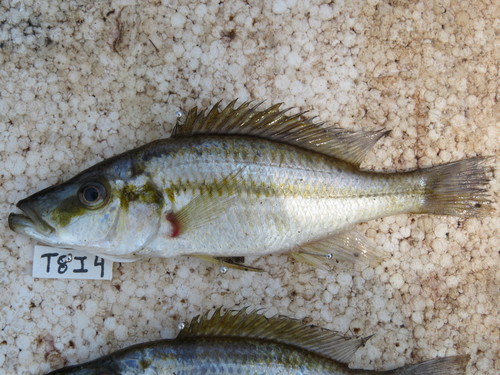
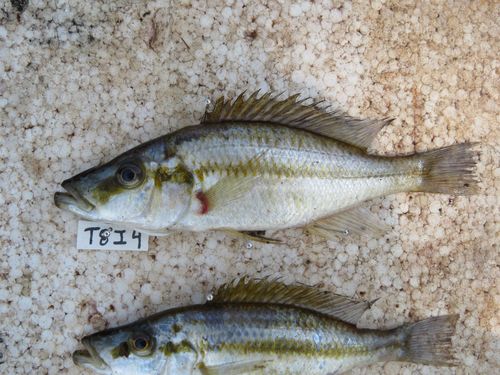
The eyebiter is one of the most extreme body shapes in Lake Malawi. It is strongly laterally compressed — so thin from side to side that, viewed head-on, it nearly disappears — and tapered at both ends, giving it a javelin-like silhouette built for lunging. FishBase records a maximum of about 23 cm (9 in) total length, citing the CLOFFA checklist; hobby and import sources commonly cite males to roughly 25 cm (10 in) and females a little smaller, around 20 cm (8 in), so the honest figure is a fish that finishes somewhere in the 8–10 in range with males the larger sex.
Most of the time the fish is plain silver, which is exactly the point: a non-breeding eyebiter is meant to be invisible against open water and pale weed. The sexes are easy to tell once mature — males develop a much larger anal fin marked with yellow-orange egg spots (ocelli), and a single dominant male will flush electric blue across the head and flank with fiery orange edging on the dorsal and anal fins when in breeding condition. Females and subordinate males stay silver and are treated as females by the breeding male. A distinctive population around Chizumulu Island carries a yellowish base color rather than silver. The lookalike to watch for is the congener Dimidiochromis strigatus, which has a similar but less exaggerated shape, more green in the male, and a red patch behind the pectoral fin; it is sometimes sold as compressiceps.
Range & habitat
Dimidiochromis compressiceps is widespread across Lake Malawi and is essentially a lake-wide animal, also occurring in Lake Malombe and the upper Shire River, the lake's outflow. The IUCN assessment lists it from Malawi, Mozambique and Tanzania, with an estimated extent of occurrence around 30,000 km² and area of occupancy near 3,150 km². It has been introduced to Israel, but its native story is a Malawi-basin one.
Its true habitat is the weed bed. The eyebiter is a fish of shallow, vegetated water, most strongly tied to underwater meadows of Vallisneria — ribbon-leaved aquatic plants that form swaying underwater grass along sheltered sandy shores. Konings associated the species with stands of higher plants, and Professor George Turner of Bangor University, who has collected the fish in Malawi, has stated that the specimens he gathered came from Vallisneria beds. The exception again is Chizumulu Island, where the yellow form is found over rock. Like the rest of the Malawi fauna, it lives in hard, alkaline water — FishBase gives a pH around 8 and temperatures of roughly 22–28 °C — that biotope chemistry the lake is famous for, and a key reason the fish needs the same in captivity.
Ecology & diet
This is an ambush piscivore, and its anatomy is the strategy. Standing head-down and motionless among the vertical ribbons of Vallisneria, its compressed, vegetation-colored body blends into the plants until a small fish drifts within range, at which point it lunges with a large, highly protrusible mouth. The narrow head lets it aim both eyes forward at once — an unusual degree of binocular vision for a cichlid — which suits a predator that must judge a single precise strike rather than chase prey down. FishBase places it at a high trophic level of about 4.2 and describes it feeding chiefly on small fishes, especially juvenile utaka (open-water Copadichromis-type plankton feeders) and other shoaling species, swallowed whole.
The eye-biting reputation belongs in this section because it is so often misunderstood. The common name traces to Wolfgang Wickler, who in 1966 reported fish eyes among the stomach contents of wild specimens. Konings, citing decades of observation in the lake, has written that targeted eye-eating has never actually been seen there — the fish are simply head-first ambush predators of whole small fish. So in the wild the "eyebiter" is better read as a striking name attached to an isolated dietary record than as a description of normal behavior.
Behavior & breeding
Out of breeding condition the eyebiter is, for a large predator, fairly easygoing toward fish too big to eat — predators of this kind are generally not strongly territorial. That changes completely when a male comes into color. Like essentially all Malawi haplochromines, D. compressiceps is a non-pair-forming, maternal (female-only) mouthbrooder. A dominant male turns blue, clears a shallow spawning pit or low sand bower — preferably tucked into a Vallisneria bed, sometimes beside a sunken log or under an overhanging rock — and defends it, courting passing ripe females with a quivering, circling display.
Spawning follows the classic egg-spot ritual: the female lays a few eggs on the sand, immediately takes them into her mouth, then nips at the dummy egg spots on the male's outstretched anal fin, drawing in his milt to fertilize the clutch she is already carrying. A female ends up holding on the order of thirty eggs and broods them in her mouth for roughly a month without feeding, eventually releasing the fry into the cover of weed and the schools of juvenile utaka. Aquarium keepers corroborate the wild picture and add a hard-won warning: in confined space the dominant male is relentless, banishing rival males and even the smallest females from his territory, and a published keeping account by Jeremy Gay describes inferior fish being battered until removed. Crowding many adults diffuses that aggression; keeping a male with only a few females in a small tank concentrates it on the weakest fish.
In the aquarium
The eyebiter is a rewarding but space-hungry fish, and most of the trouble keepers run into comes from under-sizing the tank. Because adults reach 8–10 in and males defend long territories near the surface, experienced keepers on MonsterFishKeepers and Australian cichlid forums converge on a six-foot tank of at least 100 gallons, ideally taller than average, decorated as the fish actually lives: a sand substrate, long strands of (giant) Vallisneria or a tall plant analog, and only sparing rockwork. Maintain hard, alkaline Malawi water — pH comfortably above 7.5 — at roughly 75–82 °F (24–28 °C). It eats readily, taking quality cichlid pellets, frozen and meaty foods; it is a predator, so anything that fits in that protrusible mouth is food, and tankmates should be large.
The right company is calm, large "hap"-type cichlids — Nimbochromis, Cyrtocara, Protomelas and similar — not the boisterous mbuna. Forum experience is consistent on a counterintuitive point: despite the menacing name and shape, the eyebiter is laterally thin with little bulk and often loses fights, and keepers repeatedly report male compressiceps killed by aggressive mbuna like Labeotropheus and Pseudotropheus rather than the other way around. As for the eyes — the wild record says it does not target them, but several aquarists insist it does happen in tanks, including Gay, who described an isolated fish losing an eye with no other possible culprit. The cautious reading: it is not a dedicated eye-eater, but a hungry compressiceps with smaller tankmates is a genuine risk. Finally, avoid the OB (orange-blotch) and albino forms sold as compressiceps; OB individuals are hybrids that do not occur in the wild, and an albino handicaps a fish whose whole living is made by precise vision.
Conservation
The IUCN Red List assesses Dimidiochromis compressiceps as Least Concern (assessment dated 22 June 2018, by Konings and colleagues, amended in 2019 to add distribution data). The reasoning is straightforward: the species is widespread across Lake Malawi, Lake Malombe and the upper Shire, its population is considered stable, and it occurs inside Lake Malawi National Park. The only pressures the assessment flags are minor — incidental capture by subsistence hook-and-line fishermen, who do not target it, and steady but low-level extraction for the aquarium trade, where it is sold as "Haplochromis Compressiceps." Population monitoring is the recommended action; no specific threat is judged to endanger it.
That clean bill of health belongs to the fish, not to its lake. The Chavula et al. (2023) review of the Lake Malawi/Niassa/Nyasa basin (Journal of Great Lakes Research 49(6):102241) documents a water body under real strain: over-fishing and the well-known collapse of the chambo tilapia fishery, heavy sediment and nutrient loading washing off deforested catchments, roughly 0.7 °C of warming in the shallow upper layer that strengthens stratification and trims the lake's productivity, and a growing risk from invasive species. Those pressures bear directly on the eyebiter's world. As a shallow, nearshore, weed-bed specialist, it depends on exactly the inshore habitat most exposed to sedimentation, shoreline development and nutrient enrichment — the Vallisneria meadows that silt and turbidity degrade first — and as a predator near the top of a local food chain (trophic level ~4.2), it ultimately rides on the utaka and small fishes that a less productive, warmer lake supports in smaller numbers. So the honest summary is a divided one: the species itself is secure today, but the shallow Malawi habitat it is so tightly built for is not, and a fish this specialized has little slack if those weed beds keep thinning.
Sources
- FishBase — Dimidiochromis compressiceps (Malawi eyebiter)
- Eschmeyer's Catalog of Fishes — Paratilapia/Dimidiochromis compressiceps (species record)
- GBIF — Dimidiochromis compressiceps (occurrence and taxon record)
- iNaturalist — Malawi eyebiter (Dimidiochromis compressiceps)
- IUCN Red List — Dimidiochromis compressiceps (Least Concern; Konings et al. 2019, amended 2018 assessment)
- Chavula et al. 2023 — Lake Malawi/Niassa/Nyasa basin: Status, challenges, and research needs (J. Great Lakes Research 49(6):102241)
- Gay, J. 2020 — "A feast for the eyes": keeping and breeding Dimidiochromis compressiceps (Fishkeeping News)
- Aquarium Glaser (Frank Schäfer) — Dimidiochromis compressiceps fish archive profile
- Aqua-Fish.net — Malawi eye-biter, Dimidiochromis compressiceps care profile
- Cichlid Room Companion — Dimidiochromis catalog (genus and species index)
- Cichlid-Forum.com — "Who's kept Malawi Eye Biter — Dimidiochromis compressiceps" thread — community/anecdotal
- Australian Cichlid Enthusiasts Forums — Dimidiochromis compressiceps (Malawi Eye Biter) thread — community/anecdotal
- MonsterFishKeepers.com — Dimidiochromis compressiceps keeping thread — community/anecdotal
- Reddit r/Cichlid — predator-hap grow-out stocking with Dimidiochromis compressiceps — community/anecdotal