Taxonomy & naming
The German ichthyologist Ernst Ahl described this fish from a specimen taken near Langenburg, on the northern Tanzanian shore of what was then called Lake Nyasa, publishing the name Haplochromis kiwinge in the proceedings of the Berlin natural-history society. The original description carries a date of 1926, though the volume may not have appeared until 1927 — a small bibliographic wrinkle that explains why you will see both years attached to the name. Eschmeyer's Catalog of Fishes settles the matter by treating it as valid as Dimidiochromis kiwinge (Ahl 1926), the holotype still held in Berlin's Zoological Museum. The species epithet is not Latin or Greek but a local Malawian name for the fish; 'Binga,' 'Kiwinge,' and 'Liyani' are among the Chichewa and regional names that have followed it into the literature.
For decades the fish sat in the sprawling catch-all genus Haplochromis, the bucket into which generations of taxonomists dropped Lake Malawi's bewildering variety of open-water cichlids. The genus Dimidiochromis was erected by Eccles and Trewavas in their 1989 revision of the Malawian haplochromine genera, and it now holds a small group of elongate, predatory species — the famous eyebiter Dimidiochromis compressiceps among them. The name Dimidiochromis, from the Latin for 'halved,' refers to the dark lateral stripe that splits the body lengthwise in members of the genus. One older name, Haplochromis fuelleborni, also coined by Ahl, was later recognized by Trewavas as the same fish and is treated as a synonym. Within the lake's celebrated species flock, kiwinge belongs to the assemblage that ichthyologists informally call the 'haps' — the larger, often piscivorous open-water cichlids, as distinct from the rock-grazing mbuna.
Appearance
This is an elongate, laterally compressed fish built along the lines of a pursuit predator rather than an ambusher. FishBase gives a maximum of about 12 inches (30 cm) total length and a published weight near 18 ounces (515 g), but field and aquarium observers regularly report larger males: the malawi.si biotope archive lists males slightly over 12 inches (30 cm) with females close behind at around 11 inches (27 cm), and experienced keepers on cichlid-forum.com describe males 'easily' exceeding 13 inches (33 cm). The honest summary is that an adult male is a foot-plus of muscular, deep-flanked cichlid, and the size figure you cite depends partly on whether you are measuring wild fish or well-fed captives.
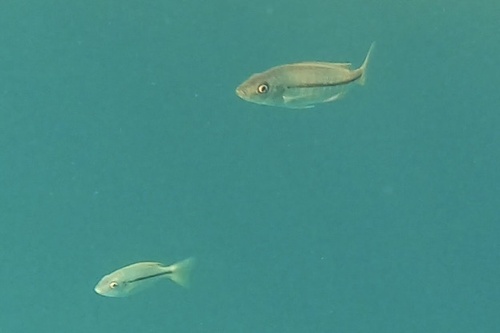
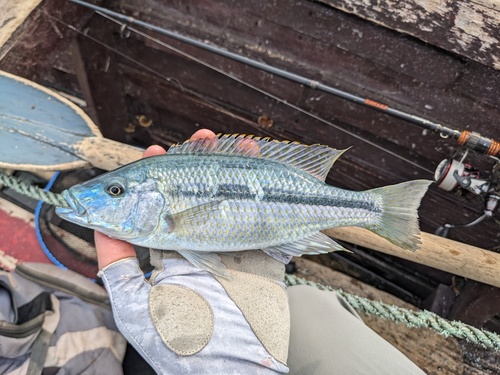
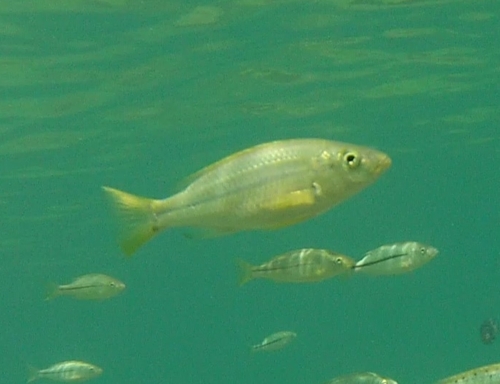
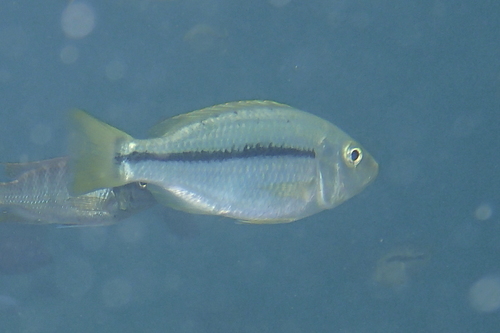
Out of breeding dress the fish is understated — silvery with a greenish sheen along the back, the long dark midline stripe that gives the genus its name running the length of the flank. Breeding males are the showpiece: they intensify into metallic blues and greens across the head and body, with red or orange tints in the fins. Sexual dimorphism is mostly a matter of color and a slight size edge to the males; females and subadults stay in the silvery-green livery. The cleanest way to separate kiwinge from its better-known congener, the eyebiter D. compressiceps, is build and behavior — the eyebiter is even more blade-thin and a sit-and-wait predator of the weed beds, while kiwinge is a comparatively robust, perpetually cruising mid-water hunter.
Range & habitat
Dimidiochromis kiwinge is a lacustrine endemic, found only in Lake Malawi and the small, shallow Lake Malombe just downstream of it on the Shire River. Within Lake Malawi it is distributed lake-wide, recorded along the Malawian, Mozambican, and Tanzanian shores, which is why all three nations appear in its IUCN range. It is a fish of the shallow, productive margins rather than the deep open lake: biotope sources place it mainly in the upper few meters down to roughly 50 feet (15 m), over sediment-rich shoreline zones where sand and scattered rock meet.
Its relationship to substrate is genuinely intermediate, and the sources reflect that. FishBase notes it is 'usually encountered near rocks' but also forms schools offshore; Konings and the malawi.si archive describe a fish that swims constantly in mid-water yet needs open sand for breeding, where males excavate their bowers. That combination — patrolling the water column above a sand-and-rock interface near shore — is what makes kiwinge a sand-and-weed-margin predator rather than a true rock-dweller or a deep open-water specialist. The water it lives in is the warm, hard, alkaline water characteristic of Lake Malawi: a stable pH around 7.7–8.6, moderate to high carbonate hardness, and surface temperatures broadly in the high 70s Fahrenheit (around 24–28°C). The lake itself is permanently stratified, with oxygenated, life-rich water confined to roughly the upper 300 feet (about 100 m) — the zone this shallow-water predator occupies.
Ecology & diet
Kiwinge is, in the words of the IUCN assessment, 'the most common piscivore of the shallow water in Lake Malawi' — a small but consequential top predator of the inshore community. Its diet is dominated by small fishes, above all juvenile utaka (the open-water Copadichromis and relatives) and the lake sardine, Engraulicypris sardella, a slim silver cyprinid that schools in vast numbers and anchors much of the lake's pelagic food web. It is an opportunist within that piscivorous niche, however, and biotope accounts add snails and larger invertebrates to the menu; the rule of thumb keepers repeat — that it will eat anything it can fit in its mouth — is a fair description of its wild behavior too.
What sets kiwinge apart ecologically is how it hunts. Rather than lurking, it ranges through mid-water, and both FishBase and hobby observers describe it hunting in pairs or in large coordinated groups — packs that herd prey toward the surface, where escape routes run out. This roving, pack-hunting habit is unusual among the genus, whose other members are more bottom-oriented, and it ties the species tightly to the abundance of small schooling prey along the shore. As a shallow-water predator dependent on utaka and sardine, kiwinge sits one link above the very fishes that the human fishery targets most heavily — a position that matters for its conservation outlook.
Behavior & breeding
Like the overwhelming majority of Lake Malawi cichlids, D. kiwinge is a maternal mouthbrooder: the female incubates the fertilized eggs and then the developing fry in her mouth, releasing them only when they can fend for themselves. The IUCN notes that mouthbrooding females stay in mid-water and release their fry there, consistent with the species' open-water lifestyle, and biotope accounts report maternal care continuing for at least three weeks after the fry are first let go. Breeding has been observed in both sandy and rocky settings, which fits a fish that lives at the boundary between the two.
The male's role is territorial display. Where the bottom is sand, males build bowers — cleared, crater-like spawning arenas — and they tend to cluster these bowers together, so that many males display in close proximity in what amounts to a loose lek. Where rock is available, males instead defend rock-based territories. Either way, the breeding season is when this fish earns its reputation: keepers across forums and the cichlid-forum.com species writeup agree that kiwinge can be markedly territorial and aggressive while spawning, but that the aggression largely subsides once the season passes. That seasonal pulse of aggression, layered on top of a normally bold, fast-moving temperament, is the behavioral signature aquarists need to plan around.
In the aquarium
This is a specialist's fish, and an uncommon one in the trade — not because it is delicate, but because of its size and pace. It is, by the consistent testimony of keepers, rarely seen in the hobby; when it does appear it is usually as an unassuming silvery juvenile that grows into a foot-plus predator needing serious room to roam. The realistic floor is a long, large tank: hobby sources that quote a 75-gallon (about 284 L) minimum are describing the bare survivable container, while keepers and biotope references who know the adult fish push toward a base footprint of six feet or more and tanks on the order of 250 gallons (around 1,000 L). The footprint matters more than sheer volume — this is a fish that wants horizontal swimming distance, not height.
Set it up the way the lake does: a sand bottom with some rock structure, hard alkaline water, and strong filtration to carry the waste load of a large carnivore. It will eat any tankmate small enough to swallow, so companions must be similarly sized, robust Malawi 'haps' or peacocks of comparable temperament — never small or timid fish, and never as a dither-fish over mbuna it will outgrow and harass. Keepers note two practical truths worth repeating: a well-fed kiwinge is noticeably calmer than a hungry one, so a protein-rich diet and routine feeding take the edge off its predatory drive; and its aggression spikes hard at breeding time, so a settled adult that has been peaceable for months can turn on its neighbors when a male starts clearing a bower. Successful aquarium spawning is reported but uncommon. None of this makes it a hard fish to keep alive — it makes it a fish that demands honesty about space before you buy the cute juvenile.
Conservation
On its own terms, Dimidiochromis kiwinge is not in trouble. The IUCN Red List assesses it as Least Concern (assessed 2018, published 2019 as an amended version of the 2018 assessment; assessors Konings, Kazembe and Makocho), on the strength of its lake-wide distribution across both Malawi and Malombe and the absence of any major species-specific threat. It is a common fish, it occurs inside Lake Malawi National Park, and — notably — it is not a target of the ornamental trade. What it is, the assessment stresses, is one of the most important food fishes of the shallow water: prized for its flavor and, because it is too fast for nets, taken largely on hook and line. Overfishing is flagged as the one potential threat to the species, and with a generation length of just two to three years it is a fish whose populations turn over quickly.
That individually reassuring status sits inside a lake under real and growing strain, and a shallow-water, shoreline predator like kiwinge is exposed to exactly the pressures bearing down hardest. The basin-scale review by Chavula and colleagues (2023) documents a Lake Malawi/Niassa/Nyasa system suffering 'severe adverse impacts' from combined human and climatic stressors, prioritizing three issues: declining fishery health, invasive species, and climate change. Catches of the iconic chambo tilapia have collapsed under fishing pressure and the loss of shallow breeding habitat. Deforested catchments are pushing sediment and nutrients into the inshore zone, and siltation is directly destroying fish habitats and altering the shallow waters where kiwinge hunts and breeds. The same review records a warming signal that is sharply uneven with depth — roughly 0.18°C of warming in the deep water against about 0.7°C in the shallows over six decades — which strengthens the lake's already permanent stratification and tends to choke off the upward mixing of nutrients that ultimately feeds the inshore food web. For a predator that depends on dense schools of utaka and lake sardine in precisely that productive surface layer, the threats converge: it is exposed both to direct fishing pressure on a tasty, easily targeted fish and to the slower erosion of the prey base beneath it through warming, sedimentation, and the introduction of invasive species into the catchment. The species is genuinely Least Concern today; the lake it depends on is not in equally good health, and that is the honest frame for its future.
Sources
- Eschmeyer's Catalog of Fishes — Haplochromis kiwinge / Dimidiochromis kiwinge (species record)
- FishBase — Dimidiochromis kiwinge (field guide: size, weight, biology, distribution)
- FishBase — Dimidiochromis kiwinge (summary)
- GBIF — Dimidiochromis kiwinge (Ahl, 1926) (occurrences, taxonomy, vernacular names)
- Konings, A. — Dimidiochromis kiwinge species profile, Cichlid Room Companion (taxonomy, synonym, conservation note)
- malawi.si — Dimidiochromis kiwinge 'Zimbawe Rock' (biotope, depth, breeding, diet, aggression)
- Eccles, D.H. & Trewavas, E. (1989), Malawian Cichlid Fishes: The Classification of Some Haplochromine Genera (genus Dimidiochromis erected) — cited via IUCN bibliography
- Chavula, G.M.S. et al. (2023), 'Lake Malawi/Niassa/Nyasa basin: Status, challenges, and research needs', Journal of Great Lakes Research 49(6):102241
- Chavula et al. (2023) — bibliographic record and reference list (DOI 10.1016/j.jglr.2023.102241)
- IUCN Red List — Dimidiochromis kiwinge (Konings, Kazembe & Makocho 2019; Least Concern)
- Cichlid Fish Forum (cichlid-forum.com) — 'Dimidiochromis kiwinge from Lake Malawi' (pack hunting, bowers, size, seasonal aggression) — community/anecdotal — community/anecdotal
- MonsterFishKeepers.com — 'Some shots of my Dimidiochromis kiwinge' (keeper account of temperament/tankmates) — community/anecdotal — community/anecdotal
- Australian Cichlid Enthusiasts Forums — 'Dimidiochromis Kiwinge' (availability/rarity in the hobby) — community/anecdotal — community/anecdotal
- Reddit r/Cichlid — 'Dimidiochromis Kiwinge male starting to color up' (breeding coloration) — community/anecdotal — community/anecdotal
- Wet Spot Tropical Fish — Dimidiochromis kiwinge (trade minimum tank size & tankmate guidance)
- Michigan Cichlid Association forum — Dimidiochromis kiwinge (rarity/uncommon in hobby) — community/anecdotal — community/anecdotal