
Taxonomy & naming
Charles Tate Regan described this fish in 1922 as Haplochromis strigatus, in his foundational survey "The Cichlid Fishes of Lake Nyassa" (Proceedings of the Zoological Society of London), working from specimens taken at Domira Bay. The type material survives in the Natural History Museum, London, where Eccles and Trewavas designated a lectotype (BMNH 1921.9.6.129) in their 1989 reassessment of the Malawian haplochromine genera. That same 1989 work moved the species into the newly erected genus Dimidiochromis, where the Catalog of Fishes and FishBase both keep it today as the valid Dimidiochromis strigatus (Regan, 1922), in family Cichlidae, subfamily Pseudocrenilabrinae, tribe Haplochromini.
The genus name nods to the look of these fishes: "dimidio" derives from the Latin for divided in half, a reference to a body that often reads as split lengthwise by a dark stripe. Dimidiochromis is a small genus of four large predatory cichlids from the Malawi region: alongside strigatus sit D. compressiceps (the Malawi eye-biter), D. dimidiatus and D. kiwinge. In the aquarium trade strigatus travels under the catch-all marketing name "Haplochromis Sunset," a holdover from the decades when most open-water Malawi predators were lumped into Haplochromis.
Appearance
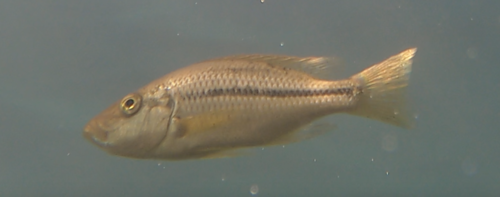
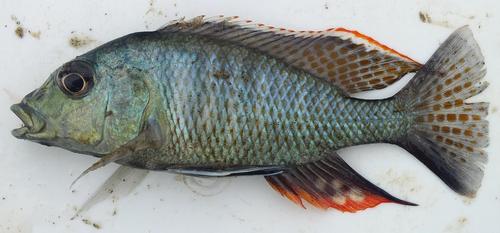
This is a long, laterally compressed cichlid with a large, sharply oblique mouth built for engulfing prey. The defining field mark is a single dark mid-lateral stripe running the length of the flank, set against a silvery to golden ground; breeding males warm up considerably, which is where the "Sunset" trade name comes from. Eccles and Trewavas separated it from the similar D. kiwinge by its deeper body and a rather prominent premaxillary pedicel, which gives the dorsal profile of the head a slightly concave dip above the eye.
Reported size depends on whether you trust museum measurements or aquarium experience, and the two disagree a little. FishBase lists a maximum of 24.4 cm (about 9.6 in) total length; specialist habitat sources put males at roughly 25 cm (10 in). Hobby accounts often note that captive fish more typically settle around 15 cm (6 in), with the largest reaching the upper figure. Females run noticeably smaller, on the order of a quarter shorter than males, and stay plainer in color. Males are both the larger and the more vividly marked sex, especially when in breeding condition.
Range & habitat
Dimidiochromis strigatus is endemic to the Lake Malawi/Niassa/Nyasa system. Its range covers Lake Malawi itself, the smaller downstream Lake Malombe, the upper and middle Shire River that drains the lake, and the lagoons and river mouths around the shore. The IUCN puts its estimated extent of occurrence near 30,000 km² and its area of occupancy around 3,150 km², a wide spread for a single lake basin.
What makes the species worth a second look is where in the lake it lives. Rather than the rocky reefs that dominate the Malawi cichlid imagination, strigatus is a fish of shallow, sediment-rich bays over sand, usually where aquatic plants such as Vallisneria grow. Konings-derived habitat data place it at depths of roughly 1 to 15 m (3 to 50 ft), and it is frequently seen in barely more than a meter of water. It swims in midwater rather than hugging the bottom. The in-situ chemistry is the hard, alkaline, mineral-rich water characteristic of the lake, warm and stable year-round.
Ecology & diet
This is an open-water predator. In the wild it hunts small fishes, with the juveniles of utaka (the open-water Copadichromis-group cichlids) repeatedly named as prey, and it supplements that with invertebrates. FishBase assigns it a trophic level near 3.8, squarely in the predatory range. There has been some genuine back-and-forth in the literature over exactly how piscivorous it is: stomach-content analyses of wild fish turn up both small fish and a meaningful share of invertebrates, so it is best described as a fish-leaning generalist carnivore rather than an obligate fish-eater.
The large oblique mouth is the giveaway. A midwater hunter in shallow vegetated bays is well placed to ambush the swarms of small fish that use weed beds as nursery habitat, and strigatus appears to fill exactly that role in the inshore community: a mobile predator linking the productive littoral plant beds to the larger fish-eating guild of the lake.
Behavior & breeding
Like the great majority of Lake Malawi cichlids, Dimidiochromis strigatus is a maternal mouthbrooder. Breeding males establish territories on the sand among the vegetation, and habitat observations describe these territories as spaced several meters apart rather than packed into dense colonies. The male excavates a spawning site; the German aquarist Baasch (1992) reported captive males digging a substantial crater nest roughly 50 cm (20 in) across and 5 to 10 cm (2 to 4 in) deep, into which spawning takes place. After spawning the female takes the eggs into her mouth and broods them there until the fry are free-swimming.
Fecundity can be high for a mouthbrooder: broods of up to about 230 fry have been recorded in aquaria. Baasch noted a quirk of the newly released young, that they feed so greedily they can effectively overeat, with losses until they reach around 2.5 cm (1 in) and become more robust. Toward similarly sized tankmates the species is comparatively peaceful for a large hap, but it is unambiguously predatory toward anything small enough to swallow, and breeding males can turn rough on females and rivals.
In the aquarium
This is not a community fish, and it is not a small-tank fish. A predator that reaches 8 to 10 in and naturally roams open midwater needs serious footprint: habitat-aware keepers recommend a tank of at least 600 liters (about 160 US gallons) and 180 to 200 cm (6 to 6.5 ft) in length, and breeders consistently say a breeding setup should be 48 in or longer. Aim for typical Malawi water, hard and alkaline, with a deep sandy substrate, open swimming space, sparse rockwork, and ideally some hardy vegetation, mirroring the shallow planted bays it comes from.
The honest compatibility rule is simple: anything that fits in that big mouth is food, so skip small tankmates and small juveniles entirely. With robust, similarly sized Malawi haps it is reasonably even-tempered, but during breeding the male's harassment of females is real, so the standard advice is to keep more than one female per male and provide cover where they can retreat. The common mistakes are predictable ones: underestimating the adult size, mixing it with bite-sized fish, and treating a midwater open-water predator as if it were a rock-dwelling mbuna. It is not a beginner fish, and it has never been common in the trade the way D. compressiceps is.
Conservation
The IUCN Red List assessed Dimidiochromis strigatus as Least Concern in 2018 (assessors Konings, Kazembe and Makocho), unchanged from its 2006 listing, on the strength of a wide distribution across the Malawi system with no major range-wide threat. The population trend is recorded as unknown. The species is taken as a food fish and only irregularly enters the ornamental trade, and reassuringly it occurs inside Lake Malawi National Park. So at the species level the status is genuinely reassuring, and it would be wrong to overstate the risk.
The complication is local, and it follows directly from where this fish lives. As a shallow-water cichlid of inshore sandy bays, it sits squarely in the path of beach-seine fishing, the threat the IUCN flags explicitly. The Cichlid Room Companion notes that strigatus has become rare in parts of the lake where it was once plentiful and has virtually disappeared where seines can be hauled onto shore, persisting mainly where rocky shorelines stop the nets. That is a textbook case of a species being globally secure while quietly thinning out wherever a specific gear type can reach it.
Those pressures are intensifying at the basin scale. The Chavula et al. (2023) review of the Lake Malawi/Niassa/Nyasa basin (Journal of Great Lakes Research 49(6):102241) documents heavy over-fishing and the well-known collapse of the chambo tilapia fishery, rising sediment and nutrient loading off deforested catchments, roughly +0.7 C of shallow-water warming that strengthens stratification and dampens productivity, and a growing invasive-species risk. For an inshore, shallow-water predator like D. strigatus, the most direct of these is the combination of fishing pressure on the very littoral zone it occupies and the sedimentation degrading the vegetated sandy bays it breeds in. Least Concern on paper, in other words, but tied to a lake under real and increasing strain.
Sources
- Eschmeyer's Catalog of Fishes: Dimidiochromis strigatus (Regan, 1922)
- FishBase: Dimidiochromis strigatus (Haplochromis sunset)
- FishBase Field Guide: Dimidiochromis strigatus
- GBIF: Dimidiochromis strigatus (Regan, 1922)
- Regan, C.T. 1922. The Cichlid Fishes of Lake Nyassa. Proc. Zool. Soc. London 1921:675-727 (reference record)
- Cichlid Room Companion: Dimidiochromis strigatus species profile (curator Ad Konings)
- malawi.si: Dimidiochromis strigatus (habitat, biotope and natural history)
- Practical Fishkeeping: Dimidiochromis strigatus (Matt Clarke)
- AquaInfo: Dimidiochromis strigatus
- Aquarium Glaser GmbH: Dimidiochromis strigatus
- Seriously Fish: Dimidiochromis compressiceps (congener care reference)
- Reddit r/AfricanCichlids: keeping experience with Dimidiochromis strigatus — community/anecdotal
- Imperial Tropicals: Dimidiochromis strigatus keeper notes (large predatory hap) — community/anecdotal
- IUCN Red List: Dimidiochromis strigatus (Least Concern, 2018; Konings, Kazembe & Makocho)
- Chavula, G.M.S. et al. 2023. Lake Malawi/Niassa/Nyasa basin: Status, challenges, and research needs. J. Great Lakes Res. 49(6):102241