Taxonomy & naming
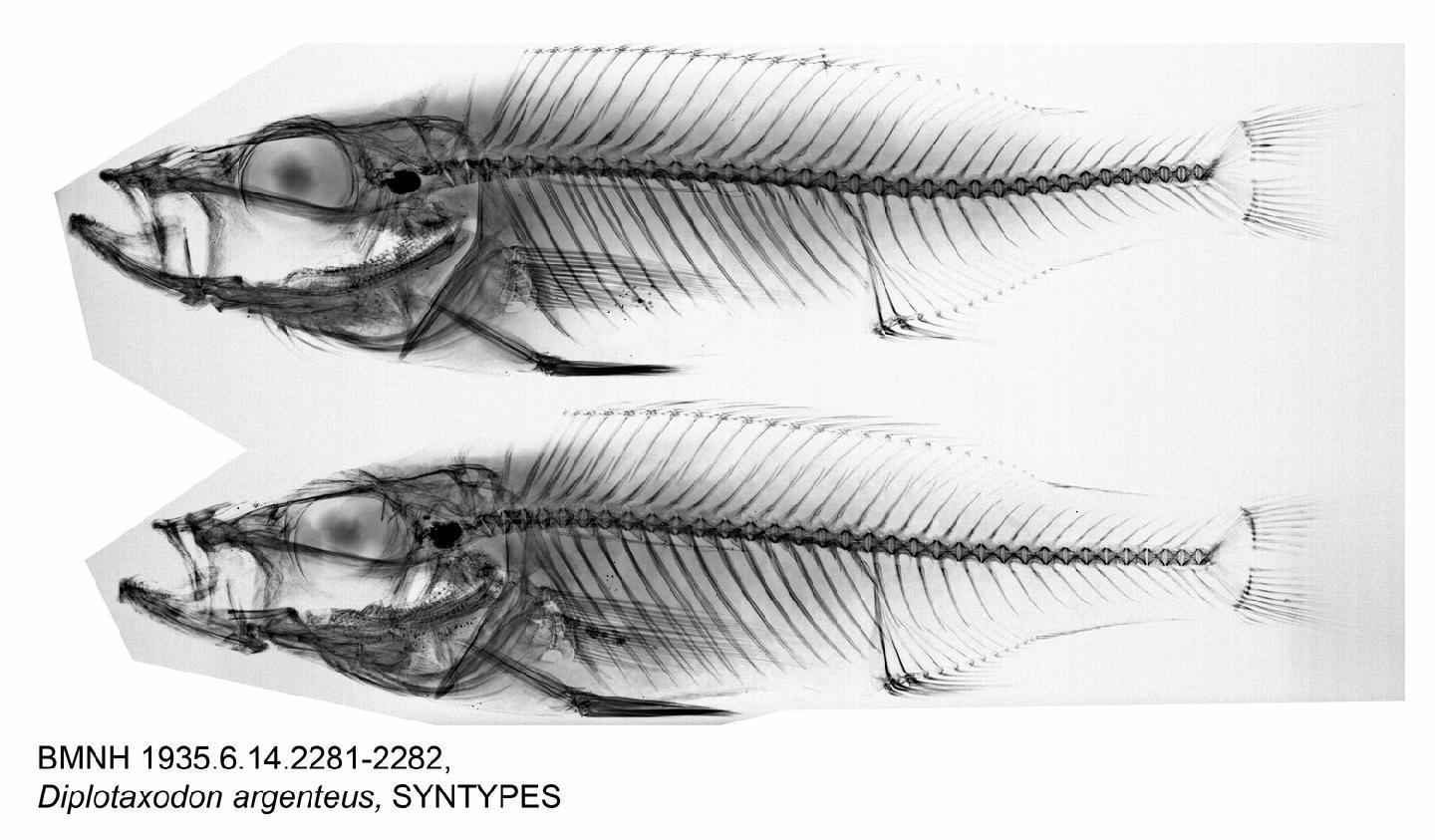
Ethelwynn Trewavas described Diplotaxodon argenteus in 1935 in her synopsis of the cichlid fishes of Lake Nyasa (the lake's older name), and built the genus Diplotaxodon around it as the type species. The genus name strings together the Greek diploos (double), taxis (arrangement or row) and odous (tooth) — a reference to the tooth pattern Trewavas saw in the jaws — while the species epithet argenteus is simply Latin for "silvery," a fair description of the live fish.
Diplotaxodon belongs to the haplochromine cichlids, the vast lineage responsible for Lake Malawi's roughly 800-plus endemic species. Within that flock it sits in a small offshore clade alongside the genus Rhamphochromis and the monotypic Pallidochromis; molecular work suggests Pallidochromis is actually nested inside Diplotaxodon, which would make the genus paraphyletic as currently drawn. Diplotaxodon itself is a taxonomic thicket: only a handful of species are formally named, yet Turner and colleagues estimated the genus may contain anywhere from roughly 11 to 22 or more forms, many still undescribed and easily confused with one another. D. argenteus has long been a catch-all into which similar offshore silver fish were lumped — Turner et al. (2004) explicitly flagged a near-identical undescribed form they called D. sp. 'similis' that earlier studies had mixed in with it. In 2018 Stauffer, Phiri and Konings re-examined the three surviving syntypes and designated a lectotype to anchor the name, a useful housekeeping step in a genus this slippery.
Appearance
This is an understated fish by Malawi standards: a streamlined, laterally compressed silver torpedo with a comparatively shallow body and a notably flat dorsal profile. The mouth is large and angled sharply upward, with a strongly protruding lower jaw and simple, closely packed conical teeth — the classic look of a fish built to take prey from below. Fin counts run to roughly 14–15 dorsal spines and 11–13 soft rays, with three anal spines and 10–11 soft rays, and the gill rakers are numerous, a trait that helps separate it from look-alike congeners.
Outside of breeding, both sexes are silvery and countershaded — darker on the back, bright on the flanks — with none of the bars, stripes or flank blotches that decorate the lake's rock cichlids. That plainness is itself diagnostic for the genus. The transformation comes with spawning: ripe males darken dramatically, developing a sooty head and dorsum, black eyes, snout and fins (both paired and unpaired), with one or two large yellow egg-spots on the anal fin. The largest specimen Turner's team recorded measured 20.4 cm (8.0 in) standard length, and the IUCN gives a maximum of about 20 cm (8 in) total length. Telling D. argenteus apart from its near-twins is genuinely hard work — separation from D. sp. 'similis' rests on subtle differences in body depth, mouth angle, inter-orbital width and gill-raker counts rather than anything obvious in the hand.
Range & habitat
Diplotaxodon argenteus is endemic to Lake Malawi (also called Lake Nyasa or Niassa), the long, deep rift lake shared by Malawi, Mozambique and Tanzania. Within the lake it occurs widely but is most common in the south, and because it ranges lake-wide it is recorded from all three riparian countries. The IUCN puts its area of occupancy near 2,700 km² and its extent of occurrence around 29,600 km².
What sets this fish apart is depth. It is an offshore, benthopelagic species turned up almost entirely by trawls and deep nets: FishBase gives a range of 34–114 m (about 110–375 ft), and Turner and colleagues record it from roughly 34–114 m in the lake's southeastern arm and 50–125 m in the southwestern arm. Remarkably, individuals have been collected at around 35 m sitting right over the lake's deep anoxic bottom — Malawi is permanently stratified below roughly 200–250 m, and oxygen runs out long before the true floor, so these fish patrol the lower edge of the habitable water column. That makes D. argenteus one of the deepest-dwelling cichlids known anywhere, part of an offshore community living in the lake's dim "twilight zone" where light, oxygen and temperature all decline with depth. It is essentially never seen by divers; almost everything known about it comes from fisheries surveys and museum collections rather than in-situ observation.
Ecology & diet
Diplotaxodon argenteus is a piscivore, and a fairly specialized one. Stomach-content work cited by Turner and colleagues found its diet dominated by juvenile usipa — the lake sardine Engraulicypris sardella, a small silvery cyprinid that swarms in the open water and forms the backbone of Malawi's pelagic food web. That upturned mouth and protruding lower jaw make sense in this light: the fish hunts prey silhouetted against the faint light above it. FishBase places its trophic level at about 4.2, squarely in predator territory.
The species can form enormous shoals, and as a group the offshore Diplotaxodon are ecologically dominant out in the deep. Surveys have estimated that cichlids make up the great majority of the offshore fish biomass in Lake Malawi, with Diplotaxodon species accounting for a large share of it; D. argenteus together with the near-identical 'similis' form was reckoned to make up roughly 3% of the demersal trawl biomass at 75–100 m. Alongside Rhamphochromis, Diplotaxodon are the principal predators of the pelagic zone — the offshore counterparts to the better-known rock and sand cichlids of the shallows, and a key link converting the usipa shoals into larger fish biomass.
Behavior & breeding
Like other haplochromine cichlids, D. argenteus is a maternal mouthbrooder: the female carries the fertilized eggs and developing young in her mouth. What makes the offshore Diplotaxodon unusual is where they appear to spawn. The evidence points to mid-water reproduction rather than the substrate-based courtship of shallow cichlids. In the southwestern arm, the IUCN assessment notes, around 60% of breeding-condition males were taken at about 75 m while ripe females came from 75–125 m, and ripe males and brooding females turned up in trawls from 40–70 m in the southeastern arm.
Fecundity is low — a maternal mouthbrooder's trade-off of fewer, larger, better-provisioned eggs for less parental real estate. Ovaries of ripe females held on the order of 22–53 eggs, each averaging around 70 mg, with size at first maturity near 14 cm (5.5 in) standard length and generation length estimated at 2–3 years. The dramatic darkening of breeding males, complete with yellow egg-spots on the anal fin, is the genus's version of nuptial dress, and in this dim environment subtle differences in that male coloration appear to help keep closely related Diplotaxodon species reproductively separate — a likely engine of the genus's quiet diversification. Color, in other words, still matters down here; there is just very little light to show it in, which has pushed these fish toward striking adaptations of the eye and visual pigments tuned to deep, blue-shifted light.
In the aquarium
Honestly, this is not an aquarium fish, and it would be misleading to pretend otherwise. Diplotaxodon argenteus is a deep, open-water, shoaling piscivore captured by commercial and artisanal fisheries, not collected for the ornamental trade — the IUCN states plainly that it is not targeted by the aquarium trade but is an important food fish. It practically never appears in the hobby; searches of the major cichlid forums turn up the usual Malawi rock-dwellers and the occasional unrelated Central American fish that happens to share the word "argenteus," but not this species.
The reasons are structural. A pelagic shoaling fish that lives at 35–125 m needs open swimming volume, cool well-oxygenated water and conspecific company on a scale no home aquarium provides, and it is adapted to a dim, blue light environment rather than a brightly lit display tank. Even setting aside availability, keeping it well would demand a very large deep system and a steady supply of small live or whole fish to satisfy a true piscivore. Aquarists drawn to Malawi's open-water predators are far better served by the haps and Rhamphochromis that are actually bred for the hobby. The useful takeaway here is conceptual: D. argenteus is a reminder that Lake Malawi's diversity runs far deeper, literally, than the colorful mbuna and peacocks that fill aquarium shops.
Conservation
The IUCN Red List assesses Diplotaxodon argenteus as Least Concern (assessed 22 June 2018; Konings & Kazembe 2019), with a stable population and no major species-specific threats identified. It is endemic to Lake Malawi but widespread within it, which underpins that rating. The one flagged pressure is fishing: as a food fish taken in mid-water and demersal trawls, chirimila (chirimila/chilimira) light-attraction nets and on handlines, it is exposed to overfishing, and the assessment names chirimila netting as a potential threat. So the honest line is the careful one — the species itself is not currently considered at risk, even as the fishery that catches it intensifies.
That picture has to be read against the state of the lake as a whole, because a deep pelagic predator is hostage to lake-wide conditions in ways a single trawl survey cannot capture. The basin review by Chavula et al. (2023, Journal of Great Lakes Research) documents mounting stress on Lake Malawi/Nyasa/Niassa: heavy and growing fishing pressure, with the iconic chambo (Oreochromis) fishery already collapsed; increased sediment and nutrient loading washing off deforested catchments; warming of roughly 0.7 °C in shallow waters that strengthens the lake's permanent stratification and reduces the mixing that lifts nutrients into productive layers; and the looming risk of invasive species. For a fish whose food chain begins with usipa in the open water and whose habitat is squeezed between the surface and a deep anoxic layer, the productivity question matters most: anything that further weakens deep mixing and trims the offshore food base — climate-driven stratification chief among the concerns — bears directly on D. argenteus and the offshore community it belongs to, even though none of those pressures has yet moved the species off Least Concern. The prudent conclusion is that the fish is secure on paper but tied to a lake under real and increasing strain.
Sources
- FishBase: Diplotaxodon argenteus
- GBIF: Diplotaxodon argenteus Trewavas, 1935
- Eschmeyer's Catalog of Fishes: Diplotaxodon argenteus
- IUCN Red List: Diplotaxodon argenteus (Konings & Kazembe 2019, amended 2018 assessment)
- Turner, Robinson, Shaw & Carvalho (2004) — Identification and Biology of Diplotaxodon, Rhamphochromis and Pallidochromis (Cichlid Press)
- Stauffer, Phiri & Konings (2018) — Description of two deep-water fishes of the genus Diplotaxodon, Proc. Biol. Soc. Washington 131(1):90–100 (lectotype designation)
- Camacho García et al. (2025) — Widespread Genetic Signals of Visual System Adaptation in Deepwater Cichlid Fishes (Diplotaxodon), Mol. Biol. Evol. 42(7):msaf147
- Hahn, Genner, Turner & Joyce (2017) — The genomic basis of cichlid fish adaptation within the deepwater 'twilight zone' of Lake Malawi, Evolution Letters
- Genner et al. (2007) — Reproductive isolation among deep-water cichlid fishes of Lake Malawi differing in monochromatic male breeding dress, Mol. Ecol. 16:651–662
- Chavula et al. (2023) — Lake Malawi/Niassa/Nyasa basin: Status, challenges, and research needs, J. Great Lakes Research 49(6):102241
- FAO — A brief review of the fish stocks and dependent fisheries of Lake Malawi
- Identification of the Cichlid Fishes of Lake Malawi/Nyasa, Part 3: Rhamphochromina and others (ResearchGate)
- FishBase: Engraulicypris sardella (Lake Malawi sardine / usipa) — primary prey
- A whole-body micro-CT scan library capturing the skeletal diversity of Lake Malawi cichlids (Diplotaxodon among deepest-living)
- Cichlid Fish Forum (cichlid-forum.com) — community discussion; confirms Diplotaxodon is essentially absent from the hobby — community/anecdotal