Taxonomy & naming
Eretmodus cyanostictus was described by the Belgian-British ichthyologist George Albert Boulenger in 1898, from specimens collected by J. E. S. Moore during his 1895–96 Lake Tanganyika expedition. The type material came from the southern end of the lake, around Mbity Rocks and Kinyamkolo, the old name for the area near present-day Mpulungu, Zambia. The genus name combines the Greek eretmos ("oar") with odous ("tooth"), a nod to the spatula-like, movably attached teeth the fish uses to scrape algae; the species epithet cyanostictus means "blue-spotted," for the bright blue flecks scattered across its head and upper body.
The fish sits in the small tribe Eretmodini, the lake's endemic radiation of "goby cichlids," alongside the genera Spathodus and Tanganicodus. For most of the twentieth century, Eretmodus was treated as a single widespread species with many geographic color forms named after collection points (Kiku, Kipili, Kibige Island, and so on). That changed in 2012, when W. E. Burgess described the northern populations as a separate species, Eretmodus marksmithi. Under the current understanding, true E. cyanostictus is the goby cichlid of the lake's southern basin, while E. marksmithi occupies the northern two-thirds; the two meet and reportedly hybridize in the Kampemba Point area of Tanzania. An undescribed form sometimes called E. sp. 'ubwari' is regarded by Ad Konings as a variant of E. marksmithi rather than a distinct taxon. This split matters for hobbyists, because much older aquarium literature and trade stock labeled "Eretmodus cyanostictus, Burundi" actually refers to the northern fish now called marksmithi.
Appearance
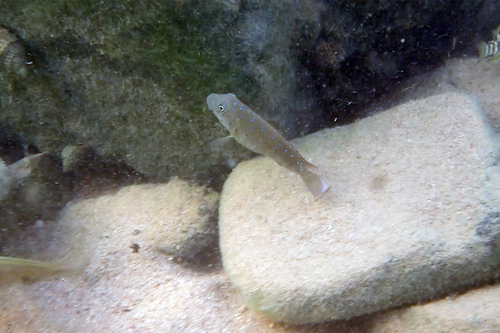
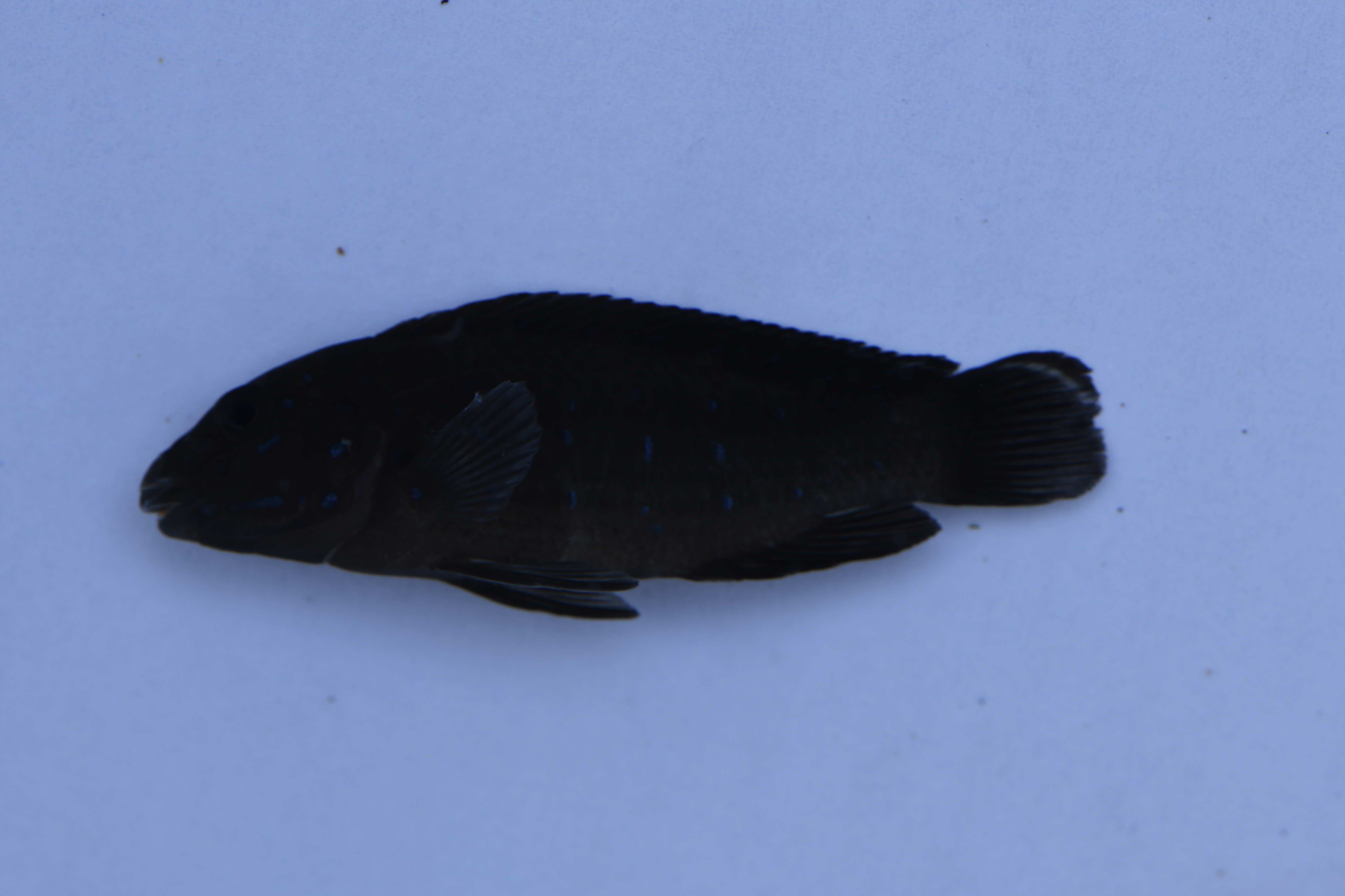
This is a small cichlid, reaching only about 3.5 in (9 cm) in total length, with females typically running 0.4–0.8 in (1–2 cm) shorter than males. The body is short and deep, almost blunt-headed, built for clinging in moving water rather than cruising open lake. The fins carry an unusually high spine count for the dorsal (roughly 23–24 spines over just 4–5 soft rays), a long, low fin profile that helps the fish hug the substrate.
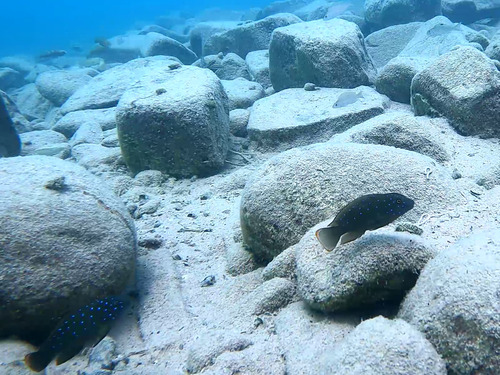
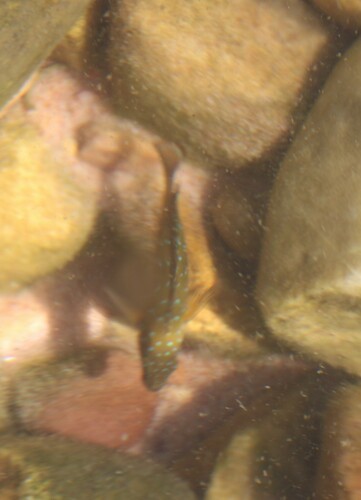
The ground color is a muted brownish-gray broken by about five lighter vertical bars; in E. cyanostictus these bars are usually evident only on the lower half of the flank and do not cross the upper body or caudal peduncle, while the upper flank and head are dusted with the brilliant blue spots that give the fish its name. This is one of the more reliable ways to separate it from the northern E. marksmithi, in which the vertical bars tend to run as complete "full bars" from belly to back and the mouth is broader and more squarish. The sexes are nearly identical externally, which is a recurring frustration for keepers; the most dependable difference is size, with males larger and, controlling for body size, possessing a noticeably larger mouth, an adaptation tied to their role in brooding the later, larger young.
Range & habitat
Eretmodus cyanostictus is a Lake Tanganyika endemic, found nowhere else on Earth, and within the lake it is confined to the southern basin. It occurs along essentially the entire Zambian coast, north into the Democratic Republic of Congo at least as far as Kalemie, and into southern Tanzania up to roughly Kampemba Point, with populations also around the Kavala Islands.
Its habitat is one of the most demanding in the lake. Adults live in the uppermost rocky zone, the surge or surf zone, often in less than a meter of water where waves break against the shore and the water is highly oxygenated. The fish is so specialized to this turbulent band that it is not found away from it. To hold position it has largely abandoned the cichlid's usual buoyancy control: a heavy body and a much-reduced swim bladder leave it negatively buoyant, so it rests and "hops" across the rocks rather than hovering. High-set eyes help it watch for predators, including birds, from above. The water it lives in is hard and alkaline, with reported in-situ conditions around pH 8–9, moderate to high hardness, and warm temperatures near 75–79°F (24–26°C). Researchers studying the species have often worked slightly deeper, around 3–13 m, where the same fish is abundant but the wave action is less violent and visibility better.
Ecology & diet
E. cyanostictus is a grazer of aufwuchs, the carpet of filamentous algae and associated micro-organisms coating the rocks. It works the stones with its oar-shaped teeth, scraping the algal film much as the larger Tropheus and Petrochromis do in calmer water nearby. Its trophic level is low (FishBase places it around 2.1), consistent with a largely herbivorous diet, though small invertebrates are taken incidentally along with the algae.
Interestingly, for a fish that feeds mainly on plant matter, its gut is fairly short, on the order of two to three times body length, much shorter than the long, coiled intestines of dedicated herbivores like many Petrochromis. Within the rocky-shore community the goby cichlids partition the habitat finely: E. cyanostictus dominates the shallowest, most turbulent band, leaving slightly calmer microhabitats to other grazers. Its niche is therefore defined as much by its tolerance for physical conditions other fish cannot exploit as by what it eats.
Behavior & breeding
Socially, E. cyanostictus is organized around territorial, pair-bonded couples and a surrounding population of smaller, non-territorial "floaters" that are disproportionately male. Field censuses on the Zambian coast found strongly male-biased samples, with paired males consistently larger than their mates and pairs mated assortatively by size. Beyond the rare aggression of establishing and defending a territory, paired fish stay together year-round on a patch that supplies both shelter and grazing.
The breeding system is what sets this species apart. It is a monogamous, biparental mouthbrooder, and genetic work (Taylor et al. 2003) confirmed that the social monogamy seen in the field is also genetic monogamy, with evidence that dispersal is female-biased. Spawning happens on a flat rock: the female lays an egg, immediately takes it into her mouth, then nuzzles the male's genital region, so that fertilization occurs inside her mouth. Clutches are small, commonly around 14–25 eggs. The female broods the eggs and newly hatched young for roughly 8–14 days, then transfers the brood to the male, who carries the larger, more developed fry for another week or two; total care runs about 20–24 days, after which the fry are released and, notably, not guarded. Detailed study showed this care is costly: mouthbrooding fish, male or female, were found with completely empty guts because they do not feed while holding, and females finishing a brood had immature ovaries, meaning they could not immediately spawn again. Because the clutch is small enough for one parent and the fry get no post-release protection, biological reasoning suggests biparental care here may be a consequence of monogamy rather than its cause, a genuinely unusual situation among cichlids.
In the aquarium
Goby cichlids have a reputation as specialist fish, and that reputation is earned. The non-negotiable requirement is water quality and oxygen: keepers and shop veterans alike report that these fish demand strong aeration and turbulence, do poorly with stale or marginal water, and are prone to bloat when kept on a monotonous dry-flake diet. A spirulina- and algae-based diet with varied frozen and fresh foods suits them better than heavy protein. The classic biotope setup is rounded rocks over sand with vigorous filtration and water movement; some hobbyists even fit a wave maker to mimic the surge zone.
The second challenge is their behavior toward each other. E. cyanostictus is comparatively peaceful toward other species but can be savage with conspecifics. A single well-bonded pair can be housed in something around a 3-foot, roughly 50-gallon (about 200 L) tank, but keeping a group to let a pair form requires far more space, with specialist and hobby sources suggesting well over 130 gallons (500+ L). The widely repeated advice is to start with about six juveniles, let a pair sort itself out, and then move the surplus, because the losers in a small tank are killed, though keepers caution that the chosen partner is also harassed and that removing the wrong fish can break a pair. They mix well with other rock-grazing Tanganyikans such as Tropheus and Petrochromis in a large tank, but should not be combined with shell-dwelling or rock-dwelling Lamprologines that occupy a different niche. Captive breeding is regularly achieved, and keepers confirm the textbook female-then-male brooding shift, with the transfer often accompanied by visible bickering; one common report is that pairs make poor guardians once fry are released, so raising young usually means stripping or separating them. A persistent piece of forum lore holds that "northern" fish are maternal-only mouthbrooders while "southern" fish are biparental; this is best understood as the taxonomic split in disguise, since the northern maternal brooders are the fish now recognized as E. marksmithi, not E. cyanostictus.
Conservation
The IUCN Red List assesses Eretmodus cyanostictus as Least Concern (most recently reviewed in early 2025). It is endemic to a single lake but ranges widely along the southern shoreline and is not currently considered threatened at the species level. It is collected for the aquarium trade, where it is a modest but steady presence, and like all shallow-rocky-shore Tanganyikan endemics it is ultimately dependent on the stability of that narrow inshore habitat; lake-wide pressures such as warming, sedimentation from deforestation, and shoreline disturbance are the kinds of long-term concerns that affect the surge-zone community as a whole rather than this species in isolation.
Sources
- Eretmodus cyanostictus (Boulenger, 1898) — FishBase species summary
- Eschmeyer's Catalog of Fishes (Eretmodus / cyanostictus entries)
- Eretmodus cyanostictus Boulenger, 1898 — GBIF
- Morley & Balshine (2003), Reproductive biology of Eretmodus cyanostictus, a cichlid fish from Lake Tanganyika — Environmental Biology of Fishes
- Taylor, Morley, Rico & Balshine (2003), Evidence for genetic monogamy and female-biased dispersal in Eretmodus cyanostictus — Molecular Ecology
- Grüter & Taborsky (2004), Monogamy and biparental care in the cichlid fish Eretmodus cyanostictus (PDF)
- Eretmodus cyanostictus — tanganyika.si (Ad Konings biotope & taxonomy page)
- Anikstein, S. (2003), Eretmodus cyanostictus (Boulenger, 1898) — Cichlid Room Companion
- How should I keep goby cichlids? — Practical Fishkeeping
- Eretmodus cyanostictus — IUCN Red List (Least Concern)
- Eretmodus cyanostictus, anyone bred this fish? — Cichlid-Forum (community thread) — community/anecdotal
- Eretmodus cyanostictus species tank — Cichlid-Forum (community thread) — community/anecdotal
- Eretmodus cyanostictus — Why 2 or 6? — Cichlid-Forum (community thread) — community/anecdotal
- Keeping Goby Cichlids — Aquarium Advice forum (community thread) — community/anecdotal
- Tanganyikan goby cichlid (Eretmodus) — r/Cichlid (community thread) — community/anecdotal