Taxonomy & naming
Eretmodus marksmithi was described by Warren E. Burgess in 2012 in the hobbyist-oriented journal Tanganika Magazyn, and the name is registered in ZooBank. It belongs to the tribe Eretmodini, a small clade of three or four genera — Eretmodus, Spathodus and Tanganicodus — within the subfamily Pseudocrenilabrinae of the Cichlidae. These are the lake's "goby cichlids," so called for their blunt, bottom-hugging build rather than any relationship to true gobies.
The genus name combines the Greek eretmos (oar) and odous (tooth), a reference to the spatulate, chisel-edged teeth the fish use to scrape rock. The species epithet honors Mark Smith, an American aquarist, underwater photographer and author of Rift Valley cichlid books, who helped obtain the specimens and images behind the description.
The split was a long time coming. Eretmodus cyanostictus, the genus's type species, was described by Boulenger in 1898 from the far south of the lake. Northern populations were exported under that name for decades even though aquarists and ichthyologists recognized they were different; Ad Konings flagged the northern fish as Eretmodus sp. "cyanostictus north" as early as the late 1980s. Burgess's 2012 paper put a formal name to that northern form. The two are close sisters and easy to confuse, which is worth remembering when reading older literature: much published "Eretmodus cyanostictus" work from the north of the lake actually concerns this species.
Appearance
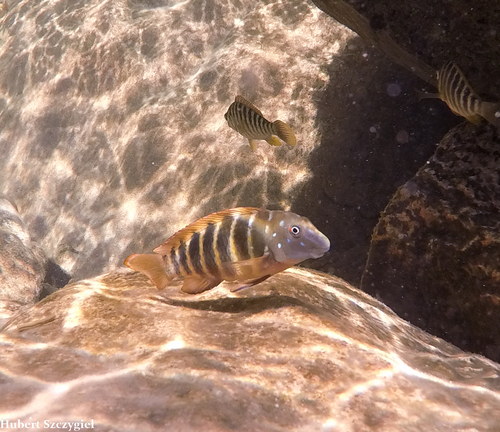
This is a stocky, small fish. FishBase lists a maximum of about 1.9 in (4.7 cm) standard length; hobbyist accounts, measuring total length, put males at roughly 4 in (10 cm) and females a touch smaller at around 3 to 3.5 in (8–9 cm). Either way it is a compact, deep-bodied, laterally compressed cichlid built to wedge against rock in moving water, with a long spiny dorsal fin running most of the back.
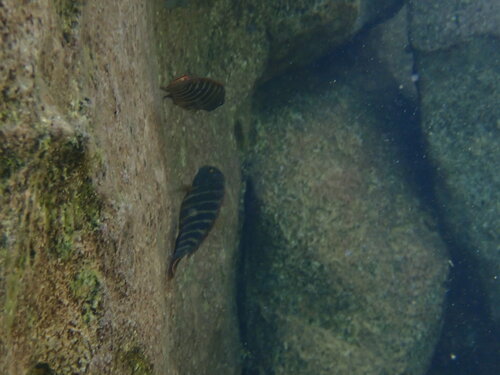
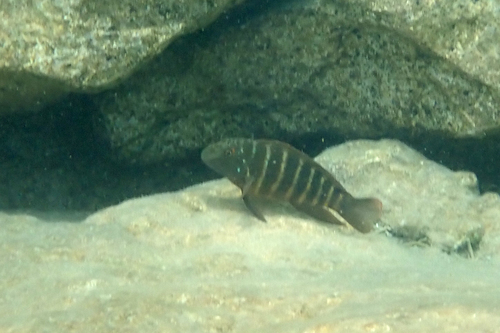
The cleanest way to separate it from its southern sister is the mouth and the markings. E. marksmithi has a subterminal (slightly underslung) mouth and 7–8 pale vertical bars that run the full depth of the body, from the dorsal-fin base down to the belly, with the last bar crossing the caudal peduncle. A scatter of light blue dots may show, mostly on the head. By contrast, E. cyanostictus has a terminal mouth and a generous spangling of bright blue spots across the head and upper body. The underslung jaw is functional, not cosmetic: it lets the fish stay pressed flat to a rock while grazing.
The sexes look much alike. Males average slightly larger and, as in related gobies, may carry marginally longer pelvic fins, but the species is genuinely hard to sex by eye — a recurring frustration for keepers trying to set up pairs.
Range & habitat
Eretmodus marksmithi is a Lake Tanganyika endemic confined to the northern part of the lake, shared between Burundi, the Democratic Republic of the Congo and Tanzania. Sources phrase the extent slightly differently — FishBase describes occupancy of the northern two-thirds to three-quarters, while the 2025 IUCN assessment and Konings place the southern limits more conservatively, reaching about Cape Katondo on the Tanzanian (eastern) shore and Kalemie on the Congolese (western) shore. The takeaway is consistent: it is a fish of the lake's northern basin, not the whole lake.
Its world is small and specific. It lives in the surge zone — the top 1–2 m (about 3–7 ft) of clear, well-oxygenated water along rocky shores, over a bottom of small cobbles roughly 10–40 cm across. This is the most turbulent band of the lake, where waves break and currents shift constantly. The fish's signature adaptation is a reduced swim bladder, which sacrifices buoyancy so it can hold position on the bottom instead of being tossed around; the compressed body and stout, spiny dorsal help it cope with the water movement and, plausibly, with bird predation in such shallow water. Tanganyika's surge zone is unusually alkaline and oxygen-rich, conditions this fish is tuned to.
Ecology & diet
Eretmodus marksmithi is a grazer of aufwuchs — the carpet of filamentous algae, diatoms and associated micro-life (the "biocover") that coats the rocks of the surge zone. It works the upper surfaces of the cobbles, scraping the film with its chisel-like teeth in the hopping, pause-and-rasp manner typical of the goby cichlids. Like its relatives it is not a strict herbivore: small invertebrates — crustaceans, mites, insects and insect larvae living in the algal mat — are taken alongside the plant matter, and FishBase places it at a trophic level of roughly 3.2, consistent with an omnivore that leans heavily on algae.
Within the community it is one of many specialists partitioning the rocky littoral. The Eretmodini are a textbook case of trophic specialization within a tight body plan, and across the tribe subtle differences in tooth and jaw form sort the genera onto slightly different food: Eretmodus tends to the algal-scraping end, while relatives such as Tanganicodus take more invertebrates. Its fishing vulnerability is rated low and it has no commercial food-fishery value; its only direct human use is the aquarium trade.
Behavior & breeding
Goby cichlids are pugnacious for their size, and E. marksmithi is no exception — it is largely solitary and territorial on the reef, defending a patch of grazing rock. The standout feature of the genus, though, is its reproduction. These are biparental mouthbrooders, and detailed studies of the closely related E. cyanostictus have shown it to be both socially and genetically monogamous, a genuinely rare combination among mouthbrooding cichlids, most of which are polygamous and offer only maternal care.
The spawning sequence is delicate. The female lays a small clutch — often just one or two eggs at a time, building to a few dozen — and takes them into her mouth almost immediately, picking up sperm cues from the male as she does. She incubates the eggs for roughly the first two weeks (about 12–14 days), then transfers the developing young into the male's mouth, where they finish developing over another one to three weeks before release. That hand-off is the linchpin of the system: the pair bond has to hold together long enough for it to happen, which is part of why these fish form lasting pairs rather than spawning and parting. Released fry are well developed, with the yolk fully absorbed, and immediately begin grazing.
In the aquarium
This is a rewarding but demanding fish, and an honest assessment is "not for beginners." It needs exactly the conditions of its habitat: hard, alkaline water (pH around 8.0–9.0), very high oxygenation and strong flow, pristine quality, and warmth around 77–82°F (25–28°C). Give it a rocky Tanganyika biotope with open algae-grown surfaces and a sandy substrate — keepers report that sand seems to aid digestion in these grazers. Feed a plant-based diet built on spirulina and vegetable flake; high-protein foods such as worms or shellfish are a mistake with an algae-grazer and invite digestive trouble.
The real challenge is social. These gobies are hard on each other. Keepers consistently report that the workable approaches are either a single confirmed pair in its own tank, or a large group — many experienced hobbyists suggest 20 or more in a 4-foot (around 75–125 gallon) tank — so that aggression is diffused and no one fish is singled out. Pairs are best obtained by raising a group of youngsters and letting them sort themselves out; buying a random adult male and female often ends with the female harassed to death, and even bonded males can be rough on their partners. A widely repeated piece of community lore is that wild-caught stock breeds more reliably than later captive generations, with aquarium-bred lines reported to grow more aggressive and pair less readily — anecdotal, but heard from enough independent keepers to be worth noting. Good tankmates occupy other zones of the tank — open-water Cyprichromis, for instance — rather than competing for the same rock. The fish is genuinely uncommon in the trade and usually sold under its own name now, though older imports may still be labeled Eretmodus sp. "cyanostictus north."
Conservation
The IUCN Red List assessed Eretmodus marksmithi as Least Concern in 2025 (assessor Y. Fermon, reviewed by Ad Konings). It is common throughout its shallow rocky range in the northern lake, and no major, lake-wide threat to it has been identified, though the assessment notes that local populations may be affected by the aquarium trade, by pollution near larger towns, and by sedimentation from deforestation in the northern basin. (For context, the southern sister species E. cyanostictus has been treated as Near Threatened, so the genus is not uniformly secure.) A fish of the top two meters of rocky shore is, almost by definition, exposed to exactly these shoreline pressures: anything that buries or silts the cobbles erases its grazing surface and its home.
Those local concerns sit inside a larger story about the lake itself. Lake Tanganyika is warming and stratifying more strongly, which suppresses the seasonal mixing that fertilizes its waters; O'Reilly and colleagues (Nature, 2003; doi:10.1038/nature01833) linked this to roughly a 20% drop in primary productivity and correspondingly lower fish yields over the twentieth century. Cohen and colleagues (PNAS, 2016; doi:10.1073/pnas.1603237113) estimated that warming has already cost the lake on the order of 38% of its oxygenated benthic habitat, and earlier work (Cohen et al. 1993) documented how sediment washing off deforested catchments degrades the rocky littoral. Much of that basin-scale strain falls hardest on the deep-water and pelagic communities — the clupeid sardine and Lates fishery that feeds Burundi, the DRC, Tanzania and Zambia, now coordinated through the four-nation Lake Tanganyika Authority. A surge-zone grazer like E. marksmithi is largely insulated from the deep-oxygen and open-water productivity problems, but not from the sedimentation and shoreline development that the same warming, growing-population basin is generating. The honest summary: the species itself looks secure today, but its narrow band of clear, rocky, oxygen-rich shoreline is precisely the habitat that local degradation can erode, in a lake under broad and worsening stress.
Sources
- FishBase: Eretmodus marksmithi
- Eschmeyer's Catalog of Fishes (California Academy of Sciences)
- Cichlid Room Companion: Eretmodus marksmithi (P. Tawil)
- Seriously Fish: Eretmodus cyanostictus (Striped Goby Cichlid)
- Greater Chicago Cichlid Association: Eretmodus marksmithi profile
- IUCN Red List: Eretmodus marksmithi (Fermon 2025, Least Concern)
- Morley & Balshine 2003: Reproductive biology of Eretmodus cyanostictus (Env. Biol. Fishes)
- Grüter & Taborsky 2004: Mate Tactics, monogamy & biparental care in Eretmodus cyanostictus (PDF)
- Taylor et al. 2003: Genetic monogamy and female-biased dispersal in Eretmodus cyanostictus (Molecular Ecology / PubMed)
- Rüber et al.: Replicated evolution of trophic specializations in Eretmodini (PNAS / PMC)
- Rüber et al. 1996: Mitochondrial phylogeography of rock-dwelling cichlids (Eretmodini)
- O'Reilly et al. 2003: Climate change decreases aquatic ecosystem productivity of Lake Tanganyika (Nature)
- Cohen et al. 2016: Climate warming reduces fish production and benthic habitat in Lake Tanganyika (PNAS)
- Cichlid-Forum.com thread: Eretmodus species tank — keeper experience (aggression, group size) — community/anecdotal