Taxonomy & naming
George Albert Boulenger described this fish in 1899 as Tilapia rostrata, from a single specimen — the holotype, BMNH 1891.12.17.8 — collected in what was then called Lake Nyasa, now Lake Malawi. The species epithet rostratus means "beaked" or "long-snouted," a nod to the elongated head that defines both its looks and its way of life. For most of the twentieth century it drifted through the catch-all genus Haplochromis, where so many Malawi cichlids were once filed (Regan's 1922 Haplochromis macrorhynchus is now treated as a synonym). Its modern home dates to 1989, when Eccles and Trewavas overhauled the classification of Malawi's haplochromine cichlids and erected the genus Fossorochromis for it alone. The genus name captures the animal precisely: Latin fossor, "a digger," joined to the Greek chromis, an old word for a perch-like fish. Catalog of Fishes, FishBase, and the IUCN all carry the name Fossorochromis rostratus (Boulenger, 1899) as valid, and it remains monotypic — a single species in its own genus, a fairly unusual standing within a species flock that runs to several hundred close relatives. The trade still sells it under the old label "Haplochromis rostratus," and in Malawi it carries the Chichewa names chigumbuli and chimbenje; English speakers mostly know it as the Malawi sand diver.
Appearance
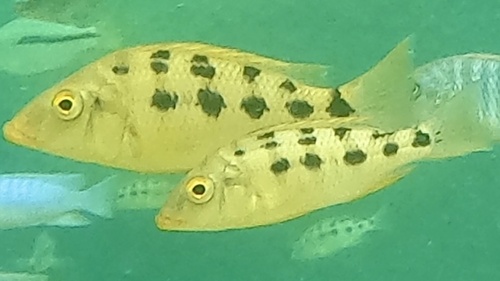
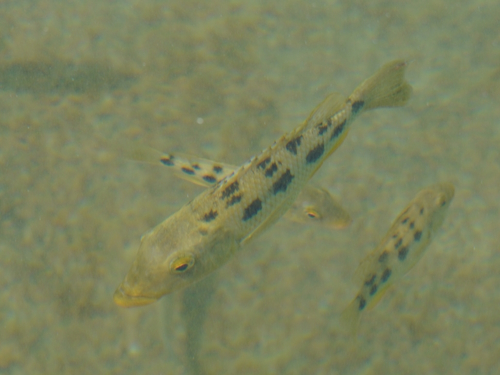
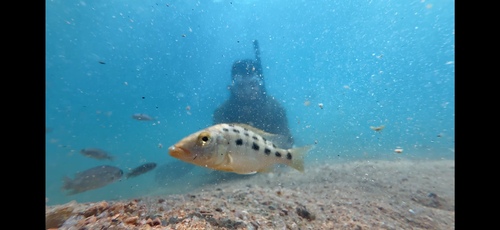
A non-breeding rostratus is built for speed and digging: a long, fusiform body, a tapering pointed snout, and a base color of pale silver to greenish-gold overlaid with three horizontal rows of large, dark blotches running the length of the flank. It is one of the more instantly recognizable cichlids in the lake, and there is little it can be confused with once you have seen the spotting. Reported maximum size is a genuine point of disagreement, and it is worth being honest about it. FishBase lists a modest 9.6 inches (24.4 cm) total length, drawn from a checklist measurement; field workers and aquarists consistently describe larger animals. Ad Konings and other Malawi specialists put wild males at roughly 10–12 inches (25–30 cm) with females somewhat smaller near 8 inches (20 cm), and well-fed captive males are repeatedly reported at 12–14 inches (30–35 cm). The honest summary is that this is a foot-long-plus fish in practice, whatever the older checklist figure says. The sexes are easy to tell apart only when a male comes into condition. A dominant, breeding male sheds the spotted pattern and turns a dark blackish-blue shot through with turquoise, often partly erasing the blotches that mark every other individual. Subdominant males and females stay in the spotted silver dress and look much alike — and, as keepers and field observers both note, non-dominant males will actively mimic female coloration to stay off the alpha's radar, which makes sexing a group genuinely difficult until one fish asserts itself. One small but diagnostic detail separates it from most of its sand-dwelling relatives: breeding males lack the egg-shaped spots (pseudo-ocelli) on the anal fin that are nearly standard equipment among haplochromines.
Range & habitat
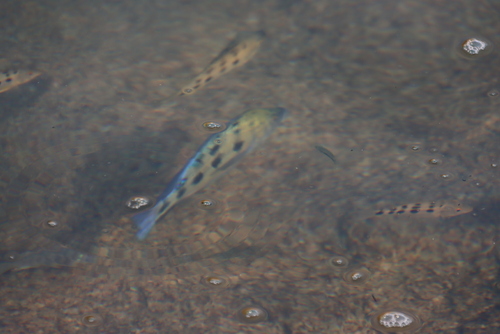
Fossorochromis rostratus is endemic to the Lake Malawi system and widespread within it. The IUCN assessment records it from Lake Malawi proper, the smaller downstream Lake Malombe, and the Upper and Middle Shire River — the river that drains the lake southward — with confirmed occurrence in all three riparian countries, Malawi, Mozambique, and Tanzania. It is described as common throughout the lake, with an estimated extent of occurrence around 30,000 km². This is a shallow-water, sand-zone animal first and foremost. It is found off open sandy beaches and in the quiet water of sheltered bays, and it does not appear to extend much below about 60 feet (18 m); FishBase brackets the depth even tighter at 0–39 feet (0–12 m). Habitat use shifts with age in a way that is well documented: juveniles and sub-adults crowd the very shallowest margins, often in less than 3 feet (1 m) of water and rarely deeper than 6 feet (2 m), where they are already practiced sand-divers, while adults work the broader sandy shelves a little farther out. Although it is a sand specialist, individuals do turn up over rock or in the transitional zones where sand meets reef, usually in transit between feeding grounds. In situ the water it lives in is hard and alkaline, as everywhere in Malawi — a pH around 7.5–8.8 and warm surface temperatures of roughly 75–79°F (24–26°C) — the chemistry that any serious attempt to keep the fish has to reproduce.
Ecology & diet
This is, above all, a sand-sifter, and its feeding is the most interesting thing about it. A foraging rostratus plunges its long snout into the substrate — frequently burying its head to the eyes — takes in a mouthful of sand, sorts the edible from the inedible inside the mouth and over the gill rakers, and expels the rest in a small cloud of fine particles. Stomach analyses tell a consistent story: the diet is overwhelmingly chironomid (midge) larvae, the "lake fly" larvae that live within the sand, with snails, small crustaceans, and other aquatic insects appearing only occasionally. FishBase places its trophic level around 3.4, the figure of a benthic insectivore rather than a fish-eater. That said, it is opportunistic at the edges: George Fryer's classic 1950s survey work recorded a wild specimen whose stomach held several small fish (alongside sand grains and, tellingly, cassava washings near a village), and the species is known to switch to picking plankton from the water column when a bloom makes that worthwhile. It typically forages in loose, cohesive groups of twenty to fifty fish. One of the lake's nicer pieces of natural theater plays out around these feeding shoals: "blue followers" — chiefly the blue dolphin cichlid Cyrtocara moorii, and also Protomelas annectens — trail the digging Fossorochromis and snap up the invertebrates and scraps stirred loose by its excavation. The followers gain a meal; the sand diver is neither helped nor hindered, a textbook commensal relationship that aquarists can sometimes watch in miniature in a large tank.
Behavior & breeding
Socially, rostratus is a shoaling fish with a lek-style breeding system, and its temperament in the wild is far milder than its reputation in captivity suggests. Out on the sand, feeding groups are generally peaceful; a single dominant male in breeding color may move with the group, driving off rival males but otherwise keeping the peace. Breeding happens year-round, most often in the morning. A territorial male darkens to that blackish-blue courtship dress, clears or digs a spawning site — in the wild a crater or sand mound within a breeding lek, reported to reach a couple of meters across — and performs a quivering, fin-spread "breeding dance" to draw females across from the foraging shoals. It is a maternal mouthbrooder. The female lays her eggs on the substrate, takes them straight into her mouth, and, because this male lacks the usual anal-fin egg spots, fertilization follows the standard haplochromine sequence of the male releasing milt as she mouths the spawning site. Broods are large for a mouthbrooder — commonly cited at 50 to 130 eggs and reported as high as 200 — and the female carries them for roughly three weeks (about 25 days at 80°F/27°C), fasting throughout, her distended jaw an obvious tell. She continues to shelter the free-swimming fry in her mouth at night or at any sign of danger for a couple of weeks after their first release. Two further quirks stand out. Juveniles inherit the adult escape behavior early, diving into the sand to dodge predators in their shallow nursery water; and brooding females are documented joining "mixed broods," guarding their own fry together with the young of other species such as Copadichromis chrysonotus — a form of inadvertent communal care.
In the aquarium
Here the honesty has to be turned up. Fossorochromis rostratus is a spectacular aquarium fish and a genuinely demanding one, and most of the trouble keepers run into traces back to underestimating two things: its size and a dominant male's temper. Take the substrate as non-negotiable first. This fish sand-sifts all day and buries itself when startled; it must have a deep bed of fine sand (pool-filter sand is the usual choice), and gravel is genuinely harmful — it abrades the fish and defeats the feeding behavior. On tank size, ignore the old care-sheet line that a four- or five-foot tank will do. Field and hobby experience both point to a foot-plus fish that swims fast and hard, so bottom footprint matters far more than height; a six-foot (roughly 125–135 gallon) tank is a realistic floor for a small group, and experienced keepers running breeding colonies often use 300-plus-gallon systems. The recurring warning across cichlid forums is blunt and worth repeating: a mature dominant male can become hyperdominant and lethal. Multiple long-time keepers describe an otherwise prized male killing or terrorizing large tankmates — livingstonii, venustus, borleyi — once he matures or comes into spawning condition, with more than one concluding that even a six-foot tank is not enough to contain a male that has decided the whole floor is his. The practical playbook that emerges is consistent: keep only one male; buy a group of 6–10 unsexed juveniles and grow them out together; aim for several females per male; break up sight lines with rockwork placed at the tank's edges (not filling the open sand he needs to swim and dig); and choose robust, similarly sized but not overly aggressive Malawi haps as tankmates — Cyrtocara moorii (an apt choice, given their natural following relationship), the larger Nimbochromis, and similar open-water species, rather than rock-dwelling mbuna, whose frantic pace doesn't suit this heavy-bodied swimmer. It is not a piscivore by trade, but a foot-long fish with a big mouth will inhale anything small enough, so don't mix it with tiny tankmates. Water should be hard and alkaline (pH about 7.5–8.5, temperature roughly 77–82°F / 25–28°C), and it is an enthusiastic, unfussy eater — frozen and live invertebrates, quality pellets and flake — that will gorge until its belly bulges. Note too that males are slow to color up and that subordinate males masquerade as females, so a young group can look like all females for a long while. None of this makes it a beginner fish; it makes it a rewarding one for a keeper with the space and patience to do it properly.
Conservation
On its own account, Fossorochromis rostratus is in reasonable shape. The IUCN Red List assessed it as Least Concern in 2018 (Konings, Kazembe & Makocho), reaffirming a 2006 Least Concern listing, on the grounds that it is widespread across the lake system with no major threat specific to it. The population trend is recorded as unknown. The one pressure the assessors flag is fishing: it lives squarely in the inshore zone that small-scale beach seines work hardest, yet it turns up only rarely in those catches — thanks, it seems, to the very sand-diving trick it uses against predators, ducking under the substrate and letting the net pass over before popping back out. It is also collected for the ornamental trade (often still sold as "Haplochromis Rostratus"), and, helpfully, part of its range falls within Lake Malawi National Park. So far, so comfortable — but the species cannot be read in isolation from the state of the lake it depends on. The basin-scale review by Chavula and colleagues (2023, Journal of Great Lakes Research) lays out a Lake Malawi/Niassa/Nyasa system under real and worsening strain: heavy and growing fishing pressure (the collapse of the prized chambo tilapia fishery is the emblem of it), rising sediment and nutrient loading washing off deforested and cultivated catchments, and a warming, more strongly stratified water column that suppresses the deep-water mixing on which the lake's productivity depends, all compounded by the looming risk of invasive species. For a fish whose entire life is staked on clean, open sand in shallow water, the sediment problem is the one to watch. Siltation from eroding shorelines smothers the sandy substrate, clogs the interstitial spaces where its chironomid prey live, and degrades exactly the inshore habitat where this species and its juveniles feed and shelter. The accurate framing, then, is the one the skill asks for and the evidence supports: the sand diver itself is Least Concern and locally common, but the lake beneath it is not without trouble, and a sand-zone specialist is among the fishes most exposed to the siltation and shoreline degradation that the basin literature now treats as a leading threat to Malawi's extraordinary cichlid fauna.
Sources
- Catalog of Fishes (Eschmeyer) — Tilapia rostrata / Fossorochromis rostratus
- FishBase — Fossorochromis rostratus summary
- GBIF — Fossorochromis rostratus occurrence search
- ITIS — Fossorochromis rostratus (TSN 649019)
- Eccles & Trewavas (1989), Malawian cichlid fishes: classification of some haplochromine genera — cited in Catalog of Fishes (erection of genus Fossorochromis)
- Boulenger, G. A. (1899), A revision of the African and Syrian fishes of the family Cichlidae, Part II — original description as Tilapia rostrata (Biodiversity Heritage Library)
- Chavula et al. (2023), Lake Malawi/Niassa/Nyasa basin: status, challenges, and research needs, J. Great Lakes Res. 49(6):102241
- Chavula et al. (2023) — abstract (NASA ADS / DOI 10.1016/j.jglr.2023.102241)
- IUCN Red List — Fossorochromis rostratus (Konings, Kazembe & Makocho 2018, Least Concern)
- Cichlid Room Companion — Fossorochromis rostratus (Ad Konings)
- Seriously Fish — Fossorochromis rostratus
- Tropical Fish Hobbyist — "Fossorochromis, Lake Malawi's Excavator" (J. M. Artigas Azas)
- Fishipedia — Fossorochromis rostratus
- Cichlid Forum — "Tankmates for Fossorochromis Rostratus?" (keeper reports of male aggression) — community/anecdotal
- MonsterFishKeepers — "F. rostratus: Malawi sand diver" (size, coloring up) — community/anecdotal
- Reddit r/Aquariums — Malawi Sand Diver (adult size, keeping) — community/anecdotal