
Taxonomy & naming
George Albert Boulenger described this fish in 1898 as Paratilapia pfefferi, working from a single specimen — the holotype, BMNH 1898.9.9.27 — collected at Kinyamkolo (modern Mpulungu, Zambia) during J. E. S. Moore's 1895–96 Tanganyika expedition. The species epithet honors Georg Johann Pfeffer (1854–1931), a zoologist and malacologist who curated at the Naturhistorisches Museum in Hamburg. Over the following century the name was shuffled through a series of genera as ichthyologists struggled to place a fish whose specialized anatomy shared few obvious features with its neighbors: it was carried at various times in Limnochromis, Haplochromis, and finally Gnathochromis, the combination — 'Gnathochromis' pfefferi — under which essentially all aquarium literature still lists it.
That long history of misplacement ended in 2024. Haefeli, Schedel, Ronco, Indermaur and Salzburger, working from an X-ray and landmark-morphometric dataset of 587 specimens across 63 taxa, showed that Gnathochromis as conceived was polyphyletic — it lumped two unrelated fishes from two different tribes. They restricted Gnathochromis (tribe Limnochromini) to its type species, the deep-water G. permaxillaris, and erected a new monotypic genus, Jabarichromis, for pfefferi, confirming its place in the tribe Tropheini. The genus name comes from the Swahili 'jabari', glossed as 'brave one' or 'ruler', a reference to the fish's active hunting and the large territories males defend. Eschmeyer's Catalog of Fishes and FishBase now both accept Jabarichromis pfefferi (Boulenger, 1898) as the valid name; the trade name has simply not caught up. Either way, the Tropheini placement matters beyond bookkeeping — this tribe is the Tanganyikan haplochromine lineage that is the sister group to the explosive species flocks of Lakes Malawi and Victoria.
Appearance
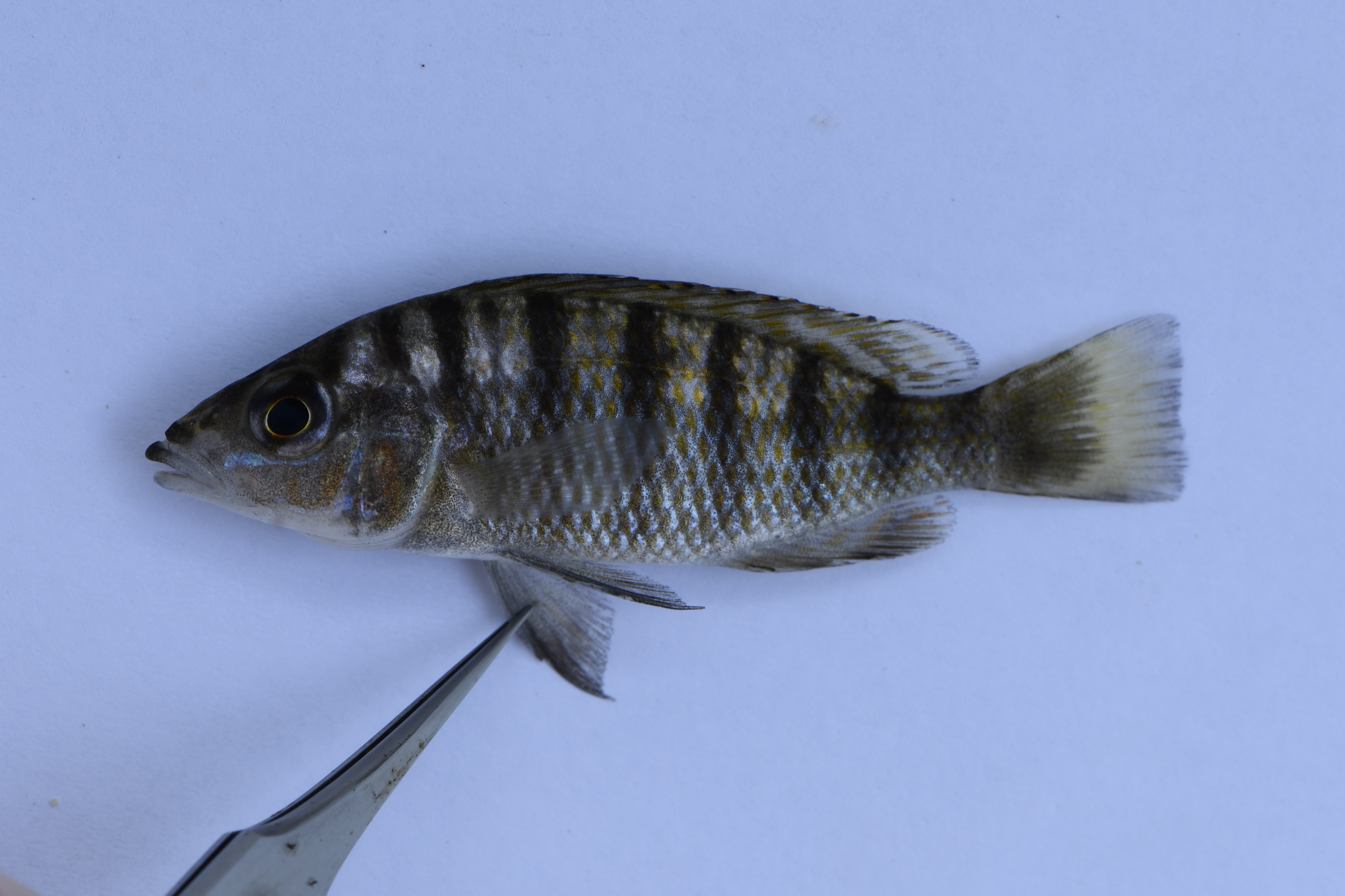
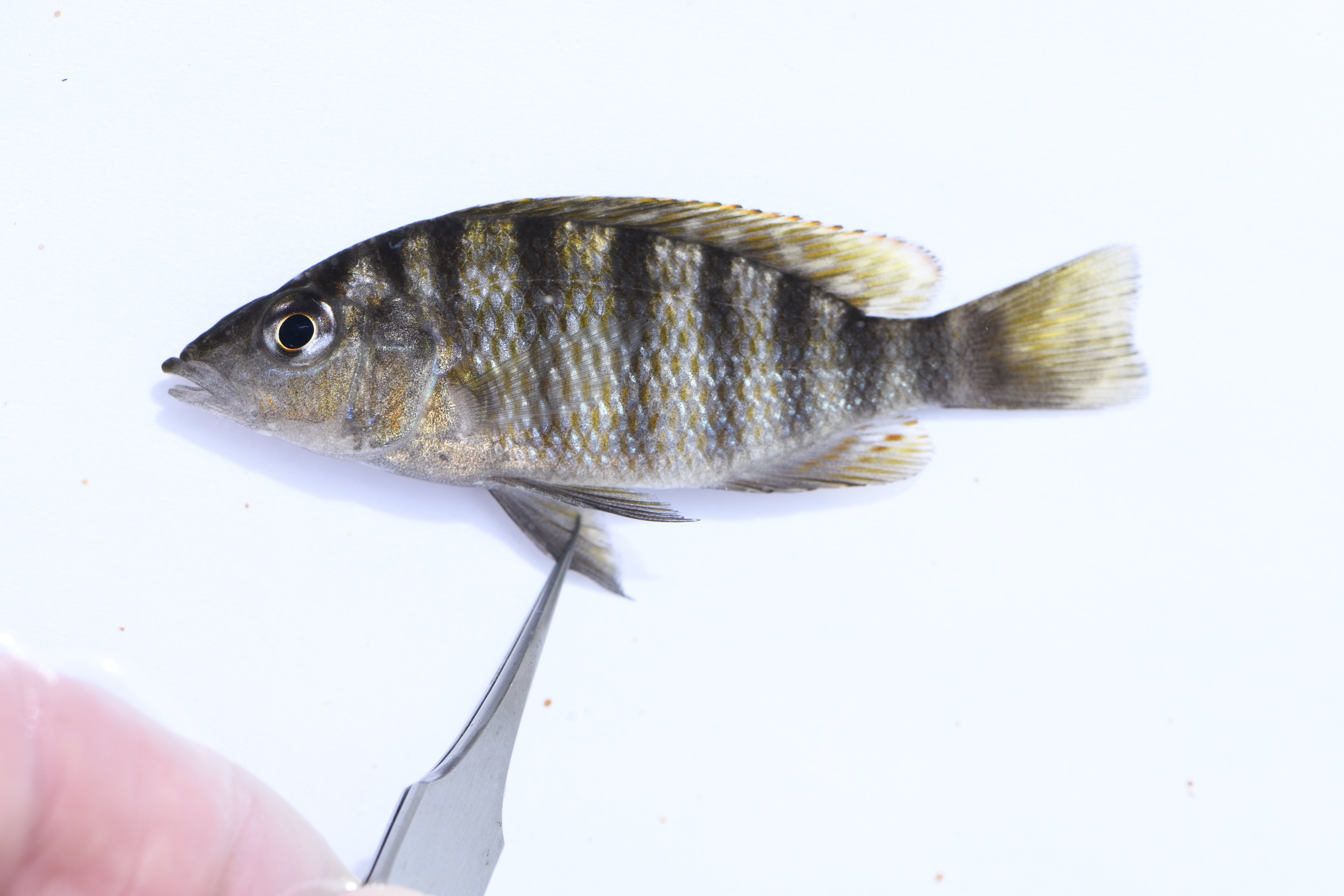
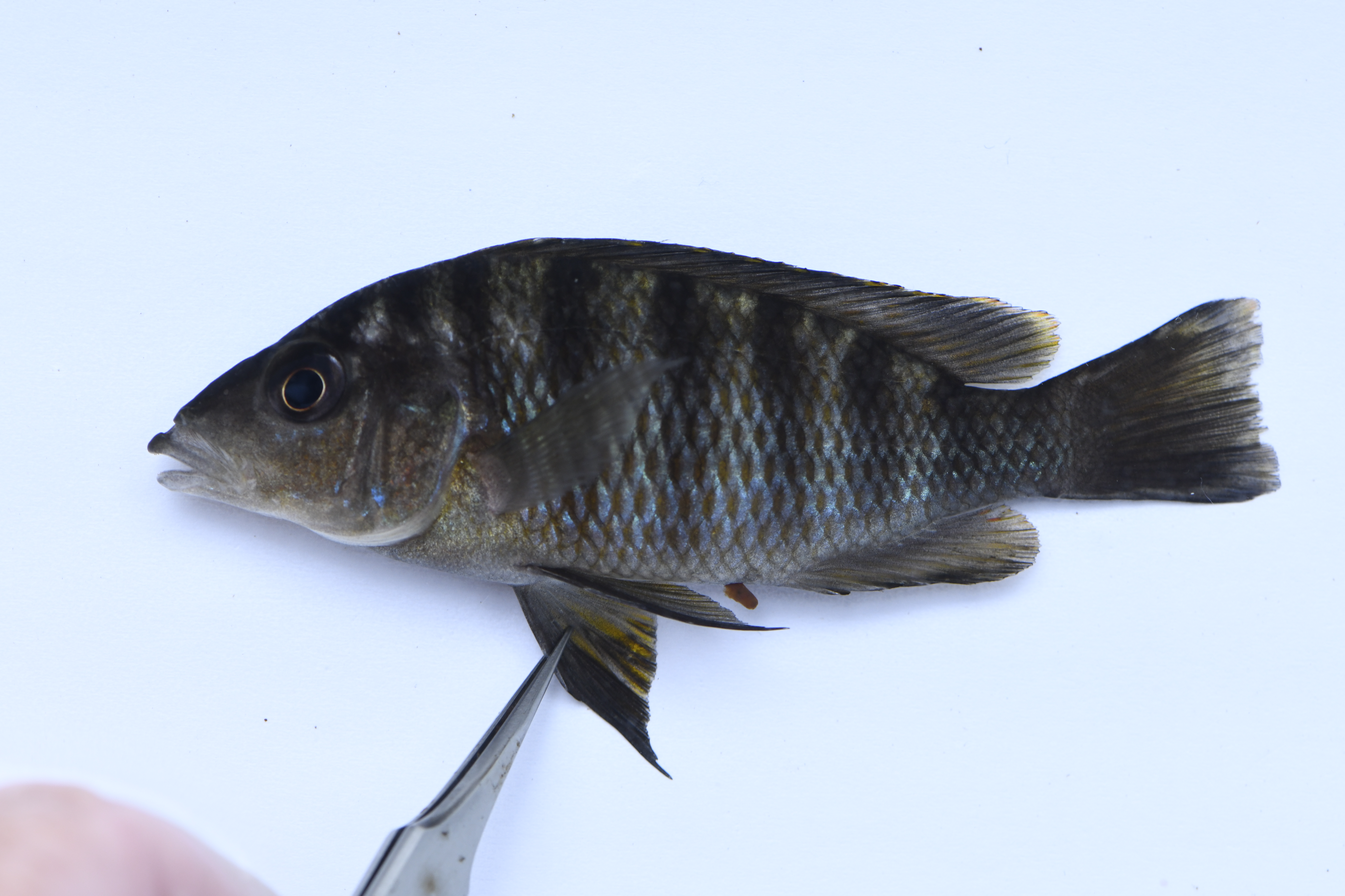
This is a small, laterally compressed cichlid — strongly flattened side to side — with a drawn-out, pointed snout and a protrusible mouth built for picking prey off the bottom. FishBase gives a maximum of about 5.5 in (14 cm) total length, and aquarium-reared fish tend to land a little under that; dominant males run largest, with females noticeably smaller, the usual haplochromine pattern. The base color is an unshowy grey-brown, often crossed by faint vertical bars and warmed with yellowish hints along the flanks and fins, and the tail is triangular with a straight trailing edge.
Sexual differences are subtle but real. Males grow larger and color up more strongly than females, and a courting male typically carries egg-spot-like ocelli on the anal fin — the haplochromine 'dummy egg' signal. Juveniles are worth a note for the cross-reference they invite: keepers repeatedly remark that very young G. pfefferi look startlingly like baby Altolamprologus, with the same hunched, stalking posture, a convergence that says more about a shared ambush-predator lifestyle than about relatedness. There is no elaborate geographic-variant trade here the way there is with Tropheus; populations differ slightly in the warmth of male color from site to site, but a pfefferi reads as a pfefferi lake-wide.
Range & habitat
Jabarichromis pfefferi is endemic to Lake Tanganyika and occurs essentially lake-wide, recorded from all four riparian nations — Burundi, the Democratic Republic of the Congo, Tanzania, and Zambia. Unlike the rock-bound specialists that dominate the lake's reputation, it is a fish of the intermediate zone: the sand-and-rubble shallows where open sediment meets scattered stone. Field accounts place it from the surface down to roughly 100 ft (30 m), with the bulk of activity in the warm, well-lit inshore band. It tolerates the slower, marginal water near river mouths better than many of the lake's stenotopic endemics, which helps explain how broadly it is distributed.
The in-situ conditions are those of Tanganyika's upper layer: warm, hard, and strongly alkaline. FishBase's husbandry-oriented figures put the fish in water around 75–79 °F (24–26 °C) at pH roughly 7.5–8.5 and moderate-to-high hardness, consistent with the open lake's stable, mineral-rich chemistry. Tying it to the water body, this is a fish of the productive sandy fringe — the interface between the rocky reefs and the open sediment plains — rather than of the deep, clear walls or the pelagic blue.
Ecology & diet
Trophically, pfefferi is a carnivore with a clear specialization: it hunts shrimp. Both the descriptive literature and field studies report a diet dominated by atyid and other crustaceans, with figures of up to about 80 percent shrimp cited for some populations, rounded out by other invertebrates and small fishes. FishBase places it at a trophic level near 3.6, squarely in the predatory range, and the fish's stretched, picking jaw and compressed body fit an animal that works the substrate and crevices for mobile invertebrate prey rather than grazing algae like its Tropheus-type relatives in the same tribe. Ad Konings, who has written on the species under the heading 'Tanganyika's shrimp-hunting haplochromine', frames it exactly this way.
The hunting behavior is genuinely the interesting part. Studies by Ota and Kohda in Lake Tanganyika, summarized in the rift-lake literature, document that a male's home range — the area over which he forages — is distinct from and larger than the breeding territory he defends, an unusual decoupling for a cichlid; reported hunting territories can reach on the order of hundreds of square meters. In the lake community the fish occupies a mid-level predatory niche, neither apex piscivore nor specialist grazer, and it is a useful reminder that the Tropheini, famous for their algae-scraping mouths, also produced dedicated carnivores.
Behavior & breeding
Socially, pfefferi is a haremic, territorial fish and a mouthbrooder, but its breeding biology carries a twist that sets it apart from most of the lake's haplochromines. A male establishes and defends a temporary breeding territory — without building a true nest — and courts passing females; spawning follows the haplochromine script, with the female taking up the eggs and the male's anal-fin ocelli drawing her to fertilize the clutch she already holds. Where it diverges is in parental care. FishBase, drawing on the descriptive literature, records that eggs and small larvae (up to about 0.35 in / 0.89 cm total length) are mouthbrooded by both parents — a biparental contribution unusual among Tanganyikan haplochromines, most of which are strictly maternal. Field observers more often describe the female as the primary or sole incubator, carrying small clutches of large eggs for three weeks or more, so the precise division of labor is best stated honestly: maternal incubation is the norm, with documented reports of male participation. Clutches are small, on the order of 10–20 large eggs in hobby accounts.
Aggression in this species is real but comparatively manageable. The consistent report across independent keepers is that males are pugnacious toward each other — to the point that surplus males must usually be removed — while being relatively tolerant of females and of unrelated tankmates. That profile, several keepers fighting over each other rather than terrorizing the whole tank, is corroborated enough across sources to state as a general tendency, though it remains anecdotal hobby experience rather than published ethology.
In the aquarium
G. pfefferi is an occasionally available, undemanding-looking fish that suits a keeper who wants a genuine Tanganyikan predator without the all-out warfare of a Tropheus or Petrochromis colony. Hobby references converge on a tank of at least a 5-foot (150 cm), roughly 75-gallon (about 285 L) footprint or larger; a sand bed and rockwork arranged into passages and caves let females retreat from an overbearing male, while open swimming space suits a fish that patrols a foraging range. Keep the water hard, alkaline (pH ~7.5–8.5), warm, and clean, with the generous water changes Tanganyikans expect — these are fish from an exceptionally stable, oxygen-rich lake and they do not forgive sloppy maintenance.
The honest tankmate advice follows from the diet. This is a shrimp-and-small-fish predator, so it will eat anything it can fit in that pointed mouth — fry and very small, slender open-water cichlids like Cyprichromis are at real risk — but it is not a tank-wrecking bully toward robust, similarly sized company. Best kept as one male with several females, with surplus males pulled out before they fight; suitable companions are sturdy, non-timid Tanganyikans of comparable size rather than delicate dither fish. The common mistakes are predictable: buying a single pair instead of a harem, under-housing a fish that wants length to patrol, and assuming that a plain grey cichlid must be peaceful — the aggression is real, just mostly pointed inward at rival males. It is a solid intermediate fish: not a beginner's first cichlid, but far from the hardest Tang to keep happy.
Conservation
The species itself is not currently of conservation concern. The IUCN Red List assesses it as Least Concern, most recently on 14 March 2025 (the prior assessment, in 2006, was also Least Concern, then under the name Gnathochromis pfefferi). The Red List justification is straightforward: the fish has a widespread, lake-wide distribution and is common, and although it faces some pressures — IUCN explicitly names sedimentation and overexploitation — these are not thought to be driving declines steep enough to warrant a threatened category. As a widespread, somewhat flexible inshore generalist, it is among the Tanganyikan cichlids least exposed to any single local threat, a contrast to the lake's many narrow-range rocky endemics.
That individual security, though, sits inside a lake under real and worsening strain, and a shallow sand-and-rubble predator like pfefferi is exposed to exactly the pressures bearing hardest on the nearshore. Two stand out. The first is warming: long-term work led by O'Reilly and colleagues (Nature, 2003) showed that a warming surface has strengthened Tanganyika's stratification and weakened the wind-driven mixing that lifts deep nutrients into the sunlit zone, inferring on the order of a 20 percent decline in primary productivity over the twentieth century — a loss that translates to roughly 30 percent lower potential fish yields and propagates up the food web this predator sits within. Paleoecological records analyzed by Cohen and colleagues (PNAS, 2016) tied the same warming to an estimated 38 percent loss of oxygenated benthic habitat as the oxygenated layer thins, squeezing exactly the kind of bottom-associated invertebrate-and-fish community pfefferi feeds on. The second is sedimentation — the very threat IUCN flags for this species: deforestation and farming across the four-nation catchment send eroded soil into the inshore shallows (Cohen et al. 1993), smothering the sand-and-rock substrate where this fish hunts shrimp and degrading the littoral as a whole. Layered onto these is the heavy, growing pelagic fishery for clupeids (Stolothrissa, Limnothrissa) and Lates that feeds millions across four nations, and the inherent difficulty of coordinating protection through the four-country Lake Tanganyika Authority. The honest summary is the one the evidence supports: this particular fish is fine for now, but its home is not, and the warming and shoreline degradation quietly remaking Tanganyika's littoral fall squarely on the shallow, sediment-floored habitat where it lives.
Sources
- Eschmeyer's Catalog of Fishes — pfefferi (Paratilapia), current status valid as Jabarichromis pfefferi (Boulenger 1898)
- FishBase — Jabarichromis pfefferi (Boulenger, 1898) [formerly Gnathochromis pfefferi]
- Haefeli, Schedel, Ronco, Indermaur & Salzburger 2024 — Revision of Gnathochromis with description of the new genus Jabarichromis (Zootaxa 5410(3):434–450)
- Cichlid Room Companion — Jabarichromis pfefferi profile and news (J. M. Artigas Azas / P. Tawil; reports the 2024 genus revision)
- Konings, A. — 'Tanganyika's shrimp-hunting Haplochromine: Gnathochromis pfefferi' (Cichlid News Magazine, abstract via Cichlid Room Companion)
- tanganyika.si — Jabarichromis pfefferi 'Kalila' (biotope, size, diet, breeding, aquarium notes; photos by Ad Konings)
- Fishipedia — Gnathochromis pfefferi species sheet (carnivorous, bottom-associated, paired/grouped)
- Paugy, Lévêque & Teugels (eds.) — The Inland Water Fishes of Africa (notes Ota & Kohda: in G. pfefferi the male home range differs from the breeding territory)
- Rossiter / Kawanabe et al. — Patterns and Processes of Speciation in Ancient Lakes (cites Ota & Kohda on courtship and male feeding in Gnathochromis pfefferi)
- Ronco et al. 2020 — The taxonomic diversity of the cichlid fish fauna of ancient Lake Tanganyika (J. Great Lakes Research 46)
- Cichlid Room Companion forum — community thread on Gnathochromis pfefferi (juvenile resemblance to Altolamprologus; male-male aggression; anecdotal) — community/anecdotal
- Cichlid-Forum — Lake Tanganyika community keeping discussion (intermediate-zone cichlids; anecdotal husbandry) — community/anecdotal
- IUCN Red List — Jabarichromis pfefferi (Least Concern, assessed 14 March 2025; threats: sedimentation, overexploitation)
- O'Reilly et al. 2003 — Climate change decreases aquatic ecosystem productivity of Lake Tanganyika (Nature, DOI 10.1038/nature01833)
- Cohen et al. 2016 — Climate warming reduces fish production and benthic habitat in Lake Tanganyika (PNAS, DOI 10.1073/pnas.1603237113)
- Lake Tanganyika: Status, challenges, and opportunities for research (J. Great Lakes Research, 2023)
- FAO — Lake Tanganyika Authority (four-nation governance: Burundi, DRC, Tanzania, Zambia)