

Taxonomy & naming
The species was described by the Belgian-British ichthyologist George Albert Boulenger in 1899, from material collected during the Congo Free State expedition led by Lieutenant Charles Lemaire. Boulenger erected a new genus, Grammatotria, to hold it, and that genus has remained monotypic ever since — G. lemairii is its sole species. The holotype, a single specimen now housed in the Royal Museum for Central Africa at Tervuren (MRAC 206), came from Moliro on the southern Congolese (DRC) coast of the lake. The Catalog of Fishes and FishBase both recognize Grammatotria lemairii Boulenger, 1899 as the valid name today.
The genus name is built from Greek roots — gramma, a mark or line, with the species honoring Lemaire himself. There is one synonym in the literature: Parectodus hemelrycki, named by Max Poll in 1943 from a specimen taken at Rumonge in the north, later recognized as the same fish and folded back into Grammatotria. On the lake, the fish carries its own vernacular names rather than a fixed aquarium-trade label: Swahili-speaking communities call it nungi, and Bantu speakers inungi.
Grammatotria sits within the tribe Ectodini, the lake's great radiation of sand- and rock-dwelling cichlids. Molecular work on the group (Koblmüller and colleagues, 2004) places these sand-dwellers as a tightly knit lineage that repeatedly colonized other habitats and independently evolved biparental mouthbrooding in some branches — a reminder that the open sand flats, far from being a backwater, were an evolutionary launch pad. Within that flock, Grammatotria is the outsized cousin: it shares the sand-winnowing habit and general build of the smaller Xenotilapia and Enantiopus, but stands apart by its sheer size and a distinct dark blotch on the tail base.
Appearance
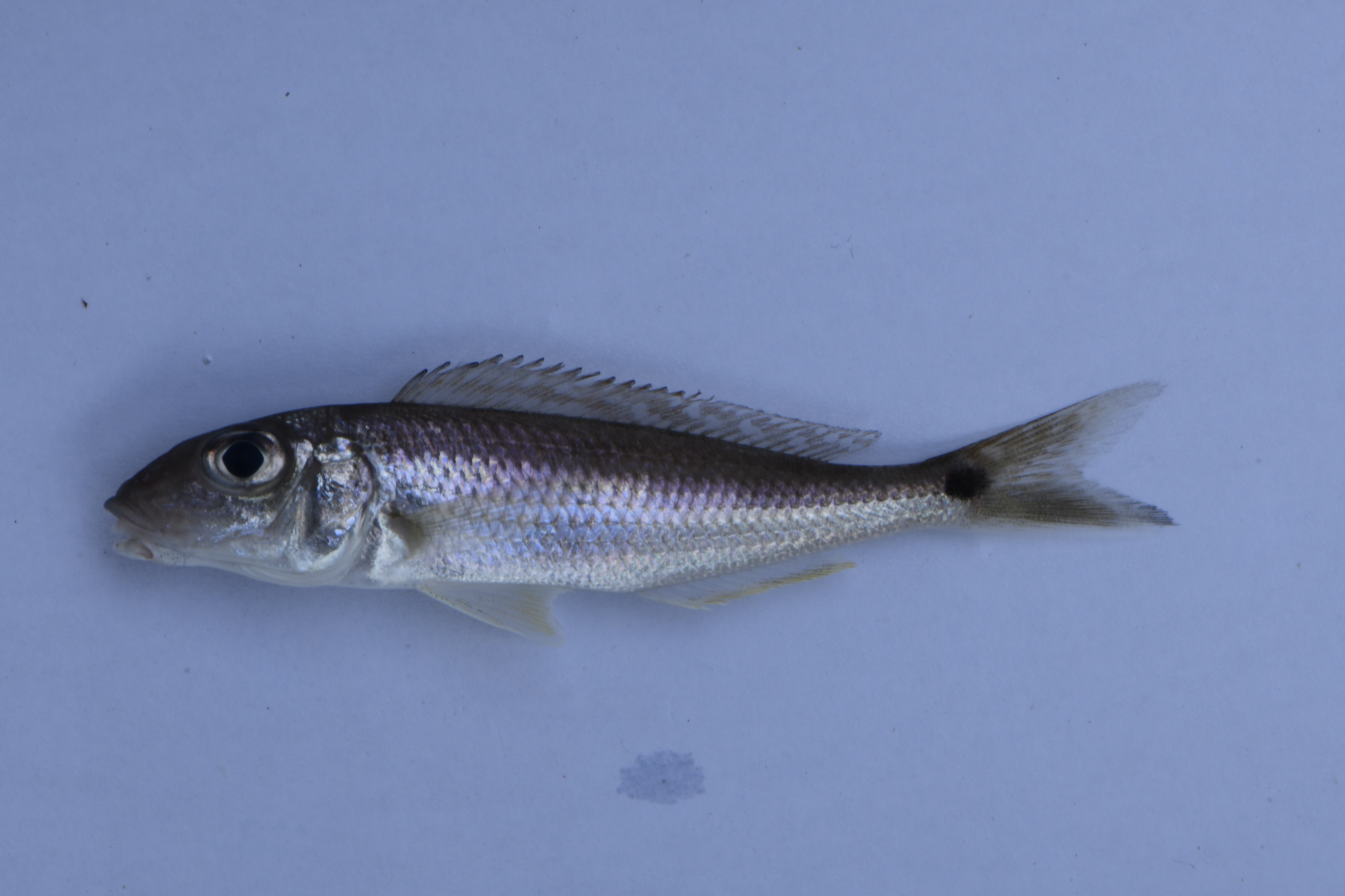
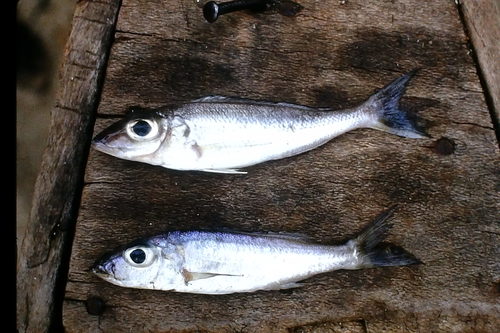
Grammatotria lemairii is a long, laterally compressed, silvery fish with a low-slung, distinctly pointed head — the snout is the giveaway, an adaptation for thrusting into sand. The body is largely plain and reflective, which is part of why a fish this large has stayed comparatively obscure in the hobby: it lacks the electric blues and barred patterns that sell rock-dwellers. The most reliable field mark is a dark spot on the caudal peduncle, the narrow part of the body just before the tail, which together with its size separates it at a glance from the smaller sand-sifters it schools alongside.
Reports of maximum size vary, and the spread is worth being honest about. FishBase lists a maximum of about 10 inches (26 cm) total length; field observers working with Ad Konings's material describe males reaching roughly 11 inches (27 cm) and females around 9 inches (22 cm). Some popular sources put it as high as 16 inches (40 cm), but that figure is not supported by the measured records and is best treated as an overstatement. Either way, the consistent finding is the important one: this is by a clear margin the biggest sand-sifting cichlid in Lake Tanganyika.
Sexual dimorphism is weak. Males grow somewhat larger and, when in spawning condition, can take on a faint bluish cast and — depending on population — a scattering of blackish body spots, which tend to be more pronounced in northern fish than in southern ones. Females stay silvery, with a rounded belly when ripe. Outside of breeding, telling the sexes apart by eye is genuinely difficult.
Range & habitat
Grammatotria lemairii is endemic to Lake Tanganyika and found lake-wide, its range spanning all four riparian nations — Burundi, the Democratic Republic of the Congo, Tanzania, and Zambia. It is a sand specialist in the most literal sense: it lives over sandy and muddy bottoms, the gently sloping sediment flats that ring much of the lake between the rocky headlands, and it is essentially absent from the rubble and rock habitats that hold the more colorful Tanganyikan cichlids. Geographic variation across this enormous range is modest, amounting mostly to the stronger black body spotting of northern males.
Depth records differ with the source. The IUCN assessment notes observations down to at least 30 m (about 100 ft), while hobby and field references describe it from the shallows down to roughly 75 m (about 245 ft), possibly deeper — consistent with a fish that ranges widely across the sediment shelf rather than clinging to one band. Either way it is a creature of the open, well-lit to dimly lit sand rather than the deep anoxic basin.
Like all Tanganyikan cichlids it lives in hard, alkaline, mineral-rich water. In-lake conditions reported for the species fall in the familiar Tanganyikan envelope: a pH around 7.5 to 8.5, substantial hardness, and warm but stable temperatures in the range of roughly 73 to 81 degrees Fahrenheit (23 to 27 degrees Celsius). The lake's famous thermal and chemical constancy is part of the backdrop here — these fish evolved in water that barely changes from week to week.
Ecology & diet
Functionally, Grammatotria lemairii is a sand-winnower. It drives its pointed snout into the substrate, takes a mouthful of sand and mud, and sorts it inside the buccal cavity: edible particles are retained on the gill rakers while the inert sand is flushed back out through the mouth and gill openings. This is the same trick used across the sand-dwelling Ectodini, but Grammatotria's size lets it dig deeper and process larger volumes, reaching invertebrate prey buried below the level the smaller sifters can work.
The diet is broadly carnivorous and opportunistic. FishBase summarizes it as feeding on mollusks and diatoms; fuller field accounts add ostracods and copepods (tiny crustaceans), insect larvae, small clams and shrimps, plant debris, and even small fish, alongside the algae and microorganisms that come up with each mouthful of substrate. Its trophic level is estimated at around 2.7 — a mid-level consumer rather than a top predator, despite its bulk. In the wild it commonly forages in mixed schools, mingling with smaller sand-dwellers such as Xenotilapia, and its deep-digging style likely opens up food that the rest of the foraging guild cannot reach. In that sense it occupies a niche of its own on the sand flats: a large-bodied sediment processor in a guild otherwise built from small fish.
Behavior & breeding
For most of the year Grammatotria lemairii is a schooling fish, drifting over the sand in loose aggregations and mixing freely with other sediment-dwellers. It is described as cautious and rather understated in temperament — not a charging, territorial brawler so much as a wary giant that keeps moving. That gregarious, low-key disposition is the default state; the territorial side of the fish only surfaces around spawning.
Reproduction is by maternal mouthbrooding: the female carries the fertilized eggs and then the developing young in her mouth, sheltering them from predators on the open sand where there is nowhere else to hide. Unlike many sand-dwelling cichlids, the males do not construct elaborate sand-scrape bowers as nests. Instead a displaying male holds a temporary territory, cuts a ripe female out of the passing school, and spawns with her directly; she then takes the clutch into her mouth. Field accounts put incubation at roughly four weeks, with clutches on the order of 50 young, and brooding females have been recorded carrying larvae of just over half an inch (about 1.3 cm). The traditional knowledge gathered for the 2025 Red List assessment echoes this from the fishers' side — describing how the female keeps the offspring in her mouth to protect them and how groups are seen moving together with parental care. The picture that emerges is a fish that spends its life in the crowd and only briefly pairs off to breed.
In the aquarium
This is not a beginner's fish, and it is not a small one. The honest starting point is space: a fish that approaches a foot long and naturally lives in moving schools over open sand needs a long tank with a large, uncluttered footprint. Specialist references suggest a minimum of around 100 US gallons (400 liters), and that should be read as a floor for a pair or a small group, not a comfortable home for several adults. The setup should be the opposite of a rockwork mbuna tank: a deep bed of fine sand, plenty of open swimming room, and minimal decor, so the fish can actually do the thing it is built to do — sift the substrate. A fine sand bed is essential, not optional, both for foraging and for the natural digging behavior.
Temperament is usually described as peaceful to only moderately aggressive, which makes it a poor match for boisterous, hyper-territorial cichlids that will harass it; calmer Tanganyikan sand-dwellers and open-water schooling species suit it far better. Keep the water hard and alkaline (pH comfortably above 7.5) and warm and stable, mirroring the lake. Diet in captivity is straightforward for a carnivore that takes invertebrates — frozen and prepared foods such as mysis, krill, and other shrimp are readily accepted.
The candid hobbyist note is that Grammatotria lemairii remains uncommon and underappreciated, largely because its subdued silver coloration doesn't compete with the lake's flashier residents on a shop shelf — and because comparatively few keepers can give a schooling fish of this size the room it wants. The keepers who do tend to value it precisely for the behavior rather than the color: a sizeable, busy, peaceful sand-sifter is an unusual centerpiece. Anyone tempted should plan around the tank size and the school first; everything else about it is relatively undemanding by Tanganyikan standards.
Conservation
Grammatotria lemairii is assessed by the IUCN Red List as Least Concern (2025, assessed March 2025; it also held that status in the previous 2006 assessment). The reasoning is straightforward: the fish is endemic to Lake Tanganyika but widespread and locally abundant across it, with no single threat severe enough to push it toward a higher category. The population trend is listed as unknown — stable in Tanzanian waters by local report, with some local declines noted in Zambia. It is taken for food (in Tanzania it is considered a delicacy, caught in fish traps and sold in local markets) and collected in modest numbers for the aquarium trade, but neither pressure is currently judged to threaten the species as a whole.
That clean bill of health for the species sits inside a lake under real and growing strain, and the threats listed for Grammatotria are exactly the basin-wide ones: shoreline agriculture and the runoff and sedimentation that come with it, water pollution, and fishing — including gill nets and traps that, while aimed at other species, sweep up sandy-shore fish communities. Two strands of the limnological literature explain why that matters even for a 'common' fish. O'Reilly and colleagues (2003, Nature) used sediment-core records to show that a warming lake has become more strongly stratified, so that the seasonal mixing which lifts nutrients from the depths has weakened; they estimated primary productivity may have fallen by roughly 20 percent, implying something like a 30 percent decline in fish yields, with climate rather than fishing as the primary driver. Cohen and colleagues (2016, PNAS) extended the picture: warming has intensified stratification (trapping nutrients in deep water) and enlarged the lake's low-oxygen zone, narrowing the shallow, oxygenated coastal band where most of Tanganyika's endemic species — Grammatotria among them — actually live.
For a sand-dwelling, shallow-to-moderate-depth fish, those two pressures land close to home. Sedimentation from deforested, cultivated catchments smothers and degrades exactly the sand and mud flats this species forages over, and the squeeze on the productive coastal zone reduces the habitat available to it even as the open-water fishery removes biomass from the system. Lake Tanganyika is shared by four countries — Burundi, the DRC, Tanzania, and Zambia — and its long-term health depends on coordinated, basin-wide management of fishing, catchment land use, and climate-driven change rather than action by any one nation. The most accurate summary is also the most useful one: Grammatotria lemairii itself is not currently threatened, but it is fully exposed to the slow, lake-scale deterioration that the science has been documenting for two decades, and its fortunes will track the lake's.
Sources
- Eschmeyer's Catalog of Fishes — Grammatotria lemairii (Boulenger, 1899)
- FishBase — Grammatotria lemairii (Boulenger, 1899)
- IRMNG — Grammatotria Boulenger, 1899
- IUCN Red List — Grammatotria lemairii (Sibomana, C. 2025; e.T60494A47193359)
- O'Reilly et al. 2003, Climate change decreases aquatic ecosystem productivity of Lake Tanganyika (Nature)
- Cohen et al. 2016, Climate warming reduces fish production and benthic habitat in Lake Tanganyika (PNAS)
- Koblmüller et al. 2004, Evolutionary relationships in the sand-dwelling cichlid lineage (Ectodini) of Lake Tanganyika (J. Mol. Evol.)
- Cichlid Room Companion — Grammatotria lemairii species profile (T. Andersen, curator)
- tanganyika.si — Grammatotria lemairii 'Cape Nangu' (species/locality account, after Konings)
- AquaInfo — Grammatotria lemairii (J. de Lange)
- Destination Tanganyika — Grammatotria lemairii (community/field account, anecdotal) — community/anecdotal