
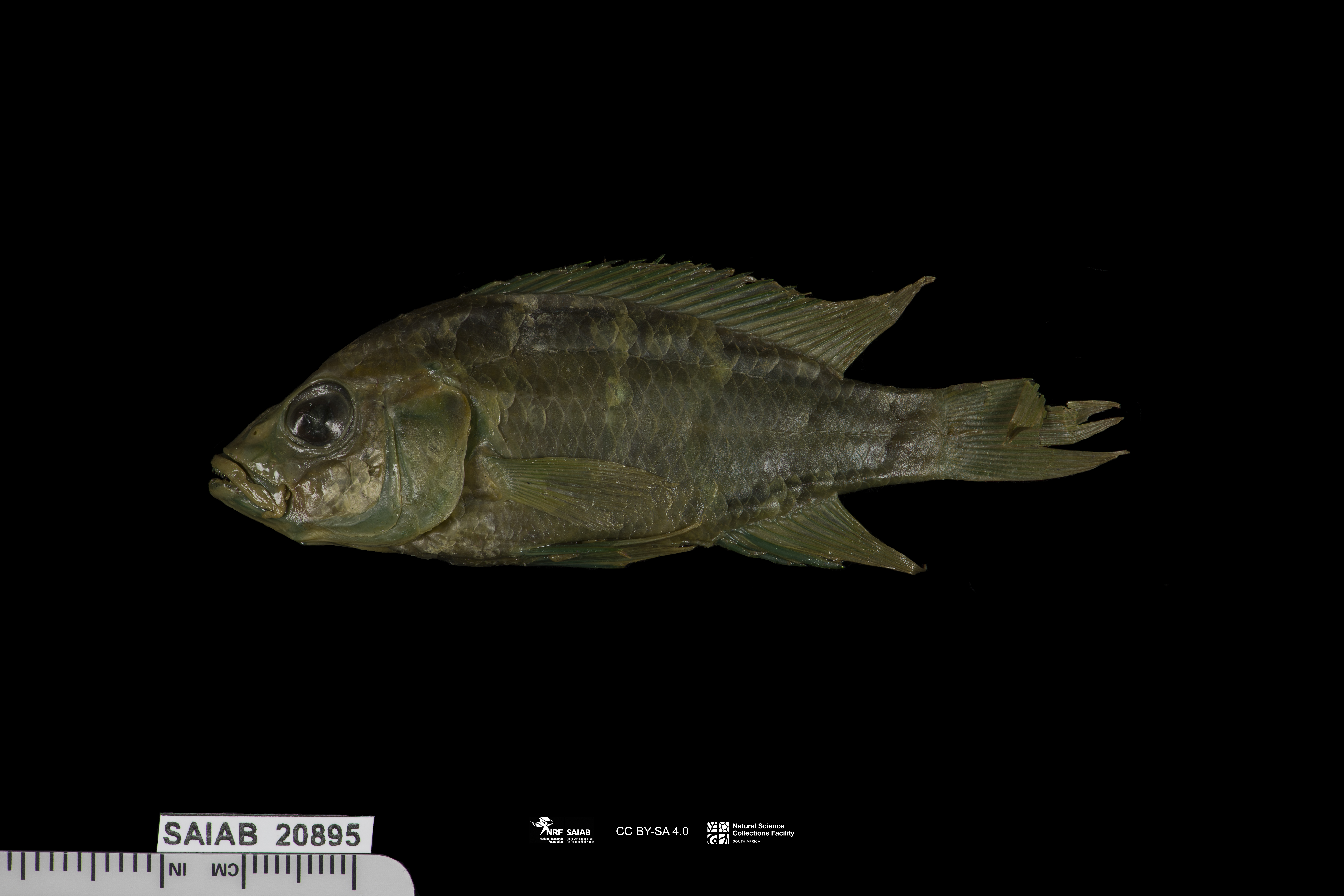
Taxonomy & naming
Peter Humphry Greenwood described this species in 1980 as Astatotilapia paludinosa, working from material collected in the Malagarasi swamps at Katare, Tanzania (the holotype, BMNH 1956.7.9.266, sits in the Natural History Museum in London). The epithet paludinosus comes from the Latin palus, "marsh" or "swamp" — a plain-spoken nod to the boggy habitat it was pulled from.
The genus, though, is genuinely unsettled, and it is worth being honest about that. Eschmeyer's Catalog of Fishes and FishBase both list it as valid as Haplochromis paludinosus, with Astatotilapia paludinosa (Greenwood's original combination) as the basis. FishBase and the CLOFFA checklist instead retain it in the older catch-all genus Haplochromis (as Haplochromis paludinosus), a deliberately provisional move while the vast "haplochromine" assemblage of East Africa awaits a full revision. The IUCN assessment uses Astatotilapia paludinosa. None of these disagree about which fish is meant; they disagree about which drawer to file it in. We use Haplochromis paludinosus here to match the prevailing usage in the regional fish literature, but a reader who meets it under Astatotilapia is looking at the same animal.
It belongs to the Pseudocrenilabrinae, the African cichlid subfamily, and to the "modern haplochromine" lineage — the same explosively diverse group that produced the species flocks of Lakes Victoria, Malawi and the satellite lakes. Astatotilapia is the riverine, generalist end of that radiation, and includes the well-studied laboratory model A. burtoni and the widespread A. bloyeti of Tanzania's coastal rivers.
Appearance
This is a modestly sized fish. FishBase records a maximum of about 14.0 cm (5.5 in) standard length, which makes it middling for a riverine haplochromine — larger than the dwarf forms but well short of the lake's big predators.
In body plan it is a typical Astatotilapia: a laterally compressed, deep-bodied little cichlid with the unfused, slightly underslung jaws of a generalist feeder. Detailed published color descriptions for this particular species are thin, and rather than invent them it is more honest to describe the pattern by analogy to its close relatives, which are well documented. In that group, breeding males flush into bold color — yellows, blues and reds along the flanks — and carry a row of round, ringed "egg spots" on the anal fin, the dummy eggs that play a role in mouthbrooding. Females and non-breeding fish are far plainer, an olive-to-silvery camouflage suited to murky, vegetated water. Confident field identification of H. paludinosus is genuinely difficult: the Malagarasi holds several superficially similar haplochromines, and separating them reliably is a job for fin-ray and tooth counts, not photographs.
Range & habitat
Haplochromis paludinosus is endemic to the Malagarasi River basin, shared between western Tanzania and a sliver of southeastern Burundi (roughly 5–7°S). It is, in other words, a Lake Tanganyika fish only in the watershed sense — the Malagarasi is the lake's single largest affluent, draining some 130,000 km² and making up close to a third of Tanganyika's entire catchment before it empties through a two-branched delta near Uvinza. The fish itself lives upstream and out in the wetlands, not down in the deep rift lake.
Its world is the swamp. FishBase and the IUCN both place it in slow-flowing streams, rivers, permanent inland deltas and the marshes between them. This is a landscape of papyrus (Cyperus papyrus), Typha, sedges and submerged Potamogeton and Ceratophyllum, with floodplains that swell enormously in the wet season — the Malagarasi-Moyowosi system supports thousands of square kilometers of permanent and seasonal swamp, parts of it protected as a Ramsar wetland of international importance. Water here is soft, warm, often turbid and seasonally low in oxygen, the kind of habitat where lungfish thrive. That is a very different set of conditions from the clear, alkaline, mineral-rich open water of Lake Tanganyika proper, and it explains why this swamp specialist never became one of the lake's rocky-shore celebrities.
Ecology & diet
Like most riverine Astatotilapia, H. paludinosus is a generalist rather than a specialist. The IUCN assessment describes it feeding on "varied food items including insect larvae, plant debris, etc.," and FishBase places it at an estimated trophic level of about 3.4 — squarely in the omnivore-to-low-carnivore band. In practice that means a diet built from whatever the swamp offers: aquatic insect larvae and other small invertebrates, plant and detrital material, and likely small crustaceans and the odd fry.
That dietary flexibility is the whole survival strategy of a floodplain fish. Habitat in the Malagarasi swings hard with the seasons — channels expand and contract, oxygen rises and falls, food shifts from one source to another — and a fish that can switch prey fares better than a committed specialist. Within the community it occupies an unglamorous but important middle tier, converting insects and detritus into fish biomass that feeds larger predators, herons and, locally, people. The Malagarasi as a whole is a biogeographic crossroads, with elements of Congolese, Nilotic and Lake Rukwa origin layered together; H. paludinosus is one of the roughly 15% of species that the system has made its own.
Behavior & breeding
Reproduction is the part of this fish's biology we can state with confidence: it is a maternal mouthbrooder, as FishBase records directly ("mouthbrooding by females"). This is the classic East African haplochromine strategy. After a courtship in which the male displays his color and egg-spots, the female lays a small clutch, takes the eggs into her mouth, and — following the egg-spot ruse on the male's anal fin — collects his milt to fertilize them. She then carries the developing eggs and larvae in her buccal cavity for several weeks, not feeding, releasing free-swimming fry only once they can fend for themselves and briefly taking them back in at the first sign of danger.
Direct behavioral observations of H. paludinosus in the wild are scarce, so the finer details — territory size, spawning triggers, social structure — are best inferred cautiously from its better-studied relatives. In Astatotilapia generally, males hold small breeding territories and are pugnacious toward rivals while females and juveniles shoal more loosely; spawning tends to track the seasonal flood, when warming, rising water opens up vegetated shallows for the fry. Treat those as well-grounded expectations for this species rather than documented facts about it specifically.
In the aquarium
Plainly: this is not an aquarium-trade fish. H. paludinosus is a swamp endemic of a remote basin, essentially absent from the hobby, and you will not find it on stock lists. So this section is honest extrapolation from its near relatives, not a care sheet for a fish people actually keep.
If one did turn up, it would behave like a riverine Astatotilapia, and those are hardy, adaptable and decidedly feisty. The genus tolerates a wide range of conditions — its wild water is soft and warm, but relatives like A. burtoni are famously forgiving — with neutral-to-slightly-alkaline water in the low-to-mid 70s°F (around 24–27°C) being a sensible target. The realistic cautions are the usual haplochromine ones: maternal mouthbrooders mean females need cover and refuge, breeding males turn territorial and can harass tankmates and each other, and a small, lively cichlid like this needs more swimming room than its body length suggests — a four-foot tank, not a nano. It is not a community fish in the peaceful-tetra sense. The single most useful thing to understand about it, though, is conservation, not husbandry: its value is as a living piece of the Malagarasi wetland, and the right place to appreciate it is in that context.
Conservation
The IUCN Red List assesses this species (as Astatotilapia paludinosa) as Least Concern, in an evaluation by G. Ntakimazi dated 31 January 2006 — now old enough that the listing itself is flagged as needing updating. The reasoning is straightforward: it is endemic to the Malagarasi basin but widespread within it, with no evidence of significant decline, and it may well be more widespread than current surveys show. The threats the assessment does name are local and habitat-based — water turbidity from soil erosion across the watershed as agriculture expands, plus livestock pressure and agricultural runoff. There is no targeted fishery or aquarium-collection pressure on it; the recommended action is simply more survey work and extending the Malagarasi Ramsar protection to include the delta. For a swamp fish, sedimentation and wetland conversion are exactly the right things to worry about.
That species-level calm sits inside a basin under real strain. The Malagarasi drains into Lake Tanganyika, and the lake is changing measurably: O'Reilly and colleagues (Nature, 2003; DOI 10.1038/nature01833) found that a warming, more strongly stratified water column has cut primary productivity by roughly 20% over the past century, implying something like a 30% drop in fish yields, while Cohen and colleagues (PNAS, 2016; DOI 10.1073/pnas.1603237113) estimated a loss on the order of 38% of the lake's oxygenated benthic habitat as warming pushes the oxygen line shallower. Those pressures fall hardest on the lake's deepwater and pelagic fishes and on the four-nation clupeid-and-Lates fishery, now coordinated through the Lake Tanganyika Authority — not directly on a swamp dweller upstream. But the connection runs the other way: the Malagarasi wetlands buffer sediment and regulate the water reaching the lake, so the same erosion and land-use changes that cloud H. paludinosus's home also load the rift lake below it. The honest summary is that this fish is genuinely Least Concern today, while the wider system it anchors is not nearly so secure.
Sources
- Eschmeyer's Catalog of Fishes: Astatotilapia paludinosa / Haplochromis paludinosus (Greenwood 1980)
- FishBase: Haplochromis paludinosus summary page
- IUCN Red List: Astatotilapia paludinosa (Ntakimazi 2006, Least Concern)
- FEOW: Malagarasi–Moyowosi freshwater ecoregion (#543)
- FEOW: Lake Tanganyika freshwater ecoregion (#542)
- Cichlid Room Companion: de Vos et al. 2001, ichthyofauna of the Malagarasi basin (abstract)
- An Updated Checklist of the Fishes from the Upper Malagarazi (Diversity, 2024)
- O'Reilly et al. 2003, Climate change decreases productivity of Lake Tanganyika (Nature; PubMed)
- Cohen et al. 2016, Climate warming reduces fish production and benthic habitat in Lake Tanganyika (PNAS)
- FishBase: Astatotilapia bloyeti (close riverine relative)
- The puzzling phylogeography of the haplochromine cichlid Astatotilapia burtoni (PMC)
- The taxonomic diversity of the cichlid fauna of Lake Tanganyika (PMC)
- The Cichlid Stage: keeping and behavior of Astatotilapia burtoni (hobby blog)
- Cichlid-Forum thread: keeping aggressive riverine cichlids (community) — community/anecdotal
- Goliad Farms: breeding African cichlid mouthbrooders (hobby reference)