Taxonomy & naming
Haplotaxodon microlepis was described by George Albert Boulenger in 1906, in the fourth of his contributions to the ichthyology of Lake Tanganyika, working from material that W. A. Cunnington brought back from the Third Tanganyika Expedition of 1904–1905. The genus name is built from Greek roots — haploos, "single," taxis, "row" or "arrangement," and odous, "tooth" — a reference to the simple, single-cusped teeth that set it apart from its relatives. The species epithet microlepis means "small-scaled."
Its placement is the interesting part. Haplotaxodon sits in the tribe Perissodini, the Tanganyikan lineage famous for lepidophagy — eating the scales of other fish. Marlier and Poll's mid-century classification, and Poll's 1986 revision, folded Haplotaxodon into that tribe, and the molecular phylogeny of Koblmüller and colleagues (2007) confirmed it: of the nine Perissodini species, seven are scale-eaters, and the two Haplotaxodon are the outliers that abandoned the habit for plankton and small prey. For a long time the genus was considered monotypic. Then Takahashi and Nakaya (1999) described a second species, H. trifasciatus, distinguished by three vertical body bars (versus four in microlepis), six or seven scale rows between the upper and lower lateral lines (versus five), and usually 34 vertebrae (versus 35–36). The IUCN's current taxonomy treats H. trifasciatus as a synonym of H. microlepis, while the molecular work and several specialist references regard it as valid — so its status is genuinely unsettled, and aquarists encountering different regional forms should not assume a single identity. Around the lake the fish carries Swahili and local names including kalilakumkumi, liukonko, and lukoko.
Appearance
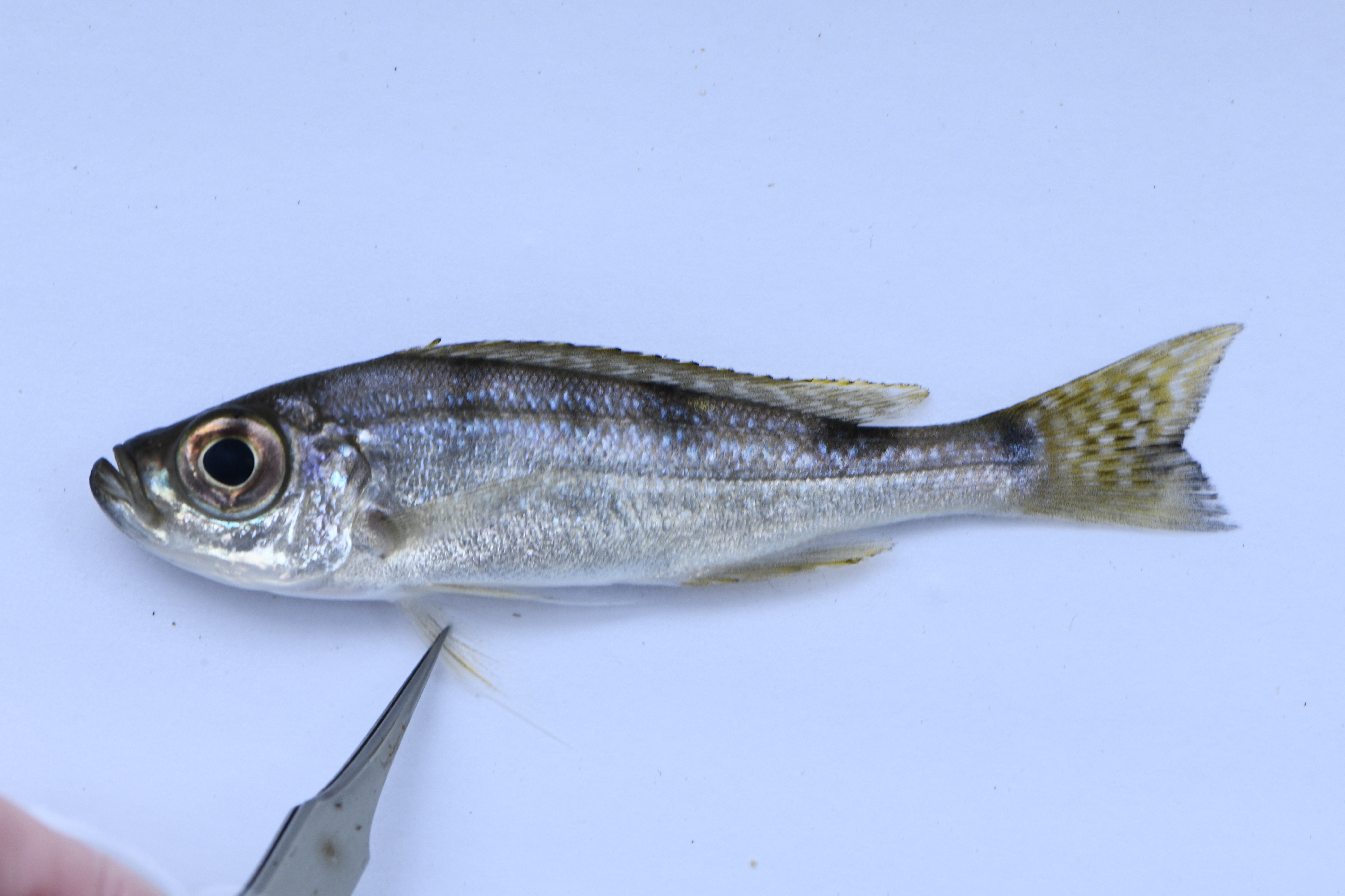
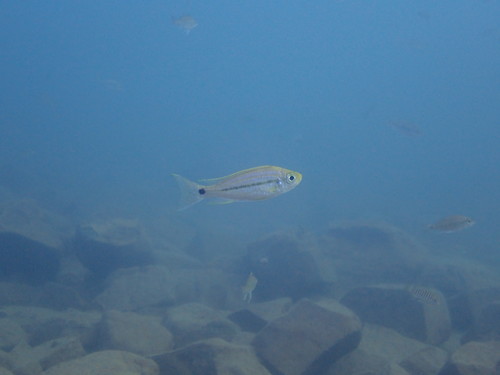
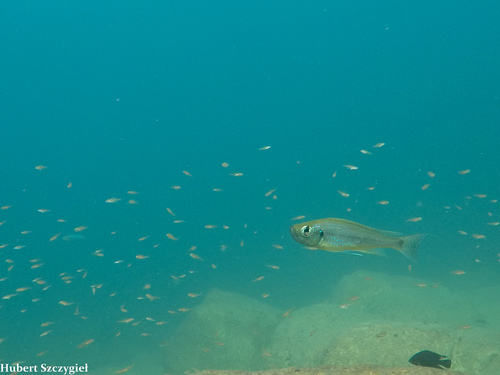
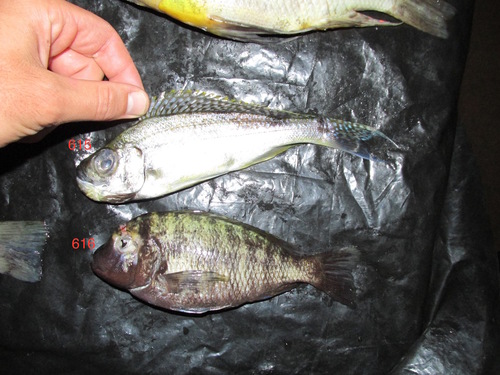
Haplotaxodon microlepis is a slim, laterally compressed, silvery fish built for open water rather than the rocks. FishBase gives a maximum of about 10 in (26 cm) total length, though most aquarium and field specimens are smaller. Its two most distinctive features are functional: a sharply upturned, almost superior mouth, and notably large eyes — both adaptations for spotting and seizing small prey above and ahead of it in the water column. The body bears a set of faint dark vertical bars on a bright, reflective ground, and the unpaired fins can show a soft bluish or violet sheen in good condition.
The bar count is the practical field mark within the genus: H. microlepis typically shows four vertical bands on the body below the dorsal-fin base, while the contested H. trifasciatus shows three. Sexual dimorphism is subdued — males and females are similar in size and pattern, with breeding adults intensifying in color — which is one reason pairing these fish in the aquarium takes patience. Numerous geographic variants are recognized by hobbyists and photographers (forms labeled for Cape Nangu, Fulwe Rocks, Kigoma, Ulwile Island and others), differing in the crispness of the barring and the overall hue.
Range & habitat
The species is endemic to Lake Tanganyika — the long, ancient Rift Valley lake shared by Burundi, the Democratic Republic of the Congo, Tanzania, and Zambia — and it occurs all around the lake rather than in a single basin. This is an open-water fish: FishBase classes it as pelagic, and the IUCN assessment places it in the upper 10 m (about 33 ft) of the water column. Adults typically roam that surface layer alone or in pairs, but schools do gather in coastal water along rocky shores, which is where divers and collectors most often encounter them.
Like all of Tanganyika's endemics, H. microlepis is built for the lake's hard, alkaline, thermally stable water. FishBase records a pH range of roughly 7.0–8.5, a hardness of about 10–15 dH, and temperatures of 73–82°F (23–28°C). Because it lives in the sunlit upper layer rather than the deep water favored by most of its scale-eating relatives — Koblmüller and colleagues note that the majority of the Perissodini evolved in deep habitat and only recently moved shallow — it is exposed to the surface conditions of the lake, including the productivity of the plankton it depends on.
Ecology & diet
If the Perissodini are defined by scale-eating, Haplotaxodon is the tribe member that didn't get the memo. Both Haplotaxodon species are zooplanktivores that also take small fish, and the genus's whole morphology reflects that diet rather than the lacerating, asymmetric jaws of its scale-rasping cousins. The upturned mouth and large eyes are the tools of a visual mid-water and near-surface predator: it picks copepods, other zooplankton, and small fishes such as juvenile clupeids out of the open water. FishBase places its trophic level at roughly 3.4, the value expected of a small-prey predator rather than a top piscivore.
That makes H. microlepis an evolutionary curiosity. Within a lineage that pushed one of the most specialized feeding strategies in all of fishes — Tanganyika's scale-eaters even show left- and right-"handed" jaw asymmetries tied to which flank of a victim they attack — Haplotaxodon represents a reversal to a more conventional planktivorous niche. Its role in the lake community is that of a mid-level open-water consumer, linking the plankton and small forage fish of the upper layer to the larger predators above it. It is taken in subsistence fisheries but is not a primary commercial target.
Behavior & breeding
The breeding biology is where this fish earns its reputation among ichthyologists. Most Tanganyikan cichlids that brood in the mouth do so maternally — the female alone carries eggs and fry. Haplotaxodon microlepis is a biparental mouthbrooder, and Kuwamura's 1988 field-and-aquarium study laid out how the duty is split. The female mouthbroods the eggs and the smallest larvae; once the young pass roughly 9 mm and begin to feed, both parents take turns carrying and guarding them until they reach about 25–30 mm — nearly two months after spawning. When part of a brood is released to swim freely, the roles shift cleanly: the female guards the free-swimming young while the male takes over the mouthbrooding of the rest. FishBase records larvae of up to about 2.3 cm being mouthbrooded by parents of 16.6–18.3 cm standard length. Unusually for a mouthbrooder, the embryos hatch without fully pigmented eyes, a trait noted in the developmental literature as a rarity among orally incubating cichlids.
This prolonged, cooperative care fits the Perissodini's reputation as a behavioral bridge between substrate-spawning and mouthbrooding cichlids. Field and hobby observations also describe young fish lingering with the parents in cohesive groups, with older juveniles reported helping to shepherd later broods — a nuclear-family structure that aquarists who have spawned the fish corroborate. Toward other species the adults are mild-mannered and not strongly territorial, reserving their predatory attention for anything small enough to swallow.
In the aquarium
Haplotaxodon microlepis is a specialist's fish, not a starter cichlid — not because it is delicate, but because of its size, its open-water habits, and its scarce supply. It is only occasionally exported, and long-time Tanganyika keepers note that wild imports show up irregularly and at a premium; until recently, captive-bred fry were almost unheard of, though hobbyist breeders (including reports out of dedicated Tanganyikan groups) have begun raising them in the last few years, which is slowly changing availability.
Give it room. This is a roaming open-water swimmer that reaches the better part of a foot, so a long tank with generous unobstructed swimming space is essential; cramped quarters are the most common mistake. Match the lake's water — hard and alkaline, pH comfortably above 7.5, temperature in the high 70s°F — and keep it clean and well oxygenated. Temperamentally these fish are peaceful for a rift-lake cichlid and tend to be ignored by, and to ignore, similarly sized tankmates; the practical catch is the one that follows from their diet, namely that small fish and shrimp will be treated as food. Suitable companions are other open-water or mid-sized Tanganyikans of comparable temperament that also accept a carnivorous diet. Feed them well on quality frozen and prepared carnivore foods. Breeding has been achieved but is not trivial: keepers consistently report difficulty getting fry through the brood-transfer stage, with broods sometimes lost during the hand-off between parents — the kind of hurdle that makes a successful spawn a genuine accomplishment.
Conservation
Haplotaxodon microlepis was assessed for the IUCN Red List in March 2025 (Mgana and Fermon) and listed as Least Concern. The reasoning is straightforward: it is endemic to Lake Tanganyika but found all around the lake and described as a common species, so although unsustainable, non-selective fishing is flagged as a likely threat "at least in some areas," there is no evidence of a decline steep enough to warrant a threatened category. The population trend is recorded as unknown. The fish is eaten locally (though not specifically targeted) and is also taken for the ornamental trade, so light collection pressure exists but is not, on present evidence, a population-level concern. The assessment notes there are no targeted conservation measures, but that the species would benefit from the May–August fishing ban trialed under the four-nation Lake Tanganyika Authority, which gives breeding fish a seasonal window.
That "Least Concern" verdict has to be read against a lake under real strain. Lake Tanganyika is warming, and a warmer surface mixes less with the deep water; O'Reilly and colleagues (2003, Nature) inferred from the sediment record that primary productivity may have fallen by roughly 20%, implying on the order of a 30% drop in fish yields, and Cohen and colleagues (2016, PNAS) found that reduced mixing has shrunk oxygenated benthic habitat by about 38% in their study areas. Sedimentation from shoreline deforestation continues to degrade the rocky littoral (Cohen et al. 1993), and the great pelagic fishery built on the clupeids Stolothrissa and Limnothrissa and the predatory Lates — which feeds four countries — is widely reported to be in decline, with catches falling sharply in recent years. For a surface-dwelling planktivore like H. microlepis, the exposure is mostly indirect but real: it does not depend on the rocky shoreline that sedimentation harms, but it lives in and feeds on the productivity of the warming upper layer, the same upper layer whose plankton and small forage fish are squeezed by reduced mixing and heavy harvest. The species itself is not a conservation priority today — but the warm, open water it hunts in is exactly where the lake's measured pressures land.
Sources
- Haplotaxodon microlepis — FishBase species summary
- Haplotaxodon microlepis Reproduction Summary — FishBase
- Eschmeyer's Catalog of Fishes — Haplotaxodon microlepis (species record)
- Haplotaxodon microlepis — Fishipedia species sheet
- Koblmüller, Egger, Sturmbauer & Sefc 2007 — Evolutionary history of Lake Tanganyika's scale-eating cichlid fishes (Mol. Phylogenet. Evol.)
- Kuwamura 1988 — Biparental mouthbrooding and guarding in a Tanganyikan cichlid Haplotaxodon microlepis (Ichthyological Research)
- Takahashi & Nakaya 1999 — New species of Haplotaxodon (Cichlidae) from Lake Tanganyika (Copeia)
- Haplotaxodon microlepis — Cichlid Room Companion (public profile)
- Haplotaxodon microlepis — tanganyika.si (geographic forms gallery)
- Tanganyikans with a twist — Practical Fishkeeping (Haplotaxodon overview; trifasciatus contention)
- Haplotaxodon microlepis — IUCN Red List 2025 (Mgana & Fermon)
- O'Reilly et al. 2003 — Climate change decreases aquatic ecosystem productivity of Lake Tanganyika (Nature)
- Cohen et al. 2016 — Climate warming reduces fish production and benthic habitat in Lake Tanganyika (PNAS)
- Lake Tanganyika: status, challenges, and opportunities for research (2023, J. Great Lakes Research)
- The fishery of Stolothrissa tanganicae in Lake Tanganyika — FAO
- Lake Tanganyika fishers fight for their future amid declining catches — Al Jazeera (2025)
- Haplotaxodon microlepis from Lake Tanganyika — Cichlid-Forum (community, anecdotal on keeping & breeding) — community/anecdotal
- Haplotaxodon microlepis — r/Tanganyikacichlids (community, anecdotal on biparental brooding) — community/anecdotal