

Taxonomy & naming
George Albert Boulenger described this fish in 1901 as Paratilapia stenosoma, working from specimens collected by J. E. S. Moore at the south end of Lake Tanganyika and at Maswa, south of Ujiji; the original syntypes reside in the Natural History Museum, London. In 1920 Charles Tate Regan erected the genus Hemibates for it, and that combination has been stable ever since (Eschmeyer's Catalog of Fishes; FishBase). The genus name blends the Greek hemi, "half," with bates, "one that walks," and the species epithet stenosoma means "narrow body."
Hemibates sits in the tribe Bathybatini, the lake's lineage of deep-water and open-water predators, alongside the genera Bathybates and Trematocara. Molecular work (Koblmüller and colleagues; Kirchberger et al. 2012) places these three as an ancient, slowly diversifying group near the base of Tanganyika's cichlid radiation. For more than a century Hemibates was considered monotypic, but in 2017 Schedel and Schliewen described a second species, Hemibates koningsi, from southern Zambian waters, so stenosoma is no longer alone in its genus. Among Zambian fishers the species carries the Bantu name "Mpande" (IUCN 2025).
Appearance
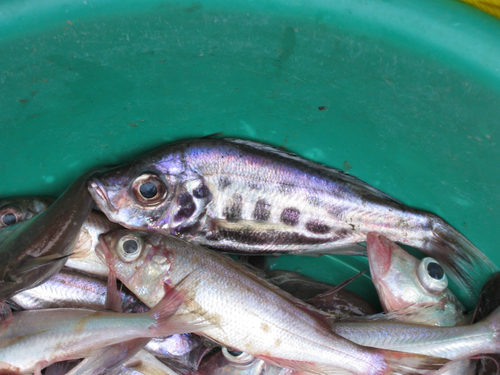
Hemibates stenosoma is a moderately large cichlid, reaching about 12 in (30 cm) total length (FishBase). The body is elongate and somewhat compressed, built for cruising rather than darting between rocks, and the ground color is a clean, reflective silver overlain by black markings.
The species is sexually dimorphic, and the male's pattern is its signature: a scatter of dark blotches across the anterior flank, variable in number, size, and shape, followed by horizontal bands toward the tail (Schedel & Schliewen 2017). Like its Bathybatini relatives, the male also carries egg-spots on the anal fin. This black-on-silver scheme is the key to separating it from its 2017-described congener H. koningsi, whose males wear neat vertical black bars rather than irregular blotches. Schedel and Schliewen also found stenosoma has, on average, more gill rakers on the first arch (35–43 versus 33–37) and a shorter, straighter-keeled lower pharyngeal jaw than koningsi. The monochrome palette is not drabness for its own sake: in the dark, short-wavelength light of the deep lake, patterns of black, white, and silver carry farther than color, and these markings are thought to function in species recognition between sexes.
Range & habitat
The species is endemic to Lake Tanganyika and ranges lake-wide, recorded from all four riparian nations: Burundi, the Democratic Republic of the Congo, Tanzania, and Zambia (IUCN 2025; FishBase). It is not a fish of the rocky littoral that most hobbyists picture when they think "Tanganyikan cichlid." Instead it is a benthic, deep-water predator that lives over mud and silt bottoms and across rocky offshore shelves, well below the sunlit reef.
Reported depths vary with the survey. FishBase and older accounts cite roughly 260–660 ft (80–200 m); the 2025 IUCN assessment gives an upper limit of about 395 ft (120 m) and a lower limit near 660 ft (200 m). Pearce's 1985 Zambian deep-water survey found peak catches around 120 m, whereas earlier surveys had the fish most numerous at 180–200 m, suggesting its vertical distribution shifts over time and with fishing pressure. Much of the population likely sits deeper than its catch records imply, and the lower limit is probably set by oxygen: Tanganyika is permanently stratified, and below a few hundred meters the water is anoxic, a hard floor no fish can cross. Many individuals are taken during seasonal inshore migrations, and in Zambia the species has been reported from both shallow and deep water (IUCN 2025).
Ecology & diet
Hemibates stenosoma is a piscivore. Wild stomach contents and ecological surveys agree that it feeds chiefly on fish and shrimp, taken over the deep bottom (Kirchberger et al. 2012; IUCN 2025; Konings). FishBase places it at a trophic level of about 4.1, squarely among the lake's top-tier predators, and notes it forms schools over mud bottoms.
Its ecological weight is considerable. On the southern shelves of the lake it is one of the three most abundant benthic fishes, the others being the centropomid Lates mariae and the catfish Chrysichthys stappersii (IUCN 2025). Pearce's survey even found it to be the single most common fish on the deep bottom, a shift that may reflect commercial fishing having thinned out the larger Lates mariae. Within the Bathybatini, Hemibates and Bathybates appear to have repeatedly toggled between bottom-feeding (benthic) and open-water (bathypelagic) modes over evolutionary time (Kirchberger et al. 2012) — a flexibility that helps explain how a small group of predators came to occupy the lake's vast, food-poor deep zone.
Behavior & breeding
Direct observations of breeding in Hemibates stenosoma are scarce, because the fish lives where divers and aquarists rarely follow. It is best understood as a maternal mouthbrooder, the dominant reproductive strategy among Tanganyika's open- and deep-water cichlids: the female takes the fertilized eggs into her mouth and broods them there until the fry are free-swimming. As of recent hobby reports the species is not known to have been bred in captivity, so the details of its spawning remain inferred rather than documented.
The male's dark blotches and the egg-spots on his anal fin point to a recognition-based courtship like that of related Bathybatini. In the perpetual gloom of the deep lake, where color vision is of little use, researchers have argued that these high-contrast melanic patterns serve as the visual signals that let males and females identify their own species and assess one another — sexual signaling rebuilt for a world of monochrome light (Kirchberger et al. 2012). Outside of spawning, the fish is gregarious, gathering in schools over the soft bottom.
In the aquarium
Be honest with yourself before chasing this one: Hemibates stenosoma is a deep-water specialist, not a hobby staple, and it turns up in the trade only occasionally, usually as wild fish taken from the commercial deep catch around Zambia. It is a large, schooling, open-water piscivore, which translates to a serious tank — long footprint, strong filtration, and room for several individuals, since a lone deep-water schooler tends to fare poorly.
Water should follow the lake: hard, alkaline, and well-oxygenated, with the high pH (around 8.5–9.0) and warm temperatures typical of Tanganyika husbandry. The honest framing is that anything small enough to swallow will be treated as food, so tankmates need to be robust, similarly sized Tanganyikans rather than dwarf shell-dwellers or delicate community fish. There is little reliable hobbyist literature and essentially no record of captive breeding, so a keeper is largely on their own. This is a fish for an experienced specialist with space and patience, not a beginner's introduction to the lake — and most aquarists will encounter it as a name in a survey paper rather than a fish in a shop.
Conservation
The IUCN Red List assessed Hemibates stenosoma as Least Concern in its most recent (2025) evaluation, repeating the category it held in 2006; the assessment, led by C. Sibomana and reviewed by cichlid specialist Ad Konings, judges the species widespread and abundant lake-wide with no major lake-scale threats. That is the honest headline: the fish itself is not currently in trouble. But the assessment is not unqualified — assessors flag water pollution and sedimentation as potential threats, and note that in Zambia local populations have likely declined over roughly two decades, attributed to destructive and less selective fishing methods (including the catch of juveniles) and to falling catch numbers (R. Chifunda, in IUCN 2025). The species is used as local food, not as a significant aquarium export.
Those local pressures sit inside a lake under measurable strain. O'Reilly et al. (2003, Nature, doi:10.1038/nature01833) showed that warming has reduced the deep mixing that fertilizes Tanganyika's surface waters, cutting primary productivity by an estimated fifth and helping drive roughly 30% lower fish yields. Cohen et al. (2016, PNAS, doi:10.1073/pnas.1603237113) found that warming has shrunk the oxygenated benthic habitat in studied areas by about 38% — a direct concern for a benthic, deep-living predator like H. stenosoma, whose lower depth limit is already set by the lake's expanding anoxic layer. Shoreline development and erosion add sediment to the system (Cohen et al. 1993), while a four-nation pelagic fishery built on clupeids (Stolothrissa and Limnothrissa) and Lates feeds millions of people and is managed, in principle, jointly through the Lake Tanganyika Authority. For now the picture is a Least Concern species in a stressed lake: stenosoma is not endangered, but the deep, oxygen-limited habitat it depends on is exactly the part of Tanganyika that climate warming is squeezing, and that is the trend worth watching.
Sources
- Eschmeyer's Catalog of Fishes — Hemibates stenosoma
- FishBase — Hemibates stenosoma summary
- FishBase — Tanganyika species ecology list
- Schedel & Schliewen (2017), Hemibates koningsi spec. nov., Zootaxa 4312(1):92–112
- Kirchberger, Sefc, Sturmbauer & Koblmüller (2012), Evolutionary history of Lake Tanganyika's predatory deepwater cichlids, Int. J. Evol. Biol.
- Reduced host-specificity in a parasite infecting non-littoral Lake Tanganyika cichlids (PMC5177900)
- O'Reilly et al. (2003), Climate change decreases aquatic ecosystem productivity of Lake Tanganyika, Nature
- Cohen et al. (2016), Climate warming reduces fish production and benthic habitat in Lake Tanganyika, PNAS
- IUCN Red List — Hemibates stenosoma (e.T60540A47197159), 2025 assessment
- Cichlid Room Companion — Hemibates stenosoma species profile (public page)
- tanganyika.si — genus Hemibates (species & locations)
- tanganyika.si — Hemibates stenosoma 'Chituta Bay' (deep-water muddy biotope)
- TA-Aquaculture — Rift Lake diets, Lake Tanganyika (Hemibates stenosoma: fish predator)
- Lake Tanganyika: Status, challenges, and opportunities for research (J. Great Lakes Research, 2023)
- Only true pelagics mix: comparative phylogeography of deepwater bathybatine cichlids (PMC6394743)
- r/Tanganyikacichlids — Hemibates stenosoma (community discussion; likely maternal mouthbrooder, not yet bred in aquaria) — community/anecdotal