

Taxonomy & naming
The species was described by the prolific British-Belgian zoologist George Albert Boulenger in 1902 from specimens collected in Lake Malawi (then Lake Nyasa). It is the type and only widely recognized species of the genus Hemitilapia, making the genus effectively monotypic. The generic name splices the Greek hemi-, "half," onto tilapia, an old catch-all for African cichlids; the epithet oxyrhynchus means "sharp-snouted," a nod to the pointed head.
There is a long-running spelling wrinkle worth flagging. Eschmeyer's Catalog of Fishes treats the valid name as Hemitilapia oxyrhynchus Boulenger 1902, following Eccles & Trewavas (1989), who designated the lectotype (BMNH 1906.9.7.38). The feminine ending oxyrhyncha, used here and on much of FishBase, traces to the CLOFFA checklist (Marechal 1991); both refer to the same fish, and Tilapia oxyrhynchus is an older combination. In the lake's species flock it belongs to the large assemblage of non-mbuna cichlids that aquarists call "haps," the open-water and sand-dwelling lineage distinct from the rock-grazing mbuna.
Appearance
This is a substantial cichlid, and the trade name "Giant Hap" is not pure marketing. FishBase lists a maximum of about 8 in (20 cm) total length; field workers and breeders report dominant males reaching roughly 8 to 9 in (20 to 22 cm), with females noticeably smaller at around 6 to 7 in (15 to 18 cm). Reports of an exact ceiling vary by a couple of centimeters between sources, which is normal for a fish whose size depends heavily on diet and tank.
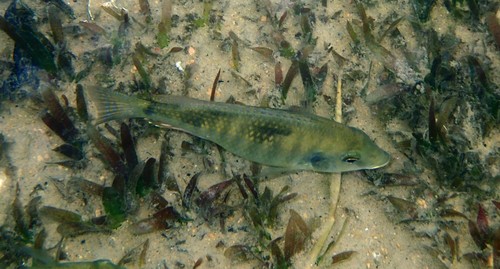
The sexes diverge sharply once males mature. A dominant male takes on an overall blue sheen, often with a metallic head, reddish margins to the scales and anal fin, and flecks of green, yellow, and orange in the caudal fin; the soft dorsal and caudal carry feathery, drawn-out trailers, and the dorsal can extend almost to the tail base. Females and subordinate males are far plainer, a tan-to-silvery grey with a row of darker blotches set high on the back. The pointed snout that gave the fish its name is a consistent field mark separating it from the rounder-headed haps it shares the sand with.
Range & habitat
Hemitilapia oxyrhyncha is endemic to the Lake Malawi system. Its core range is Lake Malawi itself, where it occurs widely around the shoreline, but it also extends downstream into Lake Malombe and the reed-fringed Upper Shire River; the IUCN places it in Malawi, Mozambique, and Tanzania, with an estimated extent of occurrence near 30,000 sq km and an area of occupancy around 3,150 sq km. It is common in Lake Malawi and decidedly less so in Lake Malombe.
The fish is a creature of the shallow, sheltered, vegetated margins rather than the rocky reefs that get the postcards. It favors sandy-bottomed bays and shoreline stands of submerged plants, almost always in association with higher vegetation, especially beds of Vallisneria and, in the Shire, reed stands. These are warm, well-lit waters, broadly 75 to 79 F (24 to 26 C), with the hard, alkaline, high-conductivity chemistry typical of the lake. That tight bond to plant beds is the single most important fact about where this species lives, because the plants are also its pantry.
Ecology & diet
Among Malawi's hundreds of cichlids, Hemitilapia oxyrhyncha occupies an unusually narrow trophic niche: it is, in the words of the older survey literature, essentially the lake's specialist grazer of the algal film growing on submerged plant leaves. Rather than rasping rock like the mbuna or chasing fish like its larger hap relatives, it nibbles the loosely attached periphyton and aufwuchs coating the leaves of Vallisneria, a low position in the food web reflected in its estimated trophic level of about 2.0.
The feeding mechanics are the interesting part. The fish grasps a single leaf and works methodically along it, frequently turning onto its side to bring its mouth flush with the blade, a posture also seen in the head-down ambush predator Dimidiochromis compressiceps that hunts the same Vallisneria beds. Its lower jaw is broadened into a spade-like shape carrying movably implanted teeth whose crowns can conform to the curved leaf surface, scraping algae without shredding the plant. It is one of the few Malawi cichlids to commit almost entirely to this plant-leaf aufwuchs guild, which ties its fortunes directly to the health of the lake's macrophyte beds.
Behavior & breeding
Like the great majority of Lake Malawi cichlids, this is a maternal (female) mouthbrooder with no lasting pair bond. At spawning time a male clears and defends a small arena among the weeds, described in the field as a circular patch roughly 6 in (15 cm) across cleared on sand or among the plants. Eggs are laid and fertilized on the substrate, then taken up and incubated in the female's mouth; brooding females retreat into the vegetation and are rarely seen, which is part of why the species is encountered far less often than its abundance would suggest.
Reports on temperament diverge in a telling way. Field accounts describe a fish that is peaceful within its own kind and best kept in groups, while experienced breeders describe the captive reality as a genuinely aggressive hap in which males spar and even females lock jaws. The two pictures are reconcilable: a wide, structured plant bed in the lake gives subordinates room to disperse that a glass box does not. Breeders report incubation of roughly three weeks, with one well-documented spawn yielding 28 large, gold-colored fry that were free-swimming and able to take baby brine shrimp within days of release. The same keepers note that these larger haps breed less freely than peacocks or mbuna, and that conditioning wild-caught females, which reject oversized foods, takes patience.
In the aquarium
This is not a beginner's mbuna, and it is not a small fish. Because adults are large, active, fast swimmers that dislike crowding, the realistic minimum is a tank of at least 6 ft (180 cm) in length, roughly 150 gallons (about 600 liters) and up; the frequently quoted minimum tank length is around 5 to 6 ft (150 to 180 cm). Decor should mirror the natural biotope: an open expanse of fine sand for swimming and digging, robust plants such as Vallisneria, and a few rock slabs for line-of-sight breaks rather than a rockpile. Standard Malawi water suits it well, hard and alkaline at pH roughly 7.5 to 8.5 and around 76 to 80 F (24 to 27 C).
The honest caveats are temperament and diet. Despite its reputation as a milder hap, keepers consistently warn that it will harass conspecifics and is a poor companion for gentle tankmates such as Aulonocara peacocks; give it space and similarly robust, non-delicate haps. On feeding, respect the fish's biology: a vegetable-forward diet built around spirulina and quality plant-based prepared foods, varied with occasional frozen items, keeps it in condition. It is rarely seen for sale because it is only irregularly exported, so most fish in the hobby pass between specialist breeders and clubs rather than appearing on shop shelves.
Conservation
On its own account the species is in reasonable shape. The IUCN Red List assessed Hemitilapia oxyrhyncha as Least Concern in 2018 (assessors Konings, Kazembe & Makocho), citing a widespread distribution across Lakes Malawi and Malombe and the Upper Shire, a stable population trend, and no major lake-wide threat; it also occurs inside Lake Malawi National Park. The assessment does flag two species-specific pressures: it is irregularly collected for the ornamental trade as the "Giant Hap," and, as a shallow-water plant-bed fish, it is exposed to beach-seine fishing. The seines matter less because the fish is a target food species and more because each pass uproots the very water plants its grazing depends on, slowing the recovery of its habitat.
That species-level calm sits inside a basin under real strain. The Chavula et al. (2023) review of the Lake Malawi/Niassa/Nyasa basin (Journal of Great Lakes Research 49(6):102241) documents over-fishing and the collapse of the chambo (Oreochromis) fishery, heavy sediment and nutrient loading washing off deforested catchments, and roughly 0.7 C of warming in the shallow water that strengthens stratification and trims primary productivity, alongside the looming risk of invasive species. For a fish whose entire foraging strategy is built on healthy, well-lit macrophyte beds in sheltered bays, the most direct of these threats are the local ones: sedimentation that smothers leaves and shades out the algae it grazes, shoreline disturbance, and the destructive inshore fishing the assessors singled out. So the accurate framing is the careful one. Hemitilapia oxyrhyncha is not itself threatened today, but it is a habitat specialist tied to exactly the inshore, vegetated zone where the basin's pressures land hardest, which makes it a fish to keep an eye on rather than to take for granted.
Sources
- Eschmeyer's Catalog of Fishes: Hemitilapia oxyrhynchus (Boulenger 1902)
- FishBase: Hemitilapia oxyrhynchus (Giant Haplochromis)
- FishBase Field Guide: Hemitilapia oxyrhynchus
- BioLib: Hemitilapia oxyrhynchus links and literature
- Fryer & Iles (1972), The Cichlid Fishes of the Great Lakes of Africa, as summarized in M.K. Oliver's Trophic Adaptations of Lake Malawi cichlids
- Eccles & Trewavas (1989), Malawian Cichlid Fishes: classification of some haplochromine genera (cited via IUCN and Catalog of Fishes)
- Chavula et al. (2023), Lake Malawi/Niassa/Nyasa basin: status, challenges, and research needs, J. Great Lakes Research 49(6):102241
- IUCN Red List: Hemitilapia oxyrhynchus (Least Concern, 2018)
- malawi.si (Konings imagery): Hemitilapia oxyrhynchus 'Ntekete' habitat and breeding profile
- AquaInfo: Hemitilapia oxyrhyncha care and breeding profile
- Greater Chicago Cichlid Association: Hemitilapia oxyrhyncha breeding report (Rick Borstein) — community/anecdotal
- Fishipedia: Hemitilapia oxyrhyncha species sheet