
Taxonomy & naming
Iodotropheus sprengerae was described by Michael K. Oliver and Paul V. Loiselle in 1972, in the Revue de Zoologie et de Botanique Africaines, as both a new species and a new genus erected to hold it. The name nods to the fish's color and habits: the Greek iodos refers to the rusty hue of iron oxide (and, loosely, to lavender), while the -tropheus element is the same one used across mouthbrooding rift-lake genera. The species epithet honors Katherine "Kappy" Sprenger, a California aquarist and artist whose insistence that the imported "rusty" did not match any described fish helped prompt the formal description.
The road to that description was unusually tangled. The fish circulated in the trade for years under wrong names entirely, including those of much larger mbuna, and appeared in print under unavailable names such as Iodochromis sprengeri before 1972. Catalog of Fishes, FishBase, and GBIF all now treat Oliver & Loiselle, 1972 as the valid authority. One nominal species muddies the genus: Iodotropheus declivitas, described by Stauffer in 1994 from the Boadzulu population on the basis of a steeper forehead and dental differences. Ad Konings synonymized it with I. sprengerae in 1995, and most specialists follow him, though Seriously Fish notes the validity of declivitas is still disputed by some. In the trade the fish is almost universally the "rusty cichlid"; FishBase also lists "lavender mbuna."
Appearance
This is a dwarf mbuna with a Labidochromis-like build: fusiform, laterally compressed, with a rounded muzzle and a terminal mouth. Reported maximum size varies with how you measure and where the fish lived. FishBase cites 10.8 cm (about 4.3 in) standard length, while the Cichlid Room Companion gives a wild-caught maximum nearer 78.6 mm SL (roughly 9 cm, or 3.5 in, total length), noting the fish grows larger in aquaria. In practice tank specimens commonly top out around 3 in (7.5 cm).
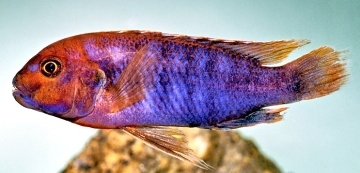
Ground color is a warm rusty orange-brown, which is most of what you see on juveniles and females. Dominant males develop the lavender-to-violet-blue flanks the "lavender" name refers to, often with a darker submarginal band edging the dorsal fin and a scatter of egg-spots on the anal fin. Males also run larger, carry a more pronounced forehead hump, and grow longer fins. The bicuspid teeth and rounder head separate it from look-alikes such as Labidochromis vellicans, which is similarly sized and occupies a comparable niche; blue-and-barred dwarfs like Pseudotropheus minutus share the body plan but not the rusty wash. The meristics back up the ID: dorsal with roughly 16-18 spines and 8-9 soft rays, anal with 6-8 soft rays.
Range & habitat
Iodotropheus sprengerae is a lacustrine endemic with one of the tightest ranges of any Lake Malawi cichlid. It is confined to the lake's southeastern arm, recorded only from Boadzulu Island, Chinyankwazi Island, Chinyamwezi Island, and Makokola Reef. The IUCN puts its area of occupancy at about 16 km2 and its extent of occurrence at 106 km2 across just four known locations. Konings has interpreted this as the relict distribution of an ancient species that found refuge around offshore islands, escaping competition from other mbuna.
It is a rocky-shore fish, living over large rocks and slabs and in the pockets where detritus and organic ooze gather between them, occasionally straying into the intermediate sand-and-rock zone at Boadzulu. The classic Ribbink et al. (1983) survey of Malawi's rocky habitats found it most numerous between about 10 and 50 ft (3-15 m), though it ranges from the surface to at least 130 ft (40 m). In-situ this is warm, hard, alkaline water; FishBase gives a surface band of 24-26 C (75-79 F) for the species, consistent with the well-mixed upper layer of the lake's littoral reefs.
Ecology & diet
Like other mbuna, the rusty cichlid makes its living grazing aufwuchs, the felt of algae, diatoms, and small invertebrates that coats lit rock surfaces. Ribbink and colleagues recorded it nipping at that biofilm and taking the animals living in it, along with plankton from the water column. Stomach-content work and FishBase's trophic-level estimate of about 4.0 point to a broader, more carnivorous-leaning diet than a strict algae scraper: insect larvae and nymphs, benthic crustaceans, and blue-green (cyanobacterial) algae all feature, and the fish behaves as an opportunistic omnivore rather than a narrow trophic specialist.
That dietary flexibility is ecologically useful. Aufwuchs grazers are the engine of the rocky littoral, cropping algal growth and converting it into fish biomass that supports larger predators, and a generalist forager can persist where a specialist might not. It is a small fish at a busy trophic crossroads, abundant where it occurs but never the dominant grazer on a reef shared with dozens of competing mbuna.
Behavior & breeding
Iodotropheus sprengerae is a maternal (polygamous) mouthbrooder, and its courtship follows the standard mbuna script with a few twists. Males are not strongly site-territorial in the way many rock cichlids are; rather than holding a fixed cave, a male works to lead a passing female toward a spawning spot, displaying and quivering around her and guiding her with undulating fins. Spawning itself plays out as the familiar circling "T-position": the female lays a few eggs, immediately takes them into her mouth, then nips at the egg-spots on the male's anal fin and draws in sperm to fertilize the clutch inside her mouth.
The female then broods alone. In aquaria she carries the eggs and fry for roughly three weeks at around 25 C (77 F) before releasing free-swimming young, and she fasts the whole time, recognizable by her distended throat. Reported brood sizes run from a handful to several dozen, with Seriously Fish citing 5-60. Females can be sexually mature at only about 1.5 in (4 cm), and the fry grow quickly. Field observation matches the lab: spawning is reported to occur at essentially any suitable spot in the rocky habitat rather than at a defended communal arena.
In the aquarium
The rusty was among the first mbuna exported from Lake Malawi in the early 1970s and has been tank-bred for decades, so wild collection pressure for the hobby is modest and most fish offered are captive-raised. Its reputation is well earned: it is one of the smaller and least aggressive mbuna, which makes it a reasonable entry point into rift-lake cichlids. That reputation comes with honest caveats. Keepers consistently report that aggression is conspecific and context-dependent: a lone male among gentler tankmates is easygoing, but multiple males in a small tank can turn lethal, and several hobbyists describe a dominant male killing rival males or even harassing larger tankmates. "Mellow" is a tendency, not a guarantee.
Practically, a 36 in (90 cm) tank can house a single male with a few females; keeping more than one male calls for at least 48 in (120 cm) of length so territories don't overlap. Because rusties don't bulldoze the substrate and are easily outcompeted, choose tankmates that won't bully them, such as Labidochromis caeruleus, peaceful peacocks (Aulonocara), or Copadichromis, and provide plenty of rockwork and broken sightlines. Water should mirror the lake: hard, alkaline, pH roughly 7.5-8.5, in the mid-to-upper 70s F (about 24-27 C). As with all mbuna, keep the diet vegetable-forward; rich, meaty foods are a common cause of bloat in this herbivore-leaning fish.
Conservation
The IUCN Red List assesses Iodotropheus sprengerae as Near Threatened (criterion B1a+2a), assessed by Ad Konings on 22 June 2018 (with a 2019 errata correcting a map). The population trend is listed as stable, and the fish is described as common at each of its four sites. The species qualifies on its tiny range and few locations, but is held back from a threatened category because the assessors judged future declines possible yet uncertain. The two named threats are direct and specific to this fish: irregular collection for the ornamental trade at Makokola Reef, and sedimentation. Three of its four known localities lie within Lake Malawi National Park, which offers some protection.
That species-level picture sits inside a strained lake. The basin review by Chavula et al. (2023, Journal of Great Lakes Research 49(6):102241) catalogs the pressures on Lake Malawi/Niassa/Nyasa: heavy fishing and the long decline of the commercially vital chambo (Oreochromis spp.), rising sediment and nutrient loading off deforested catchments, roughly 0.7 C of shallow-water warming that strengthens stratification and tends to suppress productivity, and the looming risk of invasive species. For a shallow rocky-reef grazer with a few-square-kilometer range, two of those translate almost directly: sediment smothering the lit rock surfaces its aufwuchs depends on, and shoreline catchment erosion degrading the very reefs it is restricted to, exactly the sedimentation flagged in its assessment. The honest summary is that the rusty cichlid itself is not currently threatened with extinction, but it is a narrow-range endemic in a lake under mounting pressure, and the same erosion and collection that the Red List names as its threats are basin-wide trends rather than local accidents.
Sources
- Iodotropheus sprengerae — Catalog of Fishes (Eschmeyer, California Academy of Sciences)
- Iodotropheus sprengerae (Lavender mbuna) — FishBase
- Iodotropheus sprengerae — GBIF species record
- Tawil, P. (2012). Iodotropheus sprengerae species profile — Cichlid Room Companion
- Oliver, M.K. & Loiselle, P.V. (1972). A new genus and species of cichlid of the mbuna group from Lake Malawi. Revue de Zoologie et de Botanique Africaines 85(3-4):309-320
- Ribbink, A.J. et al. (1983). A preliminary survey of the cichlid fishes of rocky habitats in Lake Malawi. South African Journal of Zoology 18(3):149-310
- Stauffer, J.R. (1994). A new species of Iodotropheus from Lake Malawi. Ichthyological Explorations of Freshwaters 5(4):331-344
- Iodotropheus sprengerae (Rusty Cichlid) — Seriously Fish
- Konings, A. (2018, errata 2019). Iodotropheus sprengerae — The IUCN Red List of Threatened Species e.T120695830A148848946
- Chavula, G.M.S. et al. (2023). Lake Malawi/Niassa/Nyasa basin: Status, challenges, and research needs. Journal of Great Lakes Research 49(6):102241
- Msukwa, A. et al. (2021). Vulnerability assessment of Lake Malawi's ornamental fish resources to export ornamental trade. Fisheries Research 238:105869
- Rusty Cichlid — Maidenhead Aquatics / Fishkeeper.co.uk care profile
- Iodotropheus sprengerae question (rusty cichlid) — Cichlid Fish Forum thread — community/anecdotal
- Iodotropheus sprengerae (Rusty cichlid) — WaFishBox forum thread — community/anecdotal
- African Cichlids (rusty cichlid discussion) — r/Cichlid, Reddit — community/anecdotal
- Rusty Cichlid (Iodotropheus sprengerae) wild-caught trade listing — Aquatics Unlimited