Taxonomy & naming
Julidochromis dickfeldi was described in 1975 by the German ichthyologist and aquarist Wolfgang Staeck, in the journal Revue de Zoologie et de Botanique Africaines (89(4):981-986), from material collected near the Sumbu (Nsumbu) National Park region on the Zambian shore of Lake Tanganyika. The species name honors Alf Dickfeld, the German hobbyist whose idea it was to mount the Zambian collecting expedition on which the holotype was taken. The genus name Julidochromis borrows from the marine wrasse lineage "julidini" (Greek ioulis), a nod to the elongate, wrasse-like body shape shared by the julies.
The genus sits within the tribe Lamprologini, the substrate-spawning lineage that dominates Tanganyika's rocky shores, and the wider Pseudocrenilabrinae of the family Cichlidae. Six julies are currently recognized; dickfeldi falls between the larger species (J. regani, J. marlieri) and the dwarfs (J. ornatus, J. transcriptus) both in adult size and in pattern. It is worth flagging honestly that Julidochromis is one of the more unsettled cichlid genera: hobbyists and taxonomists continue to argue over species limits and the status of regional color forms, and several trade names (notably "Midnight" or "Midnight Blue" dickfeldi) circulate without formal standing. The accepted valid name and authority, however, are stable and confirmed by Eschmeyer's Catalog of Fishes and FishBase. In the trade it is sold as the Brown Julie, or occasionally Dickfeld's Julie.
Appearance
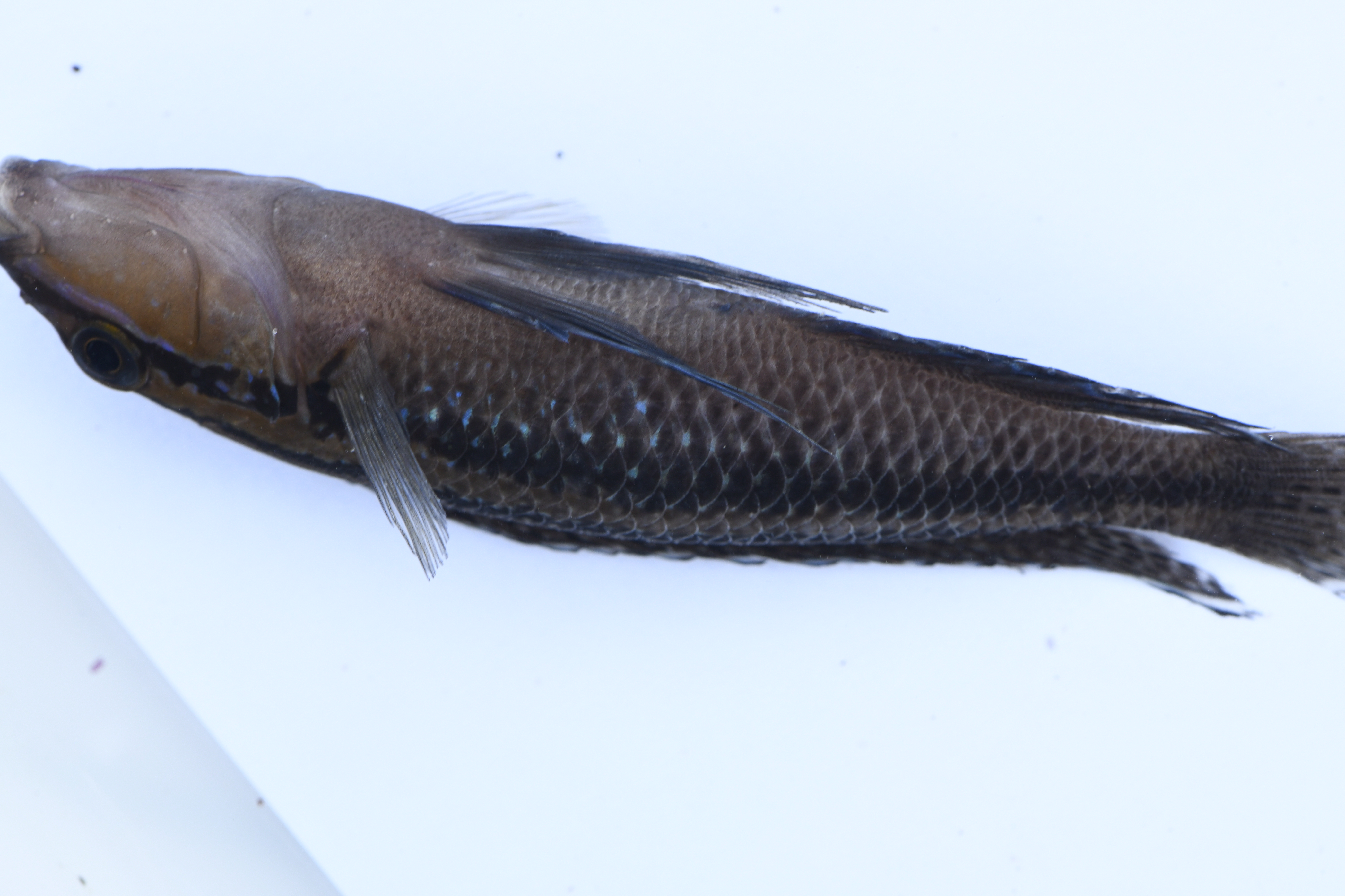
The Brown Julie is an elongate, cigar-shaped little cichlid built for slipping into rock crevices. The base color is a brownish slate-grey overlaid by three dark horizontal stripes running from snout to tail; over this sits a distinctive blue-to-lavender sheen, with pale blue fringing along the dorsal and caudal fins that gives an otherwise drab fish a surprising shimmer under good light. Compared with its congeners the snout is noticeably more pointed, the body a touch deeper, and the dorsal fin proportionally larger, with a finely patterned dorsal and tail that the Cichlid Room Companion treats as diagnostic.
Reported maximum size varies, and the disagreement is real rather than trivial. FishBase lists a maximum of about 11 cm (4.3 in) total length drawn from the CLOFFA checklist, while the species-level identification table gives a much smaller 6.3 cm (2.5 in) standard length; specialist hobby sources land in between, with Ad Konings-derived figures of roughly 4 in (10 cm) for males and 3 in (7 cm) for females. In practice most aquarium adults settle around 3-4 in (8-10 cm). Sexual dimorphism is subtle and the species is notoriously hard to sex on color alone; the prevailing view in the genus is that females run larger, but the Cichlid Room Companion profile states that in dickfeldi the male is typically the larger fish. Experienced keepers tend to vent suspected pairs rather than trust size, and note only that the larger of a bonded pair is usually the more aggressive defender of the spawning site.
Range & habitat
Julidochromis dickfeldi is a Lake Tanganyika endemic with one of the more restricted ranges in the genus. It is confined to the southwestern corner of the lake, broadly between Kapampa on the Democratic Republic of the Congo side and Ndole Bay in Zambia, north of Nsumbu National Park. The IUCN assessment puts its extent of occurrence at roughly 576-2,381 km² and area of occupancy at 16-1,528 km² - a genuinely small footprint for a lake the size of Tanganyika.
It is a rocky-shore specialist. The fish lives over rocks and rubble, frequently along sandstone slabs where rock meets the sand beaches, with the center of each territory anchored on a specific crack or fissure. Most observations place it in the shallow-to-intermediate rocky zone, around 5-20 m (16-66 ft), though it has been recorded down to about 35 m and possibly deeper. The Tanganyika littoral it occupies is hard, highly alkaline, oxygen-rich water: in-situ figures cited by Konings and FishBase run to pH around 8.5-9.2 (hobby reports stretch the range to 7.8-9.5), moderate-to-high hardness, and water temperatures of roughly 23-27 °C (73-81 °F). The only vegetation in this biotope is the algal film coating the rocks - there are no rooted plants - which matters for both diet and aquascaping.
Ecology & diet
Functionally, the Brown Julie is a small benthic micro-predator of the rocky reef. It is highly sedentary and territorial, rarely straying far from its home fissure, and it makes its living by picking food off hard surfaces. The bulk of the diet is small crustaceans and other invertebrates gleaned from the rock and the algal "aufwuchs" mat that coats it, supplemented by the occasional small snail; algae and sponge material are taken incidentally as the fish works over the substrate, and prey is now and then plucked from drifting matter. FishBase places it at a trophic level of about 3.5, consistent with a mostly carnivorous, invertebrate-based diet rather than a dedicated algae-grazer.
This feeding style sets dickfeldi a little apart from the other julies and is part of why its placement in the genus has been questioned: the Cichlid Room Companion notes that it feeds much like Chalinochromis popelini, working the rock for invertebrates. In the lake's tightly partitioned rocky community it fills the niche of a stationary crevice-dweller, contributing to the dense mosaic of small lamprologine cichlids that divide the littoral rock among themselves.
Behavior & breeding
Brown Julies are territorial but, by African cichlid standards, fairly mild. A pair holds and defends a small, fixed territory built around an enclosed cave or deep rock cavity, and the fish are far more interested in patrolling that space than in roaming. Aggression is real but moderate - directed mainly at conspecifics and intruders near the spawning site rather than expressed as general tank-wide bullying.
Reproduction is the species' headline trait for keepers. It is a substrate-spawning cave brooder, not a mouthbrooder: the pair cleans the ceiling or wall of a crevice and deposits a small clutch - commonly cited at roughly 35-50 eggs - with both parents sharing guard duty. Spawning is not strongly seasonal in good conditions; well-settled pairs breed more or less year-round, producing successive broods. The most striking behavior, corroborated across the Cichlid Room Companion and multiple hands-on keeper accounts, is cooperative or "helper" brood care: older juveniles or a third sub-adult may be tolerated within the territory and appear to assist in defending the next batch of fry, forming a loose family group. As each new spawn approaches, the parents gently push the previous, now-larger young away from the breeding cave, since older siblings eventually become a threat to the new fry.
In the aquarium
Within the Tanganyikan rock-cichlid hobby, dickfeldi has a reputation as one of the easier julies to keep and breed, and that reputation is largely deserved - with caveats. The standard route to a pair is to buy a group of five or six juveniles and let them sort themselves out; you will know a pair has formed when two fish claim a cave and defend it together. Forcing introductions between adults is unreliable, and keepers on MonsterFishKeepers and the cichlid forums repeatedly warn that moving an established pair can break the bond, so it pays to settle them and leave them be.
A bonded pair can be housed in a tank as small as a 20-gallon long (about 75 L), and dedicated breeders deliberately use 20- to 33-gallon species tanks because fry rearing and removal are easier in a smaller footprint. For a community, more room is better: a 55-gallon (around 200 L) or larger lets you keep them with other small, similarly tempered Tanganyikans. The non-negotiables are hard, alkaline water (pH comfortably above 8, ideally 8.5+), stable temperatures in the mid-70s °F (low-to-mid 20s °C), strong filtration and good oxygenation, and plenty of rockwork with defensible caves - stacked stone, slate, or commercial cichlid caves all work, and building the structure into a tank corner lets the glass do part of the territory defense. Suitable tankmates are other rock-and-sand Tanganyikans of similar size such as Cyprichromis, Altolamprologus, and the smaller Neolamprologus; avoid large, boisterous Malawi mbuna and oversized lamprologines. The most common mistakes are buying a single "pair" sight-unseen rather than growing out a group, and underestimating territorial pressure once a pair starts spawning in a crowded tank - established pairs will steadily claim more ground and harass anything that lingers near the nursery.
Conservation
Julidochromis dickfeldi is currently assessed as Near Threatened on the IUCN Red List (assessment by Haambiya, dated 14 March 2025, published in version 2025-2), an uplisting from the Least Concern status it carried in the 2006 assessment. The change does not reflect a documented crash so much as honest uncertainty: the fish has a genuinely small range (extent of occurrence roughly 576-2,381 km²) and is collected for the ornamental trade, but it is unclear whether that collection is actually driving a decline. The assessors note that if trade-driven decline is occurring the species could qualify as Vulnerable, whereas if its population is stable it would be Least Concern - so Near Threatened was chosen as the cautious middle ground, with population monitoring flagged as a research need. Within its range it is described as generally uncommon though more frequent than J. ornatus, and locally fairly common at sites such as Muzi.
Those species-specific concerns sit inside a lake that is under measurable, basin-wide strain. Lake Tanganyika has been warming and stratifying more strongly, which suppresses the deep mixing that fertilizes its surface waters; O'Reilly and colleagues (2003, Nature, doi:10.1038/nature01833) linked this warming to roughly a 20% drop in primary productivity, implying on the order of 30% lower potential fish yields, and Cohen and colleagues (2016, PNAS, doi:10.1073/pnas.1603237113) used sediment records to show declines in fish and endemic molluscs alongside an estimated ~38% loss of oxygenated benthic habitat as the oxygenated layer shoals. For an open-water species these pressures act through the pelagic clupeid (Stolothrissa, Limnothrissa) and Lates fishery that feeds four nations; for a shallow rocky-shore endemic like dickfeldi the more direct threats are the ones the IUCN names - sedimentation and soil erosion from shoreline agriculture smothering the rocky littoral it depends on, plus localized fishing pressure and targeted aquarium collection across its narrow range. Governance is shared by the four riparian states through the Lake Tanganyika Authority, which has trialed an annual three-month fishing closure (roughly May-August) that, if sustained, would give littoral fishes a reproductive window. The honest bottom line: this is not a fish on the brink, but it is a small-range endemic in a strained lake, and its security depends as much on the health of the southwestern rocky shoreline as on restraint in the trade.
Sources
- Julidochromis dickfeldi — FishBase species summary
- Eschmeyer's Catalog of Fishes (Catalog of Fishes), California Academy of Sciences
- Species in Julidochromis — FishBase identification list
- Brown Julie (Julidochromis dickfeldi) — iNaturalist taxon page
- Staeck, W. (1975). A new cichlid fish from Lake Tanganyika: Julidochromis dickfeldi sp. n. Revue de Zoologie et de Botanique Africaines 89(4):981-986 (via Cichlid Room Companion reference)
- O'Reilly, C.M. et al. (2003). Climate change decreases aquatic ecosystem productivity of Lake Tanganyika, Africa. Nature 424:766-768
- Cohen, A.S. et al. (2016). Climate warming reduces fish production and benthic habitat in Lake Tanganyika. PNAS 113(34):9563-9568
- Lake Tanganyika: Status, challenges, and opportunities for research — Journal of Great Lakes Research (ScienceDirect)
- Julidochromis dickfeldi — Cichlid Room Companion species profile (Pam Chin, 2004)
- Julidochromis dickfeldi (Brown Julie) Care Guide — Aqua-Fish.net
- Julie & Julidochromis — The Wet Spot Tropical Fish blog
- Julidochromis dickfeldi — IUCN Red List of Threatened Species 2025: e.T60543A47197303 (Haambiya, L. 2025; NT)
- Breeding Julidochromis dickfeldi — The Cichlid Stage (keeper account) — community/anecdotal
- Aggression and isolation (Julidochromis dickfeldi) — The Cichlid Stage — community/anecdotal
- Featured Fish #10 — Julidochromis dickfeldi — r/Cichlid (Reddit) — community/anecdotal
- Julidochromis dickfeldi — Cichlid-Forum.com discussion thread — community/anecdotal
- Tang advice (Julidochromis pairing/moving) — MonsterFishKeepers.com — community/anecdotal