Taxonomy & naming
Julidochromis marksmithi was described by the American ichthyologist Warren E. Burgess in 2014, in Tanganika Magazyn (issue 15), from specimens collected at Kerenge Island off the Tanzanian coast. The species epithet honors Mark Smith, an American aquarist and photographer specializing in Rift Valley cichlids, who supplied the material and the live photographs used in the description. The genus name Julidochromis borrows from the marine wrasses (the "julidini," via Greek ioulis), a nod to the elongate, banded body plan these cichlids share with those reef fishes.
For years before its description, this fish circulated in the aquarium trade under informal names — Julidochromis sp. "regani Kipili," J. "ornatus Kipili," or simply J. sp. "Kipili" — because keepers and collectors could not confidently slot it into any of the five long-recognized species (J. dickfeldi, J. marlieri, J. ornatus, J. regani, and J. transcriptus). Burgess separated it from those mainly on color and pattern: bright yellow flanks marked by two major dark bands plus a partial third stripe along the dorsal-fin base, and a dark cheek stripe running from the corner of the mouth toward the pectoral base. That cheek stripe is absent in the ornatus–transcriptus–dickfeldi group, and the species lacks the vertical barring of J. marlieri and J. transcriptus. It sits within the Lamprologini, the substrate-spawning tribe that dominates Tanganyika's rocky shores. Genus-level relationships in Julidochromis remain under active study, and several undescribed regional forms (some labeled J. cf. marksmithi) blur the edges of this species' identity.
Appearance
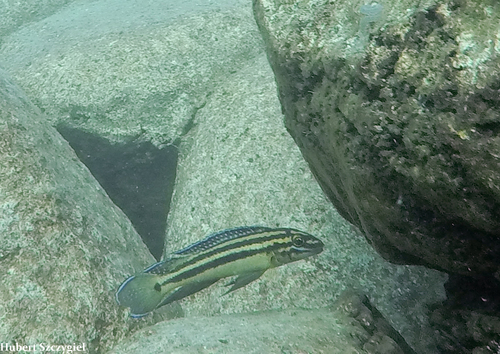
This is a slender, cigar-shaped julie built for threading through rock crevices. Its defining feature is color: a deep, warm yellow body crossed by bold black longitudinal lines. Two main dark bands run the length of the flank; a third, shorter stripe extends from the nape only about halfway along the back at the dorsal-fin base — the "two-and-a-half stripes" hobbyists use to tell it apart from J. regani, which carries four full longitudinal lines. A dark cheek stripe crosses the gill cover (often fading behind the preopercle), and a broad dark band edged with a thin blue-white submarginal line runs along the upper dorsal fin. Below the central band the body stays yellow, distinguishing it from J. dickfeldi, which is white there.
Reported maximum size is one of the genuine points of disagreement in the literature. FishBase lists only 2.5 in (6.3 cm) standard length from the type material, but that figure reflects the measured specimens rather than a true ceiling. Hobby and trade sources put adults nearer 3.5 in (9 cm) and cite reports up to roughly 4.7 in (12 cm) total length, with experienced keepers on cichlid forums describing it as a "five- to six-inch" julie that wants a four-foot tank — a useful caution even if the upper end is unverified. As with other Julidochromis, sexing is subtle and unreliable from appearance alone; in this species females are generally reported as the larger sex, as in J. regani, with no strong color difference between males and females.
Range & habitat
Julidochromis marksmithi is a narrow-range Tanganyikan endemic confined to the Tanzanian shore, with its core distribution around Kipili and the nearby islands — Kerenge (the type locality), Mvuna, Ulwile, and Nkondwe — extending north toward Cape Mpimbwe. Various authors report a broader span, roughly from the Kasoje area to Fulwe Rocks, and a number of related populations to the south (around Lubugwe and Lufungu bays) are treated as J. cf. marksmithi pending clarification. Either way, this is a fish with a small geographic footprint, the kind of tight endemism that makes Tanganyika's coastline a patchwork of locally distinct cichlid forms.
It lives in the rocky littoral but favors the transition where rock meets sand, described as an intermediate sand–rock habitat; it stays closer to the rocks than the more sand-tolerant J. regani. Like other shallow rock-dwellers, it depends on the structure of broken stone for cover, foraging surfaces, and spawning caves. Lake Tanganyika's surface waters are warm, hard, and alkaline — broadly pH 8–9, highly mineralized, and stably stratified — and this species occupies the well-oxygenated upper rocky zone rather than deep water.
Ecology & diet
Like its congeners, J. marksmithi is best understood as a micro-predator and grazer of the rocky biofilm. In the wild it feeds mainly on small invertebrates picked from the algae and aufwuchs — the dense mat of algae, diatoms, and associated micro-fauna coating Tanganyika's rocks — and in doing so ingests a meaningful amount of algae alongside the animal prey. FishBase places it at a trophic level near 3.4, consistent with an omnivore leaning carnivorous: not a dedicated algae-scraper like a Tropheus, but not a pure predator either.
In the lake community it occupies the dense guild of small, crevice-bound rock cichlids that partition the littoral among themselves. Its habit of hugging the rocks more tightly than J. regani is one way co-occurring julies and their relatives divide the same reef. As a small, cryptic species it is both predator of invertebrates and potential prey for larger rock-patrolling cichlids and predators that hunt the reef edge.
Behavior & breeding
Julidochromis marksmithi is a monogamous, biparental substrate spawner — not a mouthbrooder — that forms long-lasting pair bonds and defends a rock-cave territory. Females are typically the larger partner. Spawning takes place inside a crevice or cave, where the female attaches a clutch onto a hidden surface; reported clutch sizes are around 40–50 eggs, intermediate between the smaller broods of J. ornatus and the larger ones of J. regani. Eggs hatch in roughly two to two-and-a-half days, and fry become free-swimming after about five to six days, guarded initially by both parents.
The behavioral signature of the genus — and of this species in particular — is intense intraspecific aggression. A settled pair will hold its patch hard, and surplus individuals are driven off; juveniles are tolerated for a time but must usually be removed once they reach about 0.8–1 in (2–2.5 cm), as parents turn on them. Keepers describe marksmithi as notably shy and retiring even by julie standards, often the timidest Julidochromis they have kept, spending most of its time in cover and emerging mainly to feed. Pair formation can be slow and occasionally breaks down — "julie divorce," in which a bonded pair suddenly fights, is a recurring theme across the genus and worth anticipating.
In the aquarium
This is a rewarding but not entirely beginner-proof Tanganyikan. It wants hard, alkaline water (pH roughly 7.8–9, high mineral content) at about 75–80°F (24–27°C), pristine and well-filtered, with frequent water changes. The decor should be all about the bottom: fine sand and a generous pile of rock arranged into caves and crevices. Julies do not use tank height — they need horizontal real estate — so a long footprint matters more than gallons. A single bonded pair can be maintained in a tank of around 25–30 gallons (roughly 100 L), but a larger 4-foot tank (a 40-breeder or bigger) gives a pair room and is closer to what experienced keepers recommend for a fish this size.
The usual mistake is underestimating the aggression and over-housing. A 20-gallon, and especially a tall 20-gallon, is too small and the wrong shape — a point veteran keepers make bluntly on the forums. The reliable route to a pair is to start with a group of six or so juveniles and let them sort themselves out, then remove all but the chosen pair, because two random adults forced together often end badly. Compatible tankmates are the standard Tanganyikan supporting cast that occupies different niches — open-water Cyprichromis, shell-dwelling Neolamprologus such as multifasciatus or brevis, and similar — kept in a tank large enough that the julies can own their rockwork. Avoid other Julidochromis and ecologically similar rock cichlids, which invite relentless territorial fighting. Captive-bred stock is established in the hobby, so wild collection is not a prerequisite for keeping it.
Conservation
On the IUCN Red List, Julidochromis marksmithi was assessed in 2025 as Near Threatened (criterion B1a), reflecting its very small range along the Tanzanian coast rather than any documented crash; its population trend is listed as unknown. The threats noted are collection for the ornamental aquarium trade and fishing/harvesting pressure on the inland-water habitat. The mitigating factor for the trade is that the species is now routinely captive-bred, which can blunt collection pressure on the wild populations — though a narrowly endemic fish concentrated around a single island group is, by definition, exposed to localized over-collection in a way a wide-ranging species is not.
The wider concern is the state of the lake itself. Lake Tanganyika is warming, and that warming strengthens the water column's stratification and suppresses the deep mixing that brings nutrients to the surface: O'Reilly et al. (2003, Nature, doi:10.1038/nature01833) inferred a roughly 20% decline in primary productivity over the late 20th century, implying on the order of a 30% drop in fish yields. Cohen et al. (2016, PNAS, doi:10.1073/pnas.1603237113) found that warming has been associated with a substantial loss of oxygenated benthic habitat — on the order of 38% — squeezing the lake's bottom-dwelling fauna. Closer to this fish's home, shoreline sedimentation from deforestation and land use degrades the rocky littoral (Cohen et al. 1993), the exact biotope a rock-bound endemic like marksmithi depends on. The lake's economy rests heavily on the open-water clupeid (Stolothrissa and Limnothrissa) and Lates fishery that feeds four riparian nations — Tanzania, the Democratic Republic of the Congo, Burundi, and Zambia — and that pelagic fishery, not the small rock cichlids, is the focus of the four-country governance coordinated through the Lake Tanganyika Authority. For J. marksmithi the most direct, near-term risks are therefore local: collection for the trade and the gradual sedimentation and warming of the shallow rocky shore it cannot leave. The fish is not currently threatened with extinction, but its small range leaves little margin, which is exactly why the Near Threatened listing fits.
Sources
- Julidochromis marksmithi — FishBase species summary
- Eschmeyer's Catalog of Fishes — Julidochromis marksmithi (species record)
- Burgess, W. E. (2014). Julidochromis marksmithi, a new species of Julidochromis from the Tanzanian coast of Lake Tanganyika (reference record)
- IUCN Red List — Julidochromis marksmithi (Near Threatened, assessed 2025)
- Julidochromis marksmithi 'Kipili' — tanganyika.si (habitat, breeding, distribution)
- Julidochromis marksmithi — Aquarium Glaser GmbH
- Update on Julidochromis marksmithi — The Cichlid Stage
- Julidochromis marksmithi — Cichlid Fish Forum (tank size, aggression, stocking) — community/anecdotal
- Julidochromis Care? — Aquarium Co-Op Forum — community/anecdotal
- Options when you lose half a colony of cyprichromis (marksmithi community stocking) — Cichlid Fish Forum — community/anecdotal
- O'Reilly, C. M. et al. (2003). Climate change decreases aquatic ecosystem productivity of Lake Tanganyika. Nature 424:766–768
- Cohen, A. S. et al. (2016). Climate warming reduces fish production and benthic habitat in Lake Tanganyika. PNAS 113(34):9563–9568
- Lake Tanganyika: Status, challenges, and opportunities for research (J. Great Lakes Research, 2023)
- The fishery of Stolothrissa tanganicae in Lake Tanganyika — FAO
- Lake Tanganyika Authority — African Great Lakes Information Platform