Taxonomy & naming
The species was described by the Belgian ichthyologist Max Poll in 1956, in the monumental report on the 1946-1947 hydrobiological survey of Lake Tanganyika; the name remains valid as Julidochromis marlieri Poll, 1956, with the holotype (MRAC 115574) and paratypes held at the Royal Museum for Central Africa in Tervuren. The genus name nods to the marine wrasses (from the wrasse group "julidini" and the Greek ioulis), a reference to the slender, reef-clinging body plan that julies share with those saltwater fishes; the species epithet honors Georges Marlier, a Belgian zoologist active in the lake's mid-century exploration.
In the hobby it goes by Marlier's Julie, the checkerboard or chequered julie, and sometimes the spotted julie. It sits within a small genus of Tanganyikan rock specialists alongside J. regani, J. ornatus, J. transcriptus, J. dickfeldi, and the more recently described J. marksmithi. Among these, marlieri and regani are the two large-bodied species, and the pair's ranges partly replace one another around the lake. Hobbyists should note that the various Julidochromis are close enough that different species and even local color forms will readily hybridize in captivity, which is one reason careful keepers avoid mixing them.
Appearance
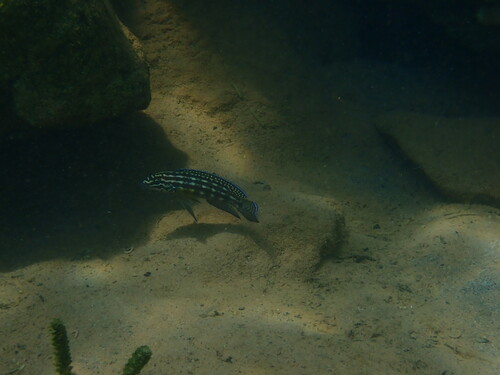
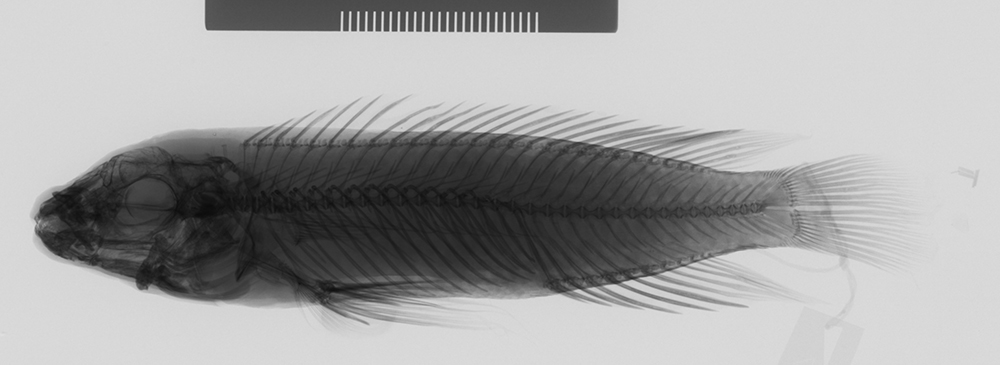
Marlier's julie is an elongate, cigar-shaped cichlid patterned in a distinctive grid: dark blackish bars and blotches break across pale cream-to-yellow ground color, often interrupting the horizontal stripes seen in its relatives to produce the checkerboard look that gives the fish its common name. The unpaired fins are edged in pale blue or white, and several geographic morphs differ in the heaviness and arrangement of the dark markings.
Reports of maximum size vary. The taxonomic and survey literature, including FishBase and the IUCN assessment, give a maximum of about 5 in (13 cm) total length, while some careful hobby references such as Seriously Fish cite up to 6 in (15 cm); the larger figure likely reflects well-fed aquarium specimens. The sexes are almost identical in color and shape, so they are reliably told apart only two ways: by examining the genital papilla (more pointed and extended in males) and, tellingly, by size. Females are the larger sex, an unusual reversal discussed below.
Range & habitat
The species is endemic to Lake Tanganyika and found nowhere else on Earth. Within the lake its distribution is patchy rather than continuous. FishBase summarizes it as restricted to the northwestern part of the lake, but the 2025 IUCN assessment documents a wider, mosaic range: populations occur in Burundi, the Democratic Republic of the Congo, Tanzania, and Zambia, and in the northern half of the lake its sections alternate with those of its larger relative J. regani. In the south it turns up around Cape Tembwe and Cape Chipimbi in the DRC and along the Kala-to-Chisanza stretch spanning Tanzania and Zambia. The differing descriptions reflect both the fish's genuinely fragmented occurrence on isolated rocky patches and the uneven survey coverage of a lake this size.
It is a strict rock-dweller of the littoral zone. It lives among boulders, crevices, and fissures along rocky shorelines, typically in fairly deep water, and is demersal in the truest sense: it never swims in open midwater and does not come to the surface, instead clinging to and patrolling the rock surface at every angle. Measured water at the surface is alkaline and hard, with pH generally in the 7.5-9 range and warm tropical temperatures around 73-81 F (23-27 C). Tied as it is to a specific rocky substrate, the fish does not cross stretches of open sand, which is what isolates its populations into the patchwork the surveys record.
Ecology & diet
Marlier's julie is a biocover grazer. Field studies of the lake's littoral fish community (Hori and colleagues, 1993; Yamagishi and Kohda, 1996) found it feeds mainly on sponges and algae growing on rock surfaces, picking through the thin "aufwuchs" film of attached organisms and the small invertebrates living within it. FishBase describes it bluntly as a microfeeder rather than a carnivore, and assigns it a low trophic level of about 2.5. Some hobby care sheets call it carnivorous, which overstates the case; the truth sits in between, since grazing rock biocover means ingesting both plant and small animal matter together. In practice it is best thought of as a generalist micro-predator and grazer of the rock film, not a hunter of larger prey.
Ecologically it is one of many small benthic specialists partitioning the crowded rocky reefs of Tanganyika, where intense competition for surface and food has driven the lake's celebrated diversity. As a small, site-attached fish it is also prey: nesting adults must defend eggs and young against a range of cichlid and non-cichlid predators that probe the rocks.
Behavior & breeding
This is a substrate-spawning, biparental cichlid, not a mouthbrooder. Pairs are strongly territorial and site-attached, centering their lives on a crevice or cave in the rock. Both parents share care of the eggs and young, and in the wild and the aquarium alike the bond tends to last for life. Spawning is secretive: the female attaches a clutch to the wall or ceiling of a cave, and keepers often do not realize a spawn has happened until fry appear. Clutch sizes are modest, reported at roughly 50-75 eggs in the wild and up to around 100 (usually fewer) in tanks.
The genus's signature quirk is sharpest in this species: the female is the larger and dominant partner. Field work by Yamagishi and Kohda (1996) found paired males averaged only about 75 percent of their mate's length; a follow-up laboratory study by George Barlow and Jonathan Lee (2005) estimated the typical paired male at roughly 56 percent of the female's mass, and showed females are not just bigger but inherently more willing to escalate a fight. The authors argued this stable female dominance may set the stage for a flexible mating system: a single large female sometimes holds a territory containing two males, which led Yamagishi and Kohda to ask whether the species is facultatively polyandrous rather than strictly monogamous. Most pairs, however, are monogamous. Care is often cooperative and extended, with older offspring lingering in the parents' territory and helping tend later broods, a "nuclear family" arrangement Sunobe (2000) and others documented at the nest.
In the aquarium
Marlier's julie is a rewarding but not beginner-proof Tanganyikan. It needs a rocky biotope with abundant caves and crevices over a sandy bottom, hard alkaline water in the high-7s to high-8s pH, and stable temperatures in the mid-to-high 70s F. The honest tank-size answer runs larger than retailers suggest: a single pair is comfortable in a 30- to 48-inch tank, and experienced keepers steer firmly away from the tiny tanks that care sheets sometimes condone. Adults are belligerent toward their own kind, so groups need real space; the standard advice is to buy a small group of juveniles and let a pair form naturally over a year or so, then remove the extras, because simply pairing a random adult male and female often ends with the smaller male harassed to death.
Two mistakes recur in hobbyist accounts. First, large water changes can destabilize an established pair and trigger them to turn on each other; small, frequent changes are safer. Second, keepers mix julie species or color morphs and get hybrids, since these fish interbreed freely. Suitable tankmates are non-competing Tanganyikans that use different parts of the tank, such as Cyprichromis and Paracyprichromis in open water or Altolamprologus among the rocks; aggressive Malawi-style cichlids and cramped quarters are poor matches. Given a settled pair and a stable tank, the species breeds readily and the slow-growing fry are easy to raise on baby brine shrimp, making it one of the more satisfying Tanganyikan rock-dwellers to keep long term.
Conservation
The IUCN Red List assessed Julidochromis marlieri as Least Concern in 2025, reaffirming its 2006 status. It is a widespread, locally common species across its scattered rocky habitats, and no single threat is currently driving a measurable decline. The assessment does flag pressures worth watching: shoreline agriculture and the sedimentation and water pollution it brings can smother the rocky reefs this fish depends on, and the species has been collected for the aquarium trade since its first export in 1971. None of its known sites yet lie within a protected area, though many have been identified as candidate Key Biodiversity Areas. As a narrow-range lake endemic tied to a specific substrate, it shares the broader vulnerability of Tanganyika's rock-dwelling cichlids to habitat degradation, even while its current numbers appear secure.
Sources
- Eschmeyer's Catalog of Fishes — Julidochromis marlieri
- FishBase — Julidochromis marlieri Poll, 1956
- GBIF — Julidochromis marlieri
- iNaturalist — Marlier's Julie (Julidochromis marlieri)
- IUCN Red List — Julidochromis marlieri (Mushagalusa, 2025)
- Barlow & Lee (2005), Sex-Reversed Dominance and Aggression in Julidochromis marlieri — reviewed in TFH, 'She's So Heavy' (W. Leibel)
- Yamagishi & Kohda (1996), 'Is the cichlid fish Julidochromis marlieri polyandrous?' — Osaka City University repository (PDF)
- Sunobe (2000), Social structure, nest guarding and interspecific relationships of Julidochromis marlieri (ResearchGate)
- Seriously Fish — Julidochromis marlieri (Marlier's Julie)
- The Cichlid Stage — Breeding Julidochromis species
- Potomac Valley Aquarium Society — Julidochromis marlieri (G. Moy) — community/anecdotal
- Cichlid Fish Forum — Julidochromis marlieri tank mate options — community/anecdotal
- Cichlid Fish Forum — Marlieri tankmates — community/anecdotal
- Cichlid Fish Forum — Julidochromis marlieri pair stability — community/anecdotal
- Reddit r/Aquariums — Julidochromis pairing/breeding behavior discussion — community/anecdotal
- British Columbia Aquaria Forum — Julidochromis marlieri success — community/anecdotal