

Taxonomy & naming
George Albert Boulenger described Julidochromis ornatus in 1898, and the species is the type of the genus Julidochromis (Cichlidae: Pseudocrenilabrinae) — the namesake of the group hobbyists simply call "julies." The genus name nods to a resemblance these elongate, banded cichlids bear to marine wrasses: it combines "Julidini" (a wrasse group) with the Greek chromis, a generic word for a fish. The species epithet ornatus — "ornamented" — captures the crisp graphic pattern that has made it a trade favorite for over a century. In English it is the golden julie; the yellow julie and ornate julie are common-name variants you will see on shop tanks.
Within the genus, J. ornatus belongs to the smaller-bodied, horizontally striped ornatus–transcriptus–dickfeldi assemblage rather than to the larger, more reticulated J. marlieri and J. regani. That distinction matters because the genus has been actively revised: Julidochromis marksmithi was described by Burgess in 2014 from the Tanzanian coast around Kipili, partly to disentangle yellow, horizontally banded fish that had circulated in the hobby under the ornatus label. The two are best separated by fin pattern — in true J. ornatus a broad dark band runs along the entire base of the dorsal fin with the rest of the fin yellow, whereas marksmithi carries a dark band along the upper part of the dorsal and a cheek stripe that ornatus lacks. If you keep the genus, expect the nomenclature to keep shifting.
Appearance
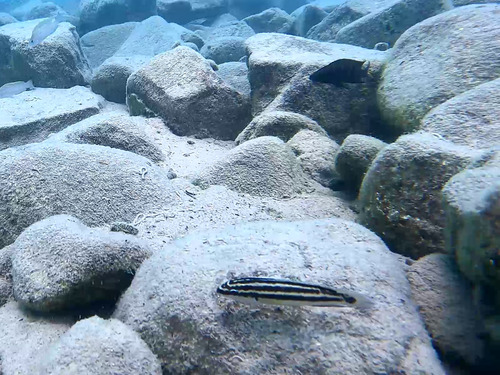
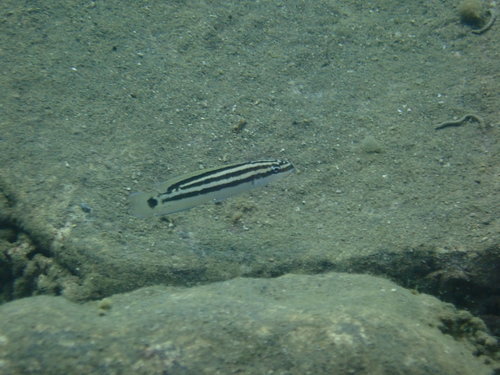
This is a dwarf cichlid. FishBase gives a maximum of about 3.3 in (8.5 cm) total length; Seriously Fish lists 3.2 in (8 cm) standard length, and field data on reproductively active adults cluster between 1.6 and 3.5 in (40–90 mm) TL — so a fully grown golden julie is a small fish by any measure. The body is elongate and slightly torpedo-shaped, built for slipping along rock faces and into crevices. The ground color is yellow to golden, crossed by clean dark horizontal bands running the length of the body, with the signature blackish stripe along the base of the dorsal fin and pale blue edging on the unpaired fins in good condition.
Sexual dimorphism is subtle and easy to get wrong. The most reliable cue is the genital papilla, which is more pointed and extended in males; size is the other tell, but it runs counter to most fishkeepers' intuition — adult females tend to be the larger sex. One honest caveat from both the literature and the trade: most ornatus sold today are tank-bred over many generations with few fresh wild imports, and these aquarium strains are frequently washed-out compared with wild fish. An albino sport also exists. If you have only ever seen captive stock, you have probably not seen this species at its best.
Range & habitat
Julidochromis ornatus is endemic to Lake Tanganyika and, unusually for a julie, has a notably patchy distribution rather than a continuous shoreline range. The IUCN's 2025 assessment maps it to three disconnected areas: the far north near Uvira in the Democratic Republic of the Congo, the south-central western coast at Kiku (also DR Congo), and the far south in Zambian waters around Mbita Island, Isanga, and Chituta. A report from Gombe National Park on the Tanzanian side awaits confirmation of identity. Older hobby summaries describing it as simply "northern, plus a southern morph near Mpulungu" capture the gist but understate how fragmented the real picture is.
It is a fish of the rocky littoral — specifically the intermediate zone where boulder and cobble give way to sand, with crevices and small caves close to open substrate. FishBase places it benthopelagic at roughly 20–40 ft (6–12 m). Like most Tanganyikan rock-dwellers it lives in hard, alkaline water: in situ pH runs about 8.0–9.0 with moderate to high hardness, and surface temperatures in the low-to-mid 70s °F (about 22–25 °C). This tie to a specific rocky biotope, repeated in isolated pockets around a very large lake, is exactly the kind of distribution that makes a species look abundant locally yet leaves it vulnerable basin-wide.
Ecology & diet
Functionally, the golden julie is a small benthic grazer-picker of the rocks. Field observations summarized in the IUCN account describe it foraging primarily on benthic algae and on sponges, with plankton taken opportunistically; FishBase characterizes the diet broadly as micro-organisms and places it at a trophic level of about 3.5 — squarely an animal-leaning omnivore rather than a strict algae-scraper. In practice that means it works the biofilm and the small invertebrates living within it on rock surfaces, a niche shared, and partitioned, with the dense guild of small cichlids that crowds Tanganyika's rocky shores.
Its ecological role is unremarkable in scale but typical of the lake's extraordinary rock-dwelling community: a sedentary, territorial micro-predator that converts encrusting algae, sponge, and tiny invertebrates into the biomass that larger predators and the lake's food web draw on. Because it stays put on a small home range rather than ranging widely, it is tightly coupled to the condition of its particular patch of reef.
Behavior & breeding
Behaviorally, J. ornatus is where the species earns scientific attention. It is a secretive, biparental substrate spawner: a bonded pair claims a rock crevice, the female lays a small clutch on the inner wall or roof of the cave, and both parents guard eggs and free-swimming young in and around the nest. Clutches are modest — Konings reports roughly 25 eggs, spawned every two to four weeks, though aquarium accounts cite up to 100 in rare cases — and parents tend successive, overlapping broods of different sizes together until the fry reach about 1.2 in (30 mm), roughly three and a half months old.
What sets the golden julie apart is that it is genuinely cooperatively breeding. Subordinate individuals — often older offspring — remain in the breeders' territory as helpers that participate in brood and territory defense, a pattern documented by Awata and colleagues and going back to Taborsky and Limberger's classic 1981 note on "helpers in fish." The pair bond is also unusually plastic: roughly 80% of wild pairs are female-largest, pairs mate assortatively by size, and the larger partner of either sex does more of the offspring care, so a female-largest pair shows the male doing more nest duty and vice versa. Very large adults of both sexes sometimes maintain multiple nests in a polygamous harem. Toward its own kind the fish is decidedly territorial; toward other species sharing the rocks it is far more tolerant.
In the aquarium
The golden julie is one of the most-kept Tanganyikans and deserves its reputation as a hardy, breedable beginner-to-intermediate fish — with two large caveats. First, it is a dwarf that nonetheless demands hard, alkaline, very stable water: pH around 7.5–9.0, hardness on the high side, and temperature in the mid-to-high 70s °F (about 23–27 °C). Keepers consistently warn that Julidochromis dislike large water changes, which can trigger a settled pair to turn on each other; smaller, frequent changes are the safer path. Second, despite the species' easygoing manner toward other genera, it is pointedly aggressive toward conspecifics, and that drives the whole approach to keeping it.
The reliable route to a pair is to buy a group of six or more juveniles and let them sort themselves out over many months, then remove the surplus once two fish bond — a process that can take a year, and one that buying a random "male and female" rarely shortcuts (mismatched adults often end with the female harassed to death). A single pair is comfortable in a tank of around 18–30 gallons (70 L, 30 in) furnished as a Tanganyika biotope: sand substrate and piled rock forming distinct caves. Forum experience is emphatic that, unlike Malawi mbuna, Tanganyikan rock-dwellers need territories that are physically and visually separated — split the rockwork into discrete piles with open sightline breaks and you can hold multiple pairs in surprisingly little water. Good tankmates are species that use different zones: Neolamprologus shell-dwellers on the sand, open-water Cyprichromis above. The classic mistake, beyond skimping on cover, is mixing two Julidochromis species or morphs, which readily hybridize and should never share a tank.
Conservation
The IUCN reassessed Julidochromis ornatus as Near Threatened (criterion B2a) on 13 March 2025, a step down from the Least Concern status it held in 2006. The reasoning is geographic and trade-driven rather than a documented crash: the species' known range resolves to a small area of occupancy — about 136 km², under the 200 km² threshold — split across only three to ten locations, and its main identified threat is over-collection for the ornamental aquarium trade, where it is highly coveted. The population trend is listed as unknown, and the assessment is explicit that no continuing decline has yet been demonstrated; if monitoring revealed one, the fish would qualify for Vulnerable or Endangered. In other words, the listing flags exposure, not an observed collapse — the honest reading is a popular fish with a naturally fragmented footprint that the hobby itself is the chief pressure on.
That species-level picture sits inside a lake under broader strain. Lake Tanganyika is warming, and stronger thermal stratification is suppressing the deep mixing that fertilizes its surface waters: O'Reilly and colleagues (2003, Nature, doi:10.1038/nature01833) inferred from sediment records a roughly 20% drop in primary productivity and an implied ~30% decline in fish yields, and Cohen and colleagues (2016, PNAS, doi:10.1073/pnas.1603237113) tied warming to losses of commercially important fishes and of oxygenated benthic habitat. Shoreline sedimentation from deforestation and development degrades exactly the rocky littoral that rock-dwellers depend on. For a sedentary, rock-bound grazer like the golden julie, the relevant threats are local and habitat-specific — sedimentation smothering its reef patches, and collection pressure on a few accessible sites — more than the open-water productivity decline that bears hardest on the pelagic clupeid and Lates fishery feeding the four lake nations. Governance is shared across Burundi, the DRC, Tanzania, and Zambia through the Lake Tanganyika Authority, which has trialed a May–August fishing closure; the 2025 assessors note this species would benefit from such seasonal protection and from controls on ornamental collection and export.
Sources
- FishBase: Julidochromis ornatus (Golden julie)
- Eschmeyer's Catalog of Fishes (genus/species record, via FishBase links)
- IUCN Red List: Julidochromis ornatus (Mushagalusa 2025, e.T60545A47197450)
- iNaturalist: Golden Julie (Julidochromis ornatus) — taxonomy & status
- FishBase: Julidochromis marksmithi (diagnosis vs. ornatus)
- Seriously Fish: Julidochromis ornatus (Golden Julie)
- Awata et al. 2005, Social system and reproduction of helpers in a cooperatively breeding cichlid (Behav. Ecol. Sociobiol. 58:506-516)
- Cooperative Breeding in the Lake Tanganyika Cichlid Julidochromis ornatus (Environ. Biol. Fishes)
- Awata & Kohda 2004, Parental roles in a bi-parental substrate-brooding cichlid (Behaviour 141:1135-1149) — via IUCN bibliography
- O'Reilly et al. 2003, Climate change decreases aquatic ecosystem productivity of Lake Tanganyika (Nature 424:766-768)
- Cohen et al. 2016, Climate warming reduces fish production and benthic habitat in Lake Tanganyika (PNAS)
- cichlid-forum.com: Julidochromis ornatus pairing behavior / aggression management (community thread) — community/anecdotal
- MonsterFishKeepers.com: Julidochromis aggression comparison (community thread) — community/anecdotal
- Reddit r/Cichlid: Golden Julie (Julidochromis ornatus) care (community thread) — community/anecdotal
- Australian Cichlid Enthusiasts Forums: Julidochromis ornatus (community thread) — community/anecdotal
- The Cichlid Stage: Breeding Julidochromis species