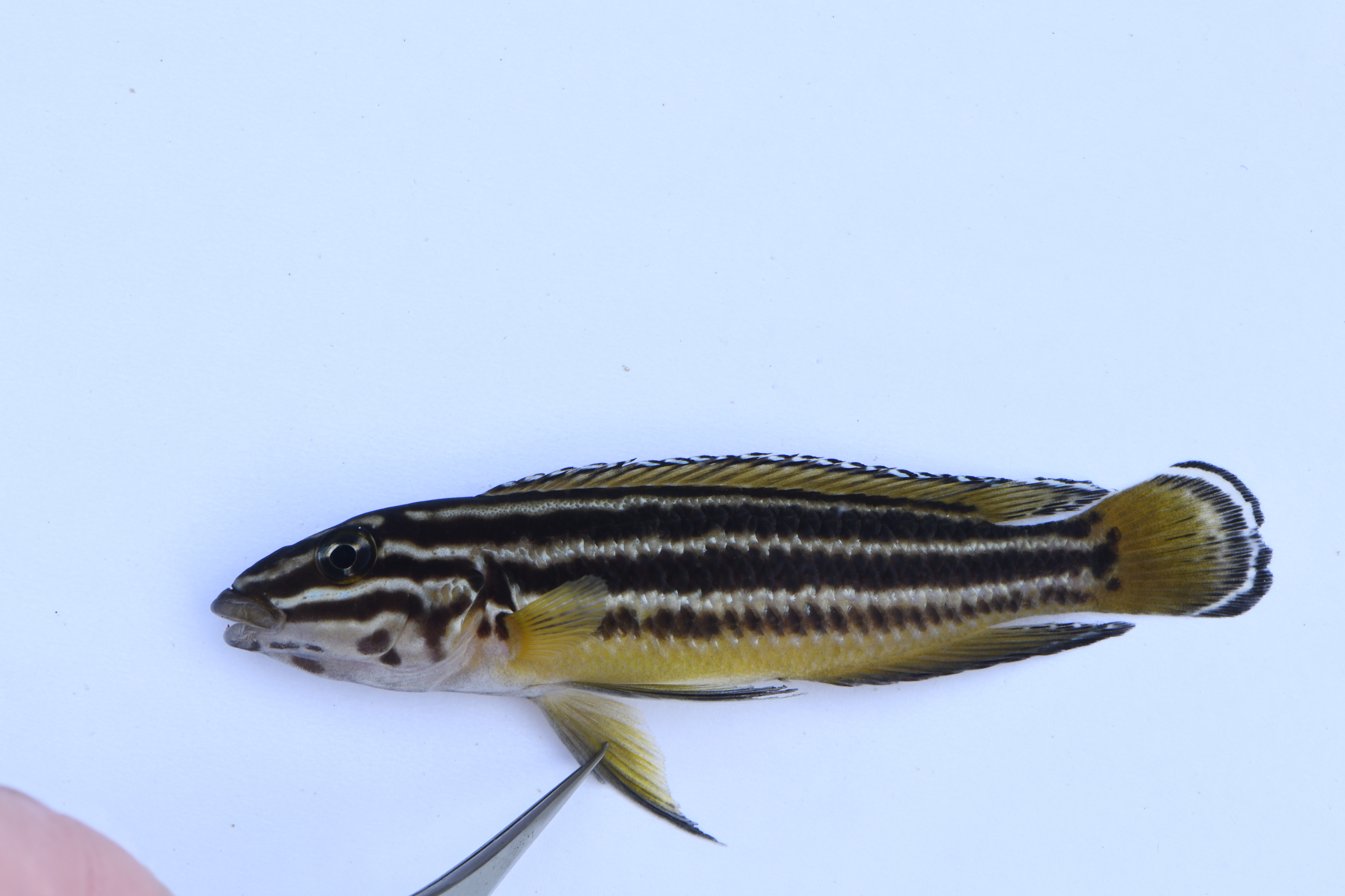
Taxonomy & naming
Julidochromis regani was described by the Belgian ichthyologist Max Poll in 1942, from a single specimen (holotype MRAC 54716) collected at Nyanza on Lake Tanganyika. The species epithet honors Charles Tate Regan (1878–1943), the British ichthyologist; the genus name nods to the marine wrasse tribe Julidini, a reference to the slim, blenny-like body shape these cichlids share with wrasses. Eschmeyer's Catalog of Fishes lists the name as valid with no junior synonyms, and places it in the family Cichlidae, subfamily Pseudocrenilabrinae.
The genus Julidochromis is a tight rift-lake radiation of small rock- and sand-associated cichlids; most authorities recognize on the order of half a dozen species, with J. regani treated as the sister form to J. marlieri, the two replacing one another around the lake. In the hobby it is sold as the "convict julie," "Regan's julie," or "striped julie," and it appears under a string of regional/location names (Kipili, Burundi, Kalemie, and others) that track the lake's many color morphs rather than separate species.
Appearance
Regani is the heavyweight of the julies, though that is relative: FishBase gives a maximum of about 5 in (13 cm) total length, and aquarium fish typically top out a little smaller. Some hobby profiles cite figures as high as 12 in (30 cm), but that number is not supported by the morphometric literature and is best read as an error; a realistic expectation is a fish in the 4–5 in (10–13 cm) range, with females running slightly larger than males.
The body is long, low, and cigar-shaped, built for threading through rock crevices and hovering nose-down against vertical surfaces. The ground color is a creamy gold to pale tan overlaid by horizontal dark stripes that run the length of the fish — the pattern that earns it the "striped" and "convict" trade names and that separates the genus at a glance from the vertically barred Chalinochromis. Fins are edged in pale blue with dark margins, and the eye is often a striking blue. Sexing is subtle: the surest external cue is the genital papilla, which is more pointed in males and blunter in females. Numerous geographic morphs exist, and keepers report that the yellower forms tend to come from shallower water while darker fish are taken deeper — a clue that some of these populations may eventually be split out as distinct species.
Range & habitat
Julidochromis regani is endemic to Lake Tanganyika and is recorded from all four riparian nations — Burundi, the Democratic Republic of the Congo, Tanzania, and Zambia. Its distribution around the lake is patchy and discontinuous, interleaving with that of its sister species J. marlieri so that the two are seldom found together at the same site.
Within the lake it is the least rock-bound of the julies. Rather than living exclusively on the steep rubble of the rocky littoral, it favors the transition zone where scattered rocks meet open sand, and it will venture well out over the sand flats in the shallows. The IUCN assessment and FishBase both place it in the uppermost few meters, roughly the top 10 m (33 ft) of the water column, where the water is alkaline and hard — in situ values run to a pH around 8.5–9.2 and the temperature sits in the low-to-mid 70s°F (about 23–25°C), the warm, stable conditions of Tanganyika's surface layer. Tying the fish to the water body: this is a shallow-shore animal, and its fortunes are bound to the clarity and structure of the nearshore rock-and-sand interface rather than the deep pelagic zone.
Ecology & diet
Like the rest of its genus, J. regani makes its living off the biofilm — the "aufwuchs" mat of algae, diatoms, and the small invertebrates that live within it — that coats the rocks and sand of the littoral. FishBase places it at a trophic level of roughly 3.6, and the IUCN assessment notes it feeds mainly on invertebrates, consistent with a generalist micro-predator that grazes and picks at the substrate rather than a dedicated algae-scraper. Its slim body and pointed snout suit a fish that probes crevices and works over surfaces for small prey.
In the community it is a modest, non-migratory resident of the shallow rocky-sandy shore, neither a major prey item for the lake's larger piscivores nor a significant predator itself. FishBase rates its fishing vulnerability as low and its resilience as high, the profile of a small, locally common fish that reproduces readily.
Behavior & breeding
This is where the julies become genuinely interesting. Julidochromis are substrate-spawning cave brooders with biparental care: a pair claims a crevice or cave, the female deposits a small clutch on the ceiling or wall, and both parents guard the brood. Reports of clutch size vary — the IUCN assessment cites 75 to 100 eggs, while hobby sources quote up to about 300 (usually fewer) — and the difference probably reflects female size and condition more than any contradiction. Brood care is unusually prolonged; fry may remain in the parents' territory until they are an inch (2–3 cm) long, and older juveniles often stay on as the pair spawns again, producing overlapping broods in a loose family group.
The genus has become a model system for the study of flexible mating systems. Across Julidochromis, researchers have documented monogamy, polygyny, and polyandry, helpers at the nest, and a striking plasticity in sex roles — in some pairings the female becomes the dominant, more aggressive partner, and several studies (on J. marlieri, J. ornatus, and J. transcriptus) describe sex-reversed dominance and even shifts in androgen levels when individuals take on the "other" sex's behavioral role. Lake Tanganyika's substrate-brooding cichlids are, in fact, among the very few fishes anywhere known to breed cooperatively with non-breeding helpers, and Julidochromis sits squarely in that story. For J. regani specifically the field data are thinner than for its smaller relatives, but the same biparental, cave-spawning, role-flexible template applies.
In the aquarium
Regani is one of the easier Tanganyikans to keep and breed, but it rewards keepers who respect its temperament. A single pair can be housed in a tank around 48 in (120 cm) long; the standard advice is to buy a group of six or so juveniles and let a pair form naturally, then remove the surplus, because an arbitrarily paired adult male and female often ends with the male harassing the female to death. Once a pair bonds it tends to bond for life. Provide a sandy floor and stacked rock arranged into distinct caves with open swimming room between — and if other rock-spawners share the tank, break the rockwork into separated piles to diffuse territorial disputes. Target hard, alkaline water: pH in the high 7s to 9, temperature in the mid-to-high 70s°F (about 24–27°C).
Reputation-wise, julies have a split personality in the hobby. Experienced keepers consistently report that regani and its relatives largely ignore unrelated tankmates — Altolamprologus (calvus/compressiceps), Cyprichromis, and shell-dwellers are common, successful companions — while being genuinely intolerant of their own kind once paired. The forum lore of a small julie "destroying" a tank of much larger fish is mostly hyperbole, but it points at a real truth: these are territorial fish, not malicious ones, and crowding two julie species or two pairs into too small a space is what turns them ugly. Two notes keepers reliably learn the hard way: never keep two different Julidochromis species or morphs together, as they readily hybridize, and avoid very large water changes on a bonded pair, which can trigger them to turn on each other.
Conservation
The IUCN Red List assesses Julidochromis regani as Least Concern (most recently in 2025, assessor Y. Fermon, reviewed by the Tanganyika specialist Ad Konings), on the grounds that it is widespread around the lake with no major lake-wide threat. The population trend is listed as unknown. The assessment does flag two species-specific pressures: collection for the international aquarium trade, and shoreline siltation; it also notes that the population near Bujumbura harbour in Burundi appears to have been extirpated, likely through pollution. So the honest headline is that the species itself is not currently threatened, even as the lake around it is under real and growing strain.
That lake-level strain matters for a shallow-shore fish like this one. Lake Tanganyika is warming: O'Reilly et al. (2003, Nature, doi:10.1038/nature01833) showed that climate-driven warming has strengthened stratification and reduced the deep mixing that fertilizes the lake, cutting primary productivity by roughly 20% with a commensurate drop in fish yields. Cohen et al. (2016, PNAS, doi:10.1073/pnas.1603237113) used sediment cores to link that warming to an estimated ~38% loss of oxygenated benthic habitat and declines in commercially important fishes and endemic molluscs. Layered on top is sedimentation: deforestation and erosion in the catchment smother the rocky littoral that julies depend on, the same nearshore siltation the IUCN names as a threat to this species. Tanganyika's huge pelagic fishery — the clupeids Stolothrissa and Limnothrissa and the predatory Lates that feed four nations — and the basin's shared, four-country governance through the Lake Tanganyika Authority mean these are international problems. Julidochromis regani is not a fishery target and not, today, a species of concern, but as an animal of the warm, shallow, rock-and-sand fringe it sits exactly where warming, lost benthic oxygen, and shoreline sedimentation all bear down hardest.
Sources
- FishBase: Julidochromis regani (Convict julie)
- Eschmeyer's Catalog of Fishes: Julidochromis regani Poll 1942
- FishBase point/occurrence data for Julidochromis regani
- AquaticRepublic: Julidochromis regani (type locality, size)
- IUCN Red List: Julidochromis regani (Fermon 2025, Least Concern)
- Seriously Fish: Julidochromis regani (Regan's Julie)
- Fishipedia: Convict julie, Julidochromis regani
- Awata, Heg, Munehara & Kohda: Social system and reproduction of helpers in a cooperatively breeding cichlid (Julidochromis ornatus)
- Heg & Bachar: Cooperative Breeding in the Lake Tanganyika Cichlid Julidochromis ornatus
- Mating and Parental Care in Lake Tanganyika's Cichlids (review; sex-reversed dominance in Julidochromis)
- Effect of body size on mating system and parental roles in Julidochromis transcriptus
- O'Reilly et al. 2003, Nature: Climate change decreases aquatic ecosystem productivity of Lake Tanganyika
- Cohen et al. 2016, PNAS: Climate warming reduces fish production and benthic habitat in Lake Tanganyika
- McGlue et al. 2021, Anthropocene: Spatial variability in nearshore sediment pollution in Lake Tanganyika
- Cichlid Fish Forum: "Are julidochromis that mean?" (keeper experience, aggression/tankmates) — community/anecdotal
- Cichlid Fish Forum: Julidochromis pairing behavior / aggression management — community/anecdotal
- The Cichlid Stage: Breeding Julidochromis (buy a group, let a pair form) — community/anecdotal