
Taxonomy & naming
Labidochromis freibergi was described by Donald S. Johnson in 1974, in the hobby magazine Today's Aquarist (1(1):12–17), as part of a short paper introducing new Lake Malawi cichlids. The genus Labidochromis itself was erected by the great cichlid taxonomist Ethelwynn Trewavas in 1935; the name fuses the Greek labidos, a pair of forceps, with chromis, an old name for a perch-like fish — a nod to the slim, pincer-like jaws the group uses to pluck food from rock.
The species epithet is an eponym. Jacob "Jack" Freiberg was a New Jersey–based importer of tropical fish who brought the cichlid to Johnson's attention and first put it in front of American hobbyists. That commercial origin lingers in the trade, where the fish has long moved under the invalid label "Labidochromis Ewarti" — a name with no scientific standing that nonetheless still appears on price lists today.
The genus was overhauled by D.S.C. Lewis in his 1982 revision (Zoological Journal of the Linnean Society 75:189–265), which sorted out a tangle of similar small mbuna. L. freibergi sits among the lake's blue Labidochromis and is easily confused with relatives such as L. zebroides and L. lividus; it has also been muddled in the literature and the hobby with L. joanjohnsonae (originally placed in Melanochromis). Catalog of Fishes and FishBase both treat freibergi as a valid species attributed to Johnson, 1974.
Appearance
This is a small, elongate cichlid. Wild males reach roughly 3 in (about 8 cm) total length, with females staying around 0.4 in (1 cm) shorter; FishBase lists a maximum of 8 cm TL, while the IUCN assessment gives about 7 cm — the kind of minor disagreement that is normal when maximum size rests on a handful of measured specimens.
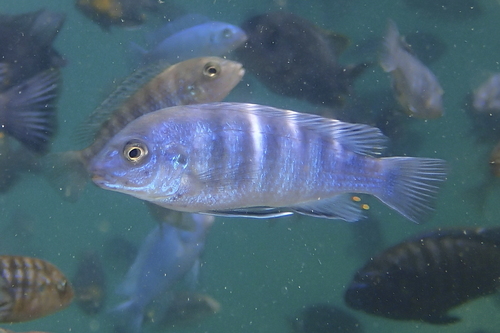
Like many Likoma blue mbuna, dominant males show a pale powder-blue body crossed by darker vertical barring, with the dark markings and fin coloration shifting with mood and dominance. Females and subordinate males are plainer. The genus's defining feature is dental: long, slender, widely spaced teeth built for picking rather than scraping. Field workers separate L. freibergi from other blue Likoma Labidochromis chiefly by its bicuspid (two-pointed) outer teeth, together with subtle differences in body proportions and fin color from look-alikes such as L. zebroides and L. lividus.
Range & habitat
Labidochromis freibergi is a lacustrine endemic with one of the more pinched natural ranges in a lake famous for them. It occurs naturally only around Likoma Island — essentially the northeastern part of it — and, notably, not on the nearby Masimbwe Islet. The IUCN puts both its extent of occurrence and area of occupancy at roughly 56 km², qualifying it as a genuinely narrow-range species. A second population now lives at Thumbi West Island near Cape Maclear, at the southern end of the lake, the result of a deliberate human introduction in the 1970s.
It is a shallow-water, rock-dwelling fish. Konings places it specifically in the turbulent, surge-washed zone of the rocky habitat, and the biotope is described as sediment-free rock, often among smaller stones. Most individuals stay shallower than about 16 ft (5 m), though the species ranges deeper — sources give roughly 1–12 m overall, with the IUCN habitat note centering it at 2–10 m. The water it lives in is hard and alkaline, on the order of pH 7.5–8.3 and around 75–79 °F (24–26 °C), typical of Malawi's well-lit rocky shallows.
Ecology & diet
L. freibergi is an aufwuchs grazer. Aufwuchs is the felt of algae — and the small crustaceans, insect larvae, and other invertebrates living within it — that coats Malawi's rocks. The fish works this mat with its slender, elongate teeth, teasing food from pockets and crevices rather than rasping the rock clean the way a Labeotropheus or Pseudotropheus does. Hobby field guides describe it as broadly omnivorous but strongly algivorous, leaning on filamentous algae anchored to stone.
That picking strategy is the signature of the whole genus, and it slots L. freibergi into the lake's rocky-shore food web as a low-trophic-level forager; FishBase estimates a trophic level near 2.7. Because individuals spread out and forage across the biotope rather than schooling, the species is a diffuse but persistent presence on the reefs it occupies, competing for the same algal film that supports the dense mbuna community around it.
Behavior & breeding
Like all Malawi mbuna, L. freibergi is a maternal mouthbrooder: the female takes the fertilized eggs into her mouth and incubates the developing young there, releasing fully formed fry after a period of weeks during which she does not feed. Spawning follows the familiar cichlid script of the male leading a female to his site and the pair circling as eggs are laid and picked up.
The social structure is loose. Territorial males hold small cave territories in the rock and defend them year-round, a sign that breeding is not tightly seasonal in the wild. Females and immature males do not hold territory — they move through the habitat singly, feeding on aufwuchs from place to place, which is why most individuals are encountered alone rather than in groups. Aggression is mainly an intraspecific, male-versus-male affair over those cave territories; toward other species the fish is comparatively unbothered, a temperament that carries over into the aquarium.
In the aquarium
By mbuna standards L. freibergi is a manageable fish, but it is not a community softie. The realistic recipe, echoed across hobby field guides and keeper reports, is one male with two or three females to spread his attention, in a rock-heavy tank with fine sand and plenty of caves; something in the range of a 50-gallon (around 200 L) footprint is a sensible minimum, valued more for its length and number of broken sightlines than its volume. Each male wants his own cave, and two males in too little space will fight.
Water should match the lake: hard, alkaline, and warm. The species' main pitfall is mismatched tankmates — at only about 3 in (8 cm), it is easily bullied or outcompeted by the larger, more robust mbuna (big Metriaclima, Melanochromis, Maylandia) that beginners often default to, so pair it with similarly sized, moderately mannered rock-dwellers. There is also a real identity hazard at the point of sale: blue Labidochromis are routinely mislabeled, and freibergi has its own trade alias ("Ewarti"), so anyone keeping it for breeding should be skeptical of names and avoid mixing it with close congeners that could hybridize. Maternal mouthbrooding makes it straightforward to spawn once a settled group is established.
Conservation
The IUCN Red List assesses Labidochromis freibergi as Least Concern (assessed 22 June 2018, by Ad Konings), with a population trend listed as stable. That is an upgrade: the species was rated Vulnerable in the 2006 assessment, and older hobby references still cite that VU status. The reasoning behind the change is that, while its natural range is tiny (extent and area of occupancy both about 56 km² at a single location), it lives in very shallow, well-lit rocky water where algal food stays abundant, and it has no real fishery value — subsistence fishers do not target it, and the aquarium trade has collected it only irregularly over the decades. The named threats are sedimentation and ornamental collection, both judged minor for this fish; a translocated population at Thumbi West Island, inside Lake Malawi National Park, adds a measure of insurance.
That species-level comfort sits inside a lake under mounting strain, and it is worth being precise about the difference. Basin reviews of Lake Malawi/Niassa/Nyasa (Chavula et al., 2023, Journal of Great Lakes Research 49(6):102241) document over-fishing and the collapse of the commercially vital chambo (Oreochromis) tilapias, heavy sediment and nutrient loading washing off deforested catchments, roughly +0.7 °C of warming in the shallow water that strengthens stratification and trims primary productivity, and a standing risk from introduced species. For a fish like L. freibergi, the most directly relevant of these is sedimentation: it is a shallow rocky-shore specialist whose food is the sunlit algal film on clean rock, so silt smothering that rock and clouding the light is the pressure that would bite first. For now the species itself is not threatened — but "Least Concern" describes its status, not the health of the lake around it, and a narrow-range endemic has little room to retreat if its one reef system degrades.
Sources
- FishBase — Labidochromis freibergi summary
- Eschmeyer's Catalog of Fishes — Labidochromis freibergi (species record)
- FishBase — Species in genus Labidochromis
- IRMNG — Labidochromis Trewavas, 1935
- IUCN Red List — Labidochromis freibergi (Konings 2018, Least Concern)
- IUCN — The Status and Distribution of Freshwater Biodiversity in the Lake Malawi/Nyasa/Niassa Catchment
- Lewis, D.S.C. 1982. A revision of the genus Labidochromis (Teleostei: Cichlidae) from Lake Malawi. Zool. J. Linn. Soc. 75:189–265 (CLOFFA record)
- Cichlid Room Companion — Labidochromis freibergi profile (Ad Konings)
- Cichlid Room Companion — genus Labidochromis
- MalawiCichlids.com (M.K. Oliver) — Labidochromis freibergi
- malawi.si — Labidochromis freibergi 'Likoma Island' (biotope, care, diet)
- Tropical Fish Hobbyist — Labidochromis: Small Cichlids of Lake Malawi's Rocky Reefs
- FishBase — Labidochromis vellicans (genus feeding ecology comparison)
- PIAA — Assessing the Invasiveness Risk of Non-Indigenous Fish (lists L. freibergi in trade)
- Deutsche Cichliden-Gesellschaft — literature bibliography (L. freibergi, syn. 'ewarti')
- Ohio Cichlid Association — bowl-show/auction listing (community keeping/trade signal) — community/anecdotal