
Taxonomy & naming
Labidochromis maculicauda was described by Digby S. C. Lewis in 1982 as part of his revision of the genus, "A revision of the genus Labidochromis (Teleostei: Cichlidae) from Lake Malawi" (Zoological Journal of the Linnean Society 75: 189–265), in which he expanded the genus diagnosis and described thirteen new species. The genus itself was erected by Ethelwynn Trewavas in 1935, originally for the single species L. vellicans. The name Labidochromis comes from the Greek labidos, "a pair of forceps," joined to chromis, an old catch-all term for cichlid-like fishes; it captures the genus's defining feature — elongated, forward-leaning front teeth that meet at the tips like pincers. The species epithet maculicauda refers to spotting or markings on the tail.
Its status has occasionally been debated: some authors have treated L. maculicauda Lewis 1982 as close to the genus's type species, Labidochromis vellicans Trewavas 1935. But FishBase, GBIF, and the IUCN Red List recognize L. maculicauda as a distinct species, and that is the name under which it is assessed, mapped, and known in the hobby. As a member of the mbuna — the rock-dwelling cichlid guild of Lake Malawi — it belongs to a flock of small, closely related, maternally mouthbrooding species that have radiated explosively across the lake's reefs.
Appearance
This is a small cichlid. Reported maximum size varies by source and by what is being measured: FishBase gives 6.4 cm (2.5 in) standard length, the IUCN assessment cites about 7.5 cm (3 in) total length, and field references following Konings put wild adults at around 10 cm (4 in), with aquarium fish sometimes a little larger. The spread is typical of Labidochromis, a genus Lewis defined as small rock-dwellers rarely exceeding 4 in (10 cm).
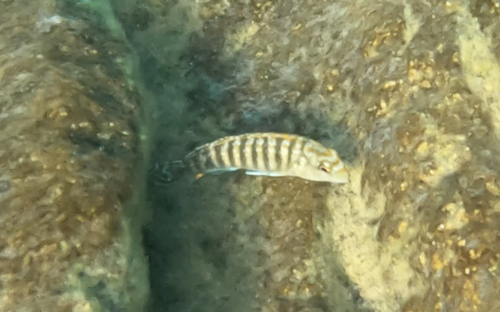
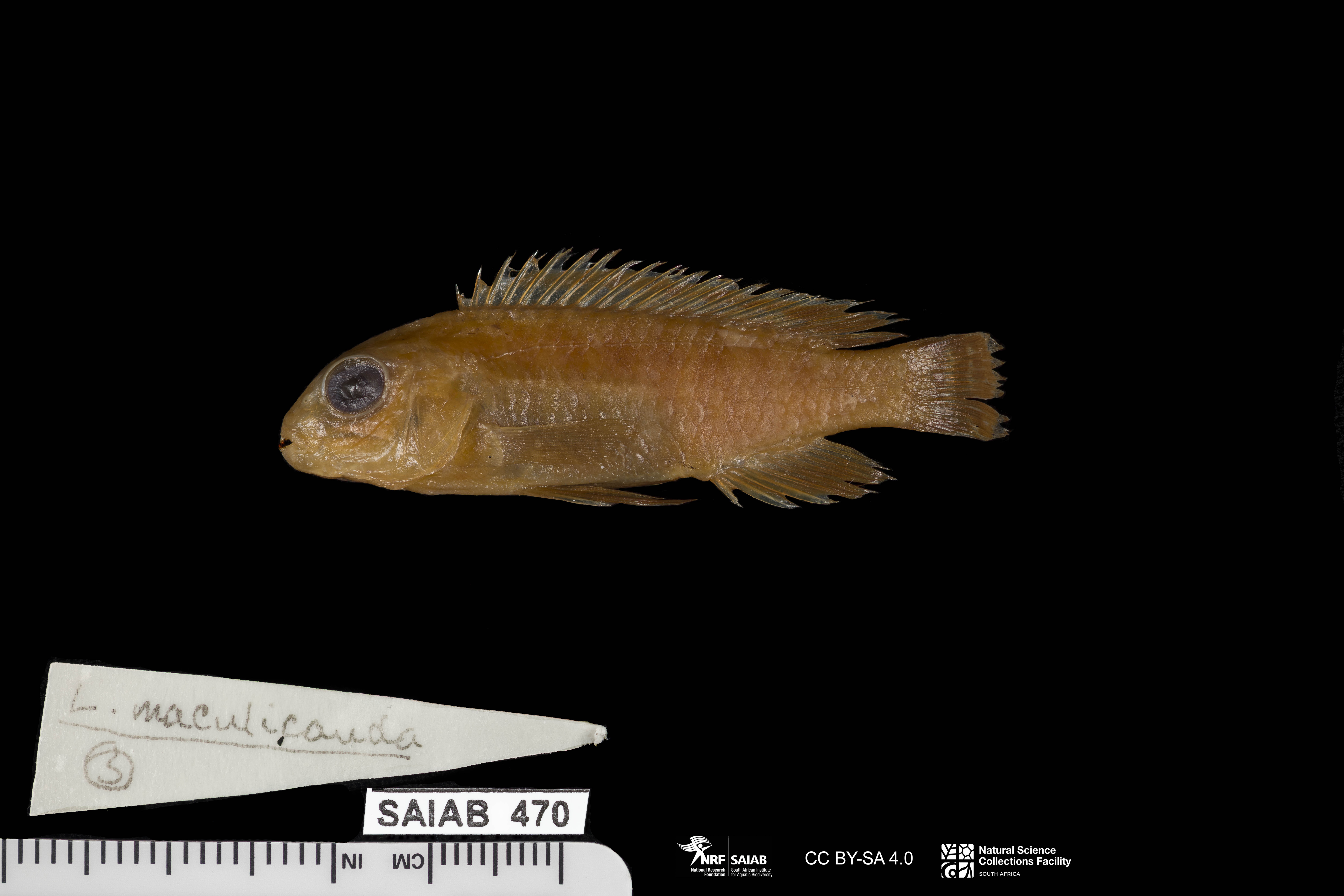
The body is elongated and laterally compressed, with the narrow, acutely pointed snout and small mouth that mark the genus. The anterior teeth in both jaws are slender and procumbent — leaning forward — and in life often touch at their tips, forming the forceps the name describes. Lewis separated maculicauda from the similar-toothed L. vellicans by its unicuspid inner teeth, more elongated body, shorter snout, and different coloration. FishBase records a pattern of orange-brown horizontal stripes along the flanks, distinctive dorsal- and caudal-fin markings, and very dark brown coloration in males. Like many mbuna, the fish can flush dark vertical bars when stressed or excited, so its appearance in a tank is not fixed. Sexual dimorphism is subtle; males and females are similar enough that sexing small individuals is difficult, and in the wild the two sexes show no clear difference in color. Fin-ray counts run to roughly 17–18 dorsal spines and 8–9 soft rays, with three anal spines.
Range & habitat
Labidochromis maculicauda is endemic to Lake Malawi — found nowhere else on Earth — and within the lake it has a patchy, northern distribution. Sources disagree on the exact extent. FishBase restricts it to the north-western coast; the IUCN assessment widens that to the north-western shore north of Kande Island plus the rocky shores north of Mbamba Bay on the eastern (Tanzanian) side, giving it a range that straddles Malawi and Tanzania. Konings-based field references describe it on the western coast between Charo and Chizi Point and on the eastern coast between Cape Kaiser and Lumbaulo.
It is a rock-dweller, like its mbuna relatives, but the reported depth band also varies. FishBase calls it abundant in shallow water mainly over rocks down to about 12 m (40 ft); the IUCN notes it is most numerous between roughly 2 and 7 m (7–23 ft); Konings-derived accounts place it on pure rocky coasts between about 10 and 50 m (33–164 ft), typically tucked inside caves and crevices, and occasionally among shallow weed beds. The honest reading is that this is a cave-and-crevice fish of the rocky littoral, encountered from the shallows down into deeper rock, but rarely out in the open. Lake Malawi's water is clear, alkaline and stable: roughly pH 8.0–8.5, conductivity near 200–250 microsiemens, and surface temperatures swinging between about 68°F (20°C) in the cool windy season and the mid-80s°F (around 28–30°C) in the warm months, with milder swings at depth.
Ecology & diet
Trophically, L. maculicauda is an insectivore that works the rock surface. FishBase, drawing on Lewis's revision, reports that it feeds primarily on chironomid (midge) larvae, with trichopteran (caddisfly) larvae, ostracods, and other small invertebrates making up the rest of the diet. The IUCN assessment likewise lists it simply as feeding on invertebrates. Its specialized head does the work: the pointed snout and pincer-like front teeth let it probe and twist small prey out of cracks and pockets in the rock that broader-mouthed cichlids cannot reach.
This foraging style is the central theme of the whole genus. Where the more famous mbuna genera evolved jaws for scraping the algal-and-detritus film (the aufwuchs) off rock, Labidochromis diversified largely as crevice pickers — a niche that let dozens of small species coexist along the same reefs without competing head-on for the same food. FishBase places maculicauda at a trophic level of about 3.4, consistent with a small predator of invertebrates rather than a grazer. Within the dense, finely partitioned community of a Malawi rocky reef, it is a minor but characteristic player: small, locally common in the right microhabitat, and tied closely to the structure of the rock itself.
Behavior & breeding
Like all mbuna, L. maculicauda is a maternal mouthbrooder. After a male leads a female to a spawning site — typically a small cave or sheltered spot in the rock — the female takes the fertilized eggs into her mouth and incubates them there, releasing free-swimming fry after roughly three weeks. Labidochromis are described as semelparous brooders in the sense that, once released, fry are generally not taken back into the mother's mouth, or only briefly; fry-guarding females have not been documented in the wild for the genus.
Its social behavior in nature is notably mild. Field observations summarized by Konings report that males of this species do not hold year-round feeding territories the way some mbuna do, and that spawning happens wherever a male and female happen to meet in the habitat; the two sexes look alike. Biotope references describe the fish as peaceful both toward its own kind and toward other species — unusual restraint for a family famous for pugnacity. That said, much of what is written about Labidochromis behavior is generalized across the genus from a handful of better-studied species, and detailed in-situ breeding data specific to maculicauda is thin. Captive observations of close relatives suggest small broods on the order of one to two dozen fry, but this should be read as a genus-level expectation rather than a measured figure for this fish.
In the aquarium
L. maculicauda occupies an odd spot in the hobby: its name is reasonably familiar, yet wild-collected fish are scarce, and dedicated keeping reports for this exact species are uncommon — most aquarium discussion of "Labidochromis" centers on its electric-yellow cousin L. caeruleus. So the care picture is drawn mostly from genus-level mbuna husbandry, which is well corroborated across hobbyist forums and specialist references.
It is a small, comparatively gentle mbuna, but it is still a Rift Lake cichlid and should be kept as one. Hard, alkaline water (pH around 7.8–8.5) and temperatures in the low-to-mid 70s°F up to about 82°F (roughly 23–28°C) match its lake. Provide generous rockwork with caves and crevices, since this is a fish that naturally spends much of its time inside shelter. Aquarium-size advice ranges from the modest — some sources suggest a breeding group can be housed in as little as 55 gallons (about 210 L) — to a more realistic community footprint of around 75 gallons or more once it shares a tank with other Malawians. A common mistake is treating any mbuna as bulletproof: although maculicauda is mild for the group, captive males of Labidochromis often become territorial even when their wild counterparts are not, so the standard mbuna strategy applies — keep several females per male, supply enough caves that each male can hold one, and avoid pairing them with bigger, rougher cichlids that will bully or eat them. Diet should lean vegetable-heavy as for most mbuna; these fish take prepared foods readily but are prone to obesity and digestive trouble if overfed protein-rich foods. Avoid mixing it with similar-looking Labidochromis, which can hybridize.
Conservation
The IUCN Red List assesses Labidochromis maculicauda as Least Concern (assessed 22 June 2018 by Konings and Kazembe; errata 2019), with a stable population. The justification is straightforward: it is endemic to Lake Malawi but reasonably widespread along northern rocky shores, with no major lake-wide threat identified. The assessment does flag sedimentation — soil erosion and runoff from agriculture and forestry — as a threat to the species, and notes it is only rarely collected for the ornamental-fish trade. Worth adding from field reports: although the fish is one of the more familiar Labidochromis names in the hobby, it is genuinely uncommon in the lake, usually seen only in small numbers inside caves, and targeted collection of its sought-after yellow variant by exporters has made an already scarce fish even harder to encounter underwater. So the trade pressure, while light overall, is locally real for particular color forms.
That "Least Concern" verdict sits inside a basin under growing strain. The recent review of the Lake Malawi/Niassa/Nyasa basin by Chavula and colleagues (Journal of Great Lakes Research 49(6): 102241, 2023) catalogues the pressures: over-fishing and the collapse of the commercially vital chambo tilapia; rising sediment and nutrient loads washing off deforested catchments; warming of roughly +0.7°C in the shallow water, which strengthens the lake's stratification and suppresses the nutrient mixing that fuels productivity; and the looming risk of invasive species. For a small, cave-bound rocky-shore insectivore like maculicauda, the most direct of these is sedimentation: silt that settles into the crevices it forages and smothers the clean rock and invertebrate prey it depends on — exactly the threat the IUCN singled out. The honest summary is that the species itself is not currently endangered, but its habitat guild is exposed to the same shoreline sedimentation and shifting lake dynamics that are reshaping Malawi's nearshore communities, and its status is best read as stable-for-now rather than secure.
Sources
- Eschmeyer's Catalog of Fishes — Labidochromis vellicans / maculicauda (Lewis 1982)
- FishBase — Labidochromis maculicauda Lewis, 1982
- GBIF — Labidochromis maculicauda Lewis, 1982
- ITIS — Labidochromis maculicauda report
- Lewis, D.S.C. 1982. A revision of the genus Labidochromis (Teleostei: Cichlidae) from Lake Malawi. Zool. J. Linn. Soc. 75:189–265
- Genner, Botha & Turner 2006. Translocations of rocky habitat cichlid fishes to Nkhata Bay, Lake Malawi. J. Fish Biol. 69:622–628
- Chavula et al. 2023. Lake Malawi/Niassa/Nyasa basin: Status, challenges, and research needs. J. Great Lakes Res. 49(6):102241
- IUCN Red List — Labidochromis maculicauda (Konings & Kazembe 2018)
- Cichlid Room Companion — Labidochromis maculicauda species profile
- Artigas Azas, J.M. 2024. Labidochromis: Small Cichlids of Lake Malawi's Rocky Reefs. Tropical Fish Hobbyist (Nov/Dec)
- malawi.si — Labidochromis maculicauda biotope & distribution (Konings/Bauer)
- Fishipedia — Labidochromis maculicauda fish sheet
- iNaturalist — Labidochromis maculicauda taxon page
- Genner et al. 2004. Beta diversity of rock-restricted cichlid fishes in Lake Malawi (Ecography 27:601–610; via JSTOR)
- Changes in the biomass of chambo in the southeast arm of Lake Malawi (stock assessment of Oreochromis spp.)
- Cichlid Fish Forum (cichlid-forum.com) — mbuna keeping, Labidochromis husbandry threads (community/anecdotal) — community/anecdotal
- r/Cichlid — Labidochromis discussion and keeping experience (community/anecdotal) — community/anecdotal