Taxonomy & naming
The species was described by the British-Belgian ichthyologist George Albert Boulenger in 1906 as Lamprologus callipterus, from syntypes collected at Mpala and Niamkolo on the Congolese (then) shore of Lake Tanganyika. The genus name Lamprologus combines the Greek lampros, "bright," with logos (its second element is sometimes given the folk gloss "hare"); the species epithet callipterus likewise builds on Greek roots meaning roughly "beautiful-finned," a nod to the rows of marbled spots that run into the fins.
Its higher classification is genuinely unsettled, and the literature reflects that. Eschmeyer's Catalog of Fishes currently treats the valid name as Neolamprologus callipterus (Boulenger, 1906), following De Vos and colleagues, while FishBase, the CLOFFA checklist (Maréchal & Poll, 1991), and the great majority of the behavioral and evolutionary literature continue to use Lamprologus callipterus; the cichlid specialist Ad Konings hedges by writing it as 'Lamprologus' callipterus, the quotation marks flagging that the genus is provisional. We keep the combination used by virtually all the research on the fish — Lamprologus callipterus — while noting that you will also see it sold and cited as Neolamprologus. Whatever the label, it belongs to the tribe Lamprologini, the large flock of substrate-spawning cichlids endemic to Tanganyika, and molecular work places its nearest analyzed relatives among large, open-water predators such as Lepidiolamprologus elongatus and Neolamprologus tetracanthus — none of which breeds in shells, which means the shell habit in callipterus evolved independently within the group.
Appearance
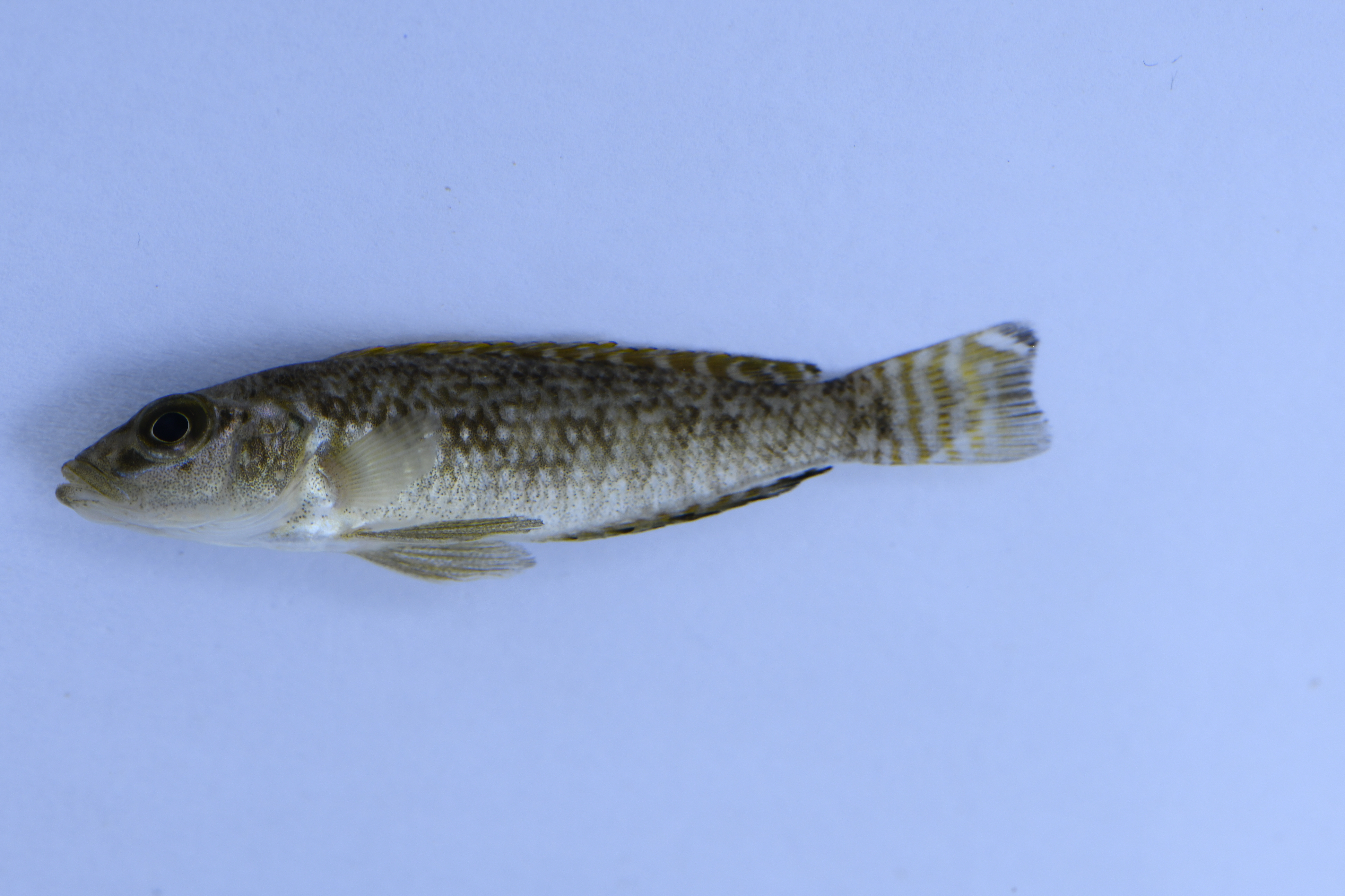
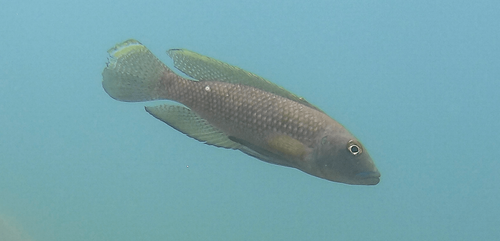
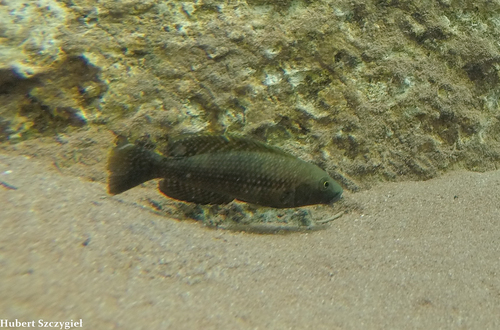
This is an elongate, silvery-bronze cichlid patterned with neat longitudinal rows of dark-centered scales that carry over into spangled, often yellow-tinged fins; mature fish show a bluish cast to the face and a pale-edged tail. Visually it is handsome rather than gaudy — a working predator's coloration, not a jewel-box.
The arresting feature is not color but size, and specifically the gulf between the sexes. FishBase lists a maximum of about 4.9 in (12.4 cm) total length for males against just 1.8 in (4.5 cm) for females, and aquarium-trade stock runs to males near 6 in (15 cm). Field measurements put the difference in stark terms: at Wonzye Point in Zambia, nesting males averaged 12 times the body weight of brooding females, and the magnitude of this sexual size dimorphism varies sharply between populations — from roughly 7-fold at nearby Kasakalawe Bay up to about 60-fold in a northern Congolese population at Muzimo. It is the most extreme sexual size dimorphism known among animals in which males are the larger sex. Overlaid on this is a third body type: "dwarf" males, a separate male morph that matures at a tiny fraction of bourgeois-male size — on the order of a few percent of their mass — and is smaller even than the females. So a single colony can hold three visibly different body sizes of the same species at once.
Range & habitat
Lamprologus callipterus is a lacustrine endemic, found nowhere outside Lake Tanganyika, but within the lake it is widespread, recorded around much of the shoreline across all four bordering countries — a broad range that sets it apart from the many Tanganyikan cichlids restricted to a single stretch of coast. FishBase reports it from roughly 3°S to 9°S, spanning the lake's length.
It is a fish of the sandy and intermediate zones rather than the rocky reef. Breeding colonies sit on sand and shell-strewn bottoms; the detailed Zambian field studies worked nests at depths of about 15 to 40 ft (4.5 to 12 m), with territories concentrated in the deeper part of that band and non-breeding fish ranging shallower and deeper still. The defining habitat element is biological: empty shells of the endemic gastropod Neothauma tanganyicense, the snail whose discarded shells the males gather and pile. Suitable shells are scarce on the open bottom and end up concentrated almost entirely inside callipterus nests, which makes the male's shell-pile both a home and a hoarded resource. The water is the lake's characteristic hard, alkaline, mineral-rich medium — FishBase gives a pH of 7.0 to 8.5 and temperatures of about 73 to 82 °F (23 to 28 °C) — stable conditions typical of this ancient rift lake.
Ecology & diet
Out of the breeding season, callipterus is a restless, roving carnivore. FishBase places it at a trophic level around 3.5 and describes it bluntly as a scavenger-predator with a voracious appetite, a fish that holds still only when it is about to strike. Juveniles and non-territorial adults form roving schools — sometimes hundreds strong — that sweep across the lake floor, and field biologists who have watched them describe "the mob": a swarm descends on another fish's territory, everyone snatches mouthfuls of sand and whatever invertebrates and small prey it turns up, the resident fish scatter, and the swarm moves on as abruptly as it arrived. The diet is opportunistic — small invertebrates, crustaceans, and anything edible sifted from the substrate.
The more interesting ecological role is structural. By collecting Neothauma shells from across the lakebed and concentrating them into nest-piles, dominant males function as ecosystem engineers: the shell beds they build become breeding and shelter habitat that a string of other small shell-dwelling cichlids and invertebrates depend on, effectively redistributing a scarce resource and creating microhabitat that would not otherwise exist. Few freshwater fish reshape their own habitat so literally.
Behavior & breeding
The breeding system is the reason this fish fills journals. A large "bourgeois" male establishes a territory and stocks it by picking up empty Neothauma shells in his mouth and carrying them, sometimes a fair distance, into a central pile — an active accumulation of spawning substrate first documented in detail by Sato in 1994. The more shells he commands, the more females he attracts; rival males will try to raid and steal good shells. Females ready to spawn move into the colony, choose a shell, and lay inside it. Because the male is far too big to enter, he fertilizes the clutch from outside, pressing his vent to the shell mouth and releasing milt that the female's own fin movements draw in past the eggs. Field and lab work show spawning is astonishingly drawn out — a single clutch is laid egg by egg over roughly 6 to 12 hours, with sperm release tightly synchronized to each egg deposition. The female then seals herself in to guard and fan the brood for about 10 to 14 days. Spawning across a colony tends to cluster around the full moon.
The size dimorphism is the evolutionary punchline. Experimental work (Schütz & Taborsky) showed females breed only in shells and choose shells matched to their own body size; their upper size limit appears set by the need to fit inside, while males are pushed large by the need to lift and carry shells and to win fights over them — opposing selection pressures that pull the two sexes to opposite extremes. Then there are the cheats. Bourgeois males face two kinds of reproductive parasite: transient medium-sized "sneaker" males, and genetically distinct dwarf males that are tiny enough to dart into the shell behind a spawning female and fertilize eggs from the inside. The dwarf tactic is heritable and fixed for life — genomic work has shown it is inherited through the Y chromosome as essentially a single-locus, Mendelian trait, so bourgeois fathers sire only bourgeois sons and dwarf fathers only dwarf sons. Dwarf males grow fast early, then stop; bourgeois males keep growing for years. They are two strategies written into the same species' genome.
In the aquarium
Callipterus is kept, but it is a specialist's fish rather than a community staple — FishBase flatly calls it a poor aquarium fish, and the reason is temperament and scale, not difficulty of upkeep. Water-wise it is undemanding by Tanganyikan standards: hard, alkaline water with a pH held above about 7.5, temperatures around 75 to 82 °F (24 to 28 °C), and the clean, well-filtered conditions any rift-lake cichlid expects. In much of the world ordinary tap water suffices. A sand bottom scattered with a generous supply of empty snail shells — culinary escargot (Helix) shells work well — lets a male build his "shell city" and is essentially mandatory for breeding, since females will spawn in nothing else.
The honest caveats are about behavior and space. Males get big and pushy, patrol constantly, and the species is a confirmed predator: anything small enough to swallow eventually will be. That rules out tiny dither fish and the dwarf shell-dwellers (Neolamprologus multifasciatus and the like) it superficially resembles in the trade. Experienced Tanganyikan keepers note both that callipterus males can be "quite large and pretty tough" — tough enough to hold their own against far meaner tankmates — and, in the same breath, that not every male reaches that intimidating size, a real-world echo of the bourgeois-versus-dwarf split. A colony wants footprint, not just volume: a four-foot tank is a sensible floor, with more for a group, so the dominant male can build a nest and subordinate fish have room to stay out of his way. The most common mistake is treating it like the small, peaceable shell-dwellers it gets shelved beside; it is neither small nor peaceable.
Conservation
On its own account, Lamprologus callipterus is in no immediate trouble. The IUCN Red List assessed it as Least Concern in its most recent (2025) evaluation, reflecting a wide distribution around the lake and no evidence of a species-specific decline. There is a modest aquarium-trade fishery for it, but it is not a conservation concern, and the species' broad range across all four riparian nations buffers it against the localized threats that imperil narrowly endemic rocky-shore cichlids.
That relative security sits inside a lake under real and growing strain, and the basin-level pressures bear on callipterus through its particular way of life. Lake Tanganyika supplies a quarter to nearly half of the animal protein for the people around it, and that supply rests on a pelagic fishery of two clupeid sardines (Stolothrissa tanganicae and Limnothrissa miodon) and the predator Lates stappersi — a fishery now squeezed from two directions. Long-term limnological work (O'Reilly et al., 2003, Nature) showed that a warming surface layer has increased the stability of the water column and, together with weakening winds, reduced the deep mixing that lifts nutrients into the sunlit zone; sediment-core evidence implied roughly a 20% drop in primary productivity over the twentieth century and, by extension, on the order of a 30% decline in potential fish yields. Paleoecological work since (Cohen et al., 2016, PNAS) tied that warming to measured declines in both commercial fishes and endemic molluscs, and estimated that reduced mixing had shrunk the oxygenated bottom habitat in their study areas by about 38%. A 2023 basin review (Phiri et al., Journal of Great Lakes Research) catalogs the rest of the load: catchment deforestation and farming that push eroded sediment into the nearshore, pollution, habitat loss, and the difficulty of coordinating management across Burundi, the DRC, Tanzania, and Zambia.
For callipterus, two of these threads matter most. First, it is itself a sand- and shallow-littoral breeder, so sedimentation and the shrinking of oxygenated benthic habitat degrade exactly the zone where its colonies sit — and its whole reproductive economy depends on a supply of empty Neothauma shells, a resource produced by an endemic snail whose own populations the warming-and-mollusc-decline studies flag as vulnerable. Choke off the snails and you choke off the shells the fish cannot breed without. Second, as a roving mid-level predator it is embedded in the same nearshore food web that warming-driven productivity loss is quietly thinning from the bottom up. The honest summary: the species itself is currently Least Concern, but it lives in a lake whose littoral is being degraded and whose productivity is declining, and its unusually specialized dependence on snail shells gives it a stake in the health of the benthos beyond what its own Red List status suggests.
Sources
- Eschmeyer's Catalog of Fishes — Lamprologus callipterus (Boulenger, 1906)
- FishBase — Lamprologus callipterus (Boulenger, 1906)
- IUCN Red List — Lamprologus callipterus (Least Concern, assessed 2025)
- Schütz & Taborsky (2000), J. Fish Biology — Giant males or dwarf females: what determines the extreme sexual size dimorphism in Lamprologus callipterus?
- Schütz et al. (2012), Int. J. Evol. Biol. — Spawning Coordination of Mates in a Shell Brooding Cichlid
- Singh et al. (2023), Molecular Ecology — Genomic basis of Y-linked dwarfism in cichlids pursuing alternative reproductive tactics
- Wirtz-Ocana et al. (2014), Proc. R. Soc. B — Y-linked Mendelian inheritance of giant and dwarf male morphs
- Sato (2004), Ethology — Size-Dependent Male Alternative Reproductive Tactics in the Shell-Brooding Cichlid Lamprologus callipterus
- O'Reilly et al. (2003), Nature — Climate change decreases aquatic ecosystem productivity of Lake Tanganyika
- Cohen et al. (2016), PNAS — Climate warming reduces fish production and benthic habitat in Lake Tanganyika
- Phiri et al. (2023), J. Great Lakes Research — Lake Tanganyika: Status, challenges, and opportunities for research collaborations
- Parker (thesis) — Adaptations to the Brood Care Paradigm in Shell-dwelling Lamprologine Cichlids
- Royal Society Phil. Trans. B (2023) — How sexual and natural selection interact and shape the evolution of (extreme) sexual dimorphism
- Aquarium Glaser GmbH — Neolamprologus callipterus (trade & care notes)
- Ligocki Research Group — Cichlid of the Week: Lamprologus callipterus, 'the mob' (field naturalist blog)
- Practical Fishkeeping — Meet the shell dwellers
- Cichlid-Forum — 'Meanest shell dweller' thread (keeper experience, anecdotal) — community/anecdotal