
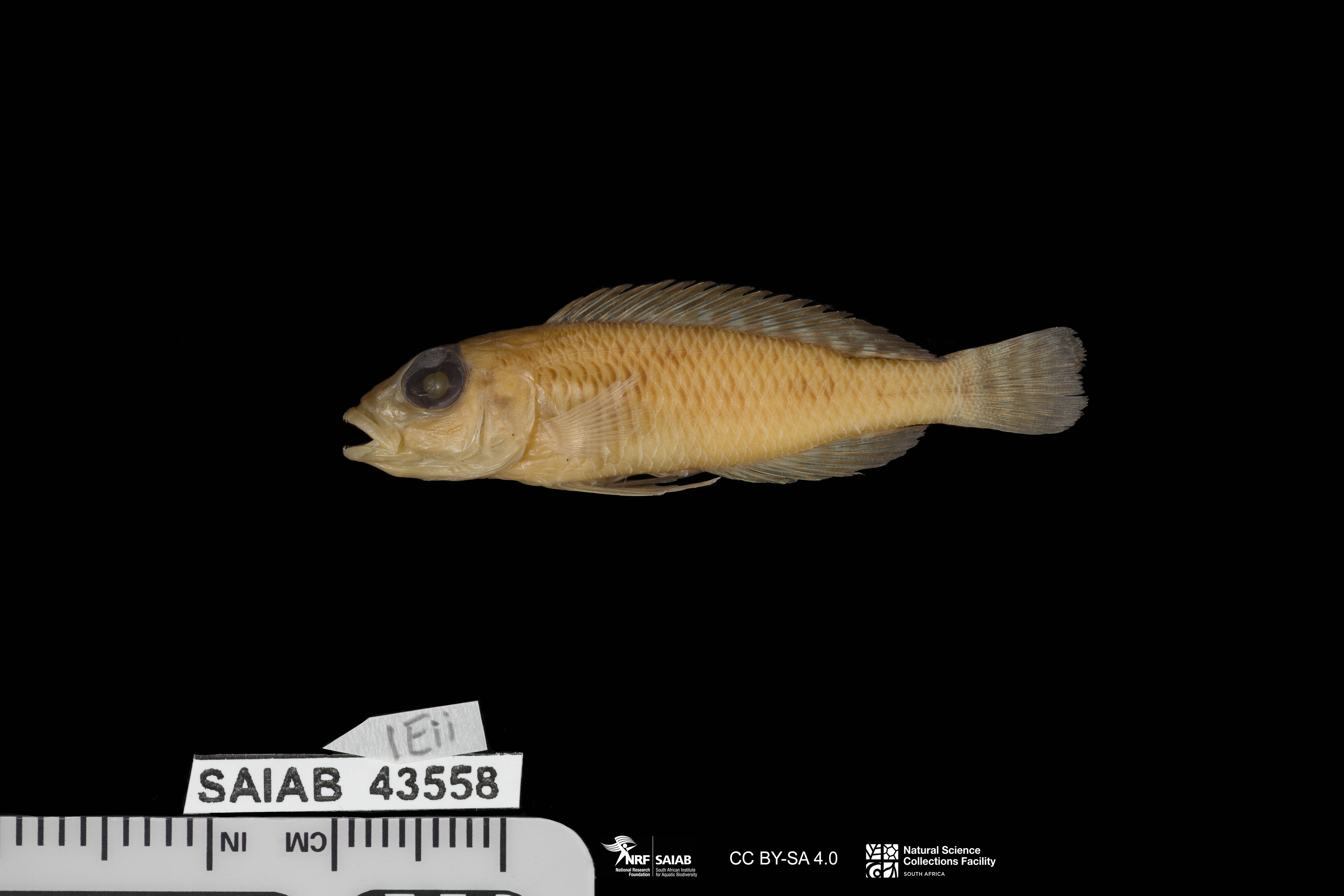
Taxonomy & naming
The species was described by Roger Bills and Anthony Ribbink in 1997, in the same paper that re-diagnosed two long-confused relatives, Lamprologus signatus (Poll, 1956) and Lamprologus kungweensis (Poll, 1952) (South African Journal of Science 93:555–564). The holotype came from Mpulungu, at the Zambian southern tip of Lake Tanganyika. The epithet laparogramma combines Greek roots for the flank (lapara) and a line or mark (gramma), a reference to the faint longitudinal striations along the male's sides; the genus name Lamprologus derives from lampros ("bright") plus lagos ("hare").
Nomenclature here is genuinely split, and it is worth being honest about it. Eschmeyer's Catalog of Fishes lists the current valid combination as Neolamprologus laparogramma, following Ad Konings' treatments (2015, 2019), and the Cichlid Room Companion files it under Neolamprologus in the Ventralis group. FishBase, by contrast, still carries it as Lamprologus laparogramma. The genus Lamprologus has long been a taxonomic catch-all for small Tanganyikan substrate-spawners, and the boundary between Lamprologus and Neolamprologus remains unsettled, so both names point to the same fish. Within the lake's lamprologine flock — the substrate-brooding lineage that dominates Tanganyika's cichlid diversity — it sits in the small "mud-tunneler" group with L. signatus and L. kungweensis, three closely related species separated mainly by coloration.
Appearance
This is one of the smaller Tanganyikan cichlids and a slender one. FishBase gives a maximum of about 1.6 in (4.0 cm) standard length; hobbyist sources, measuring total length, report males to roughly 2 in (5 cm) and females closer to 1.2 in (3 cm). Accounts of the three mud-tunnelers note that laparogramma is the largest of the trio, yet males still rarely approach 3 in (7.5 cm) — so the various figures are best read as a consistent picture of a very small, narrow-bodied fish rather than a real disagreement.
The species is sexually dimorphic in size, with males clearly larger, and reportedly sexually dichromatic as well — unusually, several hobby descriptions hold that females are the more vividly marked sex, showing a yellow-beige body, an orange to coppery belly, and a black-and-white blaze on the dorsal fin. Males share the beige ground color but carry darker longitudinal stripes down the flanks. Those stripes echo L. signatus but are less pronounced, and they help distinguish both species from the plainer L. kungweensis. In overall form laparogramma is intermediate between its two relatives, though generally regarded as closer to signatus.
Range & habitat
Lamprologus laparogramma is endemic to Lake Tanganyika and restricted to its southern basin, with the type series taken at Mpulungu, Zambia. Along the southeastern shoreline its range falls between that of L. kungweensis to the north and L. signatus to the south, the three replacing one another along the coast. It is a stenotopic, or habitat-specialized, species that occurs exclusively on mud bottoms — the flat, low-gradient sublittoral sediment plains that most rift-lake species avoid.
Reported depths run from about 16 ft (5 m) to more than 130 ft (40 m); some hobby accounts extend the band to roughly 33–165 ft (10–50 m). The habitat is essentially featureless soft mud, occasionally adjacent to beds of Neothauma gastropod shells, though those shells are usually already claimed by other shell-dwelling cichlids. Like all Tanganyika fishes it lives in hard, alkaline, well-oxygenated water — broadly pH around 8–9 and warm year-round — conditions set by the lake itself rather than by any localized chemistry.
Ecology & diet
In a lake famous for rock-grazing specialists, laparogramma makes its living in open water just above the mud. It is a planktivore and small-invertebrate feeder, taking zooplankton — copepods and the like — and other tiny prey drifting over its territory; FishBase places it around trophic level 3.5, the level of a modest carnivore. Its tunnel doubles as a feeding base, a place to retreat to between forays into the water column.
Where it occurs it can be abundant. The original describers found the fish community at Mpulungu to be dominated by this species, a notable role for so small an animal and a sign of how productive the soft-bottom guild can be when it is left to its specialists. By turning plankton into prey and excavating the sediment, the mud-tunnelers form part of the often-overlooked benthic community that underlies Tanganyika's better-known rocky-reef fauna.
Behavior & breeding
The defining behavior is digging. Each fish excavates holes in the mud that serve simultaneously as predator refuges, breeding chambers, and the centers of its territory, which the original study measured at roughly 1 to 3 m². A typical burrow has a funnel-shaped entrance leading into an oblique tunnel up to about 4.7 in (12 cm) deep and only around 0.6 in (1.5 cm) wide. Where empty Neothauma shells are available and unclaimed, they may substitute for a dug tunnel.
Lamprologus laparogramma is a monogamous substrate spawner, but with a twist: males and females each keep their own burrow, the entrances spaced on average about 20 in (50 cm) apart. Spawning takes place in the female's tunnel, after which the eggs — unusually for cave-brooding lamprologines — are non-adhesive and are often moved to the male's typically larger burrow. Eggs reach the free-swimming stage in roughly seven days, and broods are small, on the order of 15 fry. Males defend their territories vigorously against rival males, an aggression that is conspicuous in so diminutive a fish.
In the aquarium
Lamprologus laparogramma is uncommon in the trade — its relatives signatus and kungweensis show up more often — so most keeping notes draw on the mud-tunnelers as a group. The honest summary: it is a peaceful, fascinating micro-cichlid that is very easily bullied. A pair can be housed in something as small as a 60 L (about 16 gal) tank, set up with a deep bed of fine sand the fish can excavate, plus a scatter of empty snail shells or even short PVC tubes to stand in for natural burrows.
The usual mistake is the tankmate list. Because the fish is small and slender, it loses every contest with bigger or pushier neighbors, and it is especially outcompeted by aggressive shell-dwellers of the Lamprologus ocellatus type, which will monopolize every shell in the tank. It does best in a species-only setup or alongside small, gentle Tanganyikans that occupy a different layer of the aquarium — open-water Paracyprichromis, for instance. Standard hard, alkaline Tanganyika water (roughly pH 7.5–9, mid-70s to low-80s °F / about 23–27 °C) suits it, and it readily takes small live and frozen foods such as Artemia, daphnia, and bloodworms. Given its own space and a sand bed to tunnel into, it breeds willingly — part of why these dwarves are occasionally nicknamed the "guppies of Tanganyika."
Conservation
Lamprologus laparogramma has not been evaluated by the IUCN Red List — neither FishBase nor the Cichlid Room Companion records a status for it — so there is no formal conservation category to report. That absence is itself meaningful: as a small, narrow-range, soft-bottom endemic with little direct fishery or aquarium-collection pressure, it has simply never been assessed. No specific threat to the species has been documented, and the honest statement is that we do not know its status with any precision.
The wider lake is a different matter. Lake Tanganyika is under measurable strain, and a mud-dwelling endemic is exposed to those basin-scale pressures even if it is not individually targeted. Long-term work by O'Reilly and colleagues (Nature, 2003; doi:10.1038/nature01833) found that climate warming has strengthened the lake's stratification and reduced deep mixing, cutting the nutrient supply to surface waters; sediment-core records suggest primary productivity may have fallen by about 20%, implying on the order of a 30% decline in fish yields. Cohen and colleagues (PNAS, 2016; doi:10.1073/pnas.1603237113) reconstructed roughly a 38% loss of oxygenated benthic habitat as warming deepened the anoxic zone — a direct concern for any fish, like this one, tied to the bottom. Sedimentation from deforestation and shoreline development further degrades the soft-substrate sublittoral the mud-tunnelers depend on. These pressures play out against an intense pelagic fishery for clupeids (Stolothrissa and Limnothrissa) and the predatory Lates that feeds four nations — Burundi, Tanzania, Zambia, and the Democratic Republic of the Congo — and that is governed jointly through the four-country Lake Tanganyika Authority. None of this points to laparogramma being in trouble today; it is a reminder that the lake it depends on is, and that a specialist of the warming, deoxygenating mud flats sits squarely in the path of those changes.
Sources
- Eschmeyer's Catalog of Fishes — Lamprologus laparogramma (valid as Neolamprologus laparogramma)
- FishBase — Lamprologus laparogramma summary
- FishBase — Bills & Ribbink 1997 reference summary (Ref. 42182)
- Bills, R.I. & Ribbink, A.J. 1997. Description of Lamprologus laparogramma sp. nov... (EBSCO record)
- Cichlid Room Companion — Neolamprologus laparogramma (public profile header)
- tanganyika.si — Lamprologus laparogramma 'Namansi' species page
- tanganyika.si — distribution map: L. kungweensis, laparogramma & signatus
- The Cichlid Stage — Mud tunnelers (kungweensis, laparogramma, signatus)
- Practical Fishkeeping — Quick guide to Tanganyikan cichlids (lamprologines)
- American Cichlid Association group — keeper notes on L. laparogramma 'Namansi' — community/anecdotal
- American Cichlid Association group — the Tanganyikan 'moles' / mud-bottom dwarves — community/anecdotal
- Aquarium Advice forum — keeping small Lake Tanganyika cichlids — community/anecdotal
- Evolutionary history of the Lake Tanganyika cichlid tribe Lamprologini (PMC)
- O'Reilly et al. 2003 — Climate change decreases productivity of Lake Tanganyika (Nature)
- Cohen et al. 2016 — Climate warming reduces fish production and benthic habitat in Lake Tanganyika (PNAS)
- Lake Tanganyika: Status, challenges, and opportunities for research (J. Great Lakes Research)
- African Center for Aquatic Research and Education — Lake Tanganyika overview