Taxonomy & naming
The species was described by the Belgian-British ichthyologist George Albert Boulenger in 1899, from a single specimen (the holotype, MRAC 196) collected at Moliro on the southern, Congolese shore of Lake Tanganyika. The genus name Lamprologus pairs the Greek lampros, "bright," with a second element conventionally glossed as "hare"; the epithet lemairii honors Charles François Alexandre Lemaire, a Belgian army officer and colonial explorer who led expeditions in the Congo. In the German and aquarium literature the fish sometimes carries the local Tanganyikan name "Ekalakata."
Where this cichlid actually belongs in the genus-level classification is one of the more unsettled questions in the Lamprologini, and the sources openly disagree. Eschmeyer's Catalog of Fishes now lists its current valid name as Neolamprologus lemairii. FishBase, the IUCN Red List, and the CLOFFA checklist (Maréchal & Poll, 1991) keep it as Lamprologus lemairii; the cichlid specialist Ad Konings writes it as 'Lamprologus' lemairii, the quotation marks flagging a provisional placement; and for a time it was assigned to Lepidiolamprologus, the genus of large lamprologine piscivores it superficially resembles. Molecular work pulled it back out of Lepidiolamprologus, instead linking it to Lamprologus callipterus. We use the combination that FishBase and the conservation assessment use — Lamprologus lemairii — while noting you will also see it sold and cited as Neolamprologus or Lepidiolamprologus lemairii. Whatever the label on the genus, it is a member of the tribe Lamprologini, the flock of substrate-spawning cichlids that radiated within Tanganyika and dominates its rocky and intermediate zones.
Appearance
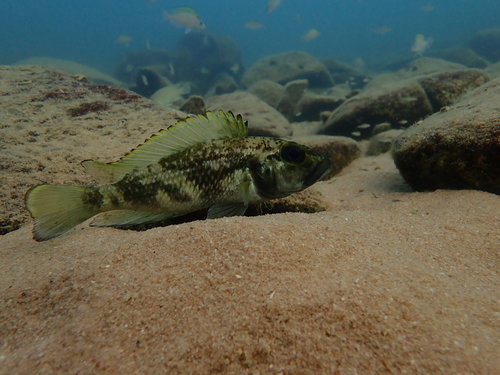
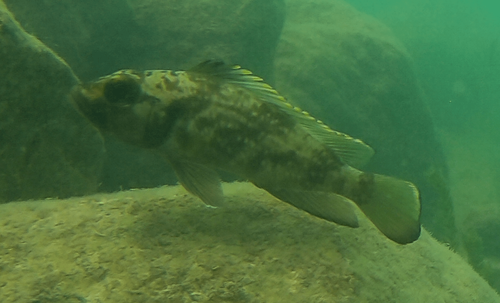
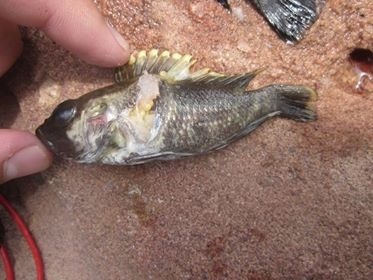
This is not a jewel-box cichlid. L. lemairii is a thick-bodied, slightly chunky lamprologine in muted greys and browns, broken by an irregular mottled or marbled pattern of darker blotches — exactly the broken camouflage a fish needs to vanish against a bottom of sand and broken rock. The large mouth and slightly upturned, heavily built head betray its trade: x-ray studies of Tanganyikan cichlid skulls use this species as the textbook example of a piscivore's jaw, with the robust feeding apparatus of a fish that swallows other fish whole. Color intensity varies between populations and collection localities, and aquarists distinguish regional forms (for example 'Bulu Point' and 'Cape Chaitika').
Reports of maximum size converge near 10 in (25 cm) total length for the largest individuals; FishBase gives 25 cm, and field guides describe males reaching roughly that length. Sources differ slightly on whether 25 cm is standard or total length, so treat it as an approximate ceiling rather than a precise figure. Sexual dimorphism is real but subtle: males grow noticeably larger — by some accounts females top out around a third smaller — and carry somewhat longer fins, but there is no reliable external color difference, and Seriously Fish flatly notes the species cannot be confidently sexed by eye.
Range & habitat
Lamprologus lemairii is a Tanganyikan endemic — found in this one ancient rift lake and nowhere else on Earth — but within it the species is widespread, recorded along the shores of all four bordering nations (Burundi, the Democratic Republic of Congo, Tanzania, and Zambia) from roughly 3°S to 9°S, the full length of the lake. That broad distribution sets it apart from the many Tanganyikan cichlids confined to a single rocky headland.
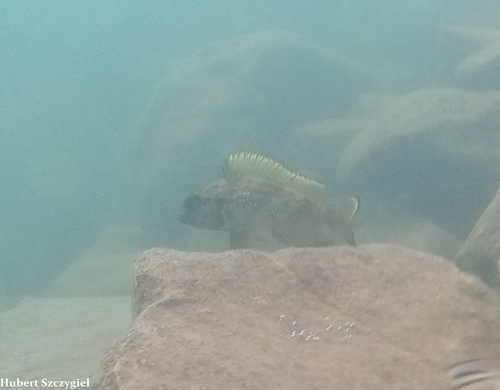
It is a fish of the intermediate zone, the transitional bottom where rock gives way to sand, rather than a pure rock-dweller or open-sand specialist. It occurs from shallow water down to considerable depth, often seen near rocks or resting directly on the floor. The water is the lake's characteristic hard, alkaline, mineral-rich medium: FishBase reports a pH of about 7.3 to 8.5 and a hardness of 10 to 18 dH, with temperatures around 73 to 79 °F (23 to 26 °C) — the stable, oxygen-rich conditions of the upper littoral that this and most Tanganyikan cichlids depend on.
Ecology & diet
L. lemairii is an exclusive piscivore — a fish-eater more or less to the exclusion of everything else — and sits near the very top of the cichlid food web, with FishBase placing it at a trophic level around 4.5, among the highest in the lake. Its prey is mostly the juveniles of other cichlids and small fishes, taken not by chasing but by ambush. The species is sedentary and solitary; it holds station near cover or lies flat on the substrate and waits, and detailed field accounts suggest much of its hunting happens at night, with daytime strikes comparatively rare.
The hunting trick is the genuinely interesting part. Its mottled camouflage lets it disappear against the bottom, and it amplifies that disguise with thanatosis — "playing dead." The fish lies utterly still, looking for all the world like a dead or dying animal; a smaller fish, drawn in to investigate the apparent carcass, comes within range and is seized in a sudden lunge. Thanatosis is normally a defensive trick in the animal world, a way to look unappetizing to a predator. L. lemairii has flipped it into an offensive weapon — a piece of behavioral mimicry turned into a feeding strategy. As a high-trophic predator concentrated in the nearshore, it helps regulate the abundance of the small and juvenile cichlids that swarm Tanganyika's rocky margins.
Behavior & breeding
Outside of breeding, this is a loner. It does not school, roam, or display much; the dominant impression keepers and divers report is of a fish that mostly sits still. Toward fishes too large to swallow it is comparatively undemonstrative rather than relentlessly aggressive — its menace is predatory, not territorial bluster.
Reproduction follows the lamprologine substrate-spawning playbook rather than the mouthbrooding of many other Tanganyikan cichlids. L. lemairii is a cave or crevice spawner: the female lays inside a shelter — a rock cavity sized so that she can enter but larger intruders cannot — and provides essentially all the parental care, plugging the entrance with her own body to keep other cichlids out while she guards and tends the clutch. Field-derived accounts put a typical brood on the order of 100 to 150 fry, with the female defending eggs and young inside the cave for roughly twenty days; once the fry leave the shelter, parental care ends. A male's territory may overlap two or three females. The species has rarely if ever been bred deliberately in aquaria, so much of what is known about its spawning comes from observation in the lake rather than the fishroom.
In the aquarium
This is an honest "experts only" fish, and the experts who keep it say so. FishBase calls it unsuited to the aquarium; Seriously Fish recommends it only for true enthusiasts. The reason is not difficulty of upkeep — its water needs are ordinary for the lake — but its diet and temperament. It is an ambush predator that will eat any tankmate small enough to fit in its mouth, full stop, and it does not soften that habit in captivity. The good news for those who do keep it: it readily takes dead, meaty foods (prawn, mussel, lancefish, whitebait and similar), so there is no need or excuse to feed live fish; avoid mammalian or poultry meat, which Tanganyikans digest poorly.
Water-wise, give it the standard rift-lake setup — hard, alkaline water with a pH held above about 7.5 and temperatures in the mid-to-high 70s °F (around 24 to 27 °C) — over a sand bottom with rockwork arranged to create caves and passages. Plan for footprint: a four-foot tank (on the order of 50-plus gallons, ~200 L, with more for a group) is a sensible floor for a fish that reaches the better part of a foot. Keep it singly or as a pair, and only alongside robust Tanganyikans too big to be food — large Lepidiolamprologus and Neolamprologus, Cyphotilapia frontosa, and similar heavyweights. Real keeper accounts back up the profile: in one Tanganyikan community thread, an aquarist who lost most of a heavily stocked tank to a spawning predator overnight noted that his lemairii were among the few survivors, having simply found a hiding spot and stayed put — a fitting epitaph for a fish whose whole strategy is to wait. The single most common mistake is the obvious one: treating a calm, slow-moving, handsome cichlid as peaceful, and stocking it with anything bite-sized.
Conservation
On its own account, Lamprologus lemairii is not currently at risk. The IUCN Red List assessed it as Least Concern in its most recent evaluation (assessed 18 February 2025; assessor D. Mushagalusa), reflecting a wide distribution across the length of the lake and the absence of any documented species-specific decline; the population trend is listed as unknown. There is no significant targeted fishery or aquarium trade pressure on it — its reputation as a fish-eater unsuited to community tanks keeps demand modest — and its broad, four-country range buffers it against the localized threats that imperil narrow rocky-shore endemics.
That relative security, though, sits inside a lake under real and growing strain, and the basin-level pressures matter for this fish through its particular ecology. Long-term limnological work (O'Reilly et al., 2003, Nature) showed that a warming surface layer has stabilized Tanganyika's water column and weakened the deep mixing that lifts nutrients into the sunlit zone, implying on the order of a 20% drop in primary productivity over the twentieth century and, by extension, roughly a 30% decline in potential fish yields. Paleoecological work since (Cohen et al., 2016, PNAS) tied that warming to measured declines in fish and molluscs and estimated that reduced mixing had shrunk the oxygenated bottom habitat in their study areas by about 38%. Layered on top is sedimentation: catchment deforestation and erosion push fine sediment into the nearshore, smothering the rocky and intermediate substrates that structure the littoral community (Cohen et al., 1993). And the lake feeds millions — its pelagic fishery of two clupeid sardines (Stolothrissa tanganicae and Limnothrissa miodon) plus the predator Lates supplies a large share of the animal protein for four nations, a fishery now squeezed by both warming and effort and coordinated, imperfectly, through the four-country Lake Tanganyika Authority.
For L. lemairii, the most relevant threads are habitat and the base of its food web. As an intermediate-zone predator that depends on rock-and-sand cover for both ambush and cave-spawning, it is exposed to sedimentation that degrades exactly the bottom structure it hunts and breeds on; and as a top piscivore feeding on small nearshore fishes, it ultimately rides on a littoral productivity that warming is quietly thinning from the bottom up. The honest summary: the species itself is Least Concern with no specific threat on the horizon, but it lives in a lake whose littoral is being degraded and whose productivity is in long-term decline — pressures that bear on this ambush hunter through the habitat and prey it cannot do without, even where its own Red List status stays reassuring.
Sources
- Eschmeyer's Catalog of Fishes — lemairii, Lamprologus (current status: valid as Neolamprologus lemairii, Boulenger 1899)
- FishBase — Lamprologus lemairii (Boulenger, 1899)
- GBIF — Lamprologus lemairii occurrence and taxonomy
- IUCN Red List — Lamprologus lemairii (Least Concern, assessed 2025; Mushagalusa, D.)
- Seriously Fish — Lamprologus lemairii (Lemaire's Lamprologus): ambush predation, thanatosis, care notes
- tanganyika.si — Lamprologus lemairii: biotope, diet, breeding, taxonomy notes
- AquaInfo — Lamprologus lemairii (care, diet, synonyms; Jan Bukkems)
- Cichlid Room Companion (cichlidae.com) — Neolamprologus genus profile (public pages)
- Takahashi & Koblmüller (2011), International Journal of Evolutionary Biology — The Adaptive Radiation of Cichlid Fish in Lake Tanganyika (uses L. lemairii as the piscivore skull exemplar)
- Wagner, McIntyre et al. (2009), Functional Ecology — Diet predicts intestine length in Lake Tanganyika's cichlid fishes (L. lemairii as piscivore)
- Britton (PhD thesis, UCL) — Assessing human impacts on Lake Tanganyika cichlid fish communities (trophic guild data incl. L. lemairii)
- O'Reilly et al. (2003), Nature — Climate change decreases aquatic ecosystem productivity of Lake Tanganyika
- Cohen et al. (2016), PNAS — Climate warming reduces fish production and benthic habitat in Lake Tanganyika
- FAO — Lake Tanganyika Authority (four-country fisheries management framework)
- Cichlid-Forum — Tanganyikan community thread (keeper account: lemairii survived an overnight predator massacre by hiding; anecdotal) — community/anecdotal
- Cichlid-Forum — Predator-hap / ambush-predator discussion (community context on 'playing dead' cichlid hunters; anecdotal) — community/anecdotal